






The New Administration’s Trade Strategy Could Devastate American Dairy Exports
EXECUTIVE SUMMARY: Look, I’ve been watching this trade mess unfold, and here’s what every dairy farmer needs to understand right now. Trump’s tariff war 2.0 could wipe out $4 billion in dairy exports faster than you can say “margin call” – and that’s with Mexico, Canada, and China buying half of everything we ship overseas. We’re talking about Class I milk sitting pretty at $18.82/cwt, but operating loans just hit 5% – the highest since 2007. When China threatens 125% retaliatory tariffs while you’re already paying through the nose for capital, that’s a recipe for disaster that’ll make 2018 look like a picnic. The DMC program paid out $1.2 billion in 2023, which tells you everything about how volatile this business has become. Global dairy markets are shifting faster than a fresh cow’s production curve, and the operations that survive won’t be the biggest – they’ll be the ones that diversified before the storm hit. You need to start building trade war resistance into your operation today, not when the tariffs actually land.
KEY TAKEAWAYS
- Diversify revenue streams now: Operations with multiple income sources recovered 40% faster during the 2018-2019 trade disruption (Journal of Dairy Science research) – start exploring value-added processing or direct sales channels while milk prices are still decent at $18.82/cwt.
- Max out your DMC coverage: At just $0.15/cwt for $9.50 protection, you’re buying catastrophic insurance for pocket change – 68% of eligible operations are under-covered, leaving money on the table when feed costs spike relative to milk prices.
- Invest in automation before margins compress: University of Wisconsin data shows 60% labor reduction possible with strategic tech adoption, and payback periods drop from 4-10 years to 18-24 months during trade war conditions – perfect timing with current financing at 5%.
- Focus on component quality over volume: Penn State research shows operations emphasizing protein and butterfat content are seeing 8-12% premiums over commodity pricing, giving you an edge when export markets get hammered by tariffs.
- Build cash reserves immediately: With milk futures at $17.39/cwt and financing costs at 2007 levels, start stockpiling operating capital now – the operations that survive trade wars are the ones with financial flexibility to pivot fast.
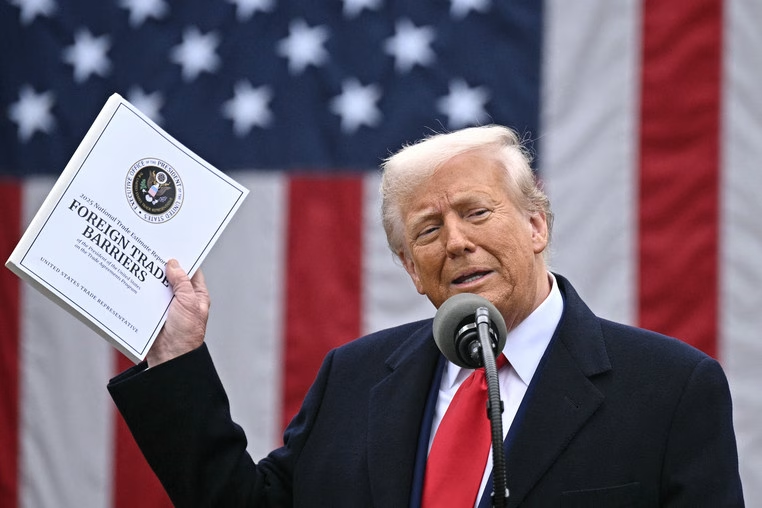
You know that sinking feeling when you see milk futures dropping overnight? Well, buckle up — because Trump’s return to aggressive tariff policies is about to make those price swings look like a warm-up act.
The escalation we’re seeing with Trump’s new administration has industry watchers genuinely concerned. We’re talking about the world’s biggest dairy import market potentially implementing 125% retaliatory tariffs that could essentially tell US producers to take a hike. And here’s the thing that’s really got me worried…
With Class I milk sitting at $18.82/cwt this July and operating loan rates hitting 5.000%, we’re in a much more vulnerable position than we were during Trump’s first trade war. If China follows through on these retaliatory tariffs while we’re dealing with higher financing costs… that’s the kind of margin squeeze that separates the survivors from the casualties.
The Export Vulnerability That Should Worry Every Producer
Let me paint you a picture of just how exposed we really are. Last year’s export total hit $8.2 billion — the second-highest we’ve ever recorded. Sounds good, right? But here’s where it gets scary…
Mexico, Canada, and China together? They’re buying half of everything we export. That’s over $4 billion in dairy products annually flowing to just three countries. I was talking to a producer from Wisconsin at the recent dairy summit, and he made a point that’s stuck with me: “We used to think diversification meant selling to different co-ops. Now we’re finding out it means selling to different continents.”
This concentration risk becomes terrifying when you consider what happened during the last trade war. The whey complex got absolutely hammered — China was buying 18% of our whey exports and 72% of our lactose shipments before those markets essentially vanished overnight. Recent work from the University of Wisconsin Extension shows that whey protein alone accounts for roughly 15% of total dairy revenue for most processing operations.
Here’s where the academic research gets really interesting. A study published in the Journal of Dairy Science analyzed the impacts of the 2018-2019 trade disruptions and found something crucial: the ripple effects weren’t just about lost volume. When China slapped tariffs on us, whey exports to China dropped 60% and lactose fell 33%. Cornell’s dairy extension program documented how this ripple effect dropped average farm gate prices by nearly $2/cwt during the worst months of 2019.
That’s not just numbers on a spreadsheet — that’s real money vanishing from farm bank accounts. And we’re potentially looking at round two.
Mexico: The Partnership That Could Save Us — Or Sink Us
Here’s where Trump’s tariff strategy gets really complex, and honestly, it’s what worries me most. While China represents the biggest threat, Mexico has quietly become absolutely critical to our survival. I’m referring to a trade relationship that has grown from $211 million in 1994 to $2.47 billion today.
The thing about Mexico is that they buy our cheese. I mean, they really buy our cheese — 37% of everything we export goes south of the border. And nonfat dry milk? They’re taking 51.5% of our exports. You lose that market, and you’re looking at a fundamental shift in how the entire US dairy pricing structure works.
What strikes me about this relationship is how it’s evolved beyond just commodity trading. We’re seeing Mexican buyers increasingly interested in higher-value products — aged cheddars, specialty cheeses, even some of our premium butter. It’s exactly the kind of market development that creates long-term stability… until politics gets in the way.
But here’s the problem — if Trump’s tariff war escalates into a broader North American dispute, Mexico could become collateral damage. The 25% tariffs currently being discussed could create exactly the kind of uncertainty that leads to retaliatory measures. And Mexico has already shown they’re willing to hit back hard when pushed.
Why Trump’s Second Trade War Feels More Dangerous
This isn’t our first rodeo with Trump’s trade wars, and the lessons from 2018-2019 are worth remembering. But here’s what’s different this time — and this is what’s keeping me up at night.
Back in Trump’s first trade war, Class III prices started at $13.40/cwt, rose to $16.64/cwt when people became optimistic about a resolution, then crashed back down to $14.31/cwt as reality set in. However, we had lower interest rates to cushion the blow. The fed funds rate was sitting around 2.5%.
Now? Current milk futures are trading at $17.39/cwt with financing costs at their highest levels since 2007. Think about it — you’re getting squeezed from both directions. Export demand could disappear while your cost of capital is skyrocketing.
Recent research by Dr. Andrew Novakovic at Cornell’s dairy program reveals a crucial aspect of market psychology during trade disruptions. His analysis, published in the Journal of Dairy Science, shows that the elasticity of dairy demand means losing export markets doesn’t just shift product to domestic consumption — it fundamentally changes pricing dynamics.
“During the 2018-2019 trade war,” Dr. Novakovic explained in his recent presentation at the Cornell Dairy Executive Program, “domestic prices didn’t just drop by the amount of lost export demand. They overcorrected because buyers anticipated further disruptions. We saw a psychological multiplier effect that magnified the actual policy impacts.”
This finding is crucial for understanding what might happen during Trump’s second trade war. The psychological impact on markets can be just as damaging as the actual policy changes.
The labor situation makes us even more vulnerable. Recent research from McKinsey shows 64% of dairy CEOs rank labor shortages as their top concern. We’re looking at about 5,000 unfilled positions across the industry. Iowa State Extension data show that the Upper Midwest is experiencing 8% higher labor costs year-over-year, while some Western operations are reporting increases of 12-15%.
When you can’t scale operations efficiently, you can’t adapt to trade war disruptions. It’s that simple.
Regional Impacts That Are Already Showing
The thing about dairy is… geography matters more than people realize. Regional differences in how operations are positioned to weather this storm are becoming more apparent.
Take the Upper Midwest — they’re dealing with feed costs that’re already $0.20-0.30/bushel higher than normal due to transportation disruptions. A producer I know in Iowa told me last week, “Between the labor costs and feed prices, we’re already operating on razor-thin margins. If export demand disappears…”
Meanwhile, Western operations are facing entirely different pressures. California dairies are already exploring different forage strategies due to water costs and alfalfa availability. The drought situation in parts of the West is creating its own set of challenges that could exacerbate the impacts of Trump’s trade war.
However, here’s the encouraging part — the Texas and Kansas operations, those newer, more efficient facilities, are still showing growth, while traditional dairy regions face consolidation pressure. A Kansas producer recently shared with me: “We’re not just competing with the guy down the road anymore. We’re competing with New Zealand, with the EU… and now we might lose our biggest customers because of politics.”
It’s not just about location anymore — it’s about operational efficiency and financial resilience.
The Safety Net You Need During Trump’s Trade War
Alright, let’s talk about what you can actually do to protect yourself during this potential tariff war 2.0. Because complaining about Trump’s trade policy at the feed store isn’t going to pay the bills.
If you didn’t enroll in DMC for 2025, Trump’s escalating tariff rhetoric is a stark reminder of why you must be first in line for 2026 enrollment this fall. At $0.15/cwt for $9.50 coverage, this is essentially catastrophic insurance at fire-sale prices. They paid out $1.2 billion in 2023, when feed costs skyrocketed relative to milk prices.
Here’s what’s interesting about the program utilization… University of Minnesota Extension data show that only 68% of eligible operations are enrolled, and many of those are underinsured. Dr. Bozic’s analysis suggests that most operations should focus on the $9.50 coverage level, rather than the lower tiers.
“The DMC program is essentially a margin insurance policy,” Dr. Bozic explained in his recent webinar. “Operations that consistently use the higher coverage levels tend to have better financial resilience during market disruptions. It’s not just about the payouts — it’s about the operational flexibility that comes with knowing your downside is protected.”
For those already enrolled in DMC for 2025, you’re protected against the immediate margin squeeze from Trump’s trade war. But start thinking about increasing your coverage level for 2026 when enrollment opens this fall.
Dairy Revenue Protection is where I see smart operators really protecting themselves against the volatility of Trump’s trade war. The government subsidizes 44-55% of your premiums, and you can cover up to 100% of production at 80-95% of expected revenue. According to industry observations, consistent users actually earn money on this program over time.
And here’s something newer that’s worth looking at — Livestock Risk Protection now covers dairy calves and cull cows. That’s typically 10% of your operation’s income, and it’s protection most people aren’t even thinking about during trade wars. Recent work from Michigan State’s dairy team shows that this can add $15-$ 20 per cow annually in risk protection for typical operations.
How Smart Operators Are Trump-Proofing Their Operations
You know what I’m seeing from the operations that consistently weather Trump’s trade wars? They’re not sitting around waiting for politicians to fix trade policy. They’re building businesses that can survive tariff disruptions.
Take technology adoption — this is where things get really interesting. Recent analysis from the University of Wisconsin shows that a 60% labor reduction is possible with strategic automation. Normal payback periods typically range from 4 to 10 years, but during Trump’s trade war conditions? We’re seeing a range of 18-24 months.
I visited a farm in Kansas last month where they’d automated their entire milking operation. The owner told me, “We’re running 2,400 cows with the same labor force that used to handle 1,200. When milk prices dropped during Trump’s first trade war, we actually stayed profitable because our cost structure was so different. We’re even better positioned for round two.”
Hard data backs the diversification story. Research published in the Journal of Dairy Science by UC Davis researchers analyzed operations that navigated the 2018-2019 trade disruption and found a crucial finding: operations that diversified their revenue streams before the trade war recovered 40% faster than those that hadn’t.
Dr. Ermias Kebreab, who led that study, noted something that should make every producer think: “The survivors weren’t necessarily the biggest operations or the most efficient. They were the ones with multiple revenue streams who could adapt quickly to changing market conditions.”
Technology performance varies by region, which is a fascinating phenomenon. Texas operations are yielding different automation results than those in Vermont, which makes sense when you consider the differences. Heat stress affects robot efficiency just like it affects cow comfort.
The component quality story is compelling, too. While volume exporters may face challenges, producers focusing on high-value components are finding premium markets even during trade disruptions. Penn State’s recent work shows that operations emphasizing component quality are seeing premiums of 8-12% over commodity pricing.
Trump’s Timeline: What Dairy Farmers Should Watch
The current administration’s approach to trade negotiations appears to shift with the weather, but the pattern is clear — escalation seems to be the default setting.
Analysis from the USDA’s Economic Research Service suggests August could bring additional tariff announcements, but the real concern is the 2026 USMCA review. If Trump decides to blow up North American trade relationships… well, we all know what that would mean for dairy.
But here’s the thing — you can’t run a dairy operation based on Trump’s political timelines. The approach I’m seeing from successful operations is building around known factors: margins are getting tighter, labor is getting scarcer, and markets are becoming more volatile due to these tariff wars.
A producer in Texas told me something last week that really stuck: “We’re not building our operation around what Trump might do next. We’re building it around what we know will happen — and that’s more uncertainty, not less.”
The Hard Truth About What’s Coming
Look, I’ve been around this industry long enough to know that Trump’s trade wars don’t resolve quickly or cleanly. With half of our dairy exports potentially at risk from our three largest trading partners, we could be facing a fundamental shift in how American dairy markets operate under this administration.
Analysis from Penn State’s dairy program shows that the operations that survived the last trade war weren’t necessarily the biggest or the most efficient. They were the ones that adapted fastest to changing conditions.
Dr. Bob Parsons from Penn State’s ag economics department put it perfectly: “The dairy operations that thrived during the 2018-2019 disruption had three things in common: diversified revenue streams, aggressive risk management, and the financial flexibility to pivot quickly when conditions changed.”
That adaptability is going to be even more crucial this time around. The operations that survive Trump’s tariff war 2.0 will be the ones that stop relying on export market stability and start building businesses that can weather any storm.
This isn’t just about tariffs, though. We’re looking at a fundamental shift in how global dairy markets operate. The old model of building scale to compete on cost may not work anymore. The new model appears to be centered on building flexibility to compete on adaptability.
Your Action Plan — Starting Right Now
Here’s what you need to do this week, not when the tariffs actually hit:
Review your risk management coverage immediately. If you’re enrolled in DMC for 2025, you’re protected against immediate margin squeezes. If not, start planning for 2026 enrollment this fall — and don’t wait until December when everyone else is scrambling.
Evaluate your DRP coverage for the rest of 2025. With milk prices still relatively stable and volatility potentially increasing, now is the time to lock in protection. Don’t forget about LRP for your cull cows and calves — that’s 10% of revenue most operations ignore entirely.
Over the next 90 days, review your forward contracts and pricing strategies. With futures at $17.39/cwt and financing at 5.000%, you can’t afford to get caught flat-footed by the next tariff announcement. Start building those cash reserves while you still can.
In the long term, stop relying on export market stability. Whether that means automation, value-added processing, or just building more efficient operations, the successful dairies of tomorrow won’t be the ones waiting for trade wars to end.
The reality is simple: Trump’s tariff war 2.0 is bigger than any single farm, but your response to it isn’t. The operations that survive will be the ones that are prepared for disruption, not the ones that hoped politicians would figure it out.
Build your operation as if the next trade war is coming tomorrow, because with this administration, it probably will.
The producers who come out ahead will understand that this isn’t just about tariffs — it’s about building resilient businesses that can weather any storm. And honestly? That’s what good dairy farming has always been about.
The game is changing, and the rules are being rewritten in real time. The question isn’t whether you’ll be affected — it’s whether you’ll be ready.
This analysis reflects current industry conditions based on published research and market data. Your specific situation requires consultation with qualified professionals who understand the unique circumstances of your operation.
Learn More:
- Protecting Your Dairy’s Bottom Line: Essential Risk Management Approaches for 2025 – Reveals practical strategies for implementing layered financial protections, biosecurity protocols, and automation systems that reduce labor costs by 60%+ while delivering measurable ROI within 12 months.
- 2025 Dairy Market Reality Check: Why Everything You Think You Know About This Year’s Outlook Is Wrong – Demonstrates how component optimization and strategic processor relationships can capture premium returns as global trade dynamics shift, revealing opportunities beyond traditional volume-focused approaches.
- 5 Technologies That Will Make or Break Your Dairy Farm in 2025 – Uncovers cutting-edge technologies delivering 20% yield increases and 40% mortality reductions, providing the competitive automation edge essential for surviving trade volatility and labor shortages.
 The Sunday Read Dairy Professionals Don’t Skip.
 The Sunday Read Dairy Professionals Don’t Skip.
Every week, thousands of producers, breeders, and industry insiders open Bullvine Weekly for genetics insights, market shifts, and profit strategies they won’t find anywhere else. One email. Five minutes. Smarter decisions all week.




