







Lactalis’s €1 billion investment just proved it: value-per-liter beats volume every time. Volume-chasers are becoming price-takers.
EXECUTIVE SUMMARY:
While 80% of dairy operations chase volume, Lactalis’s €1 billion strategic investment reveals why value-per-liter approaches will determine who survives the next consolidation wave. European producers are capturing 15-25% pricing premiums through precision feeding, environmental compliance, and integrated supply chains—advantages that volume-focused farms simply cannot match. The dairy industry is permanently bifurcating into premium players who optimize each liter and commodity price-takers stuck in the “get bigger” trap. Technology investments during market downturns create compound returns through feed efficiency gains (8-15%), component premiums ($2-3/cwt), and environmental revenue streams ($15-30/cow annually), while cooperative arrangements are becoming essential for mid-size operations to access these advantages.
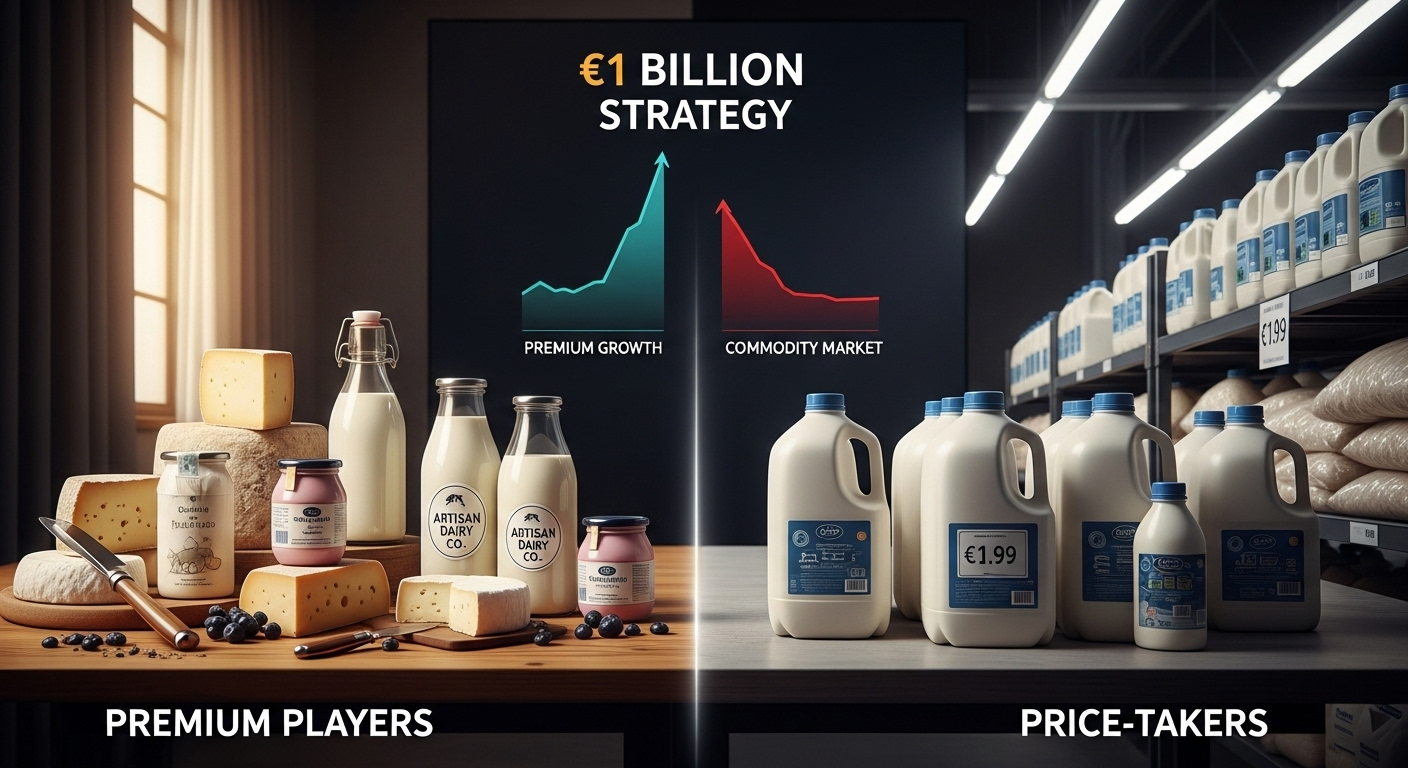
While 80% of dairy operations chase volume, Lactalis’s €1 billion bet reveals why value-per-liter strategies will determine who survives the next consolidation wave. The numbers don’t lie: European producers are capturing premiums that volume-focused farms simply cannot match.
When Lactalis announced they’re dropping €1 billion across their French facilities through 2030, it wasn’t just another press release. I mean, think about it—the world’s largest dairy company could have spent that money expanding production or acquiring more farms. Instead, they’re betting everything on a completely different approach than what most of us have been doing.
And frankly, it’s challenging everything I thought I knew about where this industry is headed.
You know how we’ve always heard that European producers are at a disadvantage? Higher labor costs, stricter environmental rules, and smaller average farm sizes? Well, here’s what’s really happening: Recent EU dairy market analysis from AHDB Economics shows European operations are finding ways to capture consistent pricing advantages, particularly during periods of tighter global supply—and these premiums are running 15-25% above baseline commodity pricing depending on product specifications and sustainability credentials.
What’s interesting is that industry consultants are starting to observe a fundamental shift in European thinking. As one told me recently, “The Europeans stopped trying to compete on volume and started competing on value.” But here’s the uncomfortable truth most operations haven’t figured out yet: this shift isn’t optional anymore.

The Numbers Behind Their Strategy — And Why They Matter to You
So I started digging into Lactalis’s 2024 numbers—they hit €30.3 billion in revenue according to their annual report, which is staggering when you consider the margin pressures we’ve all been dealing with. But what caught my attention is that they’re not using that cash flow just to expand production capacity. They’re targeting specific areas that create compound returns that most operations completely miss.

Penn State’s Dairy Extension program documented feed efficiency improvements ranging from 8-15% for operations implementing precision feeding systems in their 2024 technology adoption study, though individual results vary significantly based on existing management and facility conditions. That caught my eye because—let’s be honest—USDA’s Economic Research Service’s 2024 Cost of Production report shows feed costs averaging 55-65% of our variable expenses, depending on the region and time of year.
But here’s where it gets interesting. Consider a typical 800-cow operation that installed automated feeding systems—many extension specialists report seeing feed efficiency improvements, though results depend heavily on prior management practices and facility design. What often surprises producers is how better feed conversion also improves butterfat performance. I’ve heard about operations going from averaging 3.6% to consistently hitting 3.9% or higher, and when you’re looking at component pricing systems, those premiums can add $2-3 per hundredweight.
Equipment manufacturers commonly cite energy reductions of around 15-20% per unit of output with their newer processing systems, though independent verification through university trials shows more modest gains of 10-15% depending on installation and management practices. In a business where we’re counting pennies per hundredweight, those energy savings can compound month after month.
What’s encouraging—and this builds on what we’ve seen with other technology adoption cycles—is that these investments aren’t just for the mega-operations anymore. The reliability has improved enough that even mid-size farms are seeing consistent returns, though the learning curve can be steeper than expected. I’ve talked with producers who struggled for six months getting robotic systems dialed in properly, and that’s time you can’t afford during tight margin periods.
Environmental Compliance: The Plot Twist Nobody Saw Coming
Now, I’ll be honest. When I first started hearing about environmental regulations as revenue opportunities, I was skeptical. Most of us see compliance requirements as pure cost, right? But here’s what some operations are discovering—and what the rest of us need to understand before we get left behind.
Take anaerobic digesters. The initial investment is substantial—typically ranging $400 to $800 per cow, depending on herd size and local conditions, according to USDA Rural Development data—but EU CAP strategic plans are encouraging this kind of investment through grant programs that can cover 40% of system costs when farms meet certain criteria. That’s real money, not just pilot program funding.
Industry reports from the International Energy Agency suggest some operations are finding revenue opportunities through environmental compliance that can generate $15-30 per cow annually through carbon credit sales, though results depend heavily on local market conditions and system design. Carbon credit markets are developing—California’s cap-and-trade program currently prices credits around $30-35 per metric ton CO2 equivalent—but prices remain volatile and verification requirements can be complex.
Regional buyers are starting to differentiate pricing based on documented sustainability practices. Danone’s sustainable dairy program pays premiums of $0.50-1.50 per hundredweight for milk meeting specific environmental criteria, and similar programs are expanding across major processors.
But here’s the catch nobody talks about: these systems need consistent attention and technical expertise. If you don’t have someone who understands the technology—or reliable service support—you can end up with expensive problems pretty quickly. As extension specialists often point out, “It’s definitely not set-it-and-forget-it farming.”
I’ve noticed that the operations that have success with environmental investments share some common characteristics: they have strong technical management, they work with experienced installers, and they plan for ongoing maintenance costs from day one. Those that struggled tried to treat it like buying a piece of conventional equipment.
Why Cooperation Is Finally Working — And Why You Should Care
Something that’s been surprising to watch: mid-size operations are actually starting to work together on major investments. And I mean really cooperate, not just the traditional buying groups we’ve always had.
The regulatory structure is pushing this along. Grant programs often require minimum project sizes that basically force multiple farms to pool resources. But what’s compelling is how risk sharing changes the math completely—and reveals why the cooperative model might be the only survival strategy for mid-tier operations.
Consider the economics: when precision technology investments run $2,000-3,000 per cow to implement properly according to manufacturer data from DeLaval and Lely, splitting those costs across multiple partners suddenly makes it feasible for operations that couldn’t justify it alone. Wisconsin’s Center for Dairy Profitability has documented several successful cooperative arrangements where five or six producers share digester installations or precision feeding systems, reducing individual capital exposure by 60-80%.
And the transparency tools have gotten much better—blockchain-based tracking systems that let every partner see identical data on costs, returns, and performance metrics. When everyone’s looking at the same numbers, the trust issues that used to kill these arrangements pretty much disappear.
Of course, I’ve also seen cooperative arrangements fall apart when partners don’t communicate well or when one operation fails to maintain its end of the system properly. The key seems to be starting with neighbors you already work well with, not trying to create partnerships from scratch just to access funding.
| Farm Size | Optimal Investment Strategy | Typical ROI Timeline | Key Success Factors |
| Under 500 cows | Precision feeding + health monitoring | 4-6 years | Focus on single systems, ensure local service support |
| 500-1,500 cows | Robotic milking + automated feeding | 5-7 years | Complete facility redesign, staff training critical |
| 1,500+ cows | Integrated automation + energy systems | 7-10 years | Network effects, data analytics are essential |
Different Strategies for Different Scales — What Works and What Doesn’t
What I’ve found—and this mirrors what extension specialists are reporting—is that successful technology adoption looks completely different depending on your operation size. The most important thing is matching complexity to what you can actually manage, because I’ve seen too many good operations get burned trying to implement systems beyond their management capacity.
Smaller Operations (Under 500 Cows)
University of Vermont Extension’s 2024 technology assessment consistently shows that the key is focusing on high-impact modules rather than trying to automate everything. Automated feed systems can deliver efficiency gains without requiring complete facility overhauls, though installation costs vary significantly based on existing infrastructure—typically $1,200-1,800 per cow according to their data.
Many extension programs report positive experiences with precision health monitoring through ear tags or collars for managing mastitis and boosting yields, particularly during transition periods when fresh cows are most vulnerable. SCR Dairy’s monitoring systems show 15-25% reductions in treatment costs and 5-8% yield improvements in university trials, though individual results vary considerably.
The challenge for smaller operations is usually technical support. When something goes wrong at 2 AM during calving season, you need reliable backup and knowledgeable service within a reasonable distance. That’s not always available in rural areas, and it’s worth factoring into your decision-making.
I’ve talked with producers who love their automated systems but wish they’d spent more time finding good local service support before making the investment. One producer in northern Wisconsin told me, “The technology works great when it’s working, but when the nearest service tech is 90 miles away, you better have a backup plan.”
Mid-Size Operations (500-1,500 Cows)
This is where robotic milking starts making real economic sense. The technology has matured to the point where reliability is no longer a concern. Current equipment costs approximately $180,000-$ 220,000 per robot, according to 2024 pricing from major manufacturers such as DeLaval and Lely. Most operations achieve payback in 5-7 years when cow traffic and facility design are optimized properly.
But here’s the key—and this comes from extension specialists who’ve worked with successful transitions—you need to treat it as a complete systems upgrade, not just equipment replacement. Operations that redesign cow flow patterns and integrate data management see much better results than those that just drop robots into existing setups.
The seasonal timing matters too. Spring installations work better than fall, when you’re dealing with breeding season and trying to get cows trained on new systems while managing higher production levels. Michigan State’s dairy systems research indicates that installations occur 20-30% faster during lower-stress periods.
Large Operations (1,500+ Cows)
At this scale, comprehensive automation begins to deliver network effects that smaller operations can’t capture. Advanced systems for individual cow management become economically justifiable when you’re spreading costs across larger herds, but the complexity also increases exponentially.
Energy management systems that integrate renewable generation show promise, according to equipment manufacturers; however, independent verification and results vary significantly by installation and local conditions. Some operations report reducing their grid electricity usage by 40-60% while creating additional revenue streams during peak demand periods through net metering programs. Course, that assumes you’ve got the capital, the right location for solar installation, and favorable net metering policies—which aren’t available everywhere.
What’s interesting is that the largest operations are often the most cautious about new technology. They can’t afford downtime during peak production periods, so they tend to wait until systems are proven before adopting. Smart approach, really, though it means they sometimes miss early-adopter advantages.
Market Changes Worth Watching — And Why They Should Worry You
The Arla-DMK merger, creating that €19 billion cooperative, isn’t just about getting bigger—it’s about building integrated networks that can compete with operations like Lactalis on a global scale. Processing capacity is becoming essential for negotiating with retailers and securing favorable milk contracts, and if you don’t have access to it, you’re increasingly at a disadvantage.
Why is this significant? The economics tell the story. Geographic diversification provides natural insurance against regional disruptions while integrated supply chains capture margin throughout the value chain. Each new facility adds data and negotiating leverage that creates competitive advantages for integrated operations—and makes independent producers more vulnerable to pricing pressure.
The Federal Milk Marketing Order modernization, through the Foundation for the Future initiative, is also reflecting these structural changes. Component-based pricing advantages operations with advanced processing capabilities—exactly what these strategic investment programs are targeting. This builds on trends we’ve been seeing for the past decade, but it’s accelerating in ways that could leave volume-focused operations behind.
What concerns me is how this consolidation affects price discovery and market competition. When you’ve got fewer, larger players controlling more of the supply chain, it changes market dynamics in ways that aren’t always beneficial for individual producers. The cooperative model is starting to look like the only viable alternative for maintaining some negotiating power.
Regional Reality Check — Why Location Still Matters
One thing that’s become clear from talking with extension specialists across different regions—these investment strategies don’t work the same way everywhere. Climate, regulations, and local market access all affect the math significantly, and you can’t just copy what works in Wisconsin and expect the same results in Texas.
In Wisconsin operations, where winter feeding periods last 120-150 days, according to UW-Madison Extension data, precision feeding systems often show faster payback because efficiency gains compound over extended confinement seasons. Southern operations with year-round grazing might see better returns from pasture management technology, though heat stress mitigation is becoming increasingly important as summers get more extreme.
Regulatory variations matter too. California’s environmental standards under SB 1383 create different incentive structures than what you’ll find in Pennsylvania or Wisconsin. What makes economic sense in the Central Valley—where compliance costs can run $50-100 per cow annually—might not pencil out in Lancaster County, where regulatory pressure is lighter.
It’s worth understanding your local regulatory landscape before committing to major sustainability investments. Early indications suggest federal environmental requirements will become more standardized through EPA’s proposed dairy CAFO regulations, but we’re not there yet. I’ve seen producers get caught off guard by changing regulations that affected their investment returns.
What This Means for Your Operation — Decision Time
Looking at these trends, there are some decision points every operation needs to consider, and honestly, the window for making these decisions might be closing faster than most people realize.
Audit your competitive position honestly. How do your efficiency metrics, component quality, and cost structure stack up against regional leaders? What I’m noticing through extension reports is a growing gap between farms investing in efficiency and those still focused mainly on volume production. That gap is becoming a chasm.
Think beyond simple labor savings calculations. The operations that extension specialists report having success with automation are modeling returns across feed efficiency, component quality improvements, energy costs, and health management benefits. It’s rarely just about reducing labor hours, especially in today’s tight labor market, where good help is worth paying for.
Consider sustainability investment timing carefully. While the data are still developing, proactive environmental measures appear to transform regulatory compliance from a cost burden into a competitive advantage, especially with current CAP subsidy structures supporting early adoption. But they also require ongoing management attention and technical expertise that not every operation has.
For mid-tier operations, especially, explore cooperative opportunities seriously. The days of going it alone may be coming to an end for operations seeking to access the same advantages as larger players. Extension services are documenting successful partnerships for shared infrastructure that could make the difference between thriving and just surviving.
Focus on value per liter rather than total volume. This aligns with what we’re seeing in consumer markets—quality optimization, sustainability credentials, and operational efficiency can command better pricing than strategies focused purely on production volume.
But don’t forget the basics. I’ve seen operations get so focused on new technology that they neglect fundamental management practices like proper dry cow nutrition or effective breeding programs. Technology amplifies good management—it doesn’t replace it.
The Choice We’re All Facing — And Why Time Is Running Out
The question isn’t whether this consolidation and technology adoption will continue—it’s whether your operation will be positioned to benefit from these changes or get caught behind the curve while others capture the advantages.
Course, easier said than done when you’re dealing with input cost inflation and commodity pricing that seems to change every week. Sometimes the “strategic” choice is just keeping the lights on and the milk check coming. Cash flow trumps strategy when you’re struggling to cover operating costs.
But here’s what I find troubling: Lactalis’s billion-euro investment provides a roadmap for strategic positioning, and they’re making these investments during a challenging market period, not waiting for better conditions. What happens when market conditions improve and they’ve already established these competitive advantages?
For those of us considering this approach, the window for establishing competitive advantages may be narrowing as market structures solidify around integrated leaders. The operations that understand and implement strategic investment approaches will find themselves positioned to capture premium pricing and sustainable margins.
Those who continue to focus solely on production volume risk becoming price-takers in markets where technology, quality, and efficiency increasingly determine profitability over the long term. And once you’re a price-taker in this industry, it’s really hard to work your way back to having negotiating power.
It’s not an easy decision, but the direction seems pretty clear. The industry has already started making that distinction between strategic leaders and commodity survivors. And from what I’m seeing through extension reports and industry analysis, the gap between the two approaches is only going to get wider from here.
What gives me hope is that there are successful strategies for operations of every size. You don’t have to be Lactalis to capture some of these advantages. But you do have to be intentional about understanding your options and making decisions that position your operation for whatever comes next. Because standing still isn’t really an option anymore.
KEY TAKEAWAYS:
Strategic Shifts:
- Value-per-liter strategies command 15-25% pricing premiums over volume-focused approaches
- Technology investments during downturns create permanent competitive advantages through compound returns
- Environmental compliance transforms from cost burden to revenue opportunity ($15-30/cow annually)
- Cooperative arrangements are becoming survival strategies for mid-size operations (500-1,500 cows)
Investment Realities by Farm Size:
- Under 500 cows: Focus on precision feeding + health monitoring (4-6 year ROI)
- 500-1,500 cows: Robotic milking + facility redesign (5-7 year payback, $180-220K/robot)
- 1,500+ cows: Integrated automation + energy systems (7-10 year timeline, network effects critical)
Market Transformation:
- Industry consolidation (Arla-DMK €19B merger) makes processing capacity essential for negotiating power
- Component-based pricing through FMMO modernization advantages quality-focused operations
- Regional variations significantly affect investment ROI—California compliance costs $50-100/cow vs. lighter pressure in other regions
Critical Decision Points:
- Audit competitive position against regional leaders—efficiency gaps are widening rapidly
- Model compound returns across feed efficiency, components, energy, and health (not just labor savings)
- Understand local regulatory landscape—early environmental compliance captures subsidies and premiums
- Evaluate cooperative opportunities—shared infrastructure may be the only path to competitive advantages for mid-tier farms
The Bottom Line:
The window for strategic positioning is narrowing as market structures solidify around integrated leaders. Operations that implement value-per-liter strategies will capture premium pricing and sustainable margins. Those continuing to focus solely on volume production risk permanent relegation to commodity price-taker status—and in dairy, once you lose pricing power, it’s nearly impossible to get it back.
Complete references and supporting documentation are available upon request by contacting the editorial team at editor@thebullvine.com.
Learn More:
- Precision Feeding Strategies Every Dairy Farmer Needs to Know – This article provides a tactical guide on implementing precision feeding, focusing on actionable steps like benchmarking, forage analysis, and grouping strategies to achieve the 8-15% feed efficiency gains mentioned in the main piece, and ultimately increase your profit margins.
- The Future of Dairy: Lessons from World Dairy Expo 2025 Winners – Learn how a multi-state operation is using vertical integration and a people-first strategy to compete on value, not just volume. This article expands on the strategic leaders concept by demonstrating how advanced systems and human capital create competitive advantages.
- The Ultimate Guide to Dairy Automation for Every Farm Size – This guide offers a comprehensive breakdown of ROI and payback timelines for different technology investments, from activity monitors to full robotic systems. It provides crucial numbers to help you make informed decisions, validating the automation trends discussed in the main article.
 The Sunday Read Dairy Professionals Don’t Skip.
 The Sunday Read Dairy Professionals Don’t Skip.
Every week, thousands of producers, breeders, and industry insiders open Bullvine Weekly for genetics insights, market shifts, and profit strategies they won’t find anywhere else. One email. Five minutes. Smarter decisions all week.




