A one‑year permit delay on 600 new stalls quietly adds about $1.56/cwt to that milk you haven’t shipped yet. The Stevens County fight shows exactly how that math catches up to you.
Executive Summary: A one‑year delay on a 600‑cow expansion can quietly add about US$1.56/cwt in interest alone to every cwt those new stalls should be producing. In Stevens County, Minnesota, Riverview’s proposed 18,855‑cow West River Dairy expansion triggered that exact risk profile: a 226‑million‑gallon water permit request, an MPCA EAW under fire, and a room full of neighbors who don’t trust the math. The same company just agreed to an US$11 millionArizona settlement over groundwater in Sulphur Springs Valley, which opponents now point to as Exhibit A in their fight against more cows on the same aquifer system as Morris. The article walks through the barn math on time‑risk (capital × interest ÷ cwt), shows how a 7.5% rate and US$3 million in debt turn into that US$1.56/cwt drag, and then lays out why regulatory compliance no longer guarantees community approval. If you’re planning to add cows in the next 12–24 months, this is a playbook for pricing in permit delays, pressure‑testing your DSCR with your lender, and doing the neighbor and board work before your name shows up in the legal notices.
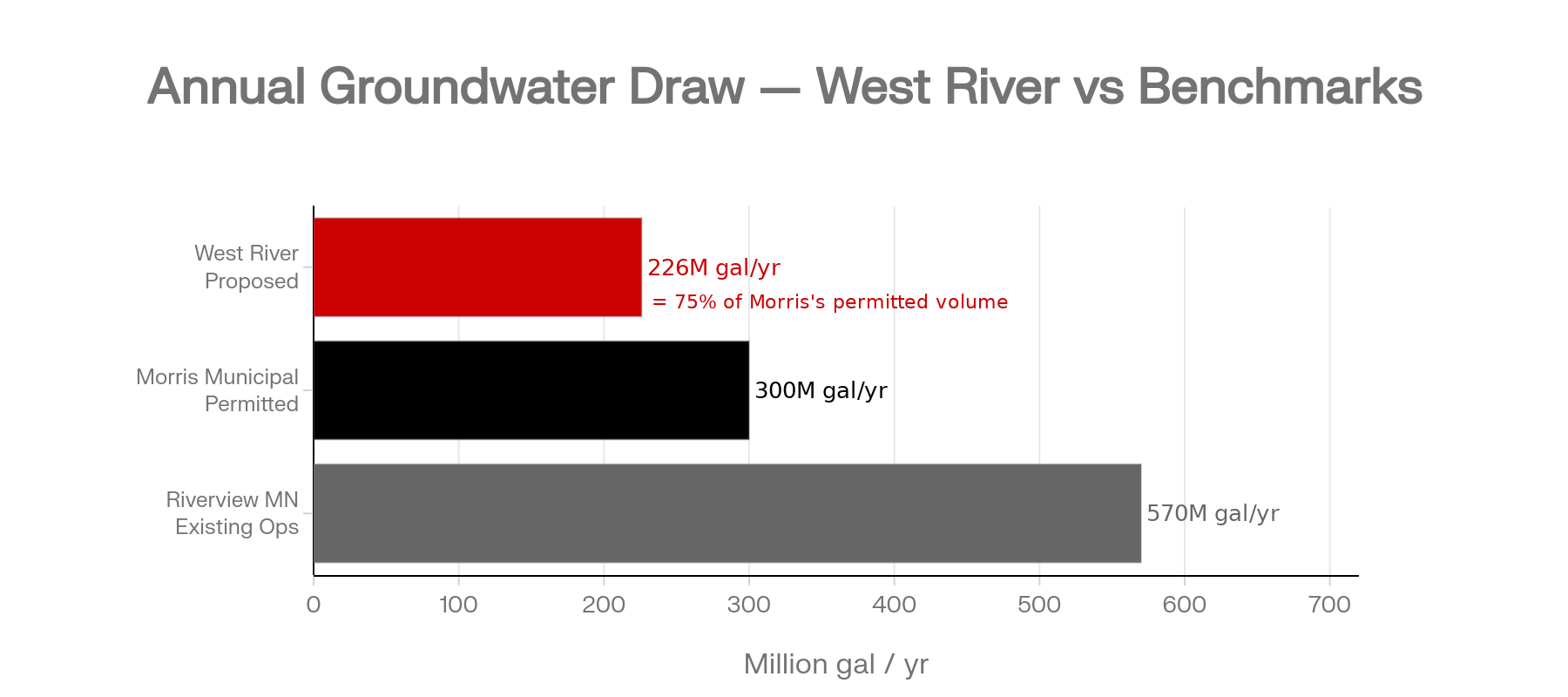
The number that froze the room in western Minnesota wasn’t the cow count. It was 226 million gallons of water per year — the volume Riverview LLP’s proposed West River Dairy expansion near Alberta would be allowed to pull from an off‑site well under a Minnesota DNR appropriation request, according to MPCA filings and a March 2026 public notice.
For nearby grain farmer Joe Stromen, who lives a few miles from the proposed site, that Minnesota dairy expansion permit isn’t an engineering abstraction; coverage from Land Stewardship Project (LSP) and Sentient Media has him clearly in the “opposed” column. It’s his well, his gravel road, his property value tied to a project that, until the public comment period opened, he had no formal say in. And for any dairy operator planning growth in 2026, Stevens County is a case study in the cost nobody budgets: the price of a permit fight you didn’t see coming, measured in months of lost revenue and interest you’re still paying on barns that aren’t milking cows.
When a Minnesota Dairy Permit Becomes the Biggest Risk in the Room
The West River Dairy proposal didn’t start with protesters. It started with paperwork.
Riverview LLP — the Fehr family‑founded dairy and beef company headquartered near Morris since 1939 and widely identified as Minnesota’s largest dairy producer — filed with the MPCA to expand West River Dairy from 7,855 to 18,855 dairy cattle, which equates to 26,397 animal units under Minnesota’s feedlot formula. LSP’s analysis calls it the largest dairy CAFO ever proposed in Minnesota by animal units.
On the engineering side, Riverview’s plan tracks with Minnesota feedlot rules on paper. LSP and MPCA summaries note that the expansion would add a new 11,000‑cow freestall site and increase covered, clay‑lined liquid manure basins from around 102 million gallons to roughly 250 million gallons, with about 13,200 acres of cropland identified for manure application. The DNR water permit would authorize pumping up to 226 million gallons per year, at no more than 1,000 gallons per minute, from an off‑site well near the dairy. The City of Morris — population just over 5,000 — is currently permitted to withdraw up to 300 million gallons per year from its municipal wells in the same aquifer system.
Opponents like Stromen, Carroll, and Matthew Sheets read those numbers differently than Riverview’s engineers.
LSP organizer Sean Carroll, who has tracked CAFO permitting across western Minnesota for years, and residents like Stromen and Sheets point to three numbers in particular: LSP’s reading of state permits says a single dairy expansion is applying to draw roughly 75% of Morris’s annual permitted groundwater volume; the site lies in a landscape dotted with waterfowl production areas and wildlife refuges; and Sentient Media’s review of Minnesota water‑use records estimates Riverview’s existing Minnesota hog and dairy operations already use at least 570 million gallons per year, with West River adding another 226 million if approved.
Carroll’s line, documented in LSP materials and comment letters, is that this isn’t “anti‑dairy,” it’s about cumulative risk: how much animal density and water a single landscape can absorb — and whether the review process is equipped to answer that question at Riverview’s current scale.
Did Riverview File First and Engage Later — and Is That Why They’re Fighting?
From Riverview’s side, the logic is familiar to anyone who has expanded a dairy. Partner and spokesperson Brady Janzen has been quoted in prior coverage saying Riverview grows where cheese demand and processor capacity pull them, and the I‑29 corridor, with billions in new cheese and processing investment, is pulling hard. That’s the same dynamic The Bullvine highlighted in earlier consolidation and plant‑investment work: processors build stainless, and cows, heifers, and capital follow the pipe.
The internal assumption behind West River is one that a lot of growth‑minded herds still share:
- Hire respected engineers.
- Model manure, storage, and acres to state specs.
- Keep water pulls under the modeled aquifer capacity.
- Deliver a tight nutrient management plan.
If the paperwork is clean, the permit might get noisy — but it eventually lands.
Stevens County is the reality check on that “clean paperwork = smooth permit” assumption. Twice.
First, history. In 2014, the Minnesota Pollution Control Agency’s Citizens’ Board — a now‑abolished citizen oversight panel — ordered a full environmental impact statement (EIS) for a proposed Riverview dairy on essentially the same Stevens County site, citing cumulative concerns about groundwater and downstream impacts. That project did not proceed in its original form. In 2015, after intense political and industry pushback, the legislature eliminated the Citizens’ Board, a move widely linked in state reporting to the Riverview decision and other controversial feedlot calls. When a new, larger West River plan emerged a decade later with only an environmental assessment worksheet (EAW) instead of a full EIS, LSP, and the Institute for Agriculture and Trade Policy (IATP) framed it as a system that had lost a layer of scrutiny, not one that had learned from 2014.
Second, track record. In January 2026, Arizona Attorney General Kris Mayes announced a US$11 million settlementwith Riverview related to concerns about declining groundwater levels in the Sulphur Springs Valley. Under the agreement, Riverview agreed to provide US$11 million to fund replacement wells, emergency and interim water supplies, and community water systems for affected residents, while continuing water‑conservation efforts; the company did not admit legal wrongdoing. LSP and Food & Water Watch have used that case, and that dollar figure, as part of their argument that West River deserves closer scrutiny.
On the one hand, Riverview can cite its MPCA and DNR filings and argue that its West River proposal fits within Minnesota’s current feedlot and water‑permit framework. On the other hand, groups like LSP and IATP argue that Riverview’s current scale — and high‑profile groundwater disputes like the Arizona case — justify tougher questions about cumulative water draw and enforcement. However, that argument plays out legally, the operator who absorbs the financial cost of any delay, conditions, or litigation is Riverview — and in the next county, with the next big barn, that operator could be you.
How Much Does a Dairy Expansion Permit Delay Actually Cost?
Here’s the math almost nobody runs before filing. You don’t need 18,855 cows for this to hurt — the arithmetic hits just as hard at 400, 800, or 1,500 new stalls.
When a permit stalls, you’re carrying:
- Interest on expansion‑tied capital you’ve already drawn or committed — land, barns, storage, parlor, rolling stock.
- Fixed costs — insurance, taxes, maintenance, utilities — on infrastructure that isn’t yet shipping milk.
- Professional fees — engineering, legal, consulting — that tick up with every hearing, comment extension, or requested study.
And you’re missing:
- Milk revenue from cows that should already be shipping.
- Component premiums and incentives are baked into the original pro‑forma.
- Manure nutrient credits you expected to offset the purchased fertilizer on your acres.
Most people budget for construction risk — overruns, weather, and contractors. Very few explicitly budget time‑risk. In a county watching West River and reading about Arizona, that line item is getting more real.
How Much Can a Minnesota Dairy Expansion Permit Delay Actually Cost?
Here’s why that Stevens County fight matters even if you’re “only” adding 600 cows two states away. Walk through this once with transparent numbers. Then swap in your own.
Assume:
- You’re adding 600 cows to your current herd.
- You’ve drawn about US$3.0 million in expansion‑tied capital — a midpoint in the US$2.5–3.5 million range seen in some Upper Midwest freestall/parlor plus manure‑infrastructure budgets for 500–700 cows.
- Your blended interest rate on that capital is 7.5%, consistent with recent Kansas City Fed data showing average interest rates on farm real‑estate loans around 7.49% in early 2025 — near the long‑term average but still high enough to make every month of delay expensive.
Here’s the time‑risk cost profile:
- Annual interest = capital × interest rate
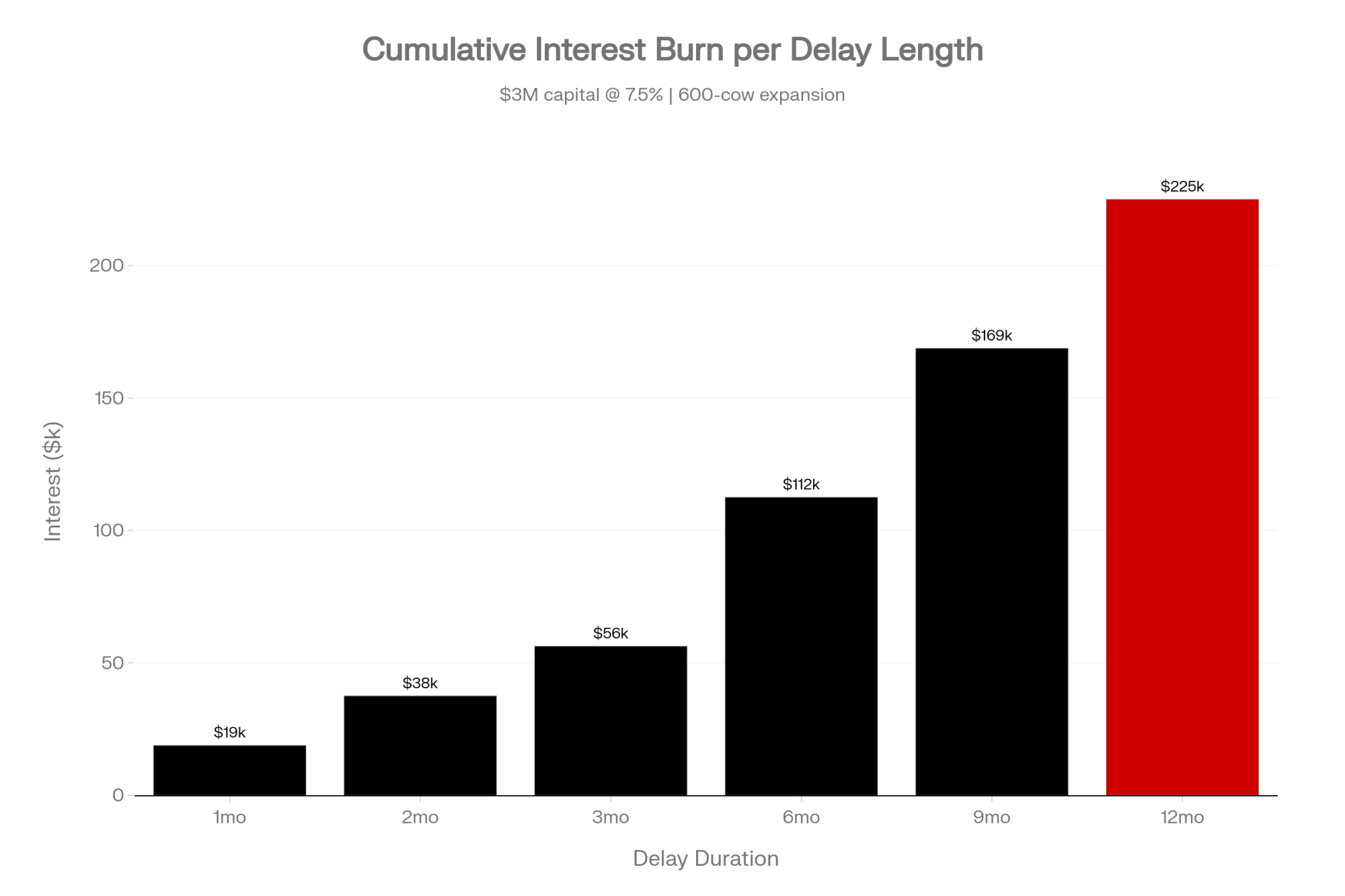
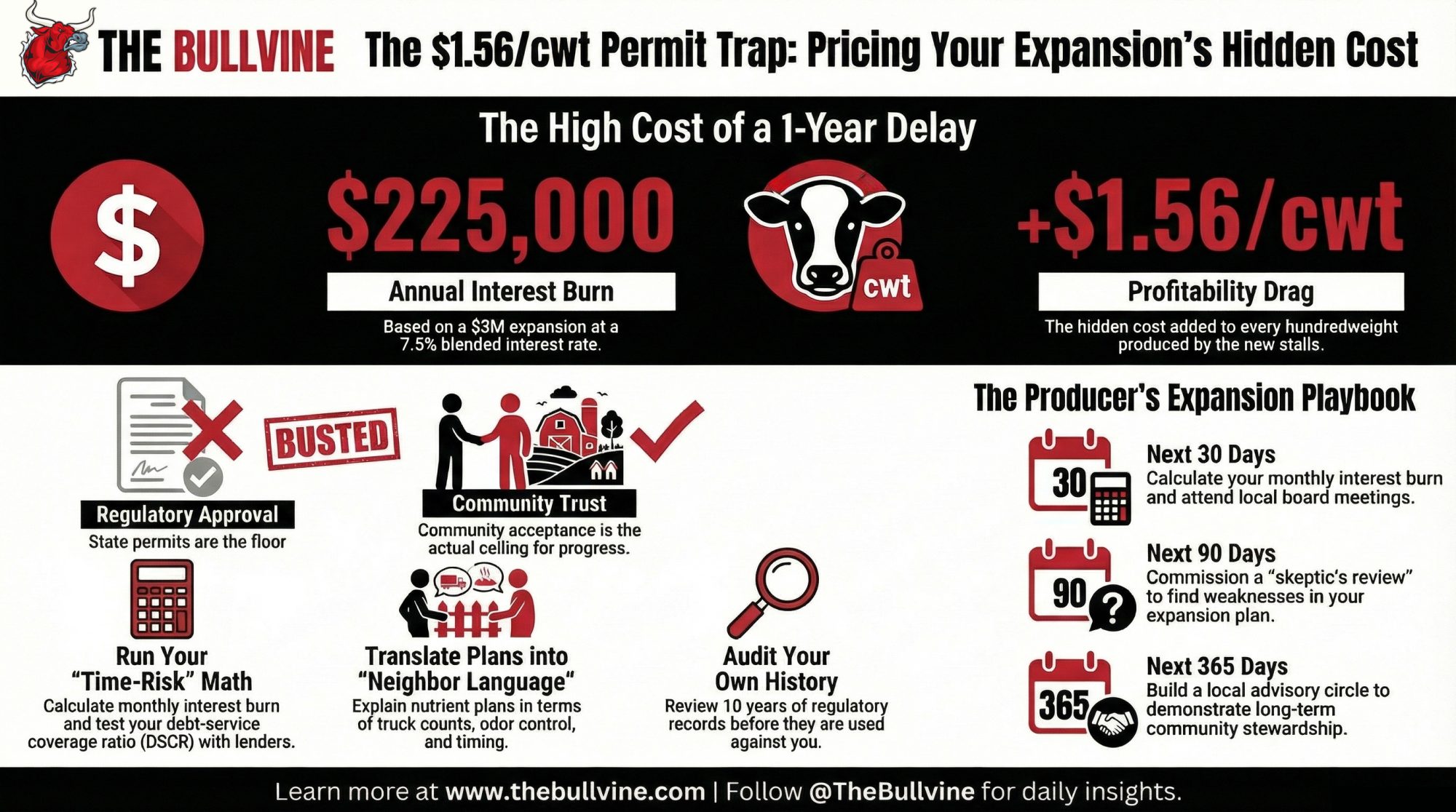
- 3,000,000 × 0.075 = US$225,000 per year in interest directly tied to the expansion.
- Monthly burn = 225,000 ÷ 12 ≈ US$18,750 per month in interest — before you count depreciation, taxes, insurance, or legal fees.
- A 12‑month permit delay at that rate = US$225,000 in interest alone, with no milk from those 600 cows.
Now convert that into something you actually feel in the milk check.
USDA and related summaries put average US milk production per cow in the low‑ to mid‑20,000‑pound range annually; using 24,000 pounds (240 cwt) per cow per year is a reasonable example for a Holstein herd in recent years.
- 600 cows × 240 cwt/cow/year = 144,000 cwt of milk per year. Those new stalls should produce once they’re filled.
Time‑risk penalty per cwt in this example:
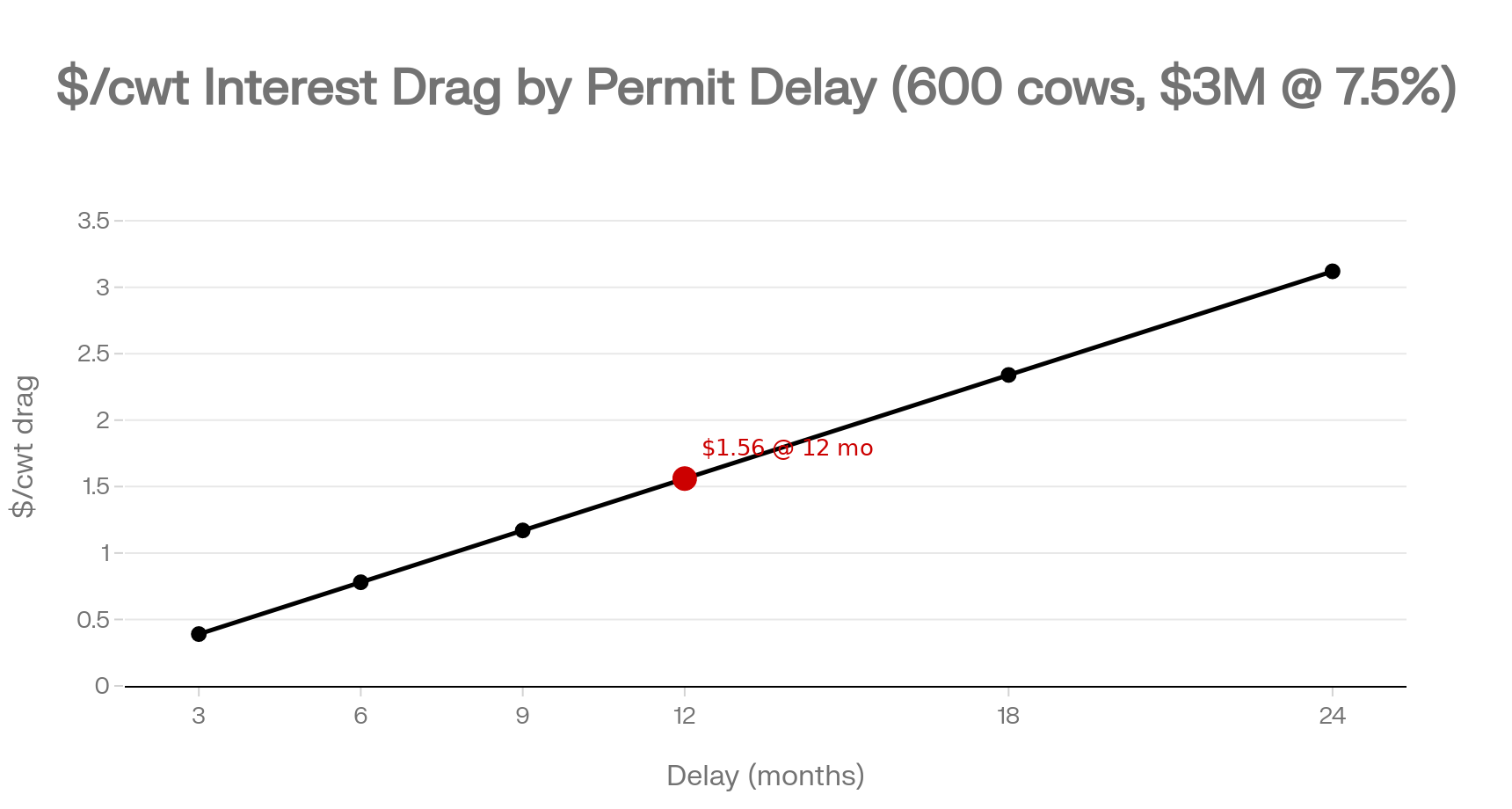
- 225,000 ÷ 144,000 cwt ≈ US$1.56/cwt.
That’s just the interest — no feed, no labor, no margin‑over‑feed math. In a 600‑cow example at current rates and infrastructure costs, a one‑year permitting delay quietly adds around a dollar and a half per cwt to the effective cost of that new production. If your build is larger, rates are higher, or production runs lower, the penalty climbs.
Run your own version:
- Expansion capital drawn × interest rate ÷ 12 = monthly time‑risk cost.
- Monthly time‑risk cost × months of delay = total time‑risk hit.
- Total time‑risk hit ÷ annual cwt from new cows = your hidden US$/cwt drag.
| Expansion Size | Capital Drawn | Monthly Interest Burn | $/cwt Drag @ 6-Mo Delay | $/cwt Drag @ 12-Mo Delay |
|---|---|---|---|---|
| 400 cows | $2,000,000 | $12,500 | $0.78 | $1.56 |
| 600 cows | $3,000,000 | $18,750 | $0.78 | $1.56 |
| 800 cows | $4,000,000 | $25,000 | $0.78 | $1.56 |
| 1,000 cows | $5,000,000 | $31,250 | $0.78 | $1.56 |
| 1,500 cows | $7,500,000 | $46,875 | $0.78 | $1.56 |
Where in your spreadsheet did you plan for that line?
What Stevens County Teaches Every Dairy Farmer to Grow
Here’s the myth this fight quietly kills: “Big guys get what they want. My smaller expansion won’t draw this kind of heat.”
Riverview did what any seasoned operator is told to do. Tight nutrient numbers. Engineered storage. A water permit request, DNR staff say, can be managed within the aquifer’s capacity on paper. Yet they still walked into a hearing room where opponents had binders of state records, an Arizona AG press release, and a decade‑old EIS fight on the same site to point at.
That dynamic doesn’t stay confined to a 26,397‑animal‑unit project. It shows up when:
- You grow from 300 to 600 cows on the edge of town.
- You site a deep pit or lagoon along a gravel road that a newer subdivision uses every day.
- You move from one barn to a multi‑barn complex in a township that has never seen that density.
Your nutrient management plan might be airtight. The question is whether you’ve done any work to translate those numbers into the lived reality of dust, headlights, and truck counts that your neighbors care about.
Stevens County also exposes a second busted assumption for any operator: “Once regulators sign off, the science argument is over.”
In their formal and media comments, LSP and IATP argue that cumulative nitrate and water‑use risks in the Pomme de Terre watershed aren’t fully captured by current modeling for a project of West River’s size. That’s a technical argument, not just a vibes‑based objection. Whether you buy their analysis or not, once that level of distrust fills a boardroom, another engineering cross‑section or appendix letter from MPCA doesn’t move the room by itself.
In 2026, regulatory approval is the floor for community trust, not the ceiling. If an expansion strategy stops at “the state says yes,” the operator is effectively handing the public narrative about their farm to critics — and doing it while the interest meter ticks and heifers keep aging.
Those months of drift also collide with other structural constraints. Work on the heifer shortage has shown how tight replacement supply and higher heifer values already squeeze expansion timelines and flexibility; every extra month of permit limbo shifts when those heifers calve in, and how you manage culling and breeding. A year‑long permitting detour doesn’t just cost you interest; it can throw your replacement, breeding, and culling plans out of sync.
| Risk Dimension | West River (Proposed) | Typical 500–1,200 Cow MN Expansion |
|---|---|---|
| Herd size (animal units) | 26,397 AU (18,855 cattle) | 700–1,700 AU |
| Water permit request | 226M gal/yr (75% of Morris municipal) | 5–25M gal/yr |
| Manure storage | ~250M gal liquid basin | 2–8M gal |
| Cropland for application | ~13,200 acres | 800–3,000 acres |
| Prior EIS/EAW history on site | Yes — 2014 fight, project abandoned | Typically none |
| AZ groundwater settlement (same operator) | $11M (Jan 2026) | N/A |
| Community opposition on record | LSP, IATP, local residents, formal comments | Occasional neighbor objections |
| Permit pathway | EAW only (no full EIS) | Standard MPCA feedlot permit |
The 30/90/365‑Day Expansion Playbook: What to Do Before You File
You don’t control aquifers, activist groups, or statehouse politics. You do control how exposed you are before your farm’s name shows up in a public notice that opposition groups can organize around.
| Timeframe | Action | Owner | Risk if Skipped |
|---|---|---|---|
| 30 days | Run time-risk math (capital × rate ÷ cwt) | Operator + lender | Flying blind on $/cwt drag |
| 30 days | Attend 2 township/county meetings | Operator | Can’t name likely opponents before filing |
| 30 days | DSCR stress-test at 6 and 12-mo delay | Lender conversation | Covenant breach risk not modeled |
| 30 days | Audit own regulatory/neighbor history | Operator + attorney | Opposition brings it up first |
| 90 days | Third-party “skeptic’s review” of operation | Environmental engineer | Gaps handed to critics at hearing |
| 90 days | Translate NMP into plain-language neighbor summary | Agronomist + operator | Nutrient narrative controlled by opponents |
| 90 days | Pre-negotiate haul routes with county road authority | Operator | Truck traffic becomes hearing flashpoint |
| 365 days | Build advisory circle (neighbors + local officials) | Operator | No trusted voices in the room when it counts |
| 365 days | Annual stewardship snapshot (public-facing) | Operator | “Distant operator” framing sticks unopposed |
| 365 days | Visible local investment (FFA, fire dept, road cleanup) | Operator | $1.56/cwt permit fight that was avoidable |
In the Next 30 Days
- Show up where decisions are already being made. Attend at least two county or township meetings you’d normally skip. Sit in the back and listen. Note who always comments, which commissioners lean in on ag issues, and what topics stall the room. If you can’t name the three people most likely to speak against your expansion today, you’re filing blind.
- Run your time‑risk math now, not after you’ve broken ground.
- Pull your expansion‑tied capital and real blended interest rate.
- Use your own rolling‑12‑month production to estimate annual cwt from the new cows.
- Plug into the formulas above to calculate your monthly burn and US$/cwt penalty for a 6‑ and 12‑month delay.
- Test your coverage with your lender. Take that time‑risk number to your lender and ask, “How many months of zero new revenue from this expansion can we absorb before my debt‑service coverage ratio drops below about 1.2?” Many ag lenders use around 1.2 as a common minimum DSCR covenant on term debt; you need your actual threshold and how close you are to it in writing, not as a guess from memory.
- Audit your own regulatory and neighbor history. Pull five to ten years of your own interactions with environmental regulators: spill reports, notices of violation, odor complaints, anything formally logged. Make a second list of serious neighbor disputes. Assume every item on those lists will be mentioned in a hearing, and start thinking now about what you’d say in response.
Over the Next 90 Days
- Commission your own “skeptic’s review” of your current operation. Hire a third‑party environmental or engineering firm — not just the engineer who’ll file your permit — to look at nutrient loading vs acres, seasonal odor, and truck traffic by season and time of day. Ask them explicitly, “Where would a critic reasonably push on this?”
- Translate your nutrient management plan into a neighbor’s language. Before your name shows up in the legal notices, pull your immediate neighbors into a conversation or mailer that says, in plain numbers:
- How many acres get manure, roughly how many gallons per acre, and how many times per year?
- Most of those nutrients replace purchased N, P, and K on those fields, based on your lab results and agronomist recommendations.
- The specific steps you take on timing, injection/surface‑application, setbacks, and slope to keep nutrients and odors as controlled as possible.
- Pre‑negotiate haul routes and timing with your county. Sit down with the county or township road authority now and lay out your anticipated truck trips at full build‑out, including peaks for silage, feed, and manure. If you can walk into a hearing with a signed or draft road‑use understanding — or at least a memo showing you’ve offered to contribute to maintenance — it changes the tone of that part of the debate.
Over the Next 365 Days
- Build a small advisory circle that outlasts the permit fight. That might be two neighbors, one local official, and a representative from the school or fire department. Meet once or twice a year to share high‑level plans and ask for blunt feedback. The goal isn’t consensus; it’s a pattern of engagement that commissioners can point to when they’re under pressure.
- Create an annual stewardship snapshot you’d be comfortable seeing on Facebook. One page on manure handled, acres receiving it, major changes you’ve made to reduce risk or nuisance, and what you’re doing on water use and emergency preparedness. Post it online and drop a printed copy with immediate neighbors.
- Invest visibly before you ask for a big yes. Target local support where your trucks and impact already show up: fire department, FFA, local EMS, and road cleanups. You’re not buying votes, you’re demonstrating that you see your operation as part of the community, not above it. That matters a lot when a commissioner is weighing two stacks of testimony.
By the time your permit hits the agenda, you want key people in that room thinking, “We know them. They show up, and they fix things.” That doesn’t eliminate organized opposition. It makes it harder to frame you the way critics have portrayed Riverview in their campaigns — as a distant, growth‑driven operator the community never really got to vet.
What This Means for Your Operation
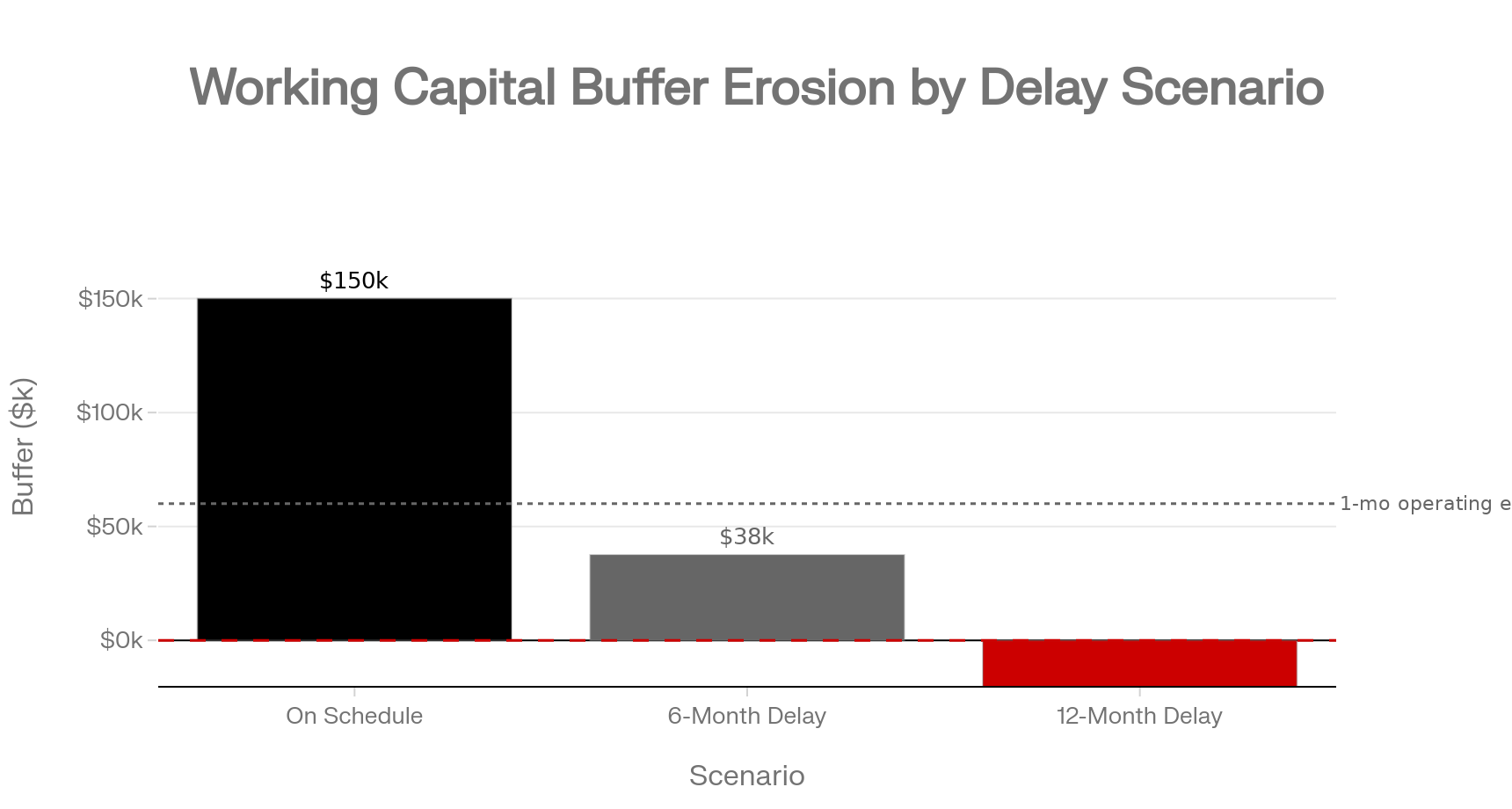
- Price the year you didn’t plan for. Use your own capital and rate to calculate your monthly time‑risk cost, then stress‑test a 6‑ and 12‑month delay. If that scenario would shove your working‑capital buffer below roughly a month of operating expenses, re‑phase or downsize the project before you file.
- Stop assuming a clean permit file equals a smooth community process. Build a basic communication and neighbor‑engagement plan the same way you build a nutrient plan — with names, dates, and specific risks you’re trying to manage.
- Clear your own skeletons off the table first. Make a realistic list of past notices, complaints, and disputes, then decide what you can fix or visibly improve this year so they’re not the only stories in the room when your name comes up.
- Treat Stevens County as tuition, not spectacle. Watch what happens with the West River Dairy permit — the timelines, the conditions, and the political fallout — and then identify where your own expansion looks similar on scale, water draw, or proximity to town. That’s your risk stripe.
- Do one concrete thing in the next 30 days. Either show up to a local board or planning meeting to listen, or book a meeting with your lender to walk through your time‑risk math and DSCR headroom. Put the date and the name on your calendar now, not “sometime this summer.”
Key Takeaways
- If your expansion pro‑forma only works when everything stays on schedule, you don’t have a plan — you have a best‑case scenario. The West River fight shows how fast a technically compliant, well‑engineered project can still get bogged down when history, water, and community trust are in play.
- Regulatory approval is the starting line in 2026, not the finish. The barns that get built without an extra year of legal and political drag usually belong to operators who did the communication and relationship work before their permit hit the agenda, not after.
- Your most expensive opponent may not be the loudest person at the hearing — it’s the monthly interest and lost margin you never modeled when the permit timeline slipped. In a realistic 600‑cow example at current rate and cost assumptions, that delay can quietly add around US$1.50 per cwt to the effective cost of that new milk; larger builds carry even more time‑risk.
The Bottom Line
Stevens County’s mega‑dairy fight will keep showing up in headlines and legal filings. Your version will show up in a local boardroom with 30 people, a sign‑up sheet, and a clock.
Before you sign the next construction contract, pull two things: your monthly expansion‑related interest burn, and the name of the first neighbor or local official you’d call before your permit goes public. If either one is blank, that’s your real permitting problem.
Complete references and supporting documentation are available upon request by contacting the editorial team at editor@thebullvine.com.
Learn More
- Decide or Decline: 2025 and the Future of Mid-Size Dairies – Arms you with immediate tactics to audit your debt-to-asset ratios and stress-test 2025 margins. It reveals how mid-tier herds are slashing labor costs by 30% through targeted automation rather than risky, high-capital physical expansions.
- More Milk, Fewer Farms, $250K at Risk: The 2026 Numbers Every Dairy Needs to Run – Delivers a brutal reality check on the “more milk, fewer farms” era. You’ll gain a strategic framework to map your processor’s regional logistics and identify the specific “trip wires” that signal when to grow or exit.
- The Future of Dairy: Lessons from World Dairy Expo 2025 Winners – Exposes the unconventional “DIRT” principles and on-farm processing models driving 20,000-cow successes. It breaks down how integrating real-time component feedback and water recycling captures massive efficiency gains that typical commodity-focused operations completely overlook.
 The Sunday Read Dairy Professionals Don’t Skip.
 The Sunday Read Dairy Professionals Don’t Skip.
Every week, thousands of producers, breeders, and industry insiders open Bullvine Weekly for genetics insights, market shifts, and profit strategies they won’t find anywhere else. One email. Five minutes. Smarter decisions all week.