





FDA’s dye ban & GRAS overhaul are here! Is your dairy biz ready for this market reset or will you get left behind? Guts, glory & big changes ahead.
EXECUTIVE SUMMARY: The U.S. food regulatory landscape faces a seismic shift as the FDA, under HHS Secretary Kennedy’s directive, moves to eliminate synthetic dyes by 2026 and fundamentally overhaul the GRAS system, ending self-affirmed GRAS. This “market reset” demands proactive adaptation from dairy processors, who must navigate aggressive timelines and a complex web of state-level bans. While the IDFA has pledged to remove dyes from school dairy products, this doesn’t cover the broader retail market where synthetics persist. The FDA’s own capacity issues and reliance on “voluntary” industry action for some dyes add layers of uncertainty. Ultimately, dairy businesses that embrace this change, innovate with natural alternatives, and treat compliance as a premium opportunity will lead, while laggards risk obsolescence.
KEY TAKEAWAYS:
- Regulatory Tsunami: The FDA is aggressively phasing out key synthetic food dyes (Red No. 3 banned, six others targeted for voluntary removal by end of 2026) and plans to eliminate the self-affirmed GRAS pathway, forcing FDA notification for all new GRAS ingredients.
- Market Reset, Not Just Compliance: These changes are a fundamental disruption. Dairy businesses must see this as an opportunity to innovate with natural colors and reposition products, rather than just a costly reformulation exercise.
- Industry & State Pressure Cooker: The IDFA’s school pledge is a start, but state-level bans are creating a patchwork driving national change. However, the FDA’s reliance on “voluntary” compliance for several dyes and its own resource constraints create implementation uncertainties.
- Strategic Adaptation is Non-Negotiable: Proactive auditing of product portfolios, immediate reformulation testing, reviewing GRAS ingredients, and leveraging natural alternatives for premium positioning are critical for survival and success.
- Lead or Be Left Behind: The dairy businesses that anticipate, innovate, and adapt quickly will define the new market norms and capture value, while those who delay or resist will struggle.
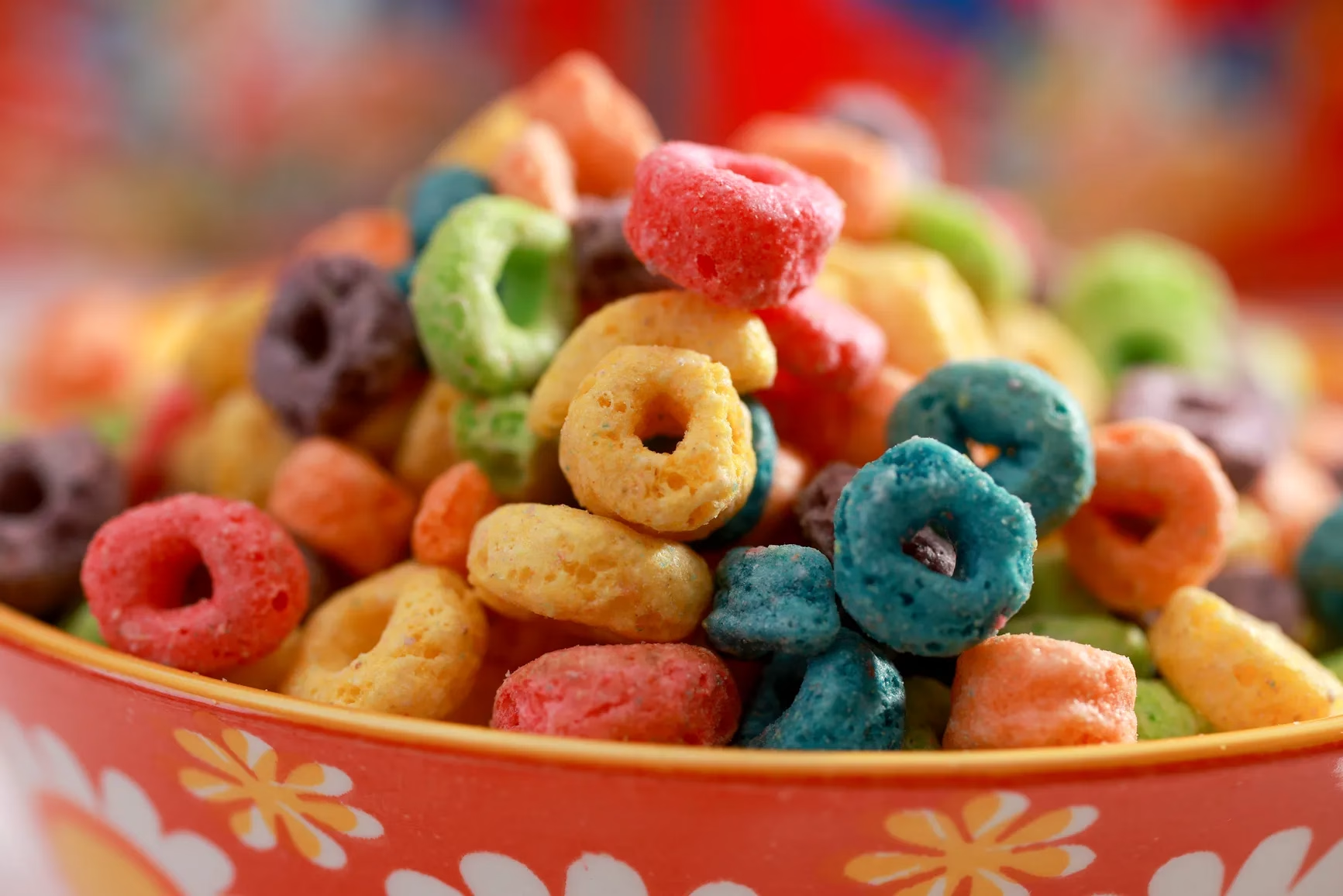
The U.S. food regulatory landscape is experiencing its most dramatic transformation in decades. With HHS Secretary Kennedy’s declaration to “get rid of every additive that can legally be addressed,” dairy processors face a double regulatory tsunami: eliminating synthetic dyes by 2026 and a complete overhaul of the GRAS system that has enabled decades of ingredient innovation. But this isn’t just another compliance headache; it’s a market reset that will reward the prepared and punish the procrastinators.
Every few years, a new regulatory storm hits the dairy industry. Sometimes it’s just a sprinkle of labeling change, a reporting requirement. But what’s brewing now is a hurricane-force shift that will fundamentally change how we formulate, manufacture, and sell dairy products across America.
The one-two punch of a synthetic dye phase-out and a complete reimagining of the Generally Recognized as Safe (GRAS) system represents the most significant regulatory shift for food ingredients in decades. And unlike some policy changes that only affect specific sectors, these reforms will touch virtually every dairy processor, from the smallest artisanal cheesemaker to the largest milk cooperative.
Let’s cut through the bureaucratic noise and get straight to what matters: How will these changes impact your dairy operation, the timeline for compliance, and most importantly, what strategic moves should you be making now?
The Synthetic Dye Crackdown: Timeline and Targets
The first major shift is already underway. On April 22, 2025, the Department of Health and Human Services (HHS) and the FDA announced a comprehensive plan to phase out petrochemical-based dyes from the nation’s food supply.
HHS Secretary Robert F. Kennedy Jr. didn’t mince words: “For too long, some food producers have been feeding Americans petroleum-based chemicals without their knowledge or consent. These poisonous compounds offer no nutritional benefit and pose measurable dangers to our children’s health and development”.
The FDA’s timeline for elimination is aggressive:
- Red No. 3: Already banned for food use through a formal order issued January 15, 2025. Manufacturers must reformulate by January 15, 2027, though the FDA is pushing for voluntary elimination by the end of 2026.
- Citrus Red No. 2 and Orange B: Authorization revocation proceedings will begin “in the coming months” (Though these are rarely used in dairy products).
- Six major synthetic dyes: Green No. 3, Red No. 40, Yellow No. 5, Yellow No. 6, Blue No. 1, and Blue No. 2 are slated for “voluntary” elimination by the end of 2026.
Why “voluntary” in quotation marks? Because while the FDA hasn’t formally banned these six dyes (yet), the writing is clearly on the wall. These dyes are on borrowed time with state-level bans multiplying and consumer pressure mounting.
The Dairy Impact Zone
Which dairy products will feel the heat? Primarily, those with added colors:
- Flavored milk: Strawberry and chocolate milk often contain Red 40 in the flavor systems or color additions
- Cultured products: Fruit-on-the-bottom yogurts and drinkable kefirs frequently use Red 40, Yellow 5, and Blue 1
- Frozen dairy desserts: Premium ice creams, frozen yogurts, and novelty items contain a rainbow of artificial colors, particularly in kid-oriented products
- Cheese: Yellow five and Yellow 6 are common in processed cheese, cheese analogs, and some colored natural cheeses for consistent appearance
- Butter and spreads: Some manufacturers use color additives for standardized appearance across seasonal variations in butterfat composition
Even if you’re not adding these dyes directly to your plant, they might be in purchased ingredients like fruit preparations, flavor systems, inclusions, or ripple syrups used in your co-manufactured products.
Why This Isn’t Just Another Regulation A Market Reset
Let’s be brutally honest: this regulatory shift isn’t just another box to check- it’s a fundamental market disruption that will create new winners and losers in the dairy space. The industry has relied on artificial colors for decades to create consumer expectations around everything from cheese to fruit yogurt. These expectations weren’t based on natural product characteristics but on artificial visual cues that became the norm.
Now the table is being reset. The winners will be companies recognizing this isn’t merely about replacing one ingredient with another, it’s about reimagining product positioning, consumer education, and premium opportunities.
As an industry, are we merely waiting for mandates, or are we genuinely ready to lead the charge for cleaner labels, even if it means short-term pain for long-term gain? The “natural-look” dairy products we’ve viewed as niche could become the new standard, leaving synthetic-colored products looking increasingly artificial and outdated.
We’ve conditioned consumers to expect vibrant, almost unnatural colors in certain dairy products for years. Is that because they demand it, or because it’s an easy shortcut we’ve relied on? What if the “natural look” became the new premium positioning rather than a compromise?
Dairy Industry’s Bold Move: The IDFA Pledge
While some industries are dragging their feet like reluctant heifers headed for the milking parlor, the dairy sector’s largest trade group has taken a proactive stance. The International Dairy Foods Association (IDFA) announced a voluntary pledge to remove Red 3, Red 40, Green 3, Blue 1, Blue 2, Yellow 5, and Yellow 6 from milk, cheese, and yogurt products sold to schools for the National School Lunch and Breakfast Programs by July 2026.
This “Healthy Dairy in Schools Commitment” positions the dairy industry as a leader rather than a follower in transitioning from synthetic dyes. But there’s a critical detail: the pledge only applies to school meal programs, not retail dairy products. This voluntary action doesn’t cover most colored dairy items on grocery store shelves.
Let’s be blunt: this is a smart, targeted play by the IDFA. By focusing on school products, a highly visible and politically sensitive sector, the industry gains positive PR while limiting the scope of costly reformulations. It’s like selectively treating a single cattle pen for a disease that could spread to your entire herd, controlling the immediate problem while buying time to develop a broader strategy.
Why This Strategic Move Makes Sense
- Most dairy products in schools already don’t contain artificial colors
- The pledge aligns with growing parent concerns about children’s diet
- It positions dairy as part of the solution, not part of the problem
- It might help forestall more stringent federal mandates
- The limited scope keeps costs manageable for dairy processors
But make no mistake- this selective approach won’t satisfy everyone. Consumer advocacy groups are already pointing out the discrepancy between school and retail products. “Why protect schoolchildren from these dyes but not families shopping at the grocery store?” they’re asking. And it’s a fair question.
GRAS Reform: The Stealth Revolution
While the dye ban is grabbing headlines, a less flashy but potentially more consequential change is brewing: an overhaul of the Generally Recognized as Safe (GRAS) system.
For decades, the GRAS provision has allowed food companies to independently determine that ingredients are safe without mandatory FDA notification, so-called “self-affirmed GRAS” pathway. This system has enabled rapid innovation but has also been criticized as a regulatory loophole.
On March 10, 2025, Secretary Kennedy directed the FDA to “explore potential rulemaking to revise its Substances Generally Recognized as Safe (GRAS) Final Rule and related guidance to eliminate the self-affirmed GRAS pathway”. In plain English, companies must notify the FDA and provide safety data before introducing new ingredients under GRAS status.
What This Means for Dairy Innovation
This change could dramatically alter how new ingredients enter dairy products. Consider the implications:
Current System:
- Your R&D team develops a new hydrocolloid stabilizer system for UHT flavored milk
- Your scientific team conducts a safety assessment
- The company concludes that the ingredient is GRAS
- Product goes to market
- The FDA may never be notified
Proposed System:
- Your R&D team develops a new hydrocolloid stabilizer system for UHT flavored milk
- Scientific team conducts safety assessment
- Company must notify the FDA of safety data
- Company must wait for FDA review
- Only then can the product go to market
This shift could significantly slow product development cycles and increase costs for an industry constantly innovating with new functional ingredients, starter cultures, milk protein concentrates, enzymes, flavors, and texturizing systems. And with thousands of self-affirmed GRAS ingredients already in use-from emulsifiers in your ice cream to acidulants in your cottage cheese-there’s huge uncertainty about whether the FDA might eventually require retrospective notification for existing ingredients.
Can the dairy industry wait and see what form these changes take? Or is now the time to audit your entire ingredient portfolio for GRAS vulnerabilities? Smart companies are already conducting this assessment, identifying which ingredients might face scrutiny, and developing contingency formulations.
The State Regulatory Patchwork: A Driving Force
Why is the federal government acting now? One major factor is that states are tired of waiting and have begun taking matters into their own hands. The result is a growing regulatory patchwork becoming a compliance nightmare for national manufacturers.
States Leading the Synthetic Dye Ban:
- California: Banned Red No. 3 in all foods (effective January 2027) and six synthetic dyes in school foods (by December 2027)
- West Virginia: Banned seven synthetic dyes in schools (August 2025) and all foods (January 2027)
- Virginia: Banned seven synthetic dyes in public schools (July 2027)
- Utah: Banned several dyes in public schools (May 2025)
- Arizona: Banned “ultraprocessed food” including various dyes in schools (2026-27 school year)
At least 20 other states are considering similar legislation. Imagine trying to maintain different formulations for different states- it’s like running a multi-state dairy operation where each state requires different butterfat standards for the same product. The logistics become unsustainable, and eventually, you standardize to meet the strictest requirements. This state-level pressure is perhaps the federal government’s strongest leverage for encouraging “voluntary” industry compliance with a national standard.
Implementation Reality Check: The FDA’s Capacity Crisis
Here’s where the rubber meets the road: the FDA’s ability to implement these ambitious changes is severely compromised. In early 2025, the agency’s workforce was reportedly cut by 19%, with 3,500 staff members laid off. These cuts have affected project managers, policy staff, and reviewers critical to the FDA’s operations.
The result? The agency is already struggling to meet existing deadlines. Now add:
- Expedited reviews for natural color alternatives
- Processing a potential flood of GRAS notifications
- Formal rulemaking for dye removals and GRAS changes
- Research partnerships with NIH on additive health effects
It’s like asking a dairy plant running at capacity to double production during holiday ice cream season without adding staff or equipment- something’s got to give.
The FDA’s capacity crisis creates both challenges and opportunities for dairy businesses. On one hand, timelines might slip, giving more breathing room for reformulation. On the other hand, uncertainty about enforcement and compliance dates makes strategic planning difficult.
Natural Alternatives: The Dairy Color Palette of the Future
So, what options do dairy formulators have to replace synthetic dyes? Fortunately, the natural color industry has been innovating for years, and many alternatives work well in dairy matrices:
Natural Color Options for Dairy Applications:
| Desired Color | Natural Alternative | Best For | Considerations |
| Yellow to Orange | Annatto extract (bixin/norbixin) | Cheese, butter, ice cream | Stable in high-fat applications; may impart a slight flavor at high concentrations |
| Yellow to Orange | Beta-carotene | Fluid milk, cheese, yogurt | Good heat stability; works well in HTST and UHT systems |
| Red to Pink | Beetroot powder | Yogurt, ice cream, dairy beverages | pH sensitive, may turn brown in fermented applications; color migration in variegated products |
| Blue | Butterfly pea flower extract | Yogurt, ice cream, dairy desserts | Recently FDA-approved, sensitive to pH shifts during fermentation |
| Blue | Gardenia blue | Yogurt, ice cream, novelty products | New to market; limited stability data in long-shelf-life applications |
| Blue | Galdieria extract blue (algae) | Various dairy foods | Recently FDA-approved; good stability in neutral pH applications |
| White | Calcium phosphate | Various dairy foods | Recently FDA-approved; minimal impact on mouthfeel in proper concentrations |
On May 9, 2025, the FDA approved three new natural color additives: galdieria extract blue, calcium phosphate, and butterfly pea flower extract, as part of their commitment to “expand the palette of available colors from natural sources”. This approval demonstrates the agency is moving quickly to provide alternatives, though many more will be needed.
But let’s be honest about the challenges:
- Cost: Natural colors typically cost 3-10 times more than synthetic dyes, impacting your COGS significantly
- Stability: Many natural colors are more sensitive to light, heat, and pH, which is pH-problematic for dairy products with varying acidity levels and thermal processing requirements
- Intensity: Natural colors often provide less vibrant hues, challenging for differentiation in crowded dairy cases
- Consistency: Batch-to-batch variation can be greater with natural sources, creating QA challenges for standardized appearance
- Interactions: Natural colors may interact differently with dairy proteins, milkfat, and native milk minerals
The Maverick Move: Natural Color as Premium Positioning
While most companies treat this transition as a defensive compliance exercise, forward-thinking dairy processors are flipping the script entirely. Instead of reluctantly adopting natural colorants as a poor substitute for synthetics, they’re launching new premium product lines celebrating their naturally-derived colors as a key selling point.
Consider one innovative mid-sized yogurt manufacturer recently launching a “Purely Colored” line featuring vibrant but slightly less uniform colors explicitly marketed as “colored by nature, not the lab.” Their packaging prominently features educational content about their color sources (like “colored with actual beetroot” or “contains real carrot extract for color”). Initial sales data show they’re commanding a 15-20% premium over conventional products while building brand loyalty with health-conscious consumers.
This maverick approach doesn’t treat natural colors as a compromise but as a differentiation opportunity. It recognizes that consumer perceptions are shifting, and what was once considered a technical limitation (less vibrant, less consistent coloring) can be reframed authenticity and premium positioning.
Could your standard products become your premium offerings simply by embracing and celebrating the natural color transition ahead of competitors? The window for this first-mover advantage is closing rapidly.
Strategic Adaptation: Your Dairy Business Playbook
With these changes bearing down on the industry, what’s a smart dairy business to do? Here’s your strategic playbook:
1. Audit Your Current Product Portfolio
Start by identifying which of your products contain the targeted dyes. Create a prioritized list based on:
- Which products use Red No. 3 (highest priority due to formal ban)
- Which products are sold to schools (due to the IDFA pledge)
- Which products are sold in states with pending bans
- Which products could be reformulated most easily
2. Begin Reformulation Testing Now
Even with “voluntary” phase-outs, the direction is clear. Starting reformulation work early gives you several advantages:
- More time to perfect formulas before deadlines
- Potential cost advantages from being ahead of the rush
- Opportunity to test consumer acceptance gradually
- Marketing advantage from early adoption
Just as the most successful dairy farmers don’t wait until the last minute to prepare for milk quality audits, forward-thinking processors shouldn’t delay reformulation efforts until deadlines loom.
3. Consider a Segmented Approach
You might adopt different strategies for different product lines:
- Immediate reformulation for school products (aligning with the IDFA pledge)
- Phased reformulation for consumer products, starting with children’s items
- Using reformulation as an opportunity for broader clean label initiatives
- Developing premium “naturally colored” variants while maintaining traditional options for price-sensitive markets
4. Review Your GRAS Ingredients
With GRAS reform looming, catalog all product ingredients that rely on self-affirmed GRAS status. You’ll want to:
- Identify which ingredients might be vulnerable to increased scrutiny (particularly hydrocolloids, emulsifiers, and novel dairy protein derivatives)
- Engage with suppliers about their plans for formal FDA notification
- Consider alternative ingredients with stronger regulatory standing
- Budget for potential reformulation if certain ingredients face challenges
5. Engage With Your Supply Chain
Your ingredient suppliers are navigating the same changes. Open communication can yield valuable insights:
- Ask about their reformulation timelines and capabilities
- Discuss pricing implications for natural alternatives
- Explore opportunities for co-development work
- Share testing results to accelerate progress
6. Turn Regulatory Compliance into Marketing Advantage
Smart dairy businesses won’t just comply with these changes- they’ll leverage them for competitive advantage:
- Highlight “naturally colored” products in marketing
- Educate consumers about your proactive approach
- Positioned reformulated products as premium offerings
- Use the transition to reinforce your commitment to quality and health
Why This Matters to Your Bottom Line
These regulatory changes aren’t just technical challenges- they have real business implications:
Potential Costs:
- Reformulation R&D expenses
- Higher ingredient costs
- Production line adjustments (particularly for flavor/color injection systems)
- Packaging updates
- Potential consumer acceptance issues
Potential Opportunities:
- Premium positioning for naturally colored products
- Getting ahead of competitors in the transition
- Strengthening your brand’s health credentials
- Developing new product variants
- Expanding into clean label markets
One dairy processor who switched to natural colors in yogurt two years ago told me: “The initial cost was painful, but we’ve seen a 15% sales increase in our children’s line since making the change. Parents recognize and appreciate the differences, such as the premium we’ve always gotten for rBST-free milk, but with even stronger consumer appeal.”
The Bottom Line: Preparation Beats Panic
The synthetic dye sunset isn’t coming- it’s already here. The GRAS system you’ve relied on is being dismantled. And these aren’t minor regulatory tweaks-they represent a fundamental reset of the dairy formulation landscape.
The companies scrambling today are the same ones that fought GMO labeling until the last minute, denied consumer concerns about artificial ingredients until forced to change, and viewed clean-label as a fad rather than the foundation of modern food production. Where are they now? Struggling to catch up while watching more agile competitors capture market share.
Will you play defense, grudgingly reformulating only when forced by regulation, or will you seize this opportunity to differentiate, innovate, and lead? The question isn’t whether these changes will affect your dairy business; it’s whether you’ll emerge stronger or weaker when they do.
The dairy industry has survived countless challenges by adapting and evolving. Those who’ve thrived didn’t just survive changes-they anticipated and capitalized on them. This regulatory shift is no different. The clock is ticking. What’s your first move going to be?
Learn more:
- MAHA: A Double-Edged Sword for the Dairy Industry – This article directly discusses the “Make America Healthy Again” (MAHA) initiative, which is a driving force behind the food dye and GRAS changes, offering insights into how it specifically impacts dairy, including opportunities for whole-food dairy and threats to processed dairy items.
- MAHA’S MILK MANDATE: HOW POLITICS FUELS THE DAIRY BOOM – Focusing on the political drivers of the MAHA initiative, this piece explores how these policies could specifically benefit traditional dairy products like whole milk and cheese by scrutinizing ultra-processed foods, including many plant-based alternatives.
- Canada’s New Liberal PM Carney: Friend or Foe to Dairy’s Future? – While focused on Canadian dairy policy, this article provides a relevant comparative perspective on how a neighboring country with a different regulatory system (supply management) is navigating agricultural policy, investment in processing, and market access, which can offer context to U.S. producers facing their own regulatory shifts.
 The Sunday Read Dairy Professionals Don’t Skip.
 The Sunday Read Dairy Professionals Don’t Skip.
Every week, thousands of producers, breeders, and industry insiders open Bullvine Weekly for genetics insights, market shifts, and profit strategies they won’t find anywhere else. One email. Five minutes. Smarter decisions all week.




