Archive for Management – Page 65

Heat Detection Skills: A Critical Factor in the Reproduction Equation

The regular creation of pregnancies is essential to providing the steady stream of fresh cows necessary to maintain a good milk production average along with the heifer calves that will become the future replacements for a dairy operation.

A common measurement of reproductive performance on dairies is Pregnancy Rate which measures the percentage of pregnancy eligible cows that actually become pregnant during a 21-day heat cycle. The two factors driving Pregnancy Rate are Service Rate (or Heat Detection Rate) and Conception Rate. A simple way to calculate Pregnancy Rate is to multiply the Service Rate x Conception Rate.

Although the national average is estimated to be around 15%, many herds consider a Pregnancy Rate of 20% a desirable and attainable goal. Of course the ultimate success of a repro program is not measured in percentages but in the hard number of pregnancies created. Creating a pregnancy starts with heat detection or service rates.

Service Rate (SR) – The total number of cows inseminated divided by the total number of Pregnancy Eligible Cows during a 21-day cycle. The term Heat Detection Rate is often used interchangeably with Service Rate. Service Rate is perhaps a more accurate term as it includes all cows inseminated, including synchronized cows that were not actually detected in heat.

Conception Rate (CR) – The total number of cows that become pregnant divided by the total number of cows inseminated during a specific time frame.

Pregnancy Rate (PR) – The total number of cows that become pregnant divided by the total number of pregnancy eligible cows during a 21-day cycle.

Service Rate or Heat Detection Rate is often the greatest limiting factor of the equation. A high Conception Rate is impressive but must be complemented by an adequate Service Rate if the ultimate goal of a high Pregnancy Rate is to be achieved. Before a cow is inseminated we must be reasonably sure she is in heat or trust in a synchronization program to cause her to ovulate at the right time if we time-breed her.

Among the factors that can contribute to a poor Service Rate:

  • Inadequate heat detection skills: A technician lacking good heat detection skills may miss some subtle signs of heat and breed fewer cows resulting in a low service rate. Conversely, an inadequately trained technician may achieve a good service rate by breeding many cows that are not actually in heat. This will be reflected in low conception rates but is really a result of poor heat detection technique. Insemination is a process that can be learned but heat detection is more of an art requiring the development of keen observation skills.
  • Noncycling cows: Nutritional, metabolic and disease issues along with a premature Voluntary Waiting Period may result in a high number of noncycling cows. According to Fertility Specialist, Dr. Arun Phatak, “In the average herd about 10% of the cows will not be cycling and show any signs of heat until about 75 days in milk. If the number exceeds 10% then nutrition and intakes need to be examined. Also, first lactation cows need their own pen.” The consequence of higher numbers of noncycling cows will be lower heat detection rates along with lower conception rates for cows bred by appointment.
  • Inadequate facilities: Overcrowded pens and slippery concrete may limit mounting and other estrus activity. Inadequate lock-up capacity and poor lighting may also hamper a technician’s ability to evaluate cows for signs of estrus.

To demonstrate the importance of Service Rate, commonly observed performance ranges for Service and
Conception Rates are listed below along with possible combinations and resulting Pregnancy Rate outcomes.

Common Range for Conception Rate= 25%-40+% | Common Range for Service Rate= 35%-70% (See Table 1.)

Compared to service rate the performance range for conception rate is relatively lower and narrower, thus it has less potential impact on the final Pregnancy Rate. The wider and higher range for service rate has more potential to affect the final Pregnancy Rate.

The economic returns are dramatically different under the different scenarios too. At an estimated $10 per point of improvement in PR, we can estimate the payback per cow. (See Table 2.)

Except for the rare situation of herds that breed their cows entirely by appointment, heat detection skills are critical for achieving a desirable Service Rate. One of the more popular methods of heat detection for large herds involves tail chalking and evaluating cows while walking behind them during a daily lock-up period. Rubbed off cows have a high probability of being in heat but according to Phatak, only 40-50% of cows will be mounted long enough to completely rub off the chalk. Therefore the ability to recognize the more subtle secondary signs of heat is critical in order to find those extra cows to breed and ensure an adequate Service Rate.

Synchronization programs can be an excellent tool for increasing service rate if they are well managed. Strict compliance to protocols is absolutely necessary for positive results. To save on drug expenses and maximize conception rates the majority of herds using a synchronization program will breed any cow that shows an active heat (assuming she is past her VWP) and remove her from the program. Therefore heat detection skills are also critical for this scenario.

A less common but interesting method of heat detection involves the use of an activity monitoring system that predicts estrus by measuring an increased activity level of a cow compared to her norm. Pedometers or neck mounted sensors count the number of steps taken by a cow at regular intervals and downloads the data to a computer program. When cows exhibit an increased level of activity they show up on a ‘hot cow’ list. Activity systems work very well on some dairies but not all. Research and visits to farms using the technology are recommended for those considering a purchase of an activity system.

If one of the goals for your dairy operation is improved reproductive performance, make sure and evaluate the number of cows you are breeding each month. Monitoring only CR, gives only half the picture. After all, the conception rate for a cow not inseminated is always zero!
To view a PDF of this article, please Click HERE

Source: AltaGenetics

Livestock’s Contributions to Climate Change: Facts and Fiction

As the November 2015 Global Climate Change Conference COP21 concluded in Paris, 196 countries reached agreement on the reduction of fossil fuel use and emissions in the production and consumption of energy, even to the extent of potentially phasing out fossil fuels out entirely.

Both globally and in the U.S., energy production and use, as well as the transportation sectors, are the largest anthropogenic contributors of greenhouse gasses (GHG), which are believed to drive climate change. While there is scientific consensus regarding the relative importance of fossil fuel use, anti animal-agriculture advocates portray the idea that livestock is to blame for a lion’s share of the contributions to total GHG emissions.

Divorcing Political Fiction from Scientific Facts

One argument often made is that U.S. livestock GHG emissions from cows, pigs, sheep and chickens are comparable to all transportation sectors from sources such as cars, trucks, planes, trains, etc. The argument suggests the solution of limiting meat consumption, starting with “Meatless Mondays,” to show a significant impact on total emissions.

When divorcing political fiction from scientific facts around the quantification of GHG from all sectors of society, one finds a different picture.

Leading scientists throughout the U.S., as well as the U.S. Environmental Protection Agency have quantified the impacts of livestock production in the U.S., which accounts for 4.2 percent of all GHG emissions, very far from the 18-51 percent range that advocates often cite.

Comparing the 4.2 percent GHG contribution from livestock to the 27 percent from the transportation sector, or 31 percent from the energy sector in the U.S. brings all contributions to GHG into perspective. Rightfully so, the attention at COP21 was focused on the combined sectors consuming fossil fuels, as they contribute more than half of all GHG in the U.S.

GHG Breakdown by Animal Species

Greenhouse gas emissions by sector.Breaking down the 4.2 percent EPA figure for livestock by animal species, shows the following contributors: beef cattle, 2.2 percent; dairy cattle, 1.37 percent; swine, 0.47 percent; poultry, 0.08 percent; sheep, 0.03 percent; goats, 0.01 percent and other (horses, etc.) 0.04 percent.

It is sometimes difficult to put these percentages in perspective, however. If all U.S. Americans practiced Meatless Mondays, we would reduce the U.S. national GHG emissions by 0.6 percent.

A beefless Monday per week would cut total emissions by 0.3 percent annually. One certainly cannot neglect emissions from the livestock sector but to compare them to the main emission sources would put us on a wrong path to solutions, namely to significantly reduce our anthropogenic carbon footprint to reduce climate change.


lightbulb graphic U.S. Population Replace Incandescent with Energy Star bulbs = 1.2 percent GHG savings

U.S. Population “Meatless Monday” = 0.6 percent GHG savings 


In spite of the relatively low contributions to total GHG emissions, the U.S. livestock sector has shown considerable progress during the last six-plus decades and commitment into the future, to continually reduce its environmental footprint while providing food security at home and abroad. These environmental advances have been the result of continued research and advances in animal genetics, precision nutrition, as well as animal care and health.

U.S. Dairy and Beef Production Carbon Footprint Reduced 

Since the 1950s, the carbon footprint of the U.S. beef and dairy sector has shrunk as production increased or stayed the same.                              

Dairy:

• 1950: 22 million dairy cows produced 117 million tons milk

• 2015: 9 million dairy cows produced 209 million tons of milk. (Fifty-nine percent fewer cows produced 79 percent more milk than they did in 1950.)

Beef:

• 1970: 140 million head of cattle produced 24 million tons of beef

• 2015: 90 million (36 percent fewer) head of cattle produce 24 million tons of beef

Globally, the U.S. is the country with the relatively lowest carbon footprint per unit of livestock product produced (i.e. meat, milk, or eggs). The reason for this achievement largely lies in the production efficiencies of these commodities. Fewer animals are needed to produce a given quantity of animal protein food, as the following milk production example demonstrates:

• The average dairy cow in the U.S. produces 22,248 lbs. milk/cow/year. In comparison, the average dairy cow in Mexico produces 10,500 lbs. milk/cow/year, so it requires more than two cows in Mexico to produce the same amount of milk as one cow in the U.S.

• India’s average milk production per cow is 2,500 lbs. milk/cow/year, increasing the methane and manure production by a factor of nine times compared to the U.S. cow. As a result, the GHG production for that same amount of milk is much lower for the U.S. versus the Mexican or Indian cow.

Production efficiency is a critical factor in sustainable animal protein production and it varies drastically by region.

Improvements in livestock production efficiencies are directly related to reductions of the environmental impact. Production efficiencies and GHG emissions are inversely related—when the one rises, the other falls.

The 2050 challenge to feeding the globe is real. Throughout our lifetime, the global human population will have tripled from three to more than nine billion people without concurrent increases of natural resources to produce more food.

Our natural resources of land, water and minerals (fertilizer) necessary for agricultural production have not grown but in fact decreased. As a result, agriculture will have to become much more efficient worldwide and engage in an efficient path similar to the one it has traveled down in U.S. livestock production in recent decades.

UN’s FAO Committee Develops Global Benchmarking Method 

How can emissions accurately and fairly be assessed to lay ground for a path for solutions?

In its quest to identify a sustainable, scientific path toward fulfilling the future global food demand, the Food and Agriculture Organization of the United Nations (FAO) has formed an international partnership project to develop and adopt a “gold standard” life cycle assessment (LCA) methodology for each livestock specie and the feed sector.

The ‘Livestock Environmental Assessment and Performance Partnership’ (LEAP), engaged with more than 300 scientists from the world’s most prestigious academic institutions in this unprecedented effort to develop a global benchmarking methodology.

The first three-year phase project was finalized in December 2015 with six publically available LCA guidelines. This globally harmonized quantification methodology will not only allow the accurate measurement by livestock species and production regions across the globe today, but will also identify opportunities for improvement and the ability to measure that progress in each region going forward.

Efficiency and Intensification Key to Low-Carbon Livestock Sector

Addressing the 2050 challenge of supplying food to a drastically growing human population can sustainably be achieved through intensification of livestock production. Indeed, intensification provides large opportunities for climate change mitigation and can reduce associated land use changes such as deforestation. Production efficiencies reduce environmental pollution per unit of product.

The U.S. livestock, poultry and feed industries are one of the most efficient and lowest environmental impact systems in the world. The research, technologies and best practices that have been developed and implemented over time in the U.S. can also be shared with other production regions around the world.

It is important to understand that all regions have unique demands and abilities, and so require regional solutions. However, the advances in the U.S. agriculture and food system can be adapted within these regional solutions.  These significant environmental advances and benefits are in addition to the well-documented human health and developmental value of incorporating animal protein in the diets of the growing population.

The livestock sector is committed to continuous improvement of their environmental impact in North America, and to doing its part in transferring knowledge, technologies and best practices to enhance global environmental livestock impact by region.

Now is the time to end the rhetoric and separate facts from fiction around the numerous sectors that contribute emissions and to identify solutions for the global food supply that allow us to reduce our impact on the planet and its resources.

Source: UC Davis

Integrating livestock provides benefits in climate-smart agriculture

With a lush pasture at the Erlandson Farm in Greenfield awaiting their arrival, organic dairy steers arrived at their new Iowa home on May 5, completing their journey from the University of Minnesota-Morris Organic Dairy Facility.

The cattle are part of a $1.9 million joint project sponsored by the USDA National Institute of Food and Agriculture, Organic Research and Extension Initiative. The project is headed at Iowa State University by Kathleen Delate, professor and extension organic specialist in horticulture and agronomy, and also includes the University of Minnesota and the Rodale Institute in Pennsylvania.

“Most organic producers separate their pastures and livestock from the cropping systems on their farms,” said Delate. “The long-term goal of this project is to enhance the sustainability of organic systems by integrating crops and livestock in the same space across time. This integrated system is common in many parts of the world, so we hope to examine the biological, environmental and economic aspects in three states (Iowa, Minnesota and Pennsylvania) in the United States.”

Organic producers often purchase off-farm feed and fertility sources, which can increase production costs. The project examines a system of integrating pasture, grain crops and small grains (wheat and rye) as forage crops. Cattle productivity, health and food components (conjugated linoleic acids) in the meat, soil-building through the additions of organic matter, carbon sequestration through cattle manure deposition and pest management (allelopathic weed prevention with small grains before corn and soybeans) also will be monitored.

“Organic grazers are looking for a method to extend the pasture season, and small grain forages are of particular interest to them,” said Brad Heins, assistant professor and animal scientist at Minnesota-Morris.

Craig Chase, program manager for the Food Systems Initiative at ISU Extension and Outreach, will be tracking the economics of the integrated systems and anticipates lower production and energy costs through the on-farm production of feed and fertility sources. In addition to reduced production costs, practicing “climate-smart agriculture” through sequestration of carbon may lead to “green” payments, similar to those already in place for California farms.

The addition of manure to cropping systems may trigger food safety concerns, but in the first year of the project ISU Extension and Outreach Specialist in Food Safety Angela Shaw has not found harmful bacteria in feed, forage or animal manure in pastures.

Animals selected for the project are particularly adapted to grass-based diets, such as the Montbeliarde breed from France. Crossbreeding of Montbeliarde cattle also imparts fertility, longevity and calving ease into Holstein cows, while the Holstein genes are associated with increased milk production.

Outcomes from the project are anticipated to include increased producer knowledge and skills to integrate livestock, forage and grain crops, increased soil quality, profitability, and food safety.

Cooling cows efficiently with water spray

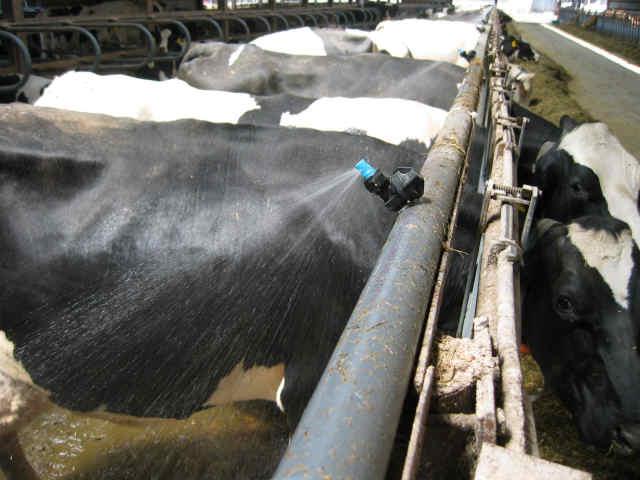
Dairies use intermittent sprinkler systems to cool cows in warm weather, but little experimental work has been done to determine how much water is needed to achieve beneficial effects. A group of dairy scientists conducted a study at the University of California, Davis, to examine the effects of using low-flow sprinkler systems that cut water use for this purpose by nearly 75%. Their research is published in the current issue (June 2016) of the Journal of Dairy Science.

“Dairies vary widely in the amount of water used to cool cows,” explained lead investigator Jennifer M. Chen, of the Department of Animal Science, University of California, Davis, but using more water results in diminishing returns and minimizing water use is a sustainability concern for U.S. dairy production.

Chen and colleagues compared the effects of high and low water use on cattle behavioral, physiological, and production responses, and evaluated heat abatement in relation to water use. The authors determined that the low-flow sprinkler systems were just as effective as the high-flow systems in mitigating the effects of heat in California’s hot, dry climate, despite using only about one-quarter as much water.

  • Cows had lower body temperatures when given access to sprinklers, but the low-flow and high-flow systems delivered similar benefits.
  • Cows exhibited similar behavior when given access to both types of sprinklers. They showed similar patterns in time spent near the sprinkler-cooled feeding area, near the uncooled water trough area, and lying down, and experienced similar changes in feed consumption with temperature.
  • Cows produced more milk when given access to sprinklers, but both types provided similar benefits.

“Future work should evaluate the degree of heat abatement that can be achieved with even less water. An alternative to reducing sprinkler flow rate may be to apply higher flow rates for a shorter duration,” added Chen. Reducing water usage by using higher flow rates for a shorter duration could also reduce spray drift, which reduces sprinkler cooling efficiency and is a concern at larger scales than the current study.

“Water use on dairies increases in the summer because cows drink more water and dairy farmers use water sprinklers to keep cows cool. This new research demonstrated that a “low-flow” sprinkler system that uses nearly 75% less water cooled cows just as well as a traditional high-volume system. Low-flow sprinklers conserve valuable natural resources without sacrificing cow comfort on-farm,” said Matt Lucy, PhD, editor-in-chief, Journal of Dairy Science, and professor of animal science, University of Missouri.

Source: American Dairy Science Association

Who Reaps the Benefits of “Bigger”?

In 2016 dairy operations everywhere are coming face to face with the pressure to “go big or go home.” Big business impacts all areas of our daily lives.

  • Entertainment is big business.
  • Politics is big business.
  • Computerization is the biggest business of all.

It isn’t surprising that the dairy industry is consistently implored to use big business principles when planning for the future.

Is “BIG” Synonymous with “BETTER”?

Big may not always be better, but good business sense is recognized as the foundation that any viable enterprise is built upon.  To support two or more family units or partnerships, the dairy must have cash flow, infrastructure, and good management.  Scrutinizing financial considerations and long-term viabilities is necessary before committing to growing bigger. These two areas are included in the following checklist of nine items to consider when deciding if expansion is right for your dairy operation.

  1. Are you READY for the RISKS?
    Managing risk and capitalizing on opportunities are two ways used by the most successful businesses to separate their operations from those that are fading fast. Sometimes weighing risk is instinctive and is done almost without conscious thought. But defining risk is crucial to seek out solutions and gain confidence in deciding whether to grow or to stay the same? People who are risk-averse may consider that avoiding change is the safest route.  But, as the dairy industry changes and grows, maintaining the status quo could well be the riskiest choice of all.
  2. Can you IDENTIFY the OPPORTUNITIES?
    Before taking even one step forward, it is well worth your while to take a quick look at where you’re standing right now! Ask yourself if there is something that you could be doing better? Even if getting bigger is the right choice, getting better before going bigger could smooth the way for expansion. For example, maximizing milk production per cow is the place to start. Do you know the industry averages for milk, fat, and protein yield? Where does your operation fall?  If you are below average, address that problem before considering expansion.
  3. Are we talking DAIRY LIFESTYLE or DAIRY LEGACY?
    Expansion is going to affect your loved ones. There is no way that a 24/7 dairy operation can be separated from the family side of the operation. Expansion decisions may give you more time with family if more staff can be added to complete the work.  Perhaps more family will be brought onto the team. Do you want more help?  More time with family?  More revenue?  The expansion decision is going to affect your loved ones: both the current generation and the next ones. Are you building a dynasty or planning for retirement?
  4. What’s HEALTH Got to Do with It?
    Expansion depends on the health, creativity and physical and mental stamina of its leader. Take time for yourself to guard against burnout. Stress and burnout lead to illness, relationship breakdowns and more. Stay healthy so that you can steer your ship through expansion to success. But don’t forget to give the same consideration to each team member. Staff –whether family or not – need to feel that all aspects of their contribution matter. They need to feel empowered and that they are contributors to the success of the dairy farm. They need to feel valued if they are to support and sustain the transition ups and downs which are a normal part of the expansion process.
  5. How Good Are Your Management Skills?
    Expansion is complicated. Realistically, you are looking at expansion not only of herd size and milk production goals but also changes in the day to day duties that make up your work day. Of course, hopefully, it includes expansion of your bottom line.  But, before that, it could all fall apart and cause panic and pandemonium, if you do not have the management skills to keep everything – cows, people and equipment and systems– running smoothly.  An expanded operation means dealing with more of everything — including problems.  Are you task-oriented?  Or people-oriented?  Are you solutions oriented?  Can you give up areas of responsibility to others? How prepared are you to deal with a bigger and much different job than you have been used to in the smaller operation?
  6. Is your Infrastructure Solid?
    Okay! You have done your homework. You have the people and the will and the plan to expand.  But do you have the land?

If you don’t have or can’t buy land, can you buy the forages you will need for an expanded herd? Realistically we should have started with land availability because it is the single most important element that will govern the success or failure of your expansion plan. This could be a deal breaker.  Not enough land or availability of feed.  No expansion.

Other factors of your infrastructure are the next challenge.  Do you have manure system? Is there enough feed storage?  What parlor capacity do you have for your expanded herd? Are you ready to handle the need for more or better equipment?  What maintenance plan is in place now and after the expansion.  Failure to carefully consider any of these can bring your forward-looking expansion plans to a screeching halt. If you’re breathing a sigh of relief, because you already have considered all of these, then you’re in great shape. However, before moving on decide how you will use the dollars saved by economies of skill to develop an even better infrastructure that includes employee training, education, and remuneration as well as investment in new technology. The bottom line is more productivity throughout the entire operation.

  1. Succession Planning is Essential
    At, its most basic, a succession plan is a documented road map for your dairy. When it’s in place, it provides a guide that partners, heirs, and successors can follow in the event of your death, disability or retirement. Are you mentoring the next generation? Does everyone know who will be responsible for the next stage in ongoing farm operations? Simply growing without planning for a smooth succession, means you are not taking advantage of the full potential of your dairy’s development.  Having a well-ordered succession plan in place means that history, education, and goals can be a part of the learning experience of the next leader on a daily basis. Many dairy operations experience their most significant challenges when it comes to a sudden situation where the hand-off of management comes as a shock or without understanding or preparation.
  2. Can you “SHOW ME THE MONEY!”?
    You may have clearly determined that expansion is the best way for your dairy to remain viable and sustainable but you are not fully prepared to achieve that goal until you prepare for the banker? Of course, it’s a tremendous advantage if your banker has the background to understand a dairy operation. In many cases, this doesn’t happen. Nevertheless, thorough preparation can make it possible to satisfy the bankers’ questions and at the same time provide a learning experience for this lender. Expansion may bring new timings of payables and receivables and create greater financial strain. You must have a strategy for controlling costs and keeping control of debt. Be ready to disclose fully all factors relating to your request for expansion. The list will include, but won’t be limited to, how much working capital is needed to long-term cash-flow assumptions, transition and construction-phase issues, contingencies and having a well-documented plan. The better you can quantify these areas, the more likely your expansion plans will be approvable and bankable.
  3. Technology Is VERY Important!
    limitations on the dairy that could limit expansion of your dairy. Operational technology can overcome challenges of available labor. Training your staff in new dairy technology is important to maximizing the potential of your operation, whether it involves 100 cows or 1,000 cows.
  4. It’s Up to You!
    Don’t wait until the decision to expand has either passed you by or is forced upon you by circumstances.  Planned expansion is the best way to ensure that your dairy is profitable.

The Bullvine Bottom Line

At the end of the day, there are only two choices: success or failure. It’s a lot of pressure but with foresight, preparation and the courage to follow your expansion dreams, you too could reap the benefits of bigger!  


Get original “Bullvine” content sent straight to your email inbox for free.


[related-posts-thumbnails]

Researchers help dairy farmers cool cows more efficiently, use less water

In California, every drop of water counts.

Recently, researchers with the University of California, Davis set out to figure out whether dairy farmers in their home state are wasting water trying to keep their cows cool.

Dairy cows with access to low-flow sprinklers produced nearly as much milk as those give access to high-flow sprinklers, while reducing water usage as much as 75 percent. Photo by WitthayaP/Shutterstock

Many dairy farmers use high-flow sprinkler systems to keep the cows cool and happy during periods of drought and high temperatures. The thinking goes: happier cows are more productive. For this reason, water usage on dairy farms rises dramatically in the summer months.

“Dairies vary widely in the amount of water used to cool cows,” lead researcher Jennifer M. Chen, an animal scientist at UC-Davis, explained in a news release.

To see if there is a better, more efficient way to keep cows cool, Chen and her colleagues measured the effects of different sprinkler systems — high-flow versus low-flow — on behavioral, physiological and production responses in cows.

Though cows given access to high-flow sprinklers had slightly lower body temperatures on average and produced a bit more milk, the differences were small. Behavior patterns were unaffected by sprinkler type, suggesting the cows were happy either way — undisturbed by the reduced flow.

The findings suggest low-flow sprinklers can offer similar benefits while cutting water use by nearly 75 percent.

“Future work should evaluate the degree of heat abatement that can be achieved with even less water,” Chen said. “An alternative to reducing sprinkler flow rate may be to apply higher flow rates for a shorter duration.”

The new research was published this week in the Journal of Dairy Science.

Source: UPI

Costs to Raise Replacement Heifers Calculator

Calf_heifer[1]The Costs to Raise Replacement Heifers spreadsheet, offered by Jud Heinrichs of Penn State University, provides a tool to determine the actual cost of raising replacement heifers on any dairy operation. It takes only about 30 minutes to complete if you have data available.

Even if you already participate in a benchmarking business analysis, it might be useful to punch your numbers into this spreadsheet to compare results. A study Heinrichs conducted on Pennsylvania dairies in 2011, with milk herds ranging from 38 cows to 1,708 cows, revealed a significant difference in efficiencies. Heinrichs says the total cost to raise a heifer from birth until freshening ranged from $1,100 to $2,500.

Disney film’s advice credited for award winning dairy farm

Susan O’Regan and John Hayward make a habit of looking beyond what they can see when it comes to ensuring their Te Awamutu dairy farm is economically and environmentally sustainable.

A Waikato dairying couple credit a Walt Disney movie for crystalising their approach to environmental and business farming, writes Gerald Piddock.

Look beyond what you can see.

The line from the classic children’s film The Lion King has played an important role in dairy farmers’ John Hayward and Susan O’Regan’s​ decision making when when it came to farming sustainably.

John Hayward and Susan O'Regan's dairy and drystock farm has 12 wetlands of various sizes, 5ha of manuka planted and ...

Gerald Piddock

John Hayward and Susan O’Regan’s dairy and drystock farm has 12 wetlands of various sizes, 5ha of manuka planted and another 8ha planned.

The Waikato Farm Environment Awards supreme winners make a habit of trying to predict what is going to happen in the industry from an environmental and economic perspective.

“To date we have got it pretty well right,” Hayward told close to 200 people at a field day held on their Te Awamutu farm.

Hayward was watching The Lion King  at home with his children one day when he first heard the film line.

It fitted in nicely with what he and his wife were trying to achieve on their farm, he says.

“I watched this and got up and stood outside and thought, that’s quite good advice.”

They had asked each other what sustainability looked like when they bought their first 99 hectare property as equity partners in 2008, which was to become their farming business Judge Valley Dairies.

“We asked ourselves, can we be doing what we do today in 100 years.”

They looked at the environmental impact their farm was having while at the same time maintaining profitability because he saw little point in being environmentally sustainable if the farm was not profitable.

The dairy industry was changing and the couple knew it was just a matter of time before tighter regulations from the Waikato Regional Council were introduced.

In their first year, they milked 250 spring calving cows and produced 83,000 kilograms of milksolids. At that stage, they also had two lease farms which they used as grazing blocks, allowing them to sell jersey bull calves for extra income.

They also undertook a major infrastructure change, including the building of a staff house, race, water and effluent systems and a 30-aside herringbone cowshed.

They viewed effluent as a positive input, and used it to fertilise 90ha of the dairy platform including their 33ha maize crop. They also had to preserve and protect the property’s natural resources.

“It allows us to use our effluent and turn it into something that we can produce milk from. We aim to harvest 30 tonnes of feed off those paddocks and every year we continue to use those paddocks. We don’t chop and change.”

In 2013, they added a 350-cow feedpad and feed bunkers with 500 tonne capacity after realising between a quarter and a third of their feed was being lost through wastage.

The feedpad has allowed a greater efficiency of conversion of supplementary feed into milk production and an improvement in cow health and condition.

Hayward says their farm needs healthy cows that reached their potential and they also have to grow as much feed as possible while creating a minimal environmental footprint.

“We have a lot of amazing cows out there but the way I look at it, we have a lot of Ferraris that are being fed like Minis. Cows are missing out on their potential and people are missing out on an opportunity that’s right in front of them.”

They want their cows to produce 500kg of milksolids and the feedpad is helping them shift towards that goal and although it increased demand on labour, the benefits are phenomenal, he says.

They have also embraced technology, using a Halo system for electronically monitoring and recording their water system operation and milk temperature status.

In addition, a flood wash system using green water recycled through the effluent pond and a weeping wall at the feedpad “gives us the chance to capture solids and use them strategically in places like our maize paddocks”.

They undertook a land use capability assessment in 2014 which  made them realise the parts of the farm which were unsuitable for livestock and areas that should be retired.

Erosion and sediment falling into water were big issues in their district  so they chose to retire these parts of the farm into either wetlands, bush or manuka plantations. They have 12 wetlands on the farm to date.

Hayward and O’Regan have 5ha of manuka plantations for high-potency honey production established and another 8ha underway which is part of an expanding joint venture with Comvita.

The manuka establishment will mitigate erosion and reduce the overall nitrogen leaching factor on the property, O’Regan says.

“It’s a win-win situation on land that was marginal in any event. The manuka deal turns it into land that is productive on three fronts and this use sits very comfortably with our views environmentally.”

In 2012, they bought the neighbouring drystock farm and integrated it into the first property and last year the couple bought the farm outright.

Today, 140ha of the 245ha farm operates as a dairy platform, there is an 80ha self-contained drystock farm and 25ha in pine, wetlands and manuka. Another 8ha will be further retired this year into manuka plantations.

They milk 480 cows, aiming for 235,000kg milksolids, operating a split calving system, milking both friesian and jerseys cows. The jerseys herd calves in the spring and the friesians in the autumn.

They work closely with their accountant and banker as well as the regional council and employ two full-time staff, married couple Amardeep Singh and Mandeep Kaur, and one permanent casual, Jeremy Reader, on the farm.

“We wouldn’t be where we are today without our staff. They are a key part to our business,” Hayward says.

Despite their success to date, the farm is still a work in progress, he says.

More manuka plantations are planned and another wetland is being constructed this year. They also recently upgraded their Halo system to include soil temperatures rain, and tank monitoring.

They are also into the final round of the Waikato Dairy Business of the Year Awards which will give them good feedback on their economic resilience in a low payout year, Hayward says.

“This year has been been a good one for us…It’s hard for all of out there now but we haven’t had to shift too much and we have managed to keep our costs at a minimal all the way through.

“We think we have got that part right and we are not going to change too much going forward.”

Source: Stuff

Could Cattle Be Fed on Waste Paper?

A new project at the University of Colombia is looking at feeding waste paper to ruminants, as part of an effort to ensure availability of animal feed in times of poor weather.

100 tons of waste paper a day leaves a company, which the project team said could provide an alternative feed source for cows in Ubaté region.

The project will start by testing the use of waste paper on sheep in the region, using a mixture of 15 per cent waste paper and 85 per cent conventional feed.

George Jaime Tenjo from the university is aiming to tackle two problems in the region through the new project. The first is to prevent the paper going to waste. Secondly, Mr Tenjo hopes that paper added to cattle rations will be ideal in times when feed for livestock is scarce for small and medium producers.

Lack of rain in certain seasons affects the availability of forage or grass to feed livestock. Since the waste paper contains cellulose, which is also present in pasture plants, the idea is that the paper can replace some grazing in the animal’s diet.

The project, with investment is approaching 64 million, is expected to provide about 300 producers in the Ubaté region with inputs to counter lack of feed when the weather is poor.

Historically, work on cellulosic waste such as paper has focused on the production of biofuels. However, the intestinal microflora of sheep and cattle rumens have the ability to degrade the cellulose component present in both the pasture and on paper.

“A number of bacteria act on the substrate, in this case cellulose, to carry out fermentation and provide energy to the animal,” he explained.

According to George Jaime Tenjo, small producers of this renowned dairy region are not prepared for possible precipitation deficits, which would produce a shortage of forage or grass.

And while the use of silage or planting materials that protect against drought are alternatives, these may be insufficient in case of lack of feed for livestock.

Overall, Ubaté does not have a great availability of water throughout the year. With the El Niño phenomenon, which occurs every three to seven years, this problem can be accentuated.

If small and medium producers are not ready for a new phenomenon, “they may face serious problems: death of animals, having to sell because they have nothing to feed them, and even those with some feed probably will not reach production levels they would normally have,” said the expert

Source: The Dairy Site

New Research: Time to Switch Antibiotic Resistance Focus from Use to Environment

Scientists have discovered a “startling” lack of resistance genes in meat, and their new research suggests the need to switch focus from reducing antibiotic use to traffic from humans to animals, and back to humans via the environment.

Meanwhile, in soil and faeces samples from cattle pens they found genes resistant to a powerful “last resort” class of antibiotics called carpabemens that aren’t used in the livestock industry. These genes may have jumped from humans or companion animals to livestock, or could even be present at low levels in the wider environment.

BeefTogether, the results, which were the first study to use new methods to track antibiotic resistance, published in eLife suggest researchers and policy-makers need to switch focus to combat the growing problem of drug-resistant bugs.

A current focus for policy-makers is to reduce antibiotic use in livestock to curb the spread of drug-resistant bugs. The team urges that traffic from humans to animals, and back to humans via the environment, should be a new focus for research.

“Our findings clearly show that the spread of resistance is not a one-way street from animals to humans and that, as new evidence emerges, we need to shift focus,” says lead author Noelle Noyes from the Microbial Ecology Group at Colorado State University.

The lack of resistance genes in post-slaughter meat samples was a big surprise for the scientists, forcing them to rethink the view that it is only antibiotic use that increases resistance.

“While we expected to find fewer bacteria and thus resistance genes, the absence of resistance genes in these samples was still a bit startling,” says co-principal investigator Paul Morley from Colorado State University.

Strict, technology-driven food safety measures prevent pathogenic bacteria like Salmonella and E. coli O157:H7 from entering the food supply chain. They include high heat, steam, organic acids and cutting off parts of the carcass at risk of harbouring pathogens.

“Our findings suggest the gauntlet of measures to kill pathogens also protects the consumer from antimicrobial resistance genes because they too are unable to survive,” says co principal investigator Keith Belk.

“We need to expand our thinking in this area, and develop new and improved methods to better understand how antibiotic use drives a complex network of genetic modifications within entire microbial communities,” he says.

Environmental routes of exposure are much harder to trace and have been largely overlooked by researchers and policy-makers. While many of us never step foot on working farms, we are physically connected to agriculture via wastewater run-off and windborne particulates. The scientists suggest investigating wind patterns and water flow to see if, and how, resistant bacteria may be disseminated, and how far.

“We may find that such dissemination is very limited geographically, or we may find that resistant bacteria can travel long distances if they find the right currents or the right waterways. In either case, this would be very important information from a public health perspective,” says Noyes.

Canadian cattle at feed bunkThe researchers collected samples from 1,741 commercial cattle. The study started in feedlots, where intensively farmed cattle are moved after grazing.

A feedlot consists of outdoor pens where cattle are fattened during their final months of life. Samples were also taken during slaughter and from market-ready products.

No previous studies have tracked antimicrobial use and resistance right through the beef production process. The team found no resistance genes to any bacteria in market-ready beef products.

They did discover changes to antibiotic resistance genes in the guts of cattle during their time in the feedlot. The changes could be due to the use of antibiotics in feedlots but could also result from adjusting to a high-energy diet or from the cattle’s maturation from adolescent to adult.

The diversity of genes in their ‘resistome’ decreased. A resistome is the collection of antibiotic resistance genes in a given environment, be it the gut of a cow or a sample of soil or water. The decrease could present an opportunity to suppress it further during the feeding period and move towards the lowest risk possible.

“The next challenge is to identify what is really driving the change we saw and to determine whether these drivers need to be modified and, if so, how,” says Noyes.

“Any changes need to be balanced with the ability of agriculture to produce enough safe, affordable food for a rapidly changing population. What concerns us most is ensuring that rational, science-driven discussion drives progress,” she says.

Further Reading

You can view the open report titled Resistome diversity in cattle and the environment decreases during beef production published in eLife by clicking here.

Source: The Dairy Site

Fort McMurray Wildfires: Why You Need An Emergency Dairy Disaster Plan

The majority of us have never experienced anything even remotely similar to the devastating wildfires that have affected the Fort McMurray, Alberta region. It is mind boggling to consider what the evacuees are going through.

As of May 5, the Alberta government reported that the fire covered an area of approximately 85,000 hectares. This is significant; the consumed area is now half as many hectares as were destroyed in the entirety of both 2008 and 2013.

If your dairy farm was to be put under a mandatory people evacuation order, would you have any idea what needs to happen?

fire31-e1461020282984

BE READY

Of course, emergencies and disasters by their very nature can occur at any time and without warning. You might think that there is absolutely nothing you can do …. but that would be incorrect.  The more you are prepared for potential disaster, the better you will be able to act, minimizing panic and confusion when an emergency occurs.

THINK BEYOND PEOPLE ONLY ON LIVESTOCK FARMS

Relatively speaking farms have more to lose than other companies when a disaster – natural or otherwise — strikes because of the combination of an imminent threat to animals as well as people.

PRIORITIES IN EMERGENCIES

It could be that you have plans in place for evacuating workers from all structures on your dairy farm.  But are those plans and the materials needed up-to-date?

It is good planning to have all building exits clearly marked.  DC emergency lighting marking exits is a good idea.

The first step is to call 911.  However, in disasters the size of Fort McMurray, the emergency lines may be down or overloaded.  In any case, make sure that the address of your dairy location is clearly marked at the entrances and that all staff knows the address.  It seems simple, but it is one of those things that can be difficult or impossible to remember under stress.

barnfire

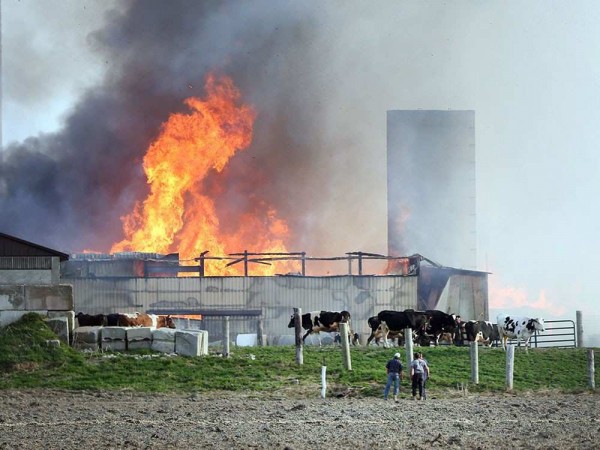
In the case of a barn fire or dairy property-specific event, the first priority is to ensure that no person is harmed. Evacuation of people who could be injured and care for those injured have the highest priority.  Always take actions to prevent the involvement of additional people in the event. This means isolating all affected areas from inadvertent involvement by keeping the curious away.

During an emergency, evacuation routes from barns, buildings, and sites must stay clear.

EMERGENCY DAIRY DISASTER PLANNING

Any contingency planning must consider the potential for injuries to people.  First aid staff and evacuation teams, rescue equipment and vehicles should be part of any emergency dairy evacuation plan.

Before you go any further, ask yourself these five basic questions:

  1. How well is your dairy prepared right now, if disaster should strike?
  2. What procedures do you already have in place for an emergency situation?
  3. What potential emergency situations could occur?
  4. If necessary, how will staff return to the disaster zone, if it’s allowed, to attend to animals?
  5. Who is the leader in times of disaster including when the owner or manager is absent?

ANIMAL EVACUATION DURING A DISASTER

  1. Put a plan in place for quickly evacuating occupants and animals. It is preferable to prepare to move at least 72 hours ahead of landfall (in the event of hurricanes). Procrastination could be especially problematic. Once the emergency hits, roads may become restricted or even impassable.
  2. Have enough transportation available and plan for where the animals will be taken.
  3. Be sure to have access to portable loading ramps to load, or unload animals.
  4. If your Plan A destination also requires evacuation, it is a good idea to have a Plan B already in place.
  5. Of course, during this time period, additional biosecurity measures will need to be in place.
  6. During the disaster event, animals will continue to require feed and water both during transportation and at the destination they are to be taken to.
  7. It is unfortunate but quite likely that the measures taken will have to remain in place for an extended period of time. Does your plan allow for long-term housing?
  8. If safe, accessible, locations are a problem, it is a good idea to establish an emergency plan with locations such as fairgrounds, racetracks or exhibition centers.
  9. Accommodation will need to include milking equipment for lactating cows.
  10. Milk will need to be stored separately from the cows of other herds. Milk “pickup” companies should be notified where to pick up the milk.

ANIMAL HEALTH DURING A DISASTER

  1. Ensure that there will be enough feed supplements and sufficient medication supplies available at the destination.
  2. Minimize the contact among animals from different premises.
  3. Verify the health and vaccination status of animals which must be co-mingled.
  4. Handle mortalities in a manner which will minimize the possible spread of contagious disease.
  5. Monitor the health and well-being of the animals on at least a daily basis, whether sheltered in place or evacuated.
  6. Seek appropriate veterinary medical advice and services where there is suspicion of an animal disease problem.
  7. Whether you evacuate or shelter in place, make sure you have adequate and safe ways to separate and group animals appropriately.
  8. Have specific actions in place to be carried out by assigned people. Assign responsibility for checking all areas to ensure that o person or animal is overlooked.
  9. Specific actions should include people to close doors, shut off power or fuel sources or to shut down computers and equipment.
  10. Be particularly aware of the possibility of contaminants or toxins getting into the feed or the animals.

THE LOGISTICS of ANIMAL EVACUATION

  1. How do animals get out of their containment areas?
  2. What needs to happen for the animals to be physically evacuated?
  3. Once removed from the structure or area under threat, where will the animals be moved to?
  4. Do you have a plan in place (with neighbors or friends?) if the animals require off-property housing and transportation?
  5. Do you have accurate records of current inventory of animals? Where is it kept and is it easily accessible?
  6. What needs will your dairy animals have once they have been evacuated?
  7. How will you address the ongoing needs of your animals throughout the duration of the evacuation order or disaster recovery time period?
  8. Information is key during an emergency. Current status and ongoing updates must be communicated keeping everyone informed regarding evacuation routes, road conditions, materials and equipment, the location of resources and other elements.
  9. Decision-makers need access to maps, phone directories and other information regarding supplies and resources.
  10. Emergency plans need to identify what supplies and equipment will be necessary when an emergency occurs.
  11. As much as possible run simulation drills with staff

THE BULLVINE BOTTOM LINE:

By developing a dairy disaster plan, you are in a much better position to respond, recover and restore your dairy operation if disaster strikes. Educate all dairy staff about the types of emergencies that may occur. Train them in the proper course of action for emergency situations and, as much as possible, run simulation drills with staff. Make sure they understand the components of your evacuation plan and who will be in charge during an emergency. Being ready for a disaster takes planning and practice. Be prepared.


Get original “Bullvine” content sent straight to your email inbox for free.


[related-posts-thumbnails]

How Are US Dairy Operations Impacting Water Quality?

The tremendous increase in productivity and efficiency in the US dairy industry has also come with an array of negative environmental impacts that are a major challenge from a sustainability perspective, reports Sarah Mikesell, live from the Large Dairy Herd Management Conference held in Oak Brook, Illinois, US.

While the productivity progress is important and needed, the industry also needs to work to minimise the negative effects including the impacts on water quality.

Manure is a rich source of nutrients including both nitrogen and phosphorus. Despite the inherent value in fertiliser, spatial intensification of livestock production in recent decades has created problems as the amount of manure produced in a region overwhelms the assimilative capacity of cropland.

Nutrient concentration

“There’s been a tremendous increase in efficiency and productivity in the dairy industry and animal agriculture in general because of increased specialisation, which essentially means that we’re bringing feed nutrients in from the phosphate mines in South Florida and the Corn Belt and Wheat Belt,” said Katharine Knowlton, professor in the Department of Dairy Science at Virginia Tech.

“With our current manure treatment technologies, turning around and sending those manure nutrients back where they originally came from is not economically feasible, so over time those nutrients tend to accumulate and concentrate in areas of intensive animal agriculture.”

That creates areas like the eastern shore of Maryland and the Shenandoah Valley in Virginia where animal agriculture is the source of more than 50 per cent of the either nitrogen or phosphorus loading to the surface water in that region, she said.

Phosphorus tends to be a bigger problem than nitrogen. Nitrogen and phosphorus are already in imbalance in manure relative to crop needs, so when we apply the nitrogen that the crop needs we are over applying phosphorus, and that phosphorus can ultimately run off.

Regulatory approaches

There are two different regulatory approaches to nutrient management. One is process based, meaning if we do the right things, we will have the right result.

“Our permit base programme in the US is what I will call process-based. It’s built around a nutrient management plan, and it’s built around best practices, regular analysis of manure and soil and, in some places, ground water, site-specific crop production and manure application. It’s front end,” she said. “The assumption is if we do the right thing, we will have the right result. It’s process-oriented regulations, but it doesn’t always work.”

The second approach is more goal or target oriented. In the US, this means that the total maximum daily load is the water quality program where we let the water tell us if it’s working.

“We sample the water and if the water exceeds the state standards then by definition we haven’t done enough and we have to go back and ratchet up our process base,” she said.

This approach can be frustrating to producers who believe they are following the rules according to their permit, and are then asked to do more because the water is not clean enough.

“In the US, what we’re increasingly seeing is a bit of a hybrid of the two. EPA is telling the state, ‘Your water is not clean enough. We’ve concluded that your permit program isn’t strict enough, so do something about it,’” Dr Knowlton said.

Challenges

These approaches create a lot of obvious challenges.

Producers don’t like it when their management practices don’t immediately result in reportable, documentable, nutrient facts and water quality improvement.

Their concern is why bother to do all the work with no results. Regulators don’t like it when practices don’t translate immediately into water quality benefits because they tend to think enough is not being done.

“There are a lot of reasons why the water quality doesn’t immediately reflect the management practices. This is just our best reality and sometimes the regulators have to take a little bit of a pause and wait for the science to catch up,” she said.

The biggest challenge with nutrients and water quality is there can be a decades long lag between changes in management practices that result in changes in surface water quality and ground water quality.

This delay happens for a number of reasons. Nutrient losses are intermittent; they are diffused; they are difficult and expensive to monitor. There is a time lag especially with nitrogen storage in the soils and in aquifers.

A real timeline exists between changes in what we’re putting in the soil and what we’re seeing running off, and measurements over time are confounded, she noted.

“European research has quantified this decades long lag time, but also demonstrates the problem of confounding,” she said. “In the EU, for instance, increased water quality regulations occurred at the same time as other policy changes like the implementation of the milk quota system in the mid 80s, and cuts in pork and poultry quotas in the 90s.”

Nutrient management can be challenging because it’s rare to see those immediate connections. But Dr Knowlton recommends the industry continue to do the things they know they have to do.

“There are a lot of technologies evolving. We do need continued research in this area, and we have made real improvements. It isn’t going to yield immediate water quality improvements, yet over time it generally does improve water quality,” she said.

Source: The Dairy Site

Safety when working with bales

Bales are commonly made from hay, straw or silage and pose a risk while being made or handled on the farm. According to Teagasc, baled silage is now made on over two thirds of all farms in Ireland and accounts for one third of all silage made in the country. It is particularly prevalent as the primary silage-making system on both beef farms and smaller-sized farms. However, it is also widespread as a second silage-making system when harvesting second-cut grass when the silage pits are full from the first cut. It also acts as a simple means of storage for extra fodder on many other farms, which is getting more popular as more and more farmers now operate their own baler.

Storage

Where space permits, best practice is to store all round bales high on their flat ends, but this may not be practical in most cases. When round bales must be stacked, the safest method is to stack them on their curved sides in a pyramid shape. The bales on the outside of the bottom row should be supported by chocks or other supports in order to stop them from moving.

The maximum height of the stack should be no more than three bales high. Where the bales are not very dense and soft, the maximum height of two bales is advised. Stacking of round bales on their ends is not recommended as bales can have a tendency to shift due to the variable density of the material in the bale. Storage of round bales on their ends or sides in a single layer on the ground can be permitted provided that the ground is level.

When deciding on a location to stack the bales, it is important to select an uncluttered storage site from which the bales can be conveniently and safely removed at feeding time. You should also choose a level, smooth and, where possible, hard surface and well-drained area on which to store the bales. Soft or uneven ground can increase the risk of machinery accidents when stacking or removing the bales during the winter feeding period.

All bale stacks should be positioned well away from overhead power lines as bales can act as a play platform for children who may climb on to them and become dangerously close to live power cable lines. Children should not be allowed to play with or on top of bales. All ladders or other means to enable access to the bales should be removed. Children should not be allowed in the farmyard or fields where bales are being moved, handled or transported.

When working with bales, a tractor or other machinery used to lift the bales can easily come into contact with overhead wires. In the event of a tractor coming in contact with the overhead wires, the metal parts of the tractor become live and can cause serious injury or even a fatality.

If your tractor contacts the overhead electricity wires, reverse the tractor out of contact with the wires, if possible. If not, stay in the cab and phone ESB Networks; emergency number on 1850 372 999.

If you must leave the cab, for example if the tyres go on fire, jump clear of the tractor and do not hold on to metal parts while stepping down because this provides a path for the electricity to flow through you into the ground.

Transportation

The removal of round bales from fields and their subsequent transportation must be planned, ensuring a safe system of work is used that considers risks arising from the machinery to be used, the competence of machinery operators, the ground conditions including slopes, the presence of overhead lines, securing the load and the safety of the route to storage.

Use bale-handling equipment, tractors, telehandlers and trailers that are well-designed, safe and well-maintained in order to complete the work safely. Drivers must ensure that their view is not obscured if using bale spikes. Two or more spikes are recommended to prevent rotation or loosening of the bale during transport. When travelling on the public road, bales spikes should be removed, covered or folded back when travelling empty so as not to pose a risk to other road users. If you need to dismount from the tractor or loader which is transporting bales in order to carry out another task, ensure that the handbrake is securely applied, switch off the engine and remove the key.

When moving bales, keep the bale as low as possible, avoid sudden movements and travel slowly to suit the terrain. Front or rear weights may be needed to counterbalance the load and give good control of the steering of the machine. It is essential that all tractors and front end loaders used to move bales are fitted with approved cabs to provide falling objects protection (FOPS) and rollover protection (ROPS).

Trailers and trucks used to transport bales must not be overloaded. Bales should be securely loaded and not overhang the edges of the trailer.

When finished, the load must be secured in place with suitable straps, including double straps at the rear of the load. On the road, avoid high speeds and take account of the effects that the weight of the load has on the effectiveness of the braking and steering and drive accordingly.

Source: Farmers Journal

Prepping calves for successful group feeding – Robotics conference

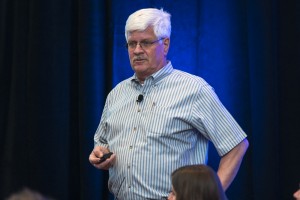
Join Dr. Bob James from Virginia Tech as he discusses how to successfully preparing and raise heifers in group housing environments. Dr James covers everything from the very start with dry cow nutrition for optimal body condition and health, through coordination of facilities and people, colostrum management, and much more. You won’t want to miss this insightful presentation by Dr James.

About The Presenter

DELAVAL - VMS2016-01-34Dr. Bob James is the dairy extension project leader in the Dept. of Dairy Science with additional responsibilities in teaching and research. He received the University Academy of Teaching Excellence Award in 2010. Bob’s research has focused on management of growing calves and heifers, and a Jersey milk replacer was developed based upon Virginia Tech studies in which he participated. Most recently, his research has focused on sanitation and management of automated calf feeding systems. He is a founding member of the Dairy Calf and Heifer Association and served as the conference chairperson several times. Bob received his B. S. degree from the University of Delaware and M.S. and Ph.D. from Virginia Tech. After two years on the faculty at West Virginia University, he returned to Virginia Tech. Bob has made presentations and consulted with calf ranches, dairies and feed companies in more than 20 U.S. states, Canada, South America , Asia and Europe.

Considerations when Planning Dairy Calf and Heifer Facilities

For quite a few years now, Dan McFarland, an Ag Engineer with Penn State Extension, has conducted a monthly webinar series, known as the “Technology Tuesday Webinars”, on various facility-based topics. In September 2015, Dan and two other speakers presented a webinar entitled “Planning Dairy Calf and Heifer Facilities”. His discussion centered on the key factors to consider when designing facilities to manage and handle dairy heifers. Summarized in this article are some of the key points made during this webinar and a companion webinar he conducted in January 2013 on youngstock housing. (Both webinars are available on the Penn State Dairy website.)

  1. Two main goals when designing and implementing a dairy heifer housing system are to (1) provide a healthy, comfortable environment for heifers year round and (2) maintain a comfortable environment for the caregivers.
  2. Heifers should be grouped by size or weight. Weaned heifers should be housed separately and in small groups. Groups of heifers after weaning should be within 200 pounds of each other. Thus, heifers should be housed in at least 7 to 8 groups which includes baby calves and weaned heifers in separate groups. Baby calves and recently weaned heifers should be housed separately from older heifers because these groups have different ventilation needs within the housing. Proper ventilation throughout the year is needed to control moisture, gases, and pollutants through proper air exchange and distribution for all age groups. When designing facilities for baby calves and weaned heifers, ventilation is important to provide for drier bedding and floor surfaces but they also need a draft-free environment.
  3. When sizing facilities, considerations include:
    • calving interval
    • calving uniformity
    • age at first calving
    • calf and heifer mortality
    • whether sexed semen is used

    For calves, ideally extra pens or hutches are needed to leave pens idle for 1 to 2 weeks between groups to help decrease pathogen loads and disease incidence.Thus, 15 to 25% more hutches or pens are needed for calves when a uniform number of calves are born throughout the year, and 30 to 50% more if calving is concentrated during certain times throughout the year.

  4. The Penn State website contains over 70 different plans for calf and heifer housing which farmers can use when designing their own facilities.
  5. Pens within a building need to be sized for the oldest or heaviest heifer expected to be housed in the group, essentially sized to reflect the body weight of heifers leaving this pen or group. When using a bedded pack or sloped non-bedded housing, pens for older heifers should be larger or should house fewer heifers than pens for younger groups. For example, Holstein heifers weighing between 300 and 500 pounds need a minimum of 40 sq. ft/animal excluding the scrape alley and feeding area. Generally, an additional 10 square feet per animal is needed for each 200 pound increase in body weight. Heifers under 8 months of age should have access to feed 24 hours daily. Even after 8 months of age, feedbunk space is critical and all heifers should be able to eat at one time, especially when given grain or when limit-fed forages.
  6. Waterers should not be located within the feedbunk or bedded area. They should be placed on the edge of the scraped/feeding area and not in the bedded resting area. Access should be restricted to the area that can be scraped. This keeps the bedded area drier and does not restrict water access.
  7. Weaned heifers represent one of the most critical stages in heifer development.
    • They should be housed in groups of no more than 8 heifers within 1 month of age.
    • Headlocks should not be used for this group, but slant-bar, stationary feeding partitions can be used. Heifers at this age are reluctant to use self-locking headlocks because of the noise and movement caused by the moving headlock bar.
    • Recently weaned heifers should be provided 18 inches of feeding space per animal. The top of the bottom rail used to attach the slant-bar partitions should be no more than 14 inches above the heifer’s standing surface so heifers can easily reach their feed. The feeding surface should be smooth and protected from the weather.
    • Weaned heifers should be well bedded in the winter and kept on dry bedding. Sloped, non-bedded pens should not be used for heifers until they are over 6 months of age.

Source: Extension

Targeting Dairy Feeding Programs for Less Feed Waste or Shrink

Feed costs represent 40 to 60% of the total cost of producing milk on dairy farms in the US.  Prices paid for purchased commodities or forages greatly impact feed cost and farm profitability.  Dairy farmers have little control over these prices, especially when purchased on the immediate market.  Current prices for commodities reflect changes in supply and demand due to US and global weather patterns, international purchases, and usage of commodities by ethanol production, all of which are outside a farmer’s control.  However, efficient usage of these commodities and forages on-farm and minimizing feed wastage or shrink are under a farmer’s control and greatly impact a farm’s profitability.  In this two-part series, we will examine areas within a feeding program where farmers can reduce feed shrink and better utilize money spent for feed ingredients.  The first article of the series will specifically examine:

  • Monitoring and Evaluating Commodity Usage on Farm
  • Communicating with Your Nutritionist  and Employees
  • Developing a Feed Usage Plan
  • Properly Using TMR Mixers

Many of these areas and concepts regarding feeding and feed management for the dairy herd may seem simple, but in my experience, they are often the practices that separate profitable dairy herds from the less profitable ones.

Monitor and Evaluate Commodity Usage on Farm

Minimizing feed waste or shrink is one aspect of a feeding program which must be managed since it impacts feed usage and costs as well as overall profitability of a dairy operation.  In order to manage the amount of feed used on farm, actual usage and disappearance needs to be measured.  The amount of each commodity needs to be weighed at either delivery or harvest and at feed out.  The difference between these amounts reflects the shrink or amount of feed lost due to:

  • Wind and rain,
  • Birds or rodents,
  • Spilt feed while loading,
  • Feed tracked on tractor tires,
  • Errors with TMR scales,
  • Feeding errors, and
  • Mismanaged practices during storage of silages (see article #2 of this series).

Today, the routine use of scales for delivery trucks and feed tracking software, for example Feed Watch™ or TMR Tracker™, make these calculations routine and easier for managers to detect problems or opportunities.Once detecting that losses are greater than established benchmarks or have increased over time, feeding practices can be evaluated and then modified to decrease feed shrink.

Generally, dry commodities stored in bins have less storage losses (usually less than 4%) compared to those stored in open-face, 3-sided commodity sheds (5 to 15% depending on commodity). Certain commodities, like whole fuzzy cottonseed, will not flow through feed bins and thus, must be stored in a commodity shed.Weather, i.e. wind, can increase feed shrink not only at delivery and storage, but as importantly when commodities are loaded into the TMR mixer.These wind-related losses can occur when commodities are stored in open-sided commodity sheds as well as feed bins and liquid delivery systems.Properly constructed windbreaks can help minimize losses.For example, “L” shaped commodity sheds which are positioned perpendicular to the prevailing winds can help reduce feed shrink.Totally enclosed commodity sheds or an enclosed area when adding commodities stored in a bin or liquid delivery system to the TMR mixer can reduce feed shrink related to weather and may be cost effective when considering reductions in feed shrink.

Storage losses with wet commodities, such as wet brewers or distillers grains, are higher (generally 20 to 25%) than when stored as a dry ingredient and, as such, these higher losses must be considered when calculating the economics of using these feeds.Fermented forages properly stored in bags, uprights, bunkers, or trenches generally have storage losses of 5 to 10%.Improperly stored forages, especially those stored in bunkers and trenches, can have storage losses from 10 to 15% or higher.Alfalfa hay stored inside generally average 3 to 5% feed shrink as a result of storage losses.

Communicate With Your Nutritionist and Employees

Dairy feeding programs that wisely use feed, labor, and economic resources start and end with good communication between dairy managers, nutritional consultants, and feeding employees.  Dairy managers should work closely with their nutritionist and other consultants to develop and modify the feeding and overall management program throughout the feeding season. All parties need to constantly work on developing an ongoing relationship that results in a true dialog. Improvements in your bottom line can occur through discussions related to different ways to group, feed, and/or manage your herd. These discussions also can help when contracting for commodities, both related to tonnage needed and alternative commodities which can save feed dollars or improve milk production.  Sometimes, producers incorrectly believe that they do not need to oversee and/or understand general feeding and nutritional concepts. Understanding these concepts is critical for this dialog and to understand when and how to make minor adjustments or temporary changes before they become disasters.

Besides maintaining good communication between the owner/manager and consultants, communication to and from the personnel actually feeding the cows and heifers is critical.  Oftentimes, the person feeding the cows can provide invaluable insight as to why things are not working as expected or suggest improved ways to feed, reduce feed shrink, and manage the feeding program.  On-going training, not just new employee training, should be provided.  Feeders need to understand the why’s and why not’s of feeding procedures, along with how to perform their job responsibilities.  This education helps explain why certain steps are critical, why ingredients need to be added in certain order and amounts, and practices that should be avoided.

Develop Feed Usage Plan

After forages are harvested for a given crop year, a plan for using these forages should be developed and modified as needed throughout the year.  This allows one to efficiently use available labor, feed, facilities, and economic resources.  By taking preliminary forage samples and developing preliminary diets for a herd, forages can be allocated to various groups of dairy cows or heifers based on their nutritional needs.  Additional forages, if needed, can be purchased or plans made as to what and how much is needed.  Also, commodity needs can be assessed as to the amount needed, and commodities can be purchased or booked at the appropriate time to minimize feed costs and economic risk.

When developing this feed usage plan, labor resources and facilities need to be considered.  All of us understand that the more uniform in production, stage of lactation (i.e. fresh cows, late lactation cows with body condition score ≥ 3.0), and number of lactations a group of cows are, the closer we can match their nutritional needs.  These rations would ideally result in a higher income over feed cost versus those from a group of cows whose performance is less homogenous.  Economic models developed by Dr. Victor Cabrera at the University of Wisconsin (2016 Tri-State Dairy Nutrition Conference) indicate at least 2 nutritional groups of lactating cows plus a fresh cow group may result in higher total income over feed cost.  This model used data from 5 herds with 331 to 1460 total dairy cows and compared the income over feed costs associated with 1, 2 or 3 nutritional groups after they were 21 days in milk.  The largest gain in income over feed cost was seen when the number of nutritional groups of cows was increased from 1 to 2 ($39 increase/cow/year difference between 1 and 2 nutritional groups). When the number of nutritional groups was increased from 2 to 3, only a $7 increase/cow/year was estimated based on scenario assumptions.  Feed costs and milk prices also greatly impacted economic returns associated with the numbers of nutritional groups of cows.  When deciding the number of nutritional groups, total impact on income, not just income over feed cost should be considered.  Thus, herd size and feeding labor, equipment, and facilities needs to be considered.

Use TMR Mixers Properly

Depending on the size of the dairy herd and economics, one or multiple total mixed rations (TMR) can be mixed and fed to the lactating herd.  The definition of a TMR is a mixture of all the forages (dry hay and silages), concentrates, and mineral, vitamin, and additive premixes blended together and offered to a group of cows as one feed mixture.   Proper preparation of a TMR reduces sorting by dairy cows and improves the consistency of nutrients provided to the rumen microbes, assuming cows consume somewhat uniform sized meals throughout the day.

Components to review include, but not limited to:

  • TMR mix time after the last ingredient is added should be 3 to 5 minutes for vertical and horizontal reel-auger mixers with tractors or trucks at nearly full power (1700 to 2000 rpm engine speed).  Under mixing results in an inconsistent mix delivered to the feedbunk.  Oftentimes, corn silage is the last ingredient loaded and with inadequate mix time, only corn silage is unloaded last from the mixer.  Over mixing can result in decreased particle size for long-stem forages and results in cows with ruminal acidosis and resulting in sub-optimum feed intakes and milk production.  To check if mix time is adequate, 10 samples from equally spaced locations along the length of the feedbunk should be collected and processed through a Penn State Particle Separate box.  Samples from the middle and bottom screens of a 3-screen system should have an average coefficient of variation (CV) of 2% or less (Oelberg and Stone, 2014.  Vet Clin Food Animal, page 721).
  • Do not overfill mixers since this will result in spilt feed, increased feed shrink, and incomplete mixing of the ration for a group of cows.  For vertical mixers, feed should not be more than 2 feet (60 cm) above the augers (Oelberg and Stone, 2014). Mixers are sized by volume not weight, with drier forages requiring more volume for their given weight.
  • Watch that batch sizes are such that the feeds reach the top of the augers within vertical mixers.  When the feeds do not reach the top of the augers, proper mixing does not occur and this can result in cow-health issues.  Undersized batches can occur when mixing rations for smaller groups of cows, such as the fresh cows or close-up dry cows.
  • Dry forages need to be chopped, such that alfalfa hay is 3 to 4 inches (7 to 10 cm) long (width of a cow’s muzzle) and straw is 2 inches (5 cm) in length in the TMR delivered into the feedbunk.  Under processed hay or straw can result in clumps of hay in the TMR mix and sorting of the TMR by cows.  In this case, the following should be checked.
    1. Possibility of processing hay/straw before adding to the TMR mixer,
    2. Review condition of knives and auger speed,
    3. Order hay/straw is added to the mix, or
    4. Insure liquid ingredients are added last and distribute using a wand over the face of the TMR while mixing.
  • Check that ingredients are being added in the correct amount, order, and location within the TMR mixer.  For vertical mixers, feeds should be loaded in the center of the box, not down the sides of the mixer.
  • Layout of the feed facilities should allow labor responsible for feeding the cows to easily and efficiently load, mix, and deliver a batch of feed to any group of cows or heifers in the facility and feed all groups of cattle within a reasonable time frame.  To accomplish this objective, feeding facilities should be designed with forage storage located in close proximity to commodities.  Commodity blends can be mixed on-farm or purchased to reduce the number of ingredients added to each batch of feed, reduce weighing errors, and improve labor efficiency.  The number of different rations mixed and fed on a farm should be a function of availability of labor to efficiently mix multiple diets, size of TMR mixer(s), cost savings, and available cattle housing and feed-mixing facilities.
  • TMR mixers should be serviced on a routine schedule and augers, knives, and kicker plates replaced when needed. Handling equipment should be sized appropriately for the dairy operation and routine maintenance performed to limit breakdowns.  Human safety always should be a top priority, and feeding facilities need to be reviewed at least yearly to correct any potential safety issues, such as uncovered PTO’s and ease and safety of adding ingredients to a mixer.
  • The mixing quality of the TMR should be evaluated occasionally. Does the mix look the same over the length of the feed bunk? Has the forage particle size decreased too much by the TMR mixer?  The use of the Penn State Particle Size box can be a useful on-farm tool to evaluate mixes and performance of personnel mixing feed.
  • Dairy cows should be consuming a similar amount of feed as suggested in balanced rations. If not, discuss this observation with your nutritionist, who may wish to make adjustments in the diet. Daily or weekly refusals need to be weighed to assess the consumption by each group of cows.

Source: Extension

Calf to CowSignals workshop – Robotics conference

Join Dr. Nico Vreeburg from Vetvice Barn Design as he discusses Calf to CowSignals. Rearing calves into heifers is a major investment in terms of money and labour. Your dual aims are to turn your heifer into a strong, productive dairy cow and to use labour, housing and feed efficiently. If you achieve these aims, you’ll cut the costs of rearing per kilogram of milk. From calf to heifer covers the basics of successful rearing, shows you how to control risks and helps you to structure your work so that each calf automatically receives the best treatment. From calf to heifer is full of sensible tips on how to improve the rearing of calves and yearlings.

About the Presenter

Dr. Nico Vreeburg D.V.M. qualified in 1994 from Utrecht University, Netherlands. From 1994 to 2008 he worked as a private practitioner in veterinary practice De Overlaet, in Oss (NL). This practice focuses on four-legged farm animals and has dedicated itself to preventive herd health management and animal production support, with a team of 12 fulltime veterinarians. In 1998 Nico became a partner. During the following years he more and more dedicated his professional time to dairy farm support and joined the team of Vetvice, as trainer/consultant. Within Vetvice, he participated in the development of the CowSignals® concept and co-founded Vetvice Barn Design. On January 1, 2009, Nico left De Overlaet to join the Vetvice Group as a partner.

At this moment, Nico works works fulltime within the Vetvice Group as a trainer/consultant on barn design, dairy farm management and cow management. Vetvice Barn Design is a leading consultancy on designing dairy barns for cow wellness, labor efficiency and sustainable milk production. Vetvice Future Farming consults and trains dairy farm staff on save and efficient working procedures. Vetvice CowSignals Company trains dairymen and their advisors worldwide, in the areas of CowSignals and preventive management. Vetvice is active in over 30 countries with a team of 6 veterinarians, 2 agricultural engineers and 1 office manager.


Five Tips for Consultants to Find Hidden Value On Farm

Farmers across the US are in a state of constant checkbook review to see how much is left at the end of the month, and reacting to mailbox prices is standard behavior. When prices drop or in this case, drop, then remain low, the industry focus shifts to the costs involved rather than performance returns. But like all businesses, a farm needs to maintain outputs and consultants play a vital role in these outputs. Now is the time to remember that each farm business can find opportunities – to maintain or even improve performance while being mindful of costs.

“Things we do now shouldn’t be that much different than what we do in times of plenty,” explains John Goeser, animal nutrition director for Rock River Laboratory, regarding the farmer and nutritionist decision-making process. With this in mind, Goeser and colleague Dustin Sawyer offer five tips for nutritionists and agronomists, to help their customers spend smarter in 2016:

Nutritionist Opportunities

1)    Understand where the farm is relative to where they could be.

“Three benchmarks come to mind when we consider the farm’s current position – specifically benchmarking by farm’s historical performance, against cohorts or peers, and assessing TMR digestion potential with an analysis tool like TMR-Digestibility (TMRD) or in situ TMR Rumen Starch Digestion. And benchmark feeds with Total Tract NDF Digestibility (TTNDFD),” says Goeser.

He goes on to explain that if fiber or starch digestion is below goal levels, nutrition consultants should consider options to improve carbohydrate digestion performance. If fiber digestion is inferior, Goeser recommends considering strategies such as replacing forage with non-forage fiber sources that are highly digestible, considering more finely ground corn, or even replacing starch or corn sources.  But, if starch digestion shows room for improvement, he suggests reducing grain particle size by whatever means possible.

2)    Realize feed potential.

Are there opportunities for performance gain relative to feed potential? “Review feeds available on-farm and determine whether feeding more or less forage can gain performance without significant extra costs,” says Goeser. Opportunity can also be uncovered by accurately determining purchased feed nutrient composition. At times protein content may be greater than stated – offering greater feed value.

3)    Revisit the transition cow program (in dairy herds).

Review transition cow performance starting at the feed center, then looking at the overall transition program,” directs Goeser.

Assessing this program includes answering questions such as “Are cows consuming clean, healthy feed?”, “how comfortable are the cows?”, “how are they handled?”, and “how are they being managed through this calving stage?”  While many nutritionists and veterinarians already assess this program, Goeser explains that in areas like this it’s important to “stick to your core fundamentals.”

4)    Organize peer groups of clients.

“Sometimes it’s our job to encourage producers toward a realistic mindset,” explains Goeser. “Organizing a peer group can allow the producer you work with to share and discuss what costs really are across all farms.”

He notes the incredible value that comes with looking at the farm as a business with economics. “Reviewing and sharing income over feed costs is one very business-savvy way to assess the state of the farm realistically,” says Goeser.

5)    Continuously reassess the feed cleanliness.

Goeser recommends considering mold, yeast and clostridia analysis, or vomitoxin analysis on the herd’s TMR to justify adding or removing a product that may hinder these anti-nutritional factors, such as binder or digestion aids. A small analysis cost up front could help save high product purchase dollars in the long run.

Agronomist Opportunities

1) Recognize the value of the feed quality as well as yield

“When you boil it down, dairy farmers and their consultants are only trying to make the most efficient conversion of fertilizer into milk,” says Dustin Sawyer, agronomy specialist for Rock River Laboratory. “Crops and cows can really be thought of as small factories that convert those fertilizer dollars into milk dollars.”

In this way, Sawyer points out that providing top quality “fuel” in the form of high-quality forage and feedstuffs and taking good care and concern for those small factories can benefit the end performance – adding to your customer’s bottom line.

2) Analyze manure to use it best

Book values are prevalent for manure, but are those values really representative of the manure that you or your customers will be spreading? Analyzing manure at each spreading event will ensure that you get all of the fertilizer credit that’s due. Be certain to incorporate, or better yet, inject the manure to help mitigate losses of nitrogen credits due to volatilization.

3) Use good proxies to measure conversion of fertilizer into milk

“There is no way to directly measure conversion of fertilizer into milk, so we have to use proxies to review efficiency of this process,” explains Sawyer. “A proxy such as plant tissue analysis can be a valuable assessment for fertilizer uptake or nutrient use efficiency. If plant tissue samples are pulled for analysis, an agronomist and grower can monitor how well the crops are converting fertilizer into useful nutrients for their herd,” says Sawyer. One mid-season plant tissue analysis is suggested around the V4-V6 growth stages in corn.

4)    4) Consider a Pre-Sidedress Nitrate Test (PSNT).

“A PSNT helps consultants know exactly what recommendations to give in regards to where growers should spend their nitrogen dollars,” explains Sawyer. A PSNT will make sure that the grower is credited for any nitrate that’s already in the soil. In years of low prices, keeping inputs to the most efficient volume can save money while maintaining or improving output volume.

5)    5) Gather a Kernel Processing Score (KPS) early into harvest.

A KPS is an easy way to assess the digestible starch that will be available to cattle. If the chopper processor doesn’t crack the kernel’s prolamin enough, digestible starch is reduced significantly, meaning it simply moves through the cow rather than contributing to the milk production.

“If it’s [KPS] done early enough in the harvest, a low score can be improved with a chopper adjustment with time to still improve the bulk of the crop,” says Sawyer. “A bucket test can also help to see, visually, if the processor is running correctly.”

2016 has already proven to be a challenging year for both producers and consultants, but looking to ways to improve performance and seek out additional values can help overcome these challenges. Now is the time to help dairymen and cattlemen excel in their livelihood by expert attention to detail and review of key management practices. Minimal additional costs are needed to realize improved performance – adding to the bottom line.

Headquartered in Watertown, Wis., Rock River Laboratory provides production assistance to the agricultural industry through the use of advanced analytical systems, progressive techniques, and research-supported analyses. Employing a team of top specialists in their respective fields, Rock River Laboratory is built on providing accurate, cost-effective, and timely analytical results to customers, while featuring unsurpassed customer service.

Source: Rock River Laboratory Inc. 

Good Looking Managers Raise Healthier Calves

Did the title get your attention? That’s what I was hoping it would do. Because first I want to get your attention, and then I want that attention directed to your calves!

The key to raising healthy calves depends on how quickly and effectively you respond to changing clues they’re sending out. This means being observant. You have got to actually get your eyes focused on the calves as a regular part of the daily routine. Walk the line! It never ceases to amaze me when I hear people talking about working with a nutritionist, vet or other consultant who makes recommendations from a phone, computer or their car or truck. Actually looking at the calves is always the best and the ONLY way to raise healthier calves.

Walking the Talk

By the time, today’s managers are receiving printouts on the production of their milking herd, it’s too late to wind back the clock and fix what went wrong when those calves should have been getting a healthy start. Great starts equal great production. Poor starts result in production problems. The challenge is that, at that very crucial time in their lives, we tend to look at calves as a group and from too far away. Not walking up close and personal with calves is like assessing the performance of cars by watching them as they pass by on the highway. As long as the traffic keeps moving, we could assume that all the cars are in good working order. We all know it takes much more careful analysis and maintenance to get longevity and performance from a car. The same applies to calves on a farm.

What Should You Be Looking For?

In the simplest terms, calf managers are looking for indicators of potential problems. Not once a day. Not once a week. They check calves often, walking through from youngest to oldest to avoid transmitting diseases. Is every calf healthy? There are so many factors that can influence the final result that regular oversight is important. The key is to be on the lookout for danger signals. Don’t overlook anything.

Head to Tails

Everyone who works with calves develops a list of indicators they look for, but a simple rule to follow is to do a quick check of the entire calf. Looking from head to tail…observing one section at a time is the proven way to make sure nothing slips through the cracks. You may say that you don’t have time to be this thorough, but this is actually a pretty fast and efficient way to get through the process. Of course, you can choose not to look closely. That indeed may be easier, but it would also be the most costly.

Take Note!

Unless you only have a few calves to monitor, you need to have a method for recording your notes. Memories are fallible and with other distractions all around you, it is best to have notes you can refer to and act upon as needed. Look at every calf, using whatever system you have for covering all the important points. Record the ear tag number and concerns, if there are any. It’s worth mentioning again that prudent managers work from the youngest to the oldest to keep from transmitting anything contagious from one group to the most vulnerable one. Often calves are fed by more than one person. It is paramount that records be available for any calf that is sick. The degree of sophistication of the record keeping system will depend on the size of the calf herd and the on-farm software system which is being used. A white board with the ear tag numbers of sick calves is good for the calf caretakers. It is also beneficial for herd managers. They can see at a glance how many calves are not up to par and if calf rearing protocols are working.

Start with the Big Picture. Then Work End to End.

When you observe a calf, the first evaluation should be of the overall health suggested by the coat and the attitude of the animal. A rough hair coat on several calves may be a reason to check closer into calf health over the past few months. Calves that catch your eye may do so because they have shaggy, dull or off color hair coats. Shiny black body hair is one indicator that calves are in good health. Speaking of eye-catching, healthy calves will be aware of you and respond to your presence. If they fail to do so and are lethargic or disinterested, you should note the calf number and pen for further follow up. Healthy calves interact with their environment. Sick calves will separate themselves and could even be unresponsive if you enter into their flight zone. Look for and take note of any unusual behavior.

“Head and Shoulder, Ears and Nose “

After your general overview, it’s time to check much closer. The eyes of calves, the same as with humans, are good indicators of the health of the calf. When health is good, the calf’s eyes will be bright and shiny. The presence of tears, mucus or thick discharge indicates that something needs attention. As well, drooling of saliva, when not sucking on a bottle, is a type of discharge that should receive follow-up.

Sticking with observation around the head, it is time to note the ears. In healthy animals, there is no crusty discharge and the ears are carried straight out and are responsive to noises. A sick calf conversely has droopy ears.

If you’re familiar with the exercise song, “Head and shoulders, knees and toes”, just give it a slight variation to “Head and shoulders, ears and nose!”. This easy to remember phrase can be a helpful checkpoint in monitoring the` health status of individual calves. Having checked the head carriage and stance of the calf, follow up with a quick look at the ears and nose. As with the ears, we are looking for an unusual discharge. While a wet nose is alright, a snotty discharge should raise concern.

BODY CHECK: Breathing, Bellybuttons, and Bulges

In looking at the calf head to tail, our next area of observation is the main body of the calf. Observe the chest for an indication of ease of breathing. The rise and fall of the calf’s chest indicate respiratory rate and should be neither faster nor slower than other calves around her. Listen for any raspiness or wheezing or calves that are taking shallow breaths. This will help you to determine if there may be a respiratory infection. Drooling from the mouth, if not already noted, is definitely a trigger now for taking the calf’s temperature and then implementing protocols to care for this sick calf.

“Where does it hurt? “

If only calves could talk, that would be the first question to ask. However, since they can’t, we must rely on how things look. As you walk through the calf pens, make a special effort to look at navels. Swelling is one thing you’re looking for. It can be caused by either a navel infection or an umbilical hernia. If your herd is using iodine as a navel dip, it should be obvious for the first day or two after dipping, because of the yellow staining. If you don’t see staining reevaluate your dipping protocol. Overlooking an effective dipping protocol can lead to problems such as navel infection and swollen joints. Once these germs settle in, it is very difficult to treat the calf successfully.

Navel-dipping protocol

To stop problems before they start, work to improve cleanliness in the calving area and improve the navel-dipping protocol.

  • Iodine for navel dipping should be the 7 percent iodine tincture.
  • Apply iodine by dipping the navel into a cup, not by spraying.
  • The dip must cover the umbilical cord and navel where the cord attaches to the body.
  • Disposable paper cups work well for dipping navels.
    • Put about an inch of fresh iodine in the bottom
    • Place the top of the cup over the navel
    • Shake the cup vigorously to thoroughly cover the umbilical cord and navel.
    • Throw away the used cup and any remaining iodine rather than trying to reuse it.
  • Even iodine can lose its disinfecting ability if it has been used over and over.

“Another pair of eyes.”

If you want to surprise yourself, ask your nutrition company consultant or veterinarian to take a look at your calves.  You may be surprised at what you learn from having what is familiar observed from a different perspective or in a more objective light.

“And so we come to the tail end!”

It would seem logical that, if we start looking at calves at the head and ears, we will most likely end with the tail.  Here we are looking for everything to be dry.  Scours always presents with a wet tail, even if you don’t see fresh manure.  If your walk through has discovered streaky walls or watery manure in the bedding, get the calves to move, and it will be easier to discover which one it is coming from. At the other end of the scale, the problem may be hard manure.  This indicates that the calf is not consuming enough water.  Clean, accessible, fresh water is a simple solution for this problem.

The Bullvine Bottom Line

Walk.  Look and listen. The goal of every dairy calf manager should be to polish the observation skills of the calf-care team until you can say, “We have the best-looking calf team anywhere!” Use all your senses and don’t overlook anything when looking over your calves.


Get original “Bullvine” content sent straight to your email inbox for free.


[related-posts-thumbnails]


Dutch dairy farmers will have to cull cows to meet phosphates limits

New EU environmental rules could see dairy farmers in Holland have to reduce the numbers of cows on their farms significantly.

According to Eamon Farrell, Agri Food Policy Executive of ICOS, it is estimated that Dutch dairy farmers will have to cull between 60,000 to 100,000 cows in order to comply with EU phosphates limits.

He says phosphate production in 2015 was 176.3m kg, which is 3.4m kg above the Dutch derogation under EU legislation.

The new rules are enforceable from January 1, 2017 and Farrell says Dutch dairy farmers will be issued with phosphate rights, based on the number of cows in July 2015.

“Farmers will be allowed to trade these rights, with extra allowances available to extensive, pasture based farms,” he said.

Production

In volume terms, Farrell highlights that Holland produced the greatest amount of extra milk in the EU in 2015.

Last year, Dutch milk production increased by 6.8%, equivalent to an additional 850,000t of milk.

There are 18,000 dairy farmers in Holland with 1.6m dairy cows, producing 12.5m tonnes on an annual basis.

“An extremely mild winter over the months of November and December created processing capacity concerns for Friesland Campina, who responded with a temporary supply initiative in January. In fact, milk supply in the latter months of 2015 exceeded their traditional Spring peak.”

According to Farrell in 2016, it is projected that Holland will continue to increase production (+520,000t) but at a lower level than 2015 due to the environmental concerns over phosphates.

 Source: Agriland

Improving Silage Quality Offers More Profitable Future for Milk Producers

Forage-based dairying underpinned by quality grass silage offers many mainstream UK milk producers a profitable future and a solution to volatile market conditions.

So said expert speakers representing Andersons, Ecosyl and Germinal at a farming industry briefing this month, where all agreed that opportunities to improve production from forage within current set-ups exist for many, without major investment.

Using The Andersons Centre’s Friesian Farm model to compare systems, Richard King, a partner in The Andersons Centre, demonstrated how a focus on quality silage allows significant cost reductions whilst maintaining relatively high yields, due to greater milk production from forage.

Both Ben Wixey of Germinal and Phil Jones for Ecosyl concurred, with Mr Wixey pointing to industry figures showing that milk from forage in the UK has actually been falling. Each therefore highlighted critical areas that could help to boost silage quality this season and allow more milk producers to reap greater benefits from their cheapest natural feed source – grass.

“First and foremost, it is vital that silage leys contain the best quality ryegrasses,” said Ben Wixey, “But whatever the state of your swards going into this current season, there is still a lot that can be done to maximise the feed value of grass silage.

“Simply cutting at the optimum stage of growth can mean a difference of several D-value points, raising the ME of the silage and boosting the milk production potential. Aiming for quality not quantity will more than likely mean lower bought-in feed costs next winter.”

Understand the biology of the silage-making process

Phil Jones, research and development manager for Ecosyl, agreed that producing higher quality silage is a key step to driving up milk from forage. That will require farmers to scrutinise every stage of their silage-making process, including the quality of the fermentation, to minimise feed value losses, he stressed.

“Making good silage isn’t all down to the weather,” said Mr Jones. “It is important that farmers really understand the biology of what is happening in the clamp.

“In a good fermentation there is a rapid domination by good bacteria to lower the pH, whereas in poorer silage, good and bad bacteria naturally present on grass compete, so fermentation is left far more to chance.

“Good bacteria convert the sugar in grass to lactic acid which produces the fastest pH fall and with no loss of dry matter, whereas in other types of fermentation other less effective products are also produced as well as carbon dioxide, which is effectively lost dry matter.

“Many farmers may be missing out on the benefits of producing a good fermentation because they don’t fully understand what adding lactic acid bacteria with a proven silage additive does.

“In trials, adding a specially-selected strain of lactic acid bacteria with a silage additive has not only produced a much quicker drop in pH in the important period of the first 24 hours after ensiling, but also improved digestibility and given an average extra 1.2 litres of milk per cow per day.”

Improve the raw material

Whilst these measures should help secure better quality grass silage this season, Ben Wixey added that improving the raw material would generate even better returns in future for a large majority of dairy farmers.

“Reseeding rates for UK grassland are far too low to maintain swards at their optimum performance levels,” he revealed.

“We estimate current reseeding rates are at around 2-3 per cent each year, which means many leys are being expected to perform well beyond the 8-10 years that we can expect sown species to remain, even under the very best management conditions.

“So in many cases, silage leys will contain large proportions of weed grasses, which yield less, are of lower quality, and do not respond as well to fertiliser as modern ryegrasses.

“Investing in more regular reseeding may seem like an added cost, which few will feel they can justify in the current climate, but the payback from grassland that is capable of delivering far higher yields of better quality, higher intake forage, will be achieved very quickly.

“Furthermore, when making the investment in reseeding, be sure you maximise the value by selecting the best available varieties from the independent Recommended List. Choose the best varieties for the purpose, and consider details like compatible heading dates within the mixture, as these small points can make a significant difference.”

This short and medium term focus on grass silage quality is something that is within the scope of the majority of UK dairy farmers, as is the forage-based system illustrated by the Andersons model.

“The forage-based model should not be confused with the grass-based system,” said Richard King.

“We recognise that the low input / low output extended grazing approach does not work for everyone, due to factors like soil type, farm layout or having the finance to convert.

“The forage-based model works for a year-round calving herd, with yields of around 8,250 litres/cow. The key to this system working is having sufficiently high quality silage to allow a reduction in concentrate feed costs and higher milk from forage.

“Under this type of system, forage costs will be higher than in the intensive system, but the savings in concentrate feed and also lower vet and med costs will more than compensate, converting a potential loss under current milk prices into a potential profit.”

Source: The Dairy Site

Decrease Dairy Cleaning Costs with Table Salt and Tap Water

A safer option for cleaning milking systems on dairy farms may also decrease cleaning time and cost, according to a team of Penn State engineers.

“We use very harsh chemicals in an acid-based and alkaline-based cleaning system on farms,” said Robert Graves, professor emeritus of agricultural and biological engineering. “We want to minimise the hazard to the people using this stuff.”

The researchers studied the effectiveness of the first three cycles of the Cleaning-in-Place process – warm water rinse, alkaline wash and acid rinse – using electrolysed oxidising, or EO, water in place of harsher chemicals typically used in the alkaline and acid washes.

EO water is the product of electrolysed tap water combined with table salt, NaCl. In electrolysis, an electrical current passes through the liquid to break the water and salt into smaller components – a hydrogen ion and hydroxide ion for water and a sodium and chlorine ion for salt.

Two electrodes placed in the water, one positive and one negative, separate the positively and negatively charged ions in the solution so the acid water is drained separately from the alkaline water.

The combination of the chlorine and hydrogen ions produce hypochlorous acid in the acidic water, with a pH of approximately 2.7, and the combination of hydroxide and sodium ions produce sodium hydroxide in the alkaline water, with a pH of approximately 11.5. These chemicals in each solution provide the cleaning and sanitizing properties, but the solutions consist mostly of water.

Cleaning-in-place, or CIP, is a method many farms employ for cleaning the pipes that transport milk after it leaves a cow. CIP consists of four steps. The first is a warm water rinse, which removes most of the residual milk soils.

The second is an alkaline wash, which removes soils including lipids, proteins and other organic materials. The third is an acid rinse, which removes minerals and slows the growth of microorganisms. The fourth is a sanitising rinse, which is run immediately before the next round of milking.

The researchers found the use of EO water was just as effective as the chemicals traditionally used, which can be harmful to humans if touched or ingested.

The researchers constructed a mock milking system using a stainless steel pipeline. Before they began testing, they soiled the pipeline to simulate the situation before a farmer cleans their system. They accomplished this by running milk through the system and letting the residue dry. They repeated this for a total of five times.

They ran the first three cycles of the CIP process, stopping several times per cycle to measure the remnants within the removable sections within the pipeline. The weight of each was measured before and after it was soiled for comparison.

It was determined that more than 90 per cent of the residue was removed solely with the warm water rinse. The researchers reported their results in a recent issue of the Journal of Food Engineering.

The researchers were the first to mathematically model each step in the CIP process using EO water, studying how much residue was removed as time passed. For each step, they found that less time than currently recommended is needed to effectively clean the system.

In effect, after a certain period of time, the wash cannot remove any further residue. They recommended shortening the warm water rinse by 20 seconds, alkaline wash by seven minutes and acid wash by four minutes. This shortened the cycle by 55 per cent while maintaining about the same effectiveness.

Not including the purchase of the machine necessary to create the EO water, the use of EO water combined with the shortened run time allow for a 30 to 40 per cent cheaper cleaning process.

The decrease in cost comes largely from the decreased run time, meaning a decrease in the amount of cleaning fluid that needs to be heated, and the decreased cost in producing the chemicals.

While the machine may be expensive for smaller farms at this time, the researchers believe the technology will soon become affordable to a wider range of farmers as more companies invest in the technology.

“EO water is a cleaning solution and sanitising solution,” said Ali Demirci, professor of agricultural and biological engineering. “Meat, fish, fruit and vegetables can be sanitised using the EO method.”

EO water also cuts down on environmental hazards caused by chemical spills during transportation and storage. Instead, machines can produce EO water at the farms, eliminating the need for transportation and storage.

Source: The Dairy Site

Johne’s Disease : Managing Exposure to Manure

Paying attention to manure exposure is a crucial component in controlling Johne’s Disease in cow-calf herds, explained Russ Daly, Professor, SDSU Extension Veterinarian, State Public Health Veterinarian.

“It’s the manure that serves as the source of bacteria for uninfected cattle,” Daly said. “Since Johne’s Disease primarily affects the intestine, an infected animal sheds the  bacteria (Mycobacterium avium subsp. paratuberculosis) through their manure.

While often considered a condition of dairy cows, Johne’s Disease has increasingly been identified as a concern for beef producers, Daly explained.

Animals affected by this disease show signs of diarrhea and progressive weight loss, often in the midst of a normal appetite.  “These animals are culled from the herd before they become debilitated, but worse yet, they serve as the source of disease to others within the herd,” Daly said.

He explained that typically, it’s a young calf that is the most likely to become infected with the bacteria.  “However, Johne’s Disease is such a slowly progressing condition that signs don’t show up until the animal is much older: often 3-4 years of age or more,” he said.

Knowing this, Daly said the key to decreasing Johne’s Disease transmission comes down to preventing young stock from coming in contact with manure from potentially infected animals.  “Preventing young stock from having excessive contact with manure from the cow herd can seem to be a daunting task, but a critical one if Johne’s Disease is to be controlled within a herd,” Daly said.

Keep Calving Areas Clean

While preventing all contact with manure is not feasible in a cow-calf operation, there are some actions that producers can take to reduce this contact.

“Infectious disease transmission often comes down to a numbers game: the fewer bacteria in a calf’s environment, the lower the likelihood of disease,” Daly said. “Anything we can do to reduce these numbers stacks the deck in favor of health over disease.”

The calving area is especially important when it comes to transmission of Johne’s Disease.

“Newborn calves are particularly vulnerable to the bacteria entering their bodies, where they begin the slow steady progression to clinical disease that may appear years later,” Daly said.

Risky conditions for calving areas include: use by multiple cows at the same time (rather than individual pens); manure buildup; dirty conditions that contribute to soiled udders; and cows with clinical Johne’s Disease or other illnesses nearby or in the calving area.

As young calves are paired up with their mothers and leave the calving area, exposure to manure remains a threat for the transmission of Johne’s Disease.

Conditions for nursing beef calves that contribute to Johne’s Disease exposure include: cows with clinical Johne’s Disease running with cow-calf pairs on pasture; manure buildup; conditions that contribute to manure contamination of water sources (stock dams and creeks rather than water tanks); conditions that contribute to manure contamination of feed (feeding on ground rather than in bunks or feeders); cows sick from other illnesses running with cow-calf pairs on pasture; and use of equipment (skid steers, loaders, etc.) contaminated with manure from the cow herd.

As cattle get older, Daly explained that their resistance to new infection with Johne’s Disease bacteria increases. “However, even weaned calves can become infected, particularly if exposure levels are high,” he said.

Because of the typical long incubation period of Johne’s Disease, newly weaned animals destined to become replacement females or bulls are the group of animals of most importance.

Conditions that increase the risk of these animals to become exposed to Johne’s Disease bacteria include: close proximity to or running with the cow herd, particularly if animals affected by Johne’s Disease are present; conditions that contribute to manure contamination of water sources (stock dams and creeks rather than water tanks); conditions that contribute to manure contamination of feed (feeding on ground rather than in bunks or feeders); manure from the cow herd spread on pastures or forages used that same season; and use of equipment (skid steers, loaders, etc.) contaminated with manure from the cow herd.

Source: iGrow

Keep calves healthy and growing by reducing pathogen exposure

One of the best ways to keep calves healthy and growing is to limit their exposure to harmful bacteria. Even when calves who are exposed to disease pathogens do not become ill, they still exert valuable energy to fight off the disease.

“When calves are exposed to fewer environmental challenges, they have more energy to utilize toward feed conversion and weight gain,” explains Christie Underwood, Ph.D., calf and heifer specialist with Purina Animal Nutrition. “By reducing their exposure, we can help keep calves healthy, but also keep their energy focused on growth.”

While most facilities have sanitation protocols in place, ensuring they are implemented and effective is key to maintaining a healthy calf environment focused on growth. Underwood recommends reviewing facilities on a regular basis, preferably at least once a month.

To look beyond the surface and truly analyze the cleanliness of your facility, Underwood points out four important areas to consider:

1) Cleaning and sanitizing steps. Are employees spraying and wiping down items in one step? This might leave the item looking clean. However, harmful bacteria can still be lurking on the surface. Items must be cleaned of all organic matter (dirt, feces, etc.) before a cleaning solution can reach the bacteria and successfully sanitize the surface. To effectively reduce pathogen loads, be sure employees use two separate steps to clean and sanitize.

2) Equipment that needs attention. When evaluating cleaning and sanitization steps, it’s also important to review all of the necessary equipment. Key items to review are the wagon or cart that transports calves from maternity pens to hutches, bottles, buckets, nipples and esophageal feeders. Don’t forget to routinely sanitize cleaning tools as well.

3) Calf morbidity and mortality rates. High incidences could point to lurking bacteria and also be an indicator that cleaning protocols aren’t being implemented correctly, or the protocols in place aren’t effective and need to be revised. Identifying the source(s) of contamination is crucial to stopping disease spread, and reducing morbidity and mortality rates. Industry benchmarks suggest mortality should be less than 5% and morbidity should be less than 25% under 60 days of age.[1]

4) Third party audits. Bringing in an outside expert, such as a Purina Animal Nutrition Calf and Heifer specialist, to review facilities and protocols can often uncover problem areas that employees might be overlooking. Outside experts may have dealt with a similar problem on another farm and they often have access to additional resources that can help solve mysterious health problems and improve sanitation protocols.

By investing a little more time and resources to reduce pathogen exposure through stringent sanitation protocols, calf raisers can have healthier calves that utilize more energy toward growth. A recent study evaluating cleaning and sanitation methods showed that calves housed in properly cleaned and sanitized calf hutches had increased average daily gain.[2]

“More work on this area is still needed, but improving the quality of a calf’s environment reduces its exposure to pathogens and results in a healthier calf that will convert feed to weight more efficiently,” says Underwood.

For more information, contact Christie Underwood by email at: cmunderwood@landolakes.com or visit: www.dairyfeedtechnology.com.

Purina Animal Nutrition LLC (www.purinamills.com) is a national organization serving producers, animal owners and their families through more than 4,700 local cooperatives, independent dealers and other large retailers throughout the United States. Driven by an uncompromising commitment to animal excellence, Purina Animal Nutrition is an industry-leading innovator offering a valued portfolio of complete feeds, supplements, premixes, ingredients and specialty technologies for the livestock and lifestyle animal markets. Headquartered in Shoreview, Minn., Purina Animal Nutrition LLC is a wholly owned subsidiary of Land O’Lakes, Inc.

Because of factors outside of Purina Animal Nutrition LLC’s control, individual results to be obtained, including but not limited to: financial performance, animal condition, health or performance cannot be predicted or guaranteed by Purina Animal Nutrition LLC.

Prevent Residues in Market Bull Calves

When it comes to residue prevention have you considered all potential food sources on your dairy? While milk production is your main food product, followed by market cows, young bull calves that you send to market should not be overlooked.

Producing wholesome milk and beef is our first priority as a dairy industry. Many overlook the opportunity to take ownership of all foodstuffs leaving the dairy and embracing the concept that day-old bull calves can become food.

Many view bull calves as an unlikely source for residue violations because they spend the least amount of time on a dairy. Plus, limited antibiotics are approved for this size and class of animal. However, bob veal calves account for the highest number of residue violations, according to the Food Safety and Inspection Service’s (FSIS) United States National Residue Program for Meat, Poultry, and Egg products 2012 Residue Sample Results report.1

Residue prevention in market bull calves begins at birth with immediate care and careful management. Work with your veterinarian to create a standard operating procedure that includes the following:

  • Feed only high-quality colostrum – Feed quality colostrum collected from healthy cows and heifers within two hours of birth. The volume of colostrum fed should amount to 10% of the calf’s body weight. Consider dry treating your cows with SPECTRAMAST® DC (ceftiofur hydrochloride)Sterile Suspension. If the label use followed correctly, no pre-slaughter withdrawal period is required for neonatal calves born from cows treated with SPECTRAMAST DC, regardless of colostrum consumption.
  • Consult with your veterinarian on the use of milk replacers – Keep in mind that starting in January 2017, a Veterinary Feed Directive will be required for all milk replacers containing antibiotics medically important for human health.
  • Do not feed waste milk – Milk from treated cows may be a source of antibiotic residues and bacteria and should not be fed to calves.
  • House calves in a safe and well-cared for location – Your market bull calves should receive the same level of care as any other calves. This includes clean, dry and comfortable housing and proper disease prevention.

Identify, Write and Record

Even if you’re following all of the protocols to ensure calves taken from your dairy won’t have any tissue residues, additional safety measures can be taken. There seems to be a tattered history of bull calves being misidentified at slaughter. Properly identifying animals that leave the dairy strengthens documentation in our food chain.

Every calf should have a durable form of identification (e.g., ear tag) and a written bull calf sales log on your dairy should be used to prevent errors. A written log should include the following information for each calf leaving your dairy:

  • Identification
  • Date of transaction
  • Signature of calf hauler
  • Intent of hauling each calf (is it going to a calf ranch or to slaughter?)

Make sure you or one of your employees are present when the calf hauler picks up market calves. This is a crucial practice that is easily adopted with today’s modern technology. Also, consider collecting a receipt from the hauler. A receipt should include the following:

  • Calf hauler business name
  • Calf hauler license number
  • Calf hauler’s name
  • Calves received on that day
  • Identification of each calf

Carefully manage details of your market animals. Even the slightest misstep in dairy management could cause residue violations and potentially damage your dairy’s reputation. Work with your veterinarian to help prevent residues in your young bull calves leaving your dairy. For more information about working with your veterinarian to reduce the risk of violative drug residues, visit AvoidResidues.com.

IMPORTANT SAFETY INFORMATION FOR SPECTRAMAST DC: People with known hypersensitivity to penicillin or cephalosporins should avoid exposure to SPECTRAMAST DC. Product requires a 30-day dry cow period, and has a 16-day pre-slaughter withdrawal period following last treatment. Use of this product in a manner other than indicated on the label, or failure to adhere to the proper milk discard period, will result in violative residues. See full Prescribing Information.

Source: Zoetis

Third of cows failing on colostrum targets, study finds

Many European cows are falling short of giving 3 litres of colostrum at their first milking, suggest the findings of a pan-national study.

Data from more than 1,900 Holstein-Friesian cows and almost 1,200 calves on farms in Germany, the Netherlands and the UK has shown many cows are not meeting industry benchmarks for colostrum yield and quality.

Top-performing farms had calves with superior growth rates of almost 300g/day to 28 days of age.

The ForFarmers group’s data showed:

  • 36% of cows in study gave less that 3 litres of colostrum in first milking
  • 20% of cows gave colostrum with under 50g/litre of immunoglobulins (IgGs)
  • 35% of calves were getting fed three litres of colostrum and less

ForFarmers ruminant product manager Nick Berni told Farmers Weekly it was likely shortcomings in colostrum provision were “multifactorial” but were hugely affected by feeding the cow close to calving.

“Some farms had no real transition cow nutrition programme in place,” he explained.

“This had an effect on the level of immunity in the calf.

“Colostrum quality and yield is closely linked to the transition cow’s diet and the correct nutritional programme three to four weeks prior to parturition boosts the number of antibodies in the calf’s blood and increases the immunity of the calf.”

He added that a significant number of farms did not have an anionic salt dietary cation-anion balance system and that this could be restricting calf growth potential on some units.

He added that the Dutch “masters in calf rearing” appeared to still have scope for improvement.

“If this is the case for the Dutch then UK farms also have room for improvement,” he added.

“This study is more relevant and aligned to the UK system than US studies as forage, climate and processing are more similar.

“The industry has made progress on disseminating information on transition cow management and dry cow feeding, as well as youngstock rearing with discussions about metabolic programming in the past couple of years.

“What we have here are results that clearly show this and illustrate it.”

Source: Farmers Weekly

TAIL DOCKING: The Long and the Short of it!

Opinions on tail docking cover the full spectrum of views. You might think that there would be a clean division of preferences between On-farm and off-farm thought leaders. This is really not the case. Not all dairy managers and animal care practitioners are in support of tail docking. Not all consumers – especially those familiar with the practice in other species are against it. In reviewing the literature, you can find support or dissension within all sectors. Having said that, time doesn’t stand still and the time is coming for a legal decision.

Clean or Mean. What is the Verdict?

The case for tail docking does not boil down to a simple conflict of the dairy community versus the non-agricultural camp. For a long time, it never really was settled which side was right –regardless of where the support came from. There were people from both sides, within both camps.

One clear shift is that research is becoming more aligned against the practice of tail docking. As long ago as 2002, the Journal of the American Dairy Journal published “The Effects of Tail Docking on Milk Quality and Cow Cleanliness” D.A. Schreiner and P.L Ruegg). The abstract stated:

“There was no significant difference between treatment groups for somatic cell count. The prevalence of contagious, environmental, or minor pathogens did not differ significantly between treatment groups. This study did not identify any differences in udder or leg hygiene or milk quality that could be attributed to tail docking.”

How Are Opinions Formed?

Here at The Bullvine we are well aware that scientific support does not necessarily sway consumer and public opinion, but two things may be having an effect on this situation. First off is that we all tend to respect opinions of those that we feel are well-informed, credible and unbiased. In the case of tail docking, it certainly carries weight when veterinarians – who may be closer to the general public than dairy farmers are— take stances against the procedure. Secondly, the scientific data is achieving critical mass on tail docking. Let’s look at these two areas.

Tail Docking is Tailing Off with Veterinarians

The country’s leading veterinary organizations have long held opinions against tail docking. The American Veterinary Medical Association, which represents over 88,000 veterinarians, came out against tail docking in 2004. They raised concerns about the pain and distress it can cause animals. The organization’s 2014 review on the welfare implications of tail docking on cattle cites 34 studies, surveys, and positions taken on tail docking. It is interesting that the review included that there is a general lack of perceived benefits to docked cattle over intact cattle. This included the often cited claims regarding cleanliness, somatic cell count, or udder health. That leaves tail docking as a management procedure that has no benefit.

However, even within the veterinary association they did not have a unanimous decision. It was a contentious discussion each time it came up,” says Riddell and reports that the contention continues. At this time, “the committee has reviewed but not reconsidered that 2010 decision.”

Science is Achieving Critical Mass

The original cow sense position held that those working herd-side concluded that long tails make milking more hazardous for workers, increased the dirt and germs on udders and contributed to poorer milk quality. In carrying out their responsibility to members, national organizations such as NMPF’s board of directors sought and continue to seek direction from animal welfare committees made up of scientists, industry representatives, and farmers. There is growing proof, scientifically supported, that is swaying opinion toward ending tail docking. The following points are taken from published studies:

  • Leptospirosis in milkers has no relationship to tail docking (Mackintosh, 1982)
  • No studies have shown statistical differences in udder cleanliness or somatic cell count (SCC) (Eicher, 2001 and Tucker, 2001)
  • While leg cleanliness scores were improved in docked cattle, no statistical differences were shown in SCC, udder cleanliness, and intramammary infections (Schrader, 2001)
  • Conversely, tail tip necrosis was found in one Ontario slaughter plant, with 3.4% having infections (Drolia, 1991).
  • Tail tip lesions occur most often in cattle with intact tails on slats, followed by cows with docked tails on slats (Schrader, 2001).
  • Two studies found no differences in performance of docked versus intact cattle on slats (Grooms, 2010 and Kroll, 2014).

Legislation Forecasts the Tail End of Tail Docking

Fifteen years ago, the issue of tail docking was not deemed a high priority and was largely left to producers’ choice. It has, however, become much more front and center with the growing public concern over animal treatment. Seven years ago (2009) California banned the practice of tail docking. The National Dairy FARM program established by the National Milk Producers Federation (NMPF) set 2022 as the expiration date for tail-docking. As with many things that have a far off horizon, it was easy to become complacent and not proactively prepare for the end game scenario. That 2022 date has since been moved forward to January 1, 2017. The support for the move includes high profile commercial enterprises, including Walmart, Chobani, Kroger, and Starbucks. With them taking public positions against the practice alongside NMPF, it would appear, therefore, to be industry wide support. Not quite so.

Are the Dairy Industry and the Public Still divided?

Recently much more reviews and literature are being published that raise animal welfare concerns. Data is being collected regarding pain from “mild distress” or a “Mild response” to “discomfort”. As happens with human amputees, one study found phantom pain following an amputation, when tested in sensitivity to heat or cold. In some cases, gangrene and tetanus have been reported in association with tail docking. Studies have also been done to see if there were differences in stress levels between heifers that were docked and three-month-old calves that were docked. No statistically significant higher blood cortisol (stress) levels were found.

Looking further into tail docking, we come to how it affects cattle behavior. Studies have reported that tail docking has a limiting effect on normal signaling behavior. As well, tail docking significantly affects fly control, with more flies found on docked young cows and calves.

Thus, reviews are finding that the benefits of tail docking are being outweighed by the problems. Alternative management solutions are better answer to tail problems. For example, lower stocking density would lower the risk of tail trampling.

“Is The Tail Wagging the Dog?”

It often seems that, by the time the problem has achieved spotlight status, we are already too late in determining how the situation got to this level of crisis. On the one hand, it is argued that consumers are largely unaware of the reasons tail docking is being done. Their only exposure may be with dog breeding, where it is largely cosmetic or to retain show dog characteristics. While more transparent communication may have helped, at this point it could be too little, too late.

Also weighing on the minds of observers is the question, “Why is a producer-led organization doing something to limit management options?” First thought would be that they would be on the “other” side! A recent article in Agri-Talk addressed this point, “NMPF’s CEO Jim Mulhern told the crowd at the NMPF/DMI annual meeting that he knew it would be unpopular, but this was a case of leadership where they needed to put a hot topic behind them. He also saw it as a chance to make one decision, rather than a patchwork of requirements pushed by processors.” It is also important to look to the future, as Mulhern added, “Many are establishing their own policies as companies to require their milk supply to come from farms that don’t use this practice.” A food supplier always needs to meet the requirements of those buy the products.

The Bullvine Bottom Line

Animal welfare is a complex issue that is interwoven throughout the food production industry.

Producers and consumers want the same thing: healthy well-cared for animals producing healthy food products. Although it’s a serious topic, with serious implications sometimes we may see more clearly, when we take a lighter viewpoint and accept that we must always move forward because, “When it comes to tail docking, it would appear that there are no shortcuts!”

Get original “Bullvine” content sent straight to your email inbox for free.

[related-posts-thumbnails]

What Are Your Dairy Cows Telling You about Their Nutrition Program?

Routine forage testing, balancing rations, and implementing these rations on-farm are all key components of cost-effective feeding programs designed for optimum performance of the lactating dairy herd. However, taking time to observe dairy cows can provide invaluable clues as to how well the nutrition program is truly working. When feeding dairy cows, we realize that multiple rations are formulated, fed, and consumed by the dairy herd. These rations include the diet balanced by the nutritionist, the ration fed to the cows by the farm staff, and most importantly the one consumed by the cows and digested within the cow. Taking time to evaluate your dairy herd‘s feeding program can help spot potential problems and allow for changes that can prevent problems. This evaluation must include not only analyzing production records but also careful observation and a “walk-through” evaluation of the dairy cows. This “walk-through” evaluation of the herd should include an evaluation of body condition, rumination, locomotion, and manure consistency.

Please check this link first if you are interested in organic or specialty dairy production.

Milk Production

Evaluating the feeding program for the milking herd can start with, but should not be limited to, evaluating the milk production for the entire herd and groups of cows managed separately. The daily average milk production per cow for the entire herd or per pen of cows can be a valuable tool to monitor the day-to-day response to the feeding program and other management practices. However, this practice does not provide the best means of comparing production over time because changes in average days in milk, lactation number, and milk components can make these comparisons invalid.

Comparisons over time are best made using milk production calculated at a standard number of days in milk and lactation number. Most DHI reports calculate an average milk production for the herd or group of cows (strings) standardized to second lactation cows and 150 days in milk. For records processed by the Dairy Records Management System (DRMS, Raleigh, NC), this calculated value is called “150-day standardized milk.” For Valley Ag Software (Dairy Comp 305), this calculation is called “management level milk.” Decreases greater than 2 to 3 lb/day of milk should be evaluated to determine the potential cause of the drop in milk between test periods. Decreases in production can reflect not only nutritional imbalances but also management changes, such as cow comfort (i.e., heat stress related to fans not turned on) or health issues (i.e., mastitis or lameness).

With the widespread use of daily milk recording software programs, individual farms can compare production at a set time period for groups of cows and compare milk production to previous groups. For example, milk production at 4 and/or 8 weeks after calving can be used to evaluate performance of fresh cows and how well transition nutrition and management programs are working on the farm. Of course, this information should be combined with health information for cows calving within a set time frame being evaluated.

Milk Components (Fat and Protein) and Milk Urea Nitrogen

  • Milk fat percent: Milk components, especially milk fat percentage, can give an indication of diet inadequacies. Decreased milk fat percent (less than 3.4% for Holstein or 4.1% for Jersey cows) can indicate an imbalanced ration being consumed, lack of effective fiber, or sorting of TMR. High milk fat percentages relative to milk protein in fresh cows can indicate excessive losses of body condition and risk for fatty liver-ketosis in the herd.
  • Milk protein percent: Low milk protein percent may indicate an inadequate metabolizable protein being fed to the herd. Lack of adequate metabolizable protein may include, but not be limited to, amino acid nutrition or suboptimum rumen fermentation.
  • Milk urea nitrogen (MUN): Targets for MUN concentrations are between 10 to 14 mg/dl. Values lower than 10 generally indicate a protein deficiency unless herd managers have worked closely with their nutritionist to lower the target value. Values greater than 14 mg/dl generally occur when protein is fed in excess of needs or a limited amount of ruminally available starch and sugars are fed. Managers should determine the normal value for their herds and monitor deviations from that targeted value (for more information, see the article titled “Using Milk Urea Nitrogen to Improve Nitrogen Efficiency and Reduce Environmental Impact of Dairy Cows”).

Body Condition by Stage of Lactation

Body condition scoring assesses whether dairy cows are carrying the appropriate amount of body fat stores to support the current or future lactation. Ideal body condition varies by stage of lactation. In early lactation, dairy cows are not able to consume an adequate amount of feed to supply the energy needed for milk synthesis and, as such, they mobilize adipose tissue or body fat stores to provide the deficit of energy needed for milk production. Later in lactation, energy intake exceeds the amount needed for milk production and maintenance; thus, dairy cows can regain body fat stores. When assessing whether a group of cows is carrying the appropriate amount of body condition, at least 10 cows, or 10% to 20% of the group of cows, should be scored and these scores for individual cows compared to those expected for the appropriate stage of lactation (see table).

Stage of Lactation Body Condition Score
Calving 3.25
Early lactation 2.75
Late-mid to late lactation 3.0
Dry off 3.25

Dairy cows that are too thin in early lactation or at calving will not peak as high in milk production or maintain production in early lactation. Dairy cows should not lose more than a 0.5 to 0.75 body condition score during the first 60 days in milk. Cows that are overconditioned in late lactation or at calving (body condition scores greater than 3.5) generally experience these conditions:

  • reduced feed intakes before calving
  • a higher likelihood of metabolic issues after calving
  • possibly less milk production
  • more health issues, and
  • reduced reproductive performance.

Rumination

Rumination or cud chewing results in saliva production. Saliva contains buffers that help in maintaining the pH in the rumen and a more optimum environment for the rumen bacteria that digest the fiber component of a dairy cow’s diet. Dairy cows secrete large amounts of saliva daily (greater than 26 gallons, an amount that contains more than 6 lb of sodium bicarbonate). As the neutral detergent fiber (NDF) content of the diet increases, the amount of saliva secreted increases which buffers the rumen contents. Thus, a fine line exists regarding the amount of starch and fiber that must be in the diet to maintain rumen pH, optimize fiber digestion, and provide an adequate amount of energy for the cow for maintenance of herself and milk production.

Dairy cows spend approximately 8 hours daily ruminating with the majority of this time spent while resting. When quietly walking through a group of cows, one will notice that approximately 60% of the cows will be chewing their cuds. In groups of cows where ruminal acidosis is suspected, fewer cows are chewing their cuds, manure consistency in general may be thinner but varies within the group of cows, and feed intake and milk production vary day to day for individual cows. Oftentimes, inconsistent dry matter intake and milk production may be difficult to spot using group averages.

Precision technologies allow one to monitor, electronically record, and generate rumination activity reports to identify cows that fall outside the normal ranges expected for a particular herd. These technologies can be used to determine individual cows or groups of cows with suboptimum rumination times and target cows that need future observation (assuming the cow is not in heat) for health-related issues and possible problems with the ration being consumed.

Locomotion Scoring

Facility design and management and infectious diseases directly impact the incidence of lame cows. From a nutritional viewpoint, lame cows generally have longer lying times and have altered feeding patterns compared to non-lame herdmates. These lame cows have been shown to have reduced feeding times, less visits to the feedbunk, and a preference for eating closest to the parlor. Thus, early detection of lame cows (locomotion score of 2) is very important. These cows should be trimmed and treated as needed so they can return to a normal walking gait. When assessing a group of cows, 70% of the group should have a locomotion score of 1 where cows have a level back when walking or standing and take confident, long strides while walking (Nigel Cook, University of Wisconsin). No more than 20% of the herd should have locomotion scores of 2 where the cow has an arched back when walking but stands with a level back. Trimming and treating cows with a locomotion score of 2 generally results in the highest probability of cows returning to a normal gait.

Manure Consistency

Manure piles from lactating dairy cows should have the consistency of shaving cream and form a pile with 3 to 6 rings which are 1.5 inches tall. When walking through a group of cows, one should notice that approximately 95% of the cows’ manure has this consistency. A variation in consistency where some cows’ manure is thinner or thicker than normal indicates that cows may be sorting their TMR, or the ration consumed by the cows is not balanced properly and subclinical ruminal acidosis may be occurring. Piles that are loose, bubbly, and pasty indicate that subclinical acidosis may be a problem. Evaluation of feed being sorted at the feedbunk may be a better method of evaluating whether ruminal acidosis is occurring than evaluating the consistency and composition of manure. (For more information, see “Issues Related to Subacute Acidosis in the Dairy Cow.”)

Some nutritionists use manure screening to determine the completeness of fiber and starch digestion in the rumen and variation among cows. Manure samples (1 cup samples from 6 to 10 cows/group) are rinsed with water through a specially-developed screen or a household screen. Inconsistency of particle size of forages among cows, undigested grain particles, and/or large forage particles may indicate incomplete rumen digestion of feed ingredients.

Bottom Line

Evaluating the herd’s response to a feeding program is critical to optimize feeding programs. These evaluations should include monitoring among cows within the dairy herd milk production and milk composition and determining current body condition, time spent ruminating, locomotion, and consistency of manure of cows. By using these criteria to evaluate a feeding program, one can objectively evaluate the effectiveness of the current feeding program and possibly detect problems early. The statement is often made that “dairy cows don’t lie.” Using this to your advantage allows dairy managers and nutritionists the insight into what really is occurring. By taking time to observe your cows’ behavior and milk production, feeding programs can result in healthy, economically efficient dairy cows that positively contribute to a dairy farm’s profitability.

Source: Extension.org

Hoof Care Tips Part 3: Take Action with Early and Effective Treatment

In the third and final part of this video series, vet Roger Blowey discusses the important actions to take when cattle are showing early signs of hoof problems.

Whilst prevention is better than cure, Mr Blowey says that early identification of lame animals and quick implementation of effective treatment are the most important steps if prevention is no longer possible.

He shows a variety of different blocks, which can be applied to the sound claw to take the pressure off the affected claw, and discusses the advantages of each type.


If you missed part one of the series, which looked at the anatomy of hooves, click here to watch it.

Or click here if you missed part two, which looked at examples of damaged hooves and how hoof damage occurs.

Source: The Dairy Site

No till goes dairy farming

The Loewiths don’t describe themselves as a crop innovators, but they’re certainly not hesitant to glean advice from others and, with some careful consideration, adapt a practice or an approach to the conditions on their farm. So, while the move to no till in a dairy operation might seem a little different to some, with one year in the field, the family is comfortable with the decision and looking forward to what the 2016 growing season will bring.

The current Loewiths are the latest in this family of dairy farmers who have been in operation since 1947, south of Copetown, Ont., just west of Hamilton. Carl stepped into the family business in 1970, was joined by his brother Dave in 1975 and then Carl’s son Ben as an equal partner in 1998. They’re now milking 400 head, three times daily, and have 850 head in total on the farm. In addition to Carl, Dave and Ben, there are two other full-time employees — Mark Wynands and Laura Schuurman —and 10 to 12 part-time workers.

No tilling definitely sets the Loewith operation apart from other dairy producers — there aren’t that many in the sector that no till, although those numbers are on the rise. But what also differentiates the Loew­iths’ operation is their move to have more of their field work performed by custom operators, another trend that’s increasing, even if it’s at a slower pace.

“More and more, we’re doing less and less field work ourselves — we hire all of that to be done — to the point where we’re just about 100 per cent other people doing that custom work,” says Carl. “We probably have less farm machinery on the farm today than any time in the past.”

The 2015 growing season was their first for no till, and Carl concedes that it was an easy year to start the practice. An open and relatively warm spring made it simple to switch, and the planting on the 800 acres that he and his family own and rent was complete in about nine days. If it had been a cold, wet spring, Carl is certain he’d be assessing no till with a different perspective, in spite of the cost and time savings.

“The workload for us was significantly less, the window of planting was shortened-up, which was a nice bonus, and again, it was good year for that sort of thing,” says Carl. “And the yields were acceptable. In the early part of the growing season, maybe it wasn’t as nice looking, but when the corn gets two feet tall, there’s really no difference.”

Positive trend

The move to no till, even in a dairy operation, is something that Allan Spicer believes is certainly worth considering, and the fact that the Loewiths are trying to make it work speaks very well of the practice. Spicer, who works with Can Grow Crop Solutions and also as an adviser for dairy and row-crop producers, knows of a handful of other dairy farmers who are long-term no-tillers, some for 20 years or more. The primary challenge for dairy producers is managing the manure, and no till is seen as an impediment to getting that job done.

But Spicer mentions studies from Agriculture and Agri-Food Canada (AAFC), and another from the U.S. that indicate applying manure on a cover crop does more to hold nutrients and reduce the chances of runoff, either from bare ground or through incorporation.

Dairy producers are under pressure to manage costs, Carl Loewith says. No till will become an important part of their cost containment, he believes, and also help them gain access to the best in crop technology.Dairy producers are under pressure to manage costs, Carl Loewith says. No till will become an important part of their cost containment, he believes, and also help them gain access to the best in crop technology.photo: Supplied 

“What’s unique about the Loewith family is that they’re considered one of the best dairy operations in Canada,” says Spicer, adding that they’ve been in the top three Dairy Herd Improvement (DHI) award winners in the past 15 years. “For them to go no till, they’re not known as innovators in crops, so they’ll turn some heads, because they’re known for dairy in the barn, and this will see them innovating in the field.”

Again, cost and time savings are the major motivators behind the switch to no till, and the cost savings are especially important, given any future impacts of the Trans-Pacific Partnership (TPP) and the Comprehensive Economic and Trade Agreement (CETA). Fold in any concerns about commodity prices and the impact on feed, fertilizer and fuel, and the need to manage costs has the potential to be all the more critical for the dairy sector.

“They challenged me to find someplace in their operation where they can cut some costs, because the price of milk they get at the farm gate is likely to go down for the next 10 years instead of up,” says Spicer.

It’s not that the idea of no tilling in dairy is a trend that’s being imported from Europe or the U.S., either, it’s just a matter of adding up costs and losses in revenue and finding a better of way of doing things, Spicer says. “I mentioned that no till was the way to go and that we could preserve the key nutrients that we’re putting on.”

Main considerations

The decision to go with no till as a management system was actually preceded by planting an oat cover crop, to capture available nitrogen from the manure. Spicer adds that the “living cover crop” approach is ideal, and that oats was the choice of cover over rye because the oats die off easier than rye, which can become harder to deal with on a volunteer basis.

But in Spicer’s experience, the key to making no till work is having the right equipment and the right people running that equipment (in a custom operator scenario). The custom operator that the Loew­iths trust is Randy Garland, who Spicer maintains is interested more in quality than quantity. The planter configuration Garland uses has what some might call an “aggressive” coulter setup, mostly to deal with corn stubble left behind by silage harvest in the fall. In the past, he’s grown some soybeans and a few acres of corn for grain harvest, both of which are expected to decrease in the years ahead.

It’s Garland’s understanding of how his equipment works, and the role it’s playing in this changing no-till environment that impresses both the Loewiths and Spicer. Garland works his customers’ land as though it were his own, a point which was demonstrated at one point last year when conditions were simply too wet following a rainy day. Instead of forcing the issue, Garland simply returned to the field a few days later when conditions had improved.

“The nice thing is that because you don’t have to do the tillage, that simplifies a wet spring, too,” says Spicer, highlighting the misconception that no till won’t work in certain conditions. “It’s a challenge in a backward spring, but that kind of spring is a challenge for everybody,” he says. “No till takes a little more management and a little more patience. But there’s no reason why it won’t work, and you know that going in.”

That misconception is particularly daunting, yet interesting to Spicer. Farmers may think they can’t no till their operations because it’s too cold, yet he maintains there’s really only about a degree temperature difference between tilled soils and those that are no tilled. Although there was more frost damage to no-till fields in 2015, most of that damage was a short-term setback, and in the Loewith fields, they harvested one of their best corn crops ever, in spite of any frost damage.

Managing the manure

Fertility also becomes more important in no till, and managing manure, particularly in the spring, will be the biggest challenge for dairy producers. For the Loewiths, the added wrinkle in their system comes from the fact that they use sand bedding instead of straw.

“So it either goes out as a liquid, and what can’t go out as a liquid goes out as a solid in sand and manure,” says Carl. “From a logistical point of view, as far as getting through with a planter and getting the seed to where it should be, the type of manure we’re using isn’t a big problem. It’s not like we have clumps of straw and a mat that we have to penetrate. From an environmental point of view, not working in the manure may be an issue, but it hasn’t been for us, so far.”

Asked if size is a deterrent — that the larger a farm, the harder it is to switch to no till, even for a dairy operation, Carl says he considers the exact opposite to be the case. The larger the operation, the better it’s likely to work.

“We’re busy here, like most dairy farms, and we’ve always felt that we should be in the barn, and not necessarily out in the field,” he says. “As the equipment becomes more complicated and more technology goes into it, you need the people who are more familiar with running that equipment, and repairing it, and that’s something other people can do far better than we can.”

That’s another hurdle for some farmers, who see a simplification of their jobs as a setback to their “jack-of-all trades” reputation. It’s not that a farmer isn’t capable of fixing the transmission on their pickup truck or filing their own income tax returns, it’s that in a day of higher stakes and tightening margins, there comes a point where efficiency has to take precedence. Hiring those professionals who can take care of the truck’s transmission or the taxes allows a farmer to do what he does best — farm.

Carl is also comfortable with listening to those who are more experienced. Again, he doesn’t see himself as an innovator, yet he’s never hesitant to follow the lead of successful farmers, advisers or veterinary specialists.

“I’m not ashamed to admit that my neighbour’s doing something better than I am, so I’m going to copy what he’s doing or try to replicate his practices,” Carl says. “We’re not real innovators here, but we like to think that we’ll try to keep our fingers on the pulse of what other good farmers are doing and then try to copy some of their practices.”

Source: Country Guide Canada

Hoof Care Tips Part 2: How Does Hoof Damage Occur?

In this video, vet Roger Blowey discusses how cows’ feet can become damaged, leading to serious welfare issues if treatment is not implemented quickly enough.

Mr Blowey explains how damage to or pressure on the structure known as the ‘corium’ inside the hoof reduces the production of new horn material, weakening the hoof.

He also shows some examples of deformed bones in the foot, which if severe enough can prevent cows from using that foot.

Mr Blowey emphasises the importance of preventing such damage occurring, for example through minimising standing.

However, in part three of the series, coming next week, he will discuss important actions to take when seeing early signs of hoof damage.

If you missed part one, click here to view the video about hoof anatomy.

Source: The Dairy Site

Hoof Care Tips Part 1: Hoof Structures

Hoof care is an extremely important consideration for farmers, as hoof defects have a serious impact on health and welfare, further affecting profitability.

In this video, vet Roger Blowey discusses the anatomy of cows’ feet.

Using real specimens, Mr Blowey shows the different tissues inside the foot. The three main components are the hoof, which is produced by the corium, and then the bone in the middle.

The hoof grows downwards at a rate of approximately 3mm per month, meaning that it can be a long time before cow treatment shows any effects.

In part two of the series, coming next week, Mr Blowey explains how these different tissues can be damaged, leading to lameness.

Roger Blowey is the author of the book ‘Cattle Lameness and Hoofcare’.

Source: The Dairy Site

Nutrition and Immune Status of the Transition Cow

Increased productivity in dairy cows has increased the challenges associated with the transition cow.

Summary

  • Nutritional strategies to reducing the negative energy balance post-partum and increasing glucose supply will improve metabolic health and immune response; it should be part of the type of additive used during the transition period. Energy supply of the cow and the immune system should take an integrated approach.
  • Propylene Glycol (PG) or glycerol should be a routine component of transition diets.
  • Direct Feed Microbial (DFM) that stimulate rumen fermentation and improve energy supply are recommended as part of a transition diet.
  • Rumen Protected Choline (RPC) is effective in avoiding fatty livers but needs to be evaluated in the presence of other methyl donors.
  • Anti-oxidants notably Selenium and Vitamin E are basic components of the transition cow diet.
  • Complementarities and synergies among additives are important and need to be considered.

Introduction

Over the last decade productivity and management of the dairy cow has changed dramatically.

In the US and many other countries, production has increased with an average of more than 100 kg/year over a period of 50 years (Oltenacu and Broom, 2010).

The current level of production has been paralleled by a significant increase in metabolic, locomotion (laminitis) and fertility problems. The dry period and the ensuing period around parturition have been recognised as being at the origin of many these problems.

This has resulted in an increased attention to the dairy cow at the end of the dry period and the beginning of lactation now commonly referred to as the transition period.

It is this period that has become, over the last 20 – 30 years, the focus of much research, resulting in a significant increase in our understanding of the biochemical and molecular processes associated with the transition period.

This in turn has led to important changes in the recommendations regarding management and nutrition of the periparturient cow focusing primarily on the supply and metabolism of energy.

Nevertheless, our understanding of the underlying processes remains incomplete underlining in part the multi-faceted aspect of the transition cow problem and the many interactions between e.g. energy metabolism and other physiological processes.

This is especially true for the immune system whose importance during the transition period is now well accepted. The role of the immune system and the interactions between metabolism and immunity has more recently received increased attention (e.g. Sordillo, 2014; Waldron, 2007).

The depressed immune system of the cow around calving, associated with the dramatic changes in circulating metabolites, is thought to be at the basis of the high disease incidence postpartum and the subsequent low performance.

In an effort to better regulate or attenuate the abrupt changes in nutrient supply and immune responses, there is an interest to look beyond the relatively short 6 weeks period that classically represents the transition period.

Changing to a shorter dry period, reducing post-partum energy demands and fluxes in circulating metabolites may be a first step in offering practical solutions (Santchi and Lefebre, 2014; Grummer and Rastani, 2004; Shoshani et al. 2014).

Coupled with the feeding of a ration formulated for a more favourable ratio between glucogenic and lipogenic precursors, may improve metabolism and overall health status (van Knegsel et al., 2014).

Confronted with the need for practical solutions and, as a logical consequence of the large number of studies, a number of additives have been developed (and are being developed).

Many of these additives have proven to be effective aids in avoiding metabolic problems or reducing their impact and have now become routine components of transition cow rations. This despite the fact that they often only address one particular aspect of the metabolic and/or immune challenges of the periparturient cow.

Since the value of these additives is well recognised and management of the underlying causes remains complex, “stacked solutions” (based on combinations of these additives) are offered and often included in the transition diet.

These solutions aim at combining beneficial effects on energy metabolism with stimulatory action on the liver and immune system. A better understanding of these additives and the conditions under which they need to be applied, will allow for a more judicial selection and application.

Energy supply during the transition-period; metabolism and immune status

At the end of the lactation period and much of the dry period cows are in a positive energy balance. At this stage the greatest risk in terms of energy supply is a relative excess resulting in over-conditioned cows.

While the ideal body condition score for these cows is 3.25, even at moderate levels of dietary energy dry cows tend to consume more net energy (NE) than needed (Drakley and Janovick-Guretzky, 2007). This occurs despite the use of low energy diets generally rich in roughages and fibre.

The first objective of these diets in the far-off dry cow is to control changes in body weight and BCS which generally equates to maintaining dry matter intake while limiting energy supply with the intention to correct the normal decrease in dry matter intake (DMI) of the dry cow.

DMI in the weeks before calving is known to decrease (Bertics et al. 1992) and is thought to be a major factor in the post-calving changes in blood metabolites resulting from excessive tissue (esp. fat and Ca) mobilisation. The pre-calving decline in DMI appears to be inversely correlated to BCS which predisposes over-conditioned cows to greater metabolic health problems.

Postpartum performance and well-being of the cow is improved by limiting the extent of negative energy balance.

Strictly from an energy point of view, the objective of a successful transition cow feeding program is therefore to reduce fat mobilisation and lower blood levels of non-esterified fatty acids (NEFAs) and ketone bodies, while increasing glucose and insulin. As part of this strategy feeding programs seek to maximise DM and energy intake after calving.

Imposing a restricted energy supply during the dry period (below NRC 2001 recommendations) has shown to improve post calving intakes and reduce body fat mobilisation as indicated by lower plasma NEFA levels (Douglas et al., 2006; Roche et al., 2005).

Cows allowed to over-consume energy in the dry period have a lower energy balance, higher BHBA), liver triglycerides (TG) and NEFA levels at the onset of lactation (Dann et al., 2006). However, the literature is not unanimous; other studies have shown that in general, energy density of dry diets (from 28d pre-calving to calving) only have a minor effect on post-partum metabolic status but that there are significant differences between primi- and multi-pari cows (Rabelo et al., 2005; Law et al 2011).

Lower energy intake during the dry period is often associated with lower plasma NEFAs and BHBA while insulin and glucose is not affected or only shows a small increase relative to cows fed higher energy diets (Dann et al., 2006; Douglas et al., 2006; Law et al 2011).

This however, is often associated with lower milk production contributing to the reduction in negative energy balance. Restricted-fed animals appear to have an increased capacity for hepatic gluconeogenesis, beta-oxidation and TAG accumulation in the liver (Roche et al., 2013), thus reducing the risk of metabolic problems, which underlines the importance of controlling energy intake.

Similar metabolic profiles post-partum are obtained by reducing the dry period (Rastani et al., 2005; Remond et al., 1997; Shoshani et al. 2014) suggesting that a reduction in energy supply during the dry period will have a beneficial effect on disease incidence and herd health.

It has been also been suggested (van Knegsel et al., 2014) that this can be further improved by feeding a more glucogenic diet (i.e. a diet that provides a larger proportion of glucogenic relative to lipogenic precursors, notably in the form of non-structural carbohydrates – at similar NE concentrations).

Combined with the increased capacity for hepatic gluconeogenesis this type of diet improved liver health and the metabolic profile of the periparturient cow, notably glucose levels and increase insulin production (Chen et al., 2014).

Indirectly, these results seem to be supported by the results obtained with feeding supplemental fat to increase energy supply and reduce NEFAs although the effects of specific, metabolically active fatty acids remains inconclusive (Overton and Waldron, 2004).

All cows experience some form of immune suppression around calving and it is now well accepted that the cow’s immune status at this period plays a major role in managing metabolic problems.

The period of reduced immunological capacity or immune dysfunction is not limited to isolated immune parameters but is rather broad in scope and affects various immune cell types (Waldron 2007).

The differential effect of dry matter or energy intake on immune status during the dry period is difficult to discern. However, it is well recognised that nutrition and nutritional status (along with management factors) play a pivotal role in the immune response and that specific nutrients influence various aspects of the immune response. These aspects have recently been reviewed in a number of publications.

Glucose and ketones play a critical role in the effectiveness of the immune cells which is accentuated by the changes in metabolism during the transition phase. This is especially the case for glucose – already in short supply – whose requirement has been demonstrated for phagocytic cells.

Glucose is preferred over other energy sources such as ketones or fatty acids by PMN, macrophages and lymphocytes. Consequently, it is to be expected that a reduction in circulating glucose – as is observed in periparturient cows – reduces their functionality (Ingvartsen and Moyes, 2013).

Other energy substrates used by the immune cells are, at least in part, a direct result of the cow’s metabolic status. The exact nature of the energetic demands and – how these are met – differs among immune cells and the type or level of response required.

It is reasonable to assume that in the immune challenged periparturient cow, with reduced blood glucose levels; these energy substrates play an important role. This especially in light of the fact that specific fatty acids have direct regulatory actions on immune cells (i.e. leukocytes) (Wolowczuk et al 2008) and that these immune cells appear to be selective in which fatty acids to incorporate from the NEFA or blood phospholipid fraction (Contreras et al., 2010).

On the other hand, a number of studies exist that suggest a direct inhibitory effect of NEFAs and BHBA on specific immune cell populations (Ingvartsen and Moyes, 2013; Sordillo and Mavangira, 2014). From a strict immunological point of view, maximising blood glucose supply and reducing NEFA and ketone levels should be beneficial.

Transition cow additives to enhance energy metabolism and immunity

Improving Energy and Glucose supply

The use of energy supplements as glucogenic precursors in the form of oral drenches to prevent or treat ketosis is more than half a century old.

Originally this concerned mainly PG and calcium propylene but more recently glycerol (also called glycerin) has been added to the list. Because of its effectiveness, PG and glycerol are now commonly used in transition cow diet as part of a TMR mix or as top feeding.

Due to the price differential the most widely used compound is feed grade glycerol. Results of in vitro and in vivo fermentation studies indicate that glycerol is rapidly fermented and will increase rumen propionate and butyrate (Remond, 1993). This also appears to be the case when PG is fed but PG’s effect on propionate is larger than that of glycerol.

Consequently, supplying PG or glycerol affects microbial fermentation with a significant increase of not only the glucose precursor propionate but also butyrate (Hippen et al., 2008; Linke et al., 2004).

In a number of studies supplying PG or glycerol increased postpartum blood glucose levels and lowered plasma NEFA and BHBA. This effect was more readily observed in drenched cows than in cows receiving a diet that had incorporated PG or glycerol.

The immediate effects on milk production or composition appear to be limited especially when glycerol or PG is used to replace another non-starch carbohydrate (NSC) source. Application of these products under practical conditions depends thus greatly on the risk of ketosis; clinical or subclinical.

It is of interest to note that glycerol supplementation increased butyrate production without a concomitant increase in BHBA. Feeding of butyrogenic carbohydrate sources (e.g. molasses, beet pulp and lactose) or direct butyrate supplementation to dairy cows have been tested as a possible alternative strategy to improve energy status and reduce ketonuria (Defrain et al., 2004; Herrick, 2012 ;).

However, neither the feeding of butyrogenic feeds nor direct butyrate infusion (at the rumen or abomasal level) have shown to increase blood glucose or insulin levels; rather the contrary (Krehbiel et al., 1992; Herrick, 2012).

Direct glucogenic effects of butyrate are thus highly unlikely. Indirect positive effects may be possible through a glucose sparing effect of butyrate by shifting glucose metabolism from the liver to peripheral tissues (Kristensen et al., 2005).

The possible role of butyrate in the etiology of periparturient health problems or the potential use as an additive remains inconclusive and deserves greater consideration; especially given the high blood levels of BHBA associated with dietary or rumen-generated butyrate and the importance of BHBA as an indicator of ketotic status.

Propionate supplementation in the form of Ca or other mineral salts has been suggested as a strategy to enhance supply of glucogenic precursors. However, results have been variable and often disappointing, possibly due to the relatively low levels of supplementation – especially relative to normal rumen propionate production (Overton and Waldron, 2004).

Although not a strict “additive solution”, dietary changes that modify rumen fermentation and stimulating glucose supply and gluconeogenesis should be mentioned; notably since they will affect additive use.

Most of these modifications are long term and look to stimulate production of propionate, quantitatively the most important glucogenic precursor.

Propionate, lactate, and amino acids are considered to be important substrates for glucose synthesis however, recent work by Larsen and Kristensen (2013) question the importance of amino acids as glucogenic precursors in periparturient cows.

This would leave lactate and propionate as the main glucose precursors. In order to increase their supply higher levels of concentrate should be fed raising the risk of rumen acidosis.

Rations moderately rich in non-fibre carbohydrates (NFC) limit this risk and these types of diets have been suggested as an effective means to achieve improved metabolic profiles and health as well as post-partum DMI and milk production. However, more recent analyses would suggest that since most of the trials evaluating this approach confounded NFC with energy supply the data do not support this concept in favor of rations higher in structural carbohydrates (Overton and Waldron, 2004; Roche et al., 2013). On such diets the use of glucogenic additives (above) may be less frequent but are likely to be more effective.

Dutch workers have suggested that ration formulations that reduce the lipogenic-to-glucogenic nutrient ratio would improve the negative energy balance (NEB) and decrease plasma ketone concentration in early lactation.

Such formulations would result in lower concentration of acetate and butyrate and higher propionate levels; with fat of dietary or body origin also being included as a lipogenic component (van Knegsel et al., 2007). These diet formulations – especially in short dry period situations – appear promising in improving energy balance and reducing plasma levels of NEFAs and BHBA while improving blood glucose and liver TAG levels. (Chen et al., 2014; van Knegsel et al., 2007; 2014).

Modifying Rumen Function – Direct-fed Microbials 

Utilisation of additives that modify rumen function is of course not limited to the transition cow but their application seeks to meet specific objectives in support of the transition cow. The DFM most widely used in lactation diets of all ruminant spp. are fungal cultures notably various yeast varieties, primarily Saccharomyces cerevisiae and Aspergillus oryzae (AO) extracts (Amaferm).

The exact mode of action of these additives remains unknown but they have been shown to work primarily at the rumen level by enhancing microbial fermentation and thus increasing substrate utilisation.

Among ruminal bacteria, two specific functional groups are stimulated, the fibre digesting and lactate utilising bacteria. In addition, it has been demonstrated that AO extracts stimulate the growth of ruminal fungi that have been shown to play an important role in fibre digestion (Nagaraja, 2012).

These additives increase rumen function by enhancing fibre digestion and reducing the transient post-prandial drop in pH. The combined effect of these DFM will assist cows to transition from high roughage diets to higher concentrate diets.

Feeding of transition cows’ diets supplemented with DFM has shown an increase in milk production and dry matter intake (e.g. Nocek and Kautz, 2012; Baumgard et al., 2004). The increase in rumen fermentation and total VFA concentration or production should improve overall energy supply and metabolic profiles especially if propionic acid production is enhanced (Miller-Webster et al., 2002).

An increase in relative proportion of propionic acid will stimulate gluconeogenesis. Improvements in levels in blood glucose, NEFA- and BHBA have been observed (Nocek and Kautz, 2012) confirming the potential positive effect on energy balance – especially postpartum. However, the response to DFM supplementation is variable in terms of production as well as blood parameters since some studies report no or limited effects.

The absence of a response underlines the need to control the conditions under which these additives are applied, most importantly, diet composition, rumen pH and possibly overall stress (Chiquette et al., 2012; AlZahal et al., 2014).

DFM – or their cell wall components – have a well-recognised effect on the immune function in monogastric animals. Mannan oligosaccharide (MOS) have been shown to act as a ligand offering competitive binding sites for gram-negative bacteria allowing removal from the digestive system. Beta-glucans have been shown to exhibit immune-modulatory effects.

The effect of DFM on the immune status of cattle is much less studied. Recent results of feeding yeast fermentation extracts to transition cows would suggest that DFM can effectively induce the nonspecific immune system postpartum but do not seem to affect immunoglobulin concentrations (Zaworski et al., 2014).

Nocek et al., (2011) demonstrated that enzymatically hydrolysed yeast had a beneficial effect on SCC numbers in early lactation cows although the greatest effect was associated with a more advanced stage of lactation (8 – 14 weeks) rather than the period immediately post-partum.

A number of commercial products based on DFM or their products are on the market and they are indeed being used as immune-stimulants in dairy cow rations. Practical experience and proprietary reports are encouraging and would suggest that these are effective in stimulating – directly or indirectly – the immune system. Further, additional and impartial evaluation is needed.

Monensin

Modification of rumen function needs to include consideration of monensin (although its utilisation is limited to a few countries). Monensin – an ionophore – selectively inhibits gram-positive bacteria which results in a shift in rumen bacterial populations with a concomitant increase in propionate production.

The increased production of propionate should stimulate gluconeogenesis and thus glucose supply. A meta-analysis of 59 studies on Monensin confirmed the increase in glucose (3 per cent) and a concomitant decrease in NEFAs, ketone bodies (BHBA, acetoacetate) especially in the transition period thus demonstrating an improvement in the energy metabolism (Duffield et al., 2008).

A direct effect of monensin on the immune response has not been shown, consequently its effect in this area is probably mediated through its effect on circulating metabolites.

Improving Liver Function 

The NEB that cows experience during the transition period is associated with the extensive mobilisation of lipids from adipose tissue, causing marked elevations in circulating blood NEFAs and subsequently TG accumulation in the liver.

In coping with the energy metabolism and the associated challenges this poses for the periparturient cow, the liver plays a key role. Liver function is impaired by TG accumulation and fatty liver is considered to be a determining factor in the reduction of normal liver function including gluconeogenesis and the metabolism of NEFAs as well as the elimination of endotoxins.

Directly or indirectly it is also considered to play a major impact in the immune response. Reducing the extent and duration of fat accumulation in the liver is thus an essential part of dealing with the challenges associated with the transition cow.

The first step in dealing with the fatty liver syndrome remains the feeding program that maximises postpartum energy supply, limits the NEB and reduces lipid mobilisation. Subsequently, additives can be used to help the liver deal with the increased supply of NEFAs resulting from the obligatory fat mobilisation through complete oxidation or the evacuation of esterified fatty acids as a constituent of VLDL.

Export of VLDL from the liver is a slow process that can be stimulated though the feeding of choline. As a constituent of VLDL, choline supplementation will stimulate the production of the latter and therefore the transport of TG from the liver (Grummer, 2011).

The use of choline in a RPC has been tested and reviewed on a number of occasions (Grummer, 2011; Overton and Waldron, 2004). Overall, RPC has been shown to be effective in improving milk production (Sales et al. 2010) and reducing the impact of some of the parameters associated with the periparturient health challenges, most importantly liver TG levels (Piepenbrink and Overton, 2003; Zom et al., 2011).

RPC has also been found to enhance specific gene expression that confirm the reduction in liver TG through improved FA processing and VLDL synthesis (Goselink et al., 2013). However, under practical conditions the effects remain variable.

Some of this variability in response may be related to the quality of the rumen protection or supply of other dietary components notably the methyl donors contributing to the generation of choline (or its use).

Unprotected choline in the stearate or chloride form has been shown to be degraded upwards of 98.0 per cent (Sharma and Erdman, 1989) and most publications assume a 100 per cent effectiveness of the fat coating which is highly unlikely.

Beside choline, ruminants have two main sources of dietary methyl donors: methionine and betaine. Studies concerning the effect of betaine are limited but methionine has been the subject of a consequential number of studies.

In most modern dairy rations methionine is the first limiting amino acid for milk – but especially milk protein – production. Under those conditions methionine should play a minor role as a critical methyl donor.

Nevertheless, considerable variations exist in rations concerning methionine supply and it is not clear as to what extent methionine has a sparing effect on choline’s function as a methyl donor or vice versa. Methionine requirements are normally based on the established official tables (NRC 2001 or any other feeding system) based primarily on milk protein production. Its function as methyl donor is only indirectly considered, if considered at all.

Methionine deficiencies however, may interfere with the process required to produce choline from phosphatidylethanolamine or other reactions such as DNA methylation and histone modifcations (thus affecting transcription of genetic information), an effect that may become more acute when choline is limiting.

The work by Ardalan et al. (2009) demonstrated a degree of additivity when rumen protected methionine was supplemented to a control diet or a diet containing 15 g of protected choline. Reproductive performance, health status and milk production of dairy cows was improved by a combined supply relative to a single components or a negative control.

Also the meta-analyses of Sales et al., (2010) concluded that on the basis of the estimated values for the metabolisable methionine, supplementary RPC functions primarily as a methyl donor to spare methionine for milk protein synthesis thus explaining the primary positive effect of RPC on milk protein.

The work by Osorio et al., (2014b) seems to confirm this as they demonstrated that methionine supplementation increased gene activation for the enzymes associated with methyl generation in periparturient cows. However, it is difficult to conclude on the exact relative role and effectiveness of the three methyl donors as the work by Davidson et al. (2008) demonstrated.

These workers found no effect of rumen protected methionine or betaine on milk production or composition in early lactation cows fed a methionine deficient ration while RPC was effective in increasing milk production and milk fat or protein in multi-parous cows.

Improving anti-oxidant status

It is now well accepted that the relatively large number and frequency of metabolic disorders associated with the transition period reflect in part a low antioxidant status resulting from the significant and fairly sudden increase in nutrient demands.

Indeed, the final stages of pregnancy and onset of lactation result in an increased production and accumulation of reactive oxygen species (ROS) and consequently higher requirements for antioxidant (Spears and Weiss, 2008).

The general relationship between oxidative stress and metabolic disorders during the periparturient period has been demonstrated by a lowered antioxidant status during metritis, retained placenta, acidosis, ketosis, milk fever and mastitis, (Celi, 2011).

Also, it has been suggested that the impaired immune status, often associated with reduced liver function and increased inflammation associated with the periparturient cow results, in part, from an increase in the production of ROS. Consequently, it stands to reason that the supply of anti-oxidants and micro-nutrients to control the effects of oxidative damage should be considered as a routine component of the transition cow.

From a direct supplementation point of view, the (preventive) anti-oxidative system that can be affected through the diet seems limited to the supply of Vitamin E, beta-carotene and selenium.

In general, supplementation with these anti-oxidants improves immune function and health status in transition cows and an inadequate dietary vitamin E or Se decreases neutrophil function (Spears and Weiss, 2008). However, the productive and reproductive improvements following the supplementation with vitamin E and selenium vary with an important number of variables notably prior antioxidant status (enzymatic as well as non-enzymatic i.e. vitamins and Se), alternative dietary sources and – not in the least – the pro-oxidative stressors resulting from a sudden accelerated energy metabolism.

Improvements in liver function and how the cow deals with the inflammatory response can be improved through improvements in nutritional status i.e. the supply of nutrients that are not directly characterised as anti-oxidants but may stimulate parallel systems.

This was explored by Osorio et al. (2014a) who measured a large set of variables that were directly or indirectly related to oxidative stress, liver function and inflammation in periparturient cows. These workers were able to demonstrate a change in oxidative stress associated with the supplementation with a methyl donor.

Increasing methionine on a methyl-deficient diet improved de novo glutathione and carnitine synthesis in liver and, thus, increased antioxidant and beta-oxidation capacity. This offers the possibility to reduce oxidative stress through other means than anti-oxidant supplementation.

Conclusion

The transition cow is confronted with a large array of physiological and nutritional challenges. Each of these can be addressed by a solution in the form of a specific additive. However, these additives must primarily be considered as support tools to a solid nutrition or feeding program that provides the basis for improvements in the cow’s energy status through an enhanced dry matter and nutrient intake leading to better health, production, and reproduction post-partum.

The selection of a specific additive needs to be based on a thorough analyses of the existing feeding program and the identification of the weakest link within the program.

Many of the additives that meet this objective need to be incorporated in the transition cow diet over the entire period in order to stimulate rumen fermentation and or energy metabolism. Since the liver plays a critical role in how the cow copes with the periparturient challenges improvements in liver function should be an important objective of the choice of additive. Direct or indirect effects on the immune system are equally important but direct effects of the available additives remain relatively poorly defined.

The additives available for incorporation in the transition cow diet affect a limited range of identified and quantified metabolic actions. Thus the use of a single additive is unlikely to cover all situations.

The use of a combination of several additives in a supplement will provide broader support and greater protection. Critical selection of these in one product or solution will offer the additional advantage of potential synergistic effects. Reports from practical experience seem to corroborate this multi-factorial approach.

Source:

Barn Design: Interaction of robotic housing systems and health – Dr. Ken Nordlund – Robotics conference #VMSPRO2016

Join Dr. Ken Nordlund from the University of Wisconsin-Madison as he discusses the four key topics: Calf Barns Designed for Calf Health; Ventilation Issues in Cow Milking Facilities; Freestall design and lameness; and Key factors for transition cow health.  This informative session will open your eyes to many of the problem areas on your dairy.

About The Presenter

DELAVAL - VMS2016-01-25Dr. Ken Nordlund is a clinical professor in the Food Animal Production Medicine group in the School of Veterinary Medicine at the University of Wisconsin-Madison. He received his veterinary degree from the University of Minnesota in 1977 and was a private practitioner and practice owner in Fergus Falls, Minnesota, from 1977 to 1989. Ken is a board-certi ed dairy specialist in the American Board of Veterinary Practitioners. In 1989, he joined the University of Wisconsin and helped to found the Food Animal Production Medicine program. His research interests include dairy record systems and the development of the Transition Cow IndexTM, as well as interactions between dairy cattle housing and health.

Myth Busting: Polled Genetics

Dehorning is one of those tasks every dairy farmer would love to never have to do again. While it seems like a fairytale concept, more and more dairy farmers are incorporating polled genetics into their herds and making that mythical dream more realistic than ever before.

The truth is, polled genetics are gaining popularity. According to Lindsey Warden, Executive Director of Holstein Genetic Services with Holstein Association USA, 318 registered animals coded as polled in 2005. In 2010, that number grew to 819, and in 2015, the number of polled registered Holsteins tallied to 4,097. “That is just about 1% of our total animals registered, but the growth and interest in polled is clear,” noted Lindsey.

Thanks to the help of dedicated breeders, Artificial Insemination (AI) companies, and breed associations, polled genetics are now available in just about every dairy breed. Currently, Holsteins, Jerseys, and Red and Whites have the largest polled populations.

Several Maryland & Virginia members are embracing polled genetics within their own herds. For member John Burket of Burket Falls Farm in East Freedom, Pennsylvania, his family’s first time using polled animals began by accident in the 1960s.

John’s father, David, had a herd of grade and crossbred Guernseys, but David wanted to transition his herd to registered Holsteins. One fateful purchase of a polled Holstein from Wisconsin launched the Burkets interest in polled genetics. “My dad wasn’t aware that this cow he purchased was polled. She turned out to be the best producer on our farm, and the polled part was secondary,” John said. “She became the foundation cow for all of our polled animals.”

Today, 90 percent of the Burket’s herd is polled. “This is the highest it’s ever been. We have gradually increased the percentage over the years,” John said. The Burkets 87-cow milking herd consists of registered Holsteins and Red and Whites.

“Fortunately for us, our best cows were in our polled family and our highest producing cow was polled. We tried to bring in the best genetics from the horned population to keep pace,” said John, who is a former President of the Pennsylvania Holstein Association and Holstein Association USA Director.

John and his family also raise registered polled bulls. Their bull Burket Falls ABC was the first known polled Holstein to enter the AI leagues and was leased to American Breeders Service.

Fellow member, Jimmy Conner of Floyd, Virginia, has used polled Red and White Holstein AI studs for the past 15 years. He aims to increase the number of polled animals in his herd of 65 Holsteins and Red and Whites.

“I thought I might try the polled genetics because nobody likes to dehorn,” Jimmy said. To start, he purchased a few bulls, but 15 years ago, there was a very limited supply.

“To me, in the last five years, there have been more polled genetics in black and white Holsteins and it’s really taken off. There are now top-of-the-line cows with some new polled bulls,” Jimmy added.

About 10 percent of Jimmy’s herd is polled with 15 percent carrying the polled gene, and 90 percent of AI semen he uses is polled.

Why so many horned cattle?

Despite the growth in polled popularity, horned cattle are still more prevalent today as many producers have opted to breed for production, confirmation, health, and other traits, instead of strictly for polled animals. And while the number of polled AI bulls has increased recently, the total number of sires providing the polled gene is still limited.

“Breeding for polled animals is a slow process,” Jimmy said. “Depending on the animal, you don’t always get the polled results in one generation. When using heterozygous bulls, it takes three generations.”

Despite representing a small population of available genetics, the quality of those bulls is increasing at a dramatic rate. “There are already polled bulls that are of similar genetic merit to some of the elite horned bulls. I suspect in the not-toodistant future, we will have polled animals that are rivaling the horned bulls at the top of the genetic merit lists – the gap between the two categories narrows a little more each year,” said Lindsey.

To producers who are hesitant to try using polled genetics, Jimmy noted “I don’t think they’d have any problem using any of these bulls. They all have good genetics behind them.”

Previously, there was the thought that breeding for polled animals would be a loss in net merit or production, but today it is less of an issue. “I can say today with confidence that if you breed for polled, you won’t lose other traits,” John said.

According to Lindsey, the use of genomics has been helpful to make faster progress in core production and health traits that are important to dairy producers, while still selecting for the polled gene.

The Burket’s animals are proof that polled animals can excel in type and production. More than half of the 150 Burket Falls bred animals that have classified as excellent are polled, with several of their polled animals boasting winnings at national shows.

“I think in time, not only our herd, but the entire Holstein breed will become polled,” John said. “I feel strongly that down the road, horned cattle will be discriminated against. Polled is the dominate trait, so it’s easier to breed for. As producers, we need to be ahead of the eight-ball; we should be breeding for polled animals voluntary, instead of waiting until we have to,” John said.

“We have had polled cows with production in the 25,000 to 30,000-pound range,” Jimmy added. Jimmy envisions that, in five years, his herd will be at least half polled or more.

Consumers, like dairy farmers, would like a world without dehorning. While that fairy tale isn’t a reality yet, dairy farmers like John and Jimmy are working towards making that polled utopia a reality.

Source: National Milk Producers Federation

Lessons from a non-family farm succession

Is it still possible to start farming from scratch? “If scratch means no farm assets and a good work ethic with a passion for agriculture, yes it can be done,” says Elaine Froese, farm succession coach from Boissevain, Man.

But how? Especially when the capital assets needed to be competitive have become so huge?

Today, new farmers are finding more and more creative solutions. Some use the traditional small start, which means they rent equipment and land. Others try their hands at direct or niche marketing. Or in some sectors they use new entrant programs, like those offered by the supply-managed boards.

They also excel at creating partnerships, swapping sweat equity for access to assets, and using creative financing.

It turns out their passion is so deep, they’ll beg, barter and borrow their way into farming.

Yet succession to non-family members remains rare.

Outside the family

Even so, non-family succession actually is happening, mostly it seems in Eastern Canada where a cluster of enthusiastic young starters and a number of retiring farmers are working together to find ways to make it work.

Usually these are smaller operations where the older farmer has no children wanting to take over and “adopts” a young ambitious couple instead. Usually too, the young couple also has off-farm income.

Jolene and Lauchie MacEachern are one such couple, and together they now own Folly River Farms Ltd. a 90 kg, 300-acre dairy farm near Truro, N.S.

Their road to farming certainly wasn’t straight. Nor was it remotely easy, or predetermined by family. It was long and winding, but luckily they took the right fork in the road early when they met a farmer who wanted to keep his dairy farm intact when he retired.

xphoto: Light & Lens Photography 

It took patience, hard work, respect and openness. Both the seller and the buyers needed strong, unwavering vision — and it helped to have some good outside advice and happy timing.

The message is, trustworthy people with good intent and the ability to work hard can still create success.

Here are the lessons the MacEacherns learned along the bumpy trail to non-family succession.

1. Work hard and keep options open

The story starts in an ordinary way. Lauchie and Jolene met as students earning their agricultural degrees at Nova Scotia Agricultural College in Truro. While Jolene finished up her final year and started her career, Lauchie got a job working for a nearby dairy farmer, Henry Eisses.

A few years later the couple decided to go out west to try their fortune. However, it was 2004. Grain prices were weak and BSE flared, so instead of finding good-paying careers in Alberta, they ran into a hiring freeze. After eight months of Lauchie working in a welding shop and both of them missing home, they headed back to the Maritimes with no plans for the future.

On the drive home, though, Jolene had an interview and she got the job at Dalhousie Agricultural Campus, where she still works while completing her MBA.

Soon after, Lauchie’s former employer called. His original plan of succeeding the farm to his sons hadn’t worked out and he needed some help. He and Lauchie had worked well together and had mutual respect.

2. Strong vision

Henry Eisses had an idea. Would the MacEacherns be interested in working on a non-family farm succession while Lauchie worked for him?

He also had a clear vision, and an opportunity in mind for the young couple. “Henry knew exactly when he wanted to retire and how much he wanted for the farm,” says Jolene. “He’s a standup person. He never deviated once from his goals and neither did we, and that helped so much.”

That set end point gave them all something to hold onto during the long process of planning and transferring. The proposal was that Lauchie would be paid with shares as well as wages so he could slowly build equity. It would also give them time to work out all the details of the final sale and for Henry to do some tax planning so he would be ready to retire at 62 years old.

It was a long transition that would see Lauchie working for Henry for seven and a half years, so it took a leap of faith for the young ambitious couple. “I was pregnant with my first child and it took some trust to enter into this agreement,” says Jolene. “At first there was nothing on paper.”

Lauchie and Jolene agree it took trust to invest so much of their energy into the farm while raising a young farmily.Lauchie and Jolene agree it took trust to invest so much of their energy into the farm while raising a young farmily.photo: Light & Lens Photography 

Instead of immediately meeting with a lawyer, they got together and discussed what they each wanted out of their arrangement. They found that neither party wanted to start out with an agreement that was legally binding. They all wanted the ability to walk away.

So they simply agreed on wages and that the Lauchie would be granted preferred shares on a yearly basis. This meant the MacEacherns could sell them back to Henry at any time and not be out for their work, or Henry could simply buy back the shares if it wasn’t working out.

Having a corporation allows some flexibility in how ownership transitions happen. First, shares can be incrementally gifted as the management is transferred to the next generation, and then the ownership. Another benefit is that shareholders can match dividends to their own personal income needs and maximize personal tax credits.

Lauchie and Henry had a good working relationship and over the seven years neither veered from the original goal. Lauchie slowly took over decision-making roles and had an ownership stake in the farm while Henry mentored him and still owned the farm.

3. Resources

The MacEacherns also went to workshops and conferences, and they read anything about succession they could get their hands on. It helped that Jolene took a keen interest in studying farm succession and dispute resolution in university.

They found there wasn’t a lot of good information available about non-family succession and that theirs’ was not a typical acquisition.

So once again they simply met with Henry and his wife Janet and went through a checklist from a succession factsheet downloaded from the Canadian Association of farm Advisors website. It guided them through some tough decisions. For example, it included risk management planning which brought up questions like what would they do if the house burned down or if one of their marriages broke up. Everyone’s opinion counted, including the wives.

They also learned they needed contingency plans for death, divorce, disability and disagreement, four topics that are very difficult to talk about, let alone to come to an agreement over.

At the end of that fact sheet is a roster of farm business advisers and other resources. For most farm business owners and new-generation farmers, obtaining outside advice during the succession process is crucial. Some farm financial advisers are particularly good in seeing ways to deal with tax implications of transition, which is imperative for the retiring generation. They can really help coordinate the succession plan with personal tax planning for retirement and the distribution of your estate.

The advisers that the MacEacherns and Eisses tried working with strongly argued for a written legal agreement. However, the couples trusted each other deeply and felt they could better build their relationship by not drawing legal lines along the way. Instead they forged ahead together with outside help for specific jobs.

Every six months the farm would review the financials with their banker, who proved to be one of their best advisers. He really understood their plan, knew their situation intimately and could identify the possible pitfalls and risks.

To come up with the valuations, they got an external third-party appraisal, which really helped build a layer of trust. They also had a financial adviser crunch worst- and best-case scenarios for them. These outside voices were something they all could trust.

In the end, the sale agreement — which of course was legally drawn — saw the MacEacherns purchase the shares of the company for a value not equal to the total market value of the individual assets, but a value that could be financed and carried by the farm going forward. The preferred shares were valued in their personal net worth but were not a major contributor to the purchase of the farm.

To finance the debt, the Eisseses were willing to leave some money in the farm for a negotiated, written payback agreement. “We decided to use the transition loan product from FCC in order to take advantage of a sustainable debt structure without Henry taking the risk,” says Jolene.

Good things come to those who wait,” says Jolene. “Better things happen to those willing to put in the work.”Good things come to those who wait,” says Jolene. “Better things happen to those willing to put in the work.”photo: Light & Lens Photography 

4. Trust replaces fear

Most of the major decisions to be made are personal, and the process used depends on the issues involved and the personalities at the table. No single approach will work for all business owners. “If you go in protecting yourself and not caring about the other person, it’s not going to work,” Jolene says.

For something like this to work, the MacEacherns say it helped that the spouses were committed to farming.

“We learned that you should treat succession relationships like a marriage,” says Jolene. This means being honest and open about your own feelings, but sensitive to everyone else’s too.

Fear can also result in being too focused on trying to protect your own family. For the older generation there’s also the fear of retirement, and the business succession process will probably have to deal with the owner moving from a long-time family home, as well as a possible retirement identity crisis.

To his credit Henry let go of the management and is enjoying retirement time in Florida in the winter, and it helped that at first he had a little break from coming to the farm at all. “We joked around about transition a few years before it happened so it wasn’t such a shock,” says Lauchie.

In one of their first attempts to hash out a buy-sell agreement, they included a 10-year clause saying the Henry had the first right to buy back the farm. However, by the end of seven years, their commitment was obvious and Henry had come to terms with the transition and didn’t want to look back.

The MacEacherns have quantified and examined all the risks and threats. So why go into an intensive capital sector like dairy farming, with all the political risk tied to quota? There really weren’t many viable alternatives in the Maritimes at the time, says Lauchie. Besides, he liked working with the cows and Jolene grew up on a dairy farm in Cape Breton.

Moreover, the banks like the guaranteed income that quota provides, and dairy farming is a good cash-flow business.

Also, the farm was close enough to the university at Truro to allow Jolene to have a good job off-farm. Their growing family could live off that wage while Lauchie was trading sweat equity for shares. Now that they own the farm, it’s even more important to have that off-farm income, especially during the first three years when they were investing in improvements.

5. Communicate, a lot

If you aren’t willing to have the tough conversations, you should do a straight-up buy and sell, says Jolene. In this case that would have meant that the Eisseses would have had to piecemeal the farm and lose the efficiencies gathered in the whole operation. Besides, in his heart, Henry wanted to keep it as a dairy farm.

So they met, and talked and talked and talked.

They worked through their checklist and came up with agreements on contentious issues. In the process they learned details about each other and the farm business. “The conversations were worth more than the agreement,” says Jolene.

Everybody has to be included. The wives attended the meetings and shared their wants. “If I was a wife nattering in Lauchie’s ear, it wouldn’t have worked,” says Jolene.

Jolene credits how the men dealt with these meetings. She’d drop in, they’d have these emotion-heavy conversations and the next morning the men had to work together. She could go back to her job, but they’d have to get up and work together the next day.

It also depends a lot on personalities and both men liked and respected each other before embarking on the heavy lifting involved in succession planning. “Keep it light and real,” says Lauchie. “Don’t dwell on what you can’t change and leave the conversation out of the day-to-day work.”

6. Patience/Time

At the end of the seven years, on January 1, 2013, the MacEacherns bought the remaining shares and Henry retired, although he still holds some of their mortgage and helps occasionally when he wants. They now had an official document — a purchase and sale agreement and financing.

A few years prior to the sale, they had worked out all the hard stuff and had a better idea of cash flow, including a more accurate number for interest rates. The market value they first agreed on stood, although land had gone up and quota had gone down in value. “We were lucky that we hadn’t seen a massive increase in values. That might have made it more difficult,” says Jolene.

Also interest rates decreased. They had done projections with six per cent interest; they ended up booking terms for about half of that rate.

Several years before the final transition, Lauchie took a course on a farm bookkeeping software and took over doing the books. He got a deep understanding of the expenses and cash flow of the farm before actually buying it. He started keeping detailed records so they had five years of numbers to use in their business plan and financing.

Having seven years helped Henry do some tax planning and let him emotionally prepare for retirement.

In retrospect, when they first started their arrangement they should have examined the option of an estate freeze. An estate freeze is a way for the older generation to retain ownership in the corporation as preferred shareholders, but allows the new generation to participate in growth. The value of the older generations’ shares in the corporation are set at a fixed, predetermined amount. The common (also called growth) shares are re-issued and the successors come in as new common shareholders, entitling them to any future increase in the value of the corporation’s shares and assets. These “frozen” shares can still pay a dividend, yet the tax liability associated with the value is set, and they can be voting shares or not.

That share-freezing process would have made reinvestment more attractive during this transition. Although Henry kept farming with best management practices, maintaining fertility and equipment, he didn’t want to make big capital investments and the MacEacherns didn’t own the farm so couldn’t make costly changes.

Succession fatigue also set in. They could see why a less committed couple could have given up halfway through. The end can seems far away at times, and the tough conversations can be wearing.

But it takes time to thoughtfully address issues, says Froese. Planning for your succession is a process rather than an event.

“Agriculture is constantly offering new opportunities,” says Froese. “The next generation can bring a strong work ethic, plus technology skills to manage data for great decision-making. The founding generation has the wisdom of experience, ability to live through cycles, and usually the luxury of debt-servicing capability.”

Froese has seen a dairy farmer create opportunity for a young employee with a 10-year contract, a place to build a home and a way to profit share with the business over time. A young town kid from her area linked up with a local farmer as a teenager and proved he could work and learn on the job. He’s being given the opportunity to rent land with the “access first, ownership maybe later” concept. In a way, he has been adopted into the farm partnership for all parties to benefit.

“Those young people wishing to start from scratch in today’s business culture would be wise to get a good ag education foundation, work long hours to prove their passion, and communicate clear expectations. That’s the triple crown of success that founders would be willing to bet on,” says Froese.

But then, family successors also need to be very grateful when they get a leg up, says Froese. “Entitlement is a problem.”

Source: Country Guide Canada

Water a major concern for dairy industry

Too much rain or too little can affect drylot dairies that offer shade for the cows but also open corral areas. (Texas A&M AgriLife Communications photo by Kay Ledbetter)

Water is a continuous concern for dairy producers, whether used for cows or crops, and management information was shared with those attending the recent High Plains Dairy Conference in Lubbock, Texas.

“Our dairy producers are very concerned about how much water they use, both for the cows and the crops they produce,” said Dr. Ellen Jordan, Texas A&M AgriLife Extension Service dairy specialist in Dallas and coordinator of the program.

The High Plains Dairy Conference was open to dairy producers from Colorado, Kansas, Oklahoma and New Mexico, in addition to Texas, Jordan said. Approximately 280 people attended this year’s conference.

“These dairy producers are looking for ways to conserve water throughout their facilities and farmland,” she said. “They are also very interested in the weather and forecast, not only for their crops but so they can manage the environment for the comfort of their cows.”

Dr. Dana Porter, AgriLife Extension agricultural engineering water management specialist in Lubbock, told the crowd the first thing they need to do is familiarize themselves with all of the water information resources, including the Texas Water Development Board, local groundwater districts, the U.S. Geological Society or their state Extension service.

These are good sources for information concerning water supply, demand, development, saturated thickness, water quality and the history for water on any given property, Porter said.

“They can let you see if salinity is likely to be a problem, and what the alternate sources of water might look like in secondary aquifers,” she said. “Just remember these local, regional, state and federal resources have a lot of answers for you.”

Porter also talked about managing their water through irrigation technologies.

“What fits best and what works best depends on each operation,” she said.

Key concerns when selecting the right irrigation system, Porter said, will be water capacity, field layout, crop rotation, management and labor, energy availability and economic feasibility.

“The challenge is to maintain productivity or increase it with limited water resources,” she said. “Advanced technology is available, but it is important to understand the best management practices to help mitigate the effects of declining water resources and adoption of the appropriate technologies.

“Regardless of our tool selection, we want to make sure we manage and maintain our irrigation system well, and have accurate knowledge of crop water requirements and soil-water-atmosphere relationships,” Porter said.

Additionally, dairy producers, especially in the High Plains, need to know what alternative water sources they have, such as the Dockum aquifer, and be able to address the salinity concerns that may come with using that water.

They will need to know about salt-tolerant crops and protecting equipment from chemical precipitation and corrosion, she said, as well as the drinking water quality for the animals and concerns if there is too much salt content.

Overall, she said, a lot of resources are dedicated to collecting and disseminating information about water supplies. Producers should take advantage of the information available.

John Nielsen-Gammon’s message to the dairy producers was one of “what’s next” in the way of weather. Nielsen-Gammon is the state climatologist and Regents Professor at Texas A&M University, College Station.

“We have lots of people asking what happened to El Nino,” Nielson-Gammon said. “We’ve had areas that have been extremely wet while others have been dry and spotty. Kansas and Colorado along with parts of Oklahoma are extremely dry. It’s been a quite variable year.”

The current El Nino is the third strongest on record. But he pointed out that what has happened with the strongest two El Ninos is not the same as if the top 12 are averaged.

Looking back at past El Ninos, the two stronger ones were both associated with wetter than normal conditions along the coasts and drier conditions through the middle of the U.S. Others were associated with much wetter conditions across Texas and the surrounding states.

The top 12 strongest show that moisture typically begins picking up in March in this region, Nielson-Gammon said. It will vary from month to month on any given El Nino, but most follow a similar pattern.

“We never really get a super wet January or February,” he said. “In the overall pattern going forward, we’re not sure which category this El Nino is going to fall into. We can expect an average of an additional inch or so of rainfall when you look at the top 12.”

Computer models at this time are indecisive, not showing any area particularly wetter or drier than normal, Nielson-Gammon said, “So there’s equal chances it could go either way.”

“Right now,” he said, “there are no good useful forecasts of summer rainfall. It looks like we can expect much of the nation to be warmer than normal. Summer, therefore, is a toss-up.”

Jordan said producers watch both short and long-term forecasts to know how to allocate their labor and corral management.

Source: Agrilife

First-class calf management leads to a lifetime of high production

Liz%20Cox[1]Setting up cattle for a long career in your herd begins when they are calves. Every dairy producer wants heifers that are easy to handle, healthy, fertile and productive from the start of the first lactation. Top-quality care from trained employees, along with positive human interactions, will positively impact a calf’s future performance as a milk cow.


Reducing stress in heifers will result in beneficial health outcomes. Research has shown a connection between animal handling stress and milk production. Heifers experiencing stress, due to poor stockmanship while entering the milking parlor, produced 3 pounds less milk per day, lost 30 pounds more weight and experienced more incidents of lameness. Results also showed that dairy cattle’s fear of humans can result in a 30 to 50 percent difference in the level of milk production between herds.1

Cattle learn from their interactions with people, and this begins when they are calves. They will remember the training they receive when they are young. As the calves graduate into larger groups, good stockmanship practices will make working with the animals more efficient when they are required to move into new pens, walk on cement and are introduced to headlocks. When practicing good stockmanship, employees might not look like they are working because they are standing or walking calmly, yet they’re still paying attention to the cattle. If the animals are calm and moving in the direction that is required, employees are doing their job well.

Good calf care requires a commitment from dairy owners and managers to continually train and support employees and develop standard operating procedures (SOPs) for handling and care of youngstock. This training can help prevent animal handling-related accidents, which may lead to lower insurance premiums, fewer workers’ compensation claims and increased worker satisfaction. Implementing SOPs and training employees is the right thing to do for your animals, your employees and your operation.

Beginning on day one

As soon as a calf is born, it needs to be closely watched and gently cared for as its mother returns to the milking herd. Protocols for newborn calf care and stockmanship should be developed and followed from day one. The following are examples of management areas that should be addressed.

·         Calves should be born in a clean, dry and well-observed environment. The cow can be allowed to lick the calf for 20 minutes to help dry the calf and stimulate breathing. Next, the calf’s navel should be dipped with strong iodine to kill bacteria on the umbilical stump. This can be repeated again on the day of birth as well as the following day.

·         Within 30 minutes of being born, the calf should be moved to a clean, warm nursery and fed its first meal of colostrum. Colostrum must be tested to ensure high levels of antibodies and low levels of bacteria. Large calves, such as Holsteins, need 1 gallon of colostrum that is warmed to 100 to 105 degrees F. Smaller Jersey calves need 2 to 3 quarts of warmed colostrum. The sooner the calf is fed colostrum, the more likely it is to have optimal absorption of antibodies.

·         Once calves are fed and dry, they can be moved from the nursery to their individual hutches. Make sure the transport trailer or wagon is clean and recently bedded. Calves will need to be lifted and placed on the trailer because they are too young to walk on their own. Be careful when moving young calves because their growth plates are not closed and mishandling can easily cause a broken leg or rib.

Consistency is key

Newborn calves gain all their nutritional calories from milk. It is important to provide enough energy for the young calf to grow and support the immune system. Energy requirements can change with the season, as a calf requires additional energy to warm itself in the winter and cool itself during the extreme heat of summer. When feeding baby calves, consistency is the most important rule to remember. There are several strategies to ensure caloric requirements of the calf are met and you see the results of healthy growing calves.

·         Feeding a higher energy density of milk, feeding a greater volume of milk at each feeding and feeding more times a day. Calves also require access to clean water and starter grain at all times.

·         Feeding milk consistent in total solids, temperature, time and volume.

·         Consistent timing between each feeding is also important. If calves are fed three times per day, for example, then the feedings should be as close to eight hours apart as possible.

·         Health complications such as diarrhea bloat and clostridial disease can occur if the rule of consistency is not followed.

Animal-friendly vaccination

Feeding time is an ideal time to vaccinate young calves, as it can usually be done by one person and eliminates the need to enter the hutch with a calf. Calves will be standing, alert and looking for milk. This makes access to the nose and neck easy for administration of intranasal and subcutaneous vaccines.

Intranasal vaccination is a great young calf option. The vaccine should be administered through a cannula that is fully inserted into the calf’s nose. Vaccines can also be conveniently administered subcutaneously while a calf is feeding or looking for milk. The calf can be restrained from outside of the hutch using a cane or strap to keep the calf from moving backwards. The prescapular area of the neck is the best location for a subcutaneous injection. A needle with a gauge of 16 or 18 and a length of one-half inch will ensure vaccine is placed under the skin and not in the calf’s muscle.

If vaccination is not performed at feeding, a worker may need to enter the hutch. If calves are in a group pen, vaccination may require two people with one person restraining the calf and one person administering the vaccine. Proper position and restraint is important to ensure the vaccine is administered in the correct location for the calf’s immune system to fully respond. If two vaccines are to be given in one day, administer the vaccines on the opposite sides of the neck. Sick calves should not be vaccinated. Simply record that the calf has not been vaccinated and administer vaccine once calf is healthy or has completed treatments.


Sick calves need special care     

A sick calf needs to be examined and the veterinarian’s treatment protocol followed. Always keep records when treating calves, including the animal identification, date of treatment, therapy given and suspect disease diagnosed. Recordkeeping and following your veterinarian’s protocols ensures proper treatment of disease, protection against unwanted residues and the receipt of data that can be analyzed later to evaluate vaccination and treatment protocols.

When treating a calf, make sure to use the correct size needle for the medicine, size of the calf and route of administration. Subcutaneous injections should use a one-half-inch needle, and intramuscular administration should use a three-fourths-inch or 1-inch needle, depending on the size of the calf. Calf restraint during treatment is also very important to ensure the medication is fully administered into the correct location, as well as for the safety of the worker.

Biosecurity is also very important to calf health. Whenever individuals enter the hutch and touch the calf, they contaminate themselves and can spread disease to the next calf. For calf and employee safety, ask employees to enter the hutch only when necessary. Always work calves from youngest to oldest. Train employees to follow this rule when feeding, vaccinating, checking health status and treating sick calves with medicine.

Calf care is everyone’s responsibility

Calves are the future of your farm and deserve special attention. To help ensure top-quality care, Merck Animal Health has produced a series of Dairy Care365® animal handling video training modules designed to help dairy producers and veterinarians train employees to provide the best animal care at every stage of life. Two new modules have been developed that focus specifically on youngstock care. The first video module covers care and handling of the newborn calf from birth through the first two weeks of life. The second video module addresses proper management of weaned calves from the hutch to group pens.

The Dairy Care365 animal handling training videos feature real on-farm settings to provide a realistic representation of how cattle behave and react to their surroundings. The training series includes: Introduction to Dairy Stockmanship; Moving Cows to the Parlor; Handling Non-Ambulatory Cows; and Euthanasia. The training is offered in English and Spanish, and each video module concludes with a short quiz to gauge employee understanding of the material. A customized certificate is also available at the end of each training module to print and keep as a record of the employee training.

Also part of Dairy Care365, the Dairy C.A.R.E. booklet includes customizable templates for developing animal care protocols, policies and standard operating procedures. Contact your local Merck Animal Health representative for more information, visit www.dairycare365.com or email info@DairyCare365.com.

Source: Merck Animal Health

Diagnosing, Treating Hoof Cracks In Cattle

Hoof wall cracks are divided into two categories – vertical (sand cracks) and horizontal. If a crack goes clear through the hoof horn, it causes pain and lameness.

Paul Greenough, DVM and professor emeritus in Saskatchewan’s Western College of Veterinary Medicine (WCVM), has studied hoof cracks for many years. In that time, he’s examined the feet of thousands of cattle in western Canada and says dry conditions are probably the biggest predisposing factor.

Meanwhile, Jan Shearer, Iowa State University professor and Extension veterinarian, says vertical wall cracks are much more common in beef cattle than dairy cattle, but horizontal cracks are common in all cattle.

Horizontal cracks

Cracks that run parallel to the coronary band often represent a benign physiological change that creates disruption of hoof-horn formation, Greenough says. Rings around the hoof are normal because the hoof wall grows at different rates during various seasons and physiological reasons, however the growth rings occasionally become cracks.

Cracks that run parallel to the coronary band often represent a benign physiological change, such as nutritional stress.

“The hoof horn is like a history book,” Greenough says. “You can see what happened to the animal at any given time during the past 12 months. Some growth lines become deep horizontal grooves, which means something happened to that cow. If a cow had a retained placenta, difficult calving, or a long period of really bad weather or some other stress, you may see a deep groove in the hoof wall.”Shearer adds that every time a cow calves, she undergoes a period where hoof growth slows or stops.

“A physiological change is affected by hormones and metabolism as she goes from non-lactating to lactating,” he says. “Interruption of hoof-horn growth creates a horizontal groove, or a growth arrest line, which is associated with calving,” he says.

Seasonal changes are another factor in growth rate. This may be partly nutritional (when feed is plentiful, with green grass), or due to longer hours of daylight. “Growth rate is affected by physiological factors. Some of these things aren’t well understood, but people need to realize that not all horizontal rings are indicative of cattle disease,” Shearer explains.

Some rings, for instance, are associated with extreme changes in nutrient level, balance or availability. “With horizontal growth arrest lines, we sometimes see a true hardship groove – an extremely significant or deep horizontal groove – which we associate with something beyond normal physiological changes,” Shearer says.

Greenough says a nutritional glitch, disease or some type of shock causes the horn to stop growing. When horn formation resumes, a full-thickness crack sometimes develops.

Like what you are reading? Subscribe to Cow-Calf Weekly NOW for more cattle health tips!

“Severe disruptions in hoof-horn formation create ridges and grooves,” Shearer says. In the most extreme cases where the fissure is deep enough to create a full thickness defect in the wall, this lesion is called a ‘thimble’.”

When a deep crack gets down to the level of the corium – the sensitive “quick” underneath – the fragment below the crack may become separated from the hoof wall above it. “As this fragment (thimble) is growing down the foot, a deep crack may become painful because every time that fragment moves, it pinches the underlying corium tissues,” Shearer says. The fragment must be removed or the cow will be in constant pain and won’t travel, he adds.

Vertical cracks

Fewer than 1% of dairy cows develop vertical wall cracks (sand cracks), but up to 64.5% of beef cows get vertical cracks, Shearer says. More than 80% of these cracks occur on the outside claw of the front foot. The inside claw is slightly larger, and bears most of the weight, but there is more movement and strain on the outer claw.

More than 80% of vertical cracks occur on the outside claw of the front foot and they more commonly occur in beef cattle.

Greenough says 27% of all mature beef cattle in Saskatchewan have a sand crack; incidence can be as high as 65% in some pedigree herds. These cracks also are more common in heavy and older animals. And, size of the foot in relation to the weight of the animal plays a role.“We don’t know why most cracks appear on the outside claw of the front foot, but this may be due to the weight and conformation of those particular animals that puts additional stress on that claw. There is a genetic component, but actual causes are far from clear; there are probably several contributing factors,” Greenough says.

“Some people think cracks are related to the fact that front feet have a steeper angle than the hind foot and are subjected to more stress. Yet dairy cows have the same steep angle in the front feet, and don’t get vertical cracks,” Shearer adds.

Based on the numbers, there seems to be a breed predisposition to wall cracks, Shearer says. For instance, some family lines, in any breed, have more tendency to crack. And, in certain herds, the cows that develop vertical cracks are often related.

“Other factors associated with vertical cracks include vitamin and trace mineral deficiencies,” Shearer says.

Dry, brittle feet may be prone to cracking. “We see brittle feet in dry regions,” Greenough says. “The moisture content of hoof horn is probably a factor. The outer layer of the hoof is waterproof, but this protective layer wears off in sandy environments allowing moisture to evaporate through the hoof wall.”

Chris Clark, DVM and an associate professor of large animal medicine at WCVM, studied the causes of hoof cracks for his master’s degree project.

“We didn’t come up with complete answers, but did discover that the water content of hoof horn varies considerably throughout the year on western Canadian prairies. In summer, the moisture content of the hoof is close to optimal. But as cattle go through winter, the hoof dries out,” he explains.

In the cold, dry climate, feet are not exposed to water, because snow is dry, not wet, he explains.

“Humidity is extremely low here in winter. We took hoof samples of cattle in February, when it’s typically -30°C. As the hoof wall dries out, it becomes brittle and less pliable. Heavier cattle probably have more force on their feet, and brittle feet may crack,” Clark says.

One factor he investigated was whether long toes made claws more susceptible to cracking, due to added strain.

“We found bigger feet were more prone to cracking, rather than a longer toe. We examined hooves from cows at slaughterhouses – cows that did and did not have sand cracks – and did biomechanical testing of the hoof; we were unable to find a difference. Many theories have been proposed regarding causes, but my final conclusion was that drying was the biggest risk factor,” Clark says.

Source: Beef Magazine

Rest assured: Bedding options for robotic milking facilities

Robotic milking embraces the basics in herd management and milk production, but other essential components, like lifestyle, daily routines and housing facilities, can and do vary. One hot topic concerning housing facilities in Automatic Milking System (AMS) barns is bedding. Appropriate bedding systems should fulfill the requirements of lactating dairy cows milked by AMS in a sustainable way, considering these four pillars: Animal Welfare, Farm Profitability, Social Responsibility and Environment

In 2013, the University of Minnesota surveyed bedding systems of 52 robotic dairies in the Midwest. They found 42% were using mattresses, 27% sand, 13% waterbeds, 6% bedded packs and 12% others.1

Let’s examine some of these bedding systems against the following variables:

Cow comfort: In terms of cushion, traction and support, with effects on overall performance but mainly cow flow and access to robots.

Locomotion: Lame cows won’t voluntarily visit the robot station. Healthy cows drive robot efficiency.

Milk quality and udder health: The only way to ensure a profitable herd and a quality product.

Impact on equipment: Wear and maintenance costs are important variables to evaluate for economic and planning purposes.

Cow flow: The goal is to maximize voluntary access to the robots and improve cow behavior.

Total Costs: A critical variable in any business.

Environment: AMS operations must be in compliance with local regulations.

Three categories of bedding systems:

Deep bedding – Sand

Sand is considered the gold standard in terms of cow comfort, locomotion, and milk quality and udder health – both in conventional or robotic operations.

A survey performed by the University of Wisconsin of 176 herds found a 7 lbs. increase in milk per cow per day when compared to herds with mattresses. Also, sand bedded herds had lower somatic cell counts (SCC), lower prevalence of lameness, lower turnover rates and improved fresh cow health. 4 A University of Minnesota survey showed that sand bedded AMS dairies in the Midwest had a lameness prevalence (% locomotion score >3) of 22.5% comparable only to composted bedded packs or pasture. Severe hock lesion prevalence was only at 3.8%.1

DeLaval surveyed the udder health records of dairies with Voluntary Milking System (VMS™) and found sand-bedded facilities have a bulk tank SCC of 40,000 to 150,000.

Pay special attention to:

  • Wear on equipment as it will affect maintenance and running costs. Normally sand increases robot maintenance costs between 50% and 80%.

Recommendations:

  • Ask your milking machine provider for the best robot configuration to deal with sand. Also, ask about the maintenance and running costs so that you can calculate the return on investment (ROI). Sand is all about theROI!


Straw, sawdust, kiln-dried shavings and other organic materials

Straw, sawdust, kiln-dried shavings and other organic materials have similar effects in terms of cow comfort, locomotion and cow flow with slight differences, especially when compared with sand.

This kind of organic bedding also has major advantages in terms of impact on equipment, and manure handling.

Pay special attention to:

  • Cow cleanliness is a real concern when using organic bedding. High bacteria growth is a problem due to the fast proliferation of pathogens that affect the mammary gland.
  • To properly maintain these stalls, labor and bedding expenses can become a big concern as well as potential cow flow disruptions.

Recommendations:

  • Detailed and specific standard operating procedures (SOPs) are needed in order to ensure proper management.
  •  Ensure consistent hair removal from the udders, otherwise clinging organic manure will affect robot performance.


Recycled manure solids (RMS)

Recycled manure solids (RMS) deliver clear advantages in terms of cow comfort, locomotion, cow flow, total cost, and impact on equipment, in addition to availability and management.  

There are three popular ways to produce RMS:

  1. Anaerobic digested manure
  2. Separation of raw manure
  3. Mechanical drum composting 5

RMS can be used on top of mattresses with a 2 to 4 inch layer or as deep as 8 to 12 inches of material. With a top layer there is some difficulty in keeping it in place, and with deep beds there is a greater risk of increased coliform counts. A survey conducted by the University of Minnesota in 2012 found out of 38 farms using these kinds of systems, 50% used deep bedding, 39% on top of mattresses and 11% in mixed configurations. 5

Pay special attention to:  

  • Udder health as it can be compromised representing a potential risk for coliform outbreaks especially caused by Klebsiella. The probability increases when raw manure solids and hot humid climates collide. Bulk tank SCC is comparable to other kind of systems.5

 Recommendations:

  • Ask your AMS provider for previous experiences with RMS and what kind of settings and milking procedures they’ve used to help prevent an environmental risk.
  • A well designed vaccination program for coliform mastitis is required.
  • Monitor dry matter and temperature on a daily basis.
  • Detailed and specific SOPs are needed in order to ensure proper management.


Mattresses

Mattresses are the most popular bedding system in robotic milking operations around the world.

Their performance depends on proper management, mattress quality and the amount of organic bedding on top. This last point applies without exceptions. Great managers with correct strategies have achieved good levels of cow comfort, locomotion, milk quality and udder health, low impact on equipment, and low cow flow disruption, with very good options for bedding automation, driving to very successful operations worldwide.

Pay special attention to:

  • Cow comfort and locomotion can be a concern. Due to mattresses’ limitations on traction, cushion and support, cows could spend more time standing in stalls with shorter lying bout times.  driving to higher congestion levels in the alleys. If a proper strategy isn’t employed, this can have a negative impact on cow flow, milkings per day, and of course, milk production.
  • Udder health. DeLaval surveyed VMS dairies in the U.S. and found facilities using mattresses with organic bedding on top had bulk tank SCC of 150,000 to 300,000.

Recommendations:      

  • Choose the best option in the market in terms of cushion, traction and support.
  • Always add organic bedding on top in order to balance cow comfort and facilitate surface cleanliness. Adding 1 to 4 inches of organic bedding on top will optimize cow comfort and udder health.
  • Detailed and specific SOPs are needed in order to ensure proper management.


Compost bedded pack (CBP)

CBPs offers clear benefits in terms of cow comfort, locomotion, low impact on equipment and low initial cost of investment.

It also provides ideal conditions for reproductive performance, as it facilitates heat signs and overall cow health. A study performed by the University of Kentucky showed how calving intervals decreased from 14.3 to 13.7 months when comparing the year before to the second year after the system was implemented. 9

Depending on the style of CBP, the cost could be significant or almost non-existent, it will depend in local conditions and design.

Pay special attention to:

  • Milk quality and udder health can be compromised as the prevalence of dirty cows is normally the highest compared to the other bedding systems. Again, as with any other organic bedding, it is very sensitive to management capabilities. Normally, AMS farms with well managed CBPs have a bulk tank SCC of 200,000 to 400,000. Of course, there are some exceptional farms with very good bulk tank SCC.
  • Depending on local conditions, bedding cost can be a big concern. Some AMS dairies in the Midwest have switched to other kinds of bedding due to extremely high costs.

Recommendations:

  • Cow hygiene is a reflection of the compost itself the art of using CBPs is to know how to produce compost. It is crucial to monitor the following variables such as temperature, humidity and area per cow.
  • Avoid green or wet shavings as Klebesiella levels can increase dramatically and therefore the risk of coliform mastitis can be high.
  • A well designed vaccination program for coliform mastitis is required.
  • Detailed and specific SOPs are needed in order to ensure proper management.
  • Ask your AMS provider for previous experiences with CBPs. Also ask about the settings and milking procedures they’ve used to help prevent environmental risks.
  • Define a barn layout that facilitates handling of cows and fetching routines.


Keep it simple and manageable

Simplicity is the ultimate sophistication. This is all about you making the best decision for your own dairy, with the cows being top priority and the sustainability of your AMS operation in the horizon.

Source: DeLaval

Send this to a friend