Archive for Dairy Industry – Page 41

Dairy Farmers of Canada urge Trudeau to keep promises

Three successive trade deals, the Comprehensive Economic Trade Agreement (CETA) with Europe, the Comprehensive and Progressive Agreement for Trans-Pacific Partnership (CPTPP) with the Asia-Pacific region and the new Canada-United States-Mexico Agreement (CUSMA), have created an annual loss of at least $450 million in revenue for Canadian dairy farmers according to Pierre Lampron, President of the Dairy Farmers of Canada advocacy group.
“They gave away our market,” Lampron said, arguing that collectively, these agreements will cause 18% of domestic dairy production to be outsourced to a number of foreign countries. “We are capable and ready to continue feeding and producing milk products for the population and we want to do the best we can.”
Due to these agreements, foreign producers will supply imported milk for dairy products which will displace Canadian dairy products on supermarket shelves.
In an open letter published this week, Lampron stated that in 2019, the Canadian government announced compensation for the CETA and the CPTPP that would be paid directly to farmers over an eight year period. Only the first payment was made, however, after which the government fell silent, stopping payments and giving no information about when more might be issued. Additional compensation for CUSMA was promised, but no further details have been released.
“First, it was programs to help us that fell through, now its compensation that we aren’t seeing,” the president said, pointing out that dairy farms exist all across Canada and are one of the most important agricultural sectors in the country. They’re a key driver in economic activity and provide support for a number of rural economies, he added, sharing that although the government has repeated their commitment toward compensating dairy farmers for the trade agreements a number of times, often speaking about their positive contribution to the economy and food security, little to no real support has been seen.
“For years, we have supported the supply and demand process in the country, but by giving other countries access to our market; we’re losing money,” added Lampron. “It’s even worse for young people of those who have just made these large investments in the industry who are being promised compensation for the lack of market and aren’t seeing it. These deals will have impacts that are wider-reaching and longer-lasting then anything Canadian dairy farmers are dealing with.”
For full story and others, subscribe now.

Why Urban America Can’t Forget Its Farmers

Why do agricultural issues matter to young cosmopolites attending an Ivy League institution and who quite possibly are from a family in the top one percent? Besides being consistently ranked as one of the top agricultural schools in the country and the world, Cornell’s College of Agriculture and Life Sciences conducts an enormous amount of research and outreach to help end food insecurity, combat climate change and, most recently, protect food production workers against COVID-19; just check out the litany of innovations being reported by the Cornell Chronicle

Cornell is in a unique position to conduct its research; unlike many of its peers, it’s not a bubble of academia set apart from the communities that surround it. 43 percent of the counties in the Southern Tier are classified as rural. If you include upstate micropolities, such as Corning and Cortland, as semi-rural, that figure jumps to 57 percent.

Within these communities, people are intimately connected to our nation’s food system. The most recent United States Department of Agriculture census conducted in 2017 shows that 55,363 people are employed by New York farms, and that 98 percent of these farms are family owned. From the hard work of these New Yorkers in the same year came $3.785 billion worth of agricultural products, with dairy dominating sales. This goes to show how important it is to not take American farmers for granted. However, because of the relatively small population size of rural communities compared to metropolitan centers like New York City, whose population alone is larger than 38 states, it will be in the electoral college that rural voices are heard — a system now under attack by the National Popular Vote campaign, already passed in 14 states and Washington D.C. 

America’s family-run farms are threatened by big ag and a lack of access to federal subsidies. I looked at the statements made by Joe Biden and Donald Trump in response to the Farm Bureau’s annual presidential candidate questionnaire to see what they had to say about these and other issues affecting American farmers. Biden argues, “The Biden-Harris administration will protect small and medium-sized farmers and producers by strengthening enforcement of the Sherman and Clayton Antitrust Acts and the Packers and Stockyards Act.” Biden and Harris say they will stand up and fight for family farms, in Tompkins county, in the Southern Tier and across the United States. Trump, however, seems to favor the big industry producers who already reap most of the benefits resulting from current agriculture policy. His response to the same question on food system resiliency recounted how, “Throughout this [COVID-19] crisis, the Trump/Pence administration has engaged heavily with leaders in the industry at every point in the supply chain.” How many farmers running family operations were “engaged” by the Trump administration? My guess — not many if at all

Even though the majority of farmers would not benefit from another four years of trade wars, tariffs, commodity price drops and unaddressed climate change, DTN, an agricultural focus news source, reported on Friday that Trump still leads by 18 points amongst rural adults. However, rural communities are not unified in their support of Trump. In fact, the same report shows a great deal of indecision among many rural adults, with 39 percent of farmers believing U.S. agriculture is worse off than it was when Trump took office. 

In any case, the issues that farmers are facing exist outside the realm of polls and percentages. I don’t downplay the importance of agriculture specific issues when I highlight climate change; it affects farmers as much, if not more, than urbanites. When it comes to agricultural sustainability and supporting rural communities specifically, Biden has a plan and policy “to ensure our agricultural sector is the first in the world to achieve net-zero emissions.” Proposed as an expansion to the Conservation Stewardship Program created by Senator Tom Harkin (D-IA), the program will “support farm income through payments based on farmers’ practices to protect the environment,” and is based on scientific evidence. I echo Biden when I say Trump has no plan to address climate change, and in his response to the Farm Bureau’s questionnaire he makes no attempt to give one. Instead, he says we should be thanking our farmers as they’re the best stewards of the land America has got. At least we agree on one thing. 

Regardless, Trump has the firm support of many rural communities despite his harmful policies towards small American farmers. But why? Arlie Russell Hochschild, in her 2016 book Strangers in Their Own Land: Anger and Mourning on the American Right, sets out to understand how Tea Party conservatives think and feel. Through extensive interviews, she shows how white Americans have been “triply marginalized by flat or falling wages, rapid demographic change and liberal culture that mocks their faith and patriotism.” It only makes sense that someone who expresses farmers’ grievances and shares their fears will make them feel heard and have their political support. That someone was Donald Trump and his supporters were frustrated, rural, white Americans. However, I would argue there is now a candidate that those same Trump supporters can get behind without getting stabbed in the back — Joe Biden. 

Source: cornellsun.com

Wellness for dairy cows

Does butter taste better when the cows are happy?

FHow much is too much for a liter of milk? What will dairy cows of the future look like? What does a glass of milk have to do with environmental protection? Will cows be pastured in future, too? These are some of the questions that the new Center of Integrated Dairy Research (Zentrum für Integrierte Milchwirtschaftliche Forschung) or “CIDRe” for short is looking to answer. Scientists from a wide range of disciplines are working in this recently established center at the University of Bonn for the benefit of a balanced and sustainable dairy industry.

or more than 10,000 years, humans have been using cows for obtaining milk and meat, as providers of fertilizer, and as draft animals. During cold periods, humans used the animals’ skins or their leather for protection. In short, cattle helped humans survive under adverse conditions. The production conditions have, however, changed drastically over time. Originally, cows gave about eight liters of milk a day to feed a calf.

Modern high-performance cows produce 50 liters a day now, sometimes at a dramatic price. “The dairy industry system has been off balance for quite some time,” said Prof. Dr. Wolfgang Büscher, Speaker of the new Zentrum für Integrierte Milchwirtschaftliche Forschung at the University of Bonn (CIDRe).

Extreme increase in milk production results in problems

Due to the extreme increase in milk production, cows often need significantly more energy during the first 100 days after calving than they can take in with their feed.

“This imbalance can result in fat and muscle wasting as well as metabolic diseases,” said veterinary Dr. Susanne Plattes, CIDRe Coordinator. High-performance cows are more susceptible to fertility problems or hoof and udder infections. Dr. Plattes explained further, “The animals’ wellness is becoming the focus for ethical and economic reasons. If more species-appropriate animal husbandry results in better products, the economic advantages will also be obvious.”

Environmental consequences

The environmental effects of modern milk production are also tangible. Gases that further stoke global climate change can escape from dairy cows’ stomachs. Consequently, the central question the researchers involved with the CIDRe, who come from Agricultural Science, IT, Physics, Veterinary Medicine, Economics and Social Sciences, are seeking to answer is how the complex dairy industry system can be brought into balance. In addition to mere milk production, both the health and wellness of the animals, as well as the protection of the environment should be taken into account. Related to this are socioeconomic questions; such as, how highly – in terms of price – consumers value a sustainable dairy industry.

Unique research project at the Frankenforst research station

First, however, lots of data must be collected in order to be able to optimize the dairy industry system also with regard to animal wellness and environmental protection. Here, the Frankenforst research station of the University of Bonn plays a central role in this research area.

“It is the only one of its kind in Germany and allows research at the highest level,” said Prof. Büscher.

So for example, a host of sensors captures how much feed a cow eats and how much she moves. Water intake, milk flow and ingredients as well as heart frequency are among the parameters that are recorded digitally, based on which the scientists can determine how each individual cow is doing. The animals’ behavior is analyzed in cooperation with the University of Halle-Wittenberg.

Comprehensive measured data for a simulation model

The scientists want to capture the dairy industry system as completely as possible and then develop models from their results.

“This will allow us to answer several critical questions,” said Dr. Plattes. “Such as solutions for the trade-off between more freedom to move and the related increase in ammonia and odor emissions.”

In addition, the scientists are interested in finding out whether there is an increased health risk an increased health risk for cows with high milk production. But economic issues are also studied, such as the difference in dairy animal husbandry profitability on field versus pasture locations.

Support for young scholars

“Over the past years, interdisciplinary cooperation in diary industry research at the Agricultural Faculty has been intensified greatly,” said the Dean, Prof. Dr. Karl Schellander. “CIDRe will focus the strengths of the participants involved in this research focus, intensify interdisciplinary research and contribute to increasing its visibility here and abroad.”

Another focus of the Center is supporting young scholars – among others, by means of the Theodor-Brinkmann Graduate School that offers both the Faculty’s Master courses of study as well as its structured doctoral studies, all under one roof. In addition, the CIDRe is scheduled to offer an interdisciplinary Summer School.

USTR Review of Indonesia Trade Arrangement Secures Benefits for U.S. Dairy

The U.S. dairy industry commended the U.S. Trade Representative (USTR) for using its review of Indonesia’s Generalized System of Preferences (GSP) status to hold Indonesia accountable for issues that had threatened the smooth flow of U.S. dairy exports. USTR announced yesterday the conclusion of its review of Indonesia’s eligibility to continue receiving preferential tariff access to the U.S. market under the GSP program.

“The U.S. dairy industry and all of its supplying dairy farmers rely on the enforcement of fair trade rules. We appreciate the work invested by the U.S. government to use the GSP review process to ensure that Indonesia complies with its trade obligations under the terms of the GSP program,” said Jim Mulhern, president and CEO of the National Milk Producers Federation (NMPF).

“This outcome demonstrates how the GSP review process can be utilized to scrutinize a country’s compliance with the program and to achieve improvements in U.S. market access where changes are needed. We look forward to working with both governments to ensure that all U.S. exporters eager to ship to Indonesia have the ability to do so smoothly.”

NMPF and the U.S. Dairy Export Council (USDEC) were among the organizations that originally filed a complaint with USTR regarding Indonesia’s GSP compliance in 2018, citing its law mandating local partnership arrangements in order to secure import licenses. In response to dairy’s concerns raised through the GSP process, Indonesia removed that requirement.

“We appreciate USTR ensuring that Indonesia meet its market access obligations under the GSP review process. Through that process, USTR helped address Indonesian policies that had endangered U.S. dairy exports to Indonesia, one of our largest markets. The government of Indonesia has been responsive to these concerns, and we look forward to building further upon this positive development,” said Tom Vilsack, president and CEO of USDEC.

The U.S. dairy industry exported $238 million in dairy products to Indonesia in 2019, making it the seventh largest market for U.S. dairy exports. That represents an increase of 80% percent by value from 2017. With a potential for even greater growth for U.S. dairy in this key market, it’s important that U.S. products can flow smoothly.

CowManager Launches New Nutrition Module

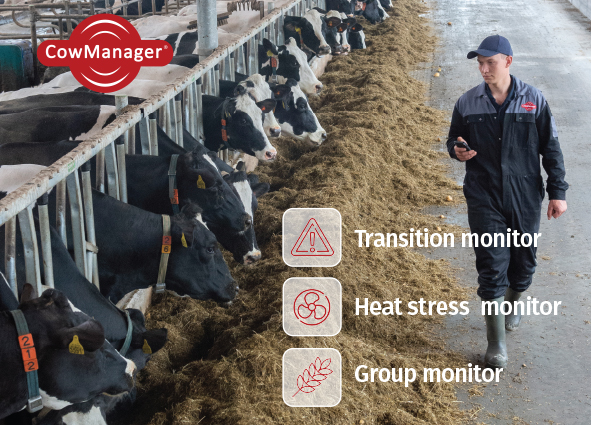
Today, CowManager® launches a new Nutrition module that provides actionable insights regarding feed and transition management on dairy farms. The module has been expanded with clear graphs and user-friendly comparison functionality. Timely notifications regarding cows at risk during the transition period, heat stress, low feed intake, and herd health help to focus a producer’s attention where it is needed most. These notifications allow the producer to approach herd management in a preventive, proactive, and precise manner, resulting in better cow health and a more productive herd.

Koen van Meurs, Head of R&D at CowManager, said, “Nutrition is of great importance to a cows’ performance. It also accounts for the largest portion of the variable costs on farms. Having the right insights to make data-driven decisions about feed and transition management are key to successful and profitable farming. Machine learning technology helped us to create exactly these insights based on the behavior and temperature data we collected from millions of cows worldwide.”

Global customer panel

The Nutrition module was designed with the help of dairy producers and nutritionists in CowManager’s global customer panel. Wilfried Reuvekamp, member of the customer panel and owner of Hilltop Dairy (USA) said, “The insights provided by the Nutrition module encouraged me to implement management changes, which led to a sustained dry matter intake of 38 pounds for our close-up cows. This has already contributed strongly to healthier fresh cows and higher peak milk production. I believe in a few months we will hit the 95-pound milk production mark.”

Working preventively

The transition period is the primary risk period where 75 percent of all adult cow disease events occur. In the past, producers could only dream of cows at risk being identified days or weeks before they

became sick. Today this has become reality. Dry cows with decreased eating and rumination behavior will be flagged as being at risk of becoming sick after calving. Early intervention prevents losses and results in a healthier herd. All alerts within the Nutrition module are designed to foster preventive management practices.

Optimized feed management

The Nutrition module consists of various easy-to-read graphs offering full insight into the eating, rumination, and activity of each group of cows. The comparison functionality makes it easy to compare certain groups or time frames with each other, allowing the producer and nutritionist to evaluate the impact of ration changes and feed management in a fact-based and quick manner. Access to valuable herd data can be granted to trusted advisors through the MultiView function. The Nutrition module provides producers with the tools to take feed and transition management to the next level. More control and full insights will help producers achieve the goals they have set for their herds with better pregnancy rates, an overall healthier herd, lower feed costs and more milk per cow.

About CowManager

Thousands of farmers in over 40 countries already rely on CowManager’s user-friendly ear sensor technology, to help manage their herds. CowManager monitors each cow 24/7, it is an extra pair of eyes on the herd. This valuable management tool shows real-time alerts via easy-to-read and colored hourly behavior graphs on your smartphone or desktop computer. CowManager monitors health, fertility, nutrition, and location, with impressive accuracy.

For more information, visit www.selectsires.com or www.cowmanager.com or follow CowManager on Twitter, Facebook, LinkedIn and YouTube.

Based in Plain City, Ohio, Select Sires Inc., is the largest global A.I. cooperative and is comprised of six farmer-owned and -controlled local organizations in the United States. As the industry leader, it provides highly fertile semen, as well as excellence in service and programs to supply dairy and beef producers with the world’s best genetics.


IDF announces new president

Brazzale takes over from Dr Judith Bryans, chief executive of Dairy UK, who was elected at the 2016 World Dairy Summit in Rotterdam, The Netherlands.

In his new role, Brazzale will steer the work of IDF with the support of the IDF board, the Science Programme Coordination Committee (SPCC), of which he is the former chair, along with the IDF head office and IDF national committees. He has been involved with IDF at all levels since 2012.

Speaking after his election at the virtual IDF AGM on November 2, Brazzale said, “I am thankful and honored for the trust the IDF community has put in me to lead the organization for the next four years. Judith has done a fantastic job over the last four years and we owe her our thanks for her hard work and remarkable leadership, guiding the federation through numerous changes and challenges with unfailing vision and passion.

“I will be focusing on several key areas during my term; promoting and highlighting the value of the work undertaken by IDF, ensuring dairy continues to be recognized as making a significant role in sustainable food systems; and ensuring IDF and our sector is prepared for the future and speaking out on the big issues of our time. The challenges facing the world regarding sustainable nutrition are immense, and I am confident that with the contribution of our strong and growing base of global dairy experts, we can and will embrace them.”

Brazzale will continue to be involved with Brazzale S.p.A., Italy’s oldest dairy company, in uninterrupted activity for at least eight generations, producing cheese and butter since 1784.

Outgoing IDF president Bryans, the first female president of the IDF, said, “I am thankful for the time I have spent as president and the value we have been able to create, for the dairy sector and its stakeholders. The work of IDF is essential in creating a positive future for the dairy sector. Its unique structure and global network of experts allows us to pool our resources and expertise together to ensure the role of dairy is recognized properly at every level. Moving forwards IDF will be in good hands with a committed board under the new IDF president, Piercristiano Brazzale.”

Source: dairyreporter.com

U.S. dairy year-to-date exports up 16%

Core products—NDM/SMP, cheese and whey—make for strong August.

Trade data released Tuesday show that eight months into 2020, the value and volume of U.S. dairy exports continues to grow at a double-digit pace. Volume on a milk solids basis was up 17% compared to last August, putting year-to-date performance up 16%. Value grew by 11% (YTD up 14%).

Most major product categories booked strong gains in August. U.S. suppliers shipped 190,435 tons of milk powder, cheese, whey products, lactose and butterfat—a record for the month. The August increase capped a full year—12 straight months—of year-over-year increases in aggregate U.S. dairy export volume.

chart201 (2)

chart201 (2)chart202 (4)


In August, the United States’ core categories—NDM/SMP, cheese and whey products—propelled a strong month overall and extended year-to-date gains. Each was fueled by different factors.

Total U.S. NDM/SMP exports rose 35% to 68,798 tons, driven primarily from a doubling of shipments to Southeast Asia, with the aid of competitive pricing and a committed U.S. presence in the region. Total U.S. NDM/SMP exports were up by 17,714 tons; shipments to the six primary markets in Southeast Asia grew 14,288 tons.

chart203 (2)


Another bright spot: Shipments to China went from virtually nothing in August 2019 (173 tons) to 5,343 tons in August 2020, making it the third largest destination for U.S. milk powder for the month. Our No. 2 market, Mexico, lagged in August, with U.S. NDM/SMP shipments down 15% to 23,754 tons.

Even though U.S. NDM/SMP export volumes have decelerated over the past three months, the latest USDA Dairy Products report shows a decline in August inventories and levels remaining below 2019 comparables after the March and April surge. This suggests the market remains in balance despite weakness in Mexican demand.

Cheese enjoyed a surprisingly strong month: U.S. exports grew 17% to 31,009 tons, with impressive growth across the core U.S. markets. U.S. cheese exports to Mexico rebounded in August with a 29% increase to 8,807 tons, while sales to South Korea (+88%), Japan (+49%) and Australia (+53%) soared.

U.S. cheese export prices were well below May-June U.S. domestic prices, suggesting U.S. exporters accepted lower margins to maintain international relationships.

Other markets, where tourism accounts for larger shares of GDP and cheese consumption – such as Central America, the Caribbean and Southeast Asia — continue to lag in cheese buying. International tourism in most import regions remains significantly restricted by COVID-19.

August whey shipments recorded double-digit gains in all categories with U.S. whey strength almost entirely due to China and its continuing attempts to rebuild its hog herd. Total U.S. whey exports grew 29% in August, an increase of 11,281 tons; U.S. shipments to China for the month jumped 318% or by 17,212 tons.

At +318%, it was a significant month-to-month surge that could be a signal of an increase in U.S. whey market share thanks in part to the Phase I trade agreement. U.S. whey export growth to China should be further supported by China’s move last month to extend a retaliatory tariff exemption on U.S. permeate for animal feed.

The Chinese whey import gain more than made up for declines to other regions, like Southeast Asia (-14%) and Mexico (-60%).

In other products, U.S. butterfat exports rose 4% with gains to Canada, Saudi Arabia and Japan.

Lactose volume fell 8% to 29,168 tons, with declines to Mexico (-23%), China (-12%) and South America (-33%). 

MPC exports rose 37% and Canada was the top U.S. MPC market. The increase was a hopeful sign that changes to Canada’s Class 7 pricing scheme mandated by the USMCA might be effective in helping U.S. suppliers reestablish business (MPC and ultrafiltered milk were the major U.S. exports affected by Class 7).

chart204 (2)


To download a printable PDF summary with charts showing August  trade data in detail, click here.      


The Impact of COVID-19 on Dairy Pricing. – A look in the Rear-View Mirror

 COVID-19 has changed most every aspect of life around the globe.  This post will examine the impact on the U.S. dairy industry.  The analysis below reflects primarily the impact on producer pricing of milk.

The first item to be reviewed will be the deaths in the U.S. that are related to COVID-19.  Chart I below shows a 7 day rolling average of COVID-19 deaths starting in March 2020 through the most current available data.  As reported by the CDC, the majority of these deaths result from underlying health conditions complicated by COVID-19.  The largest spike was in April with another increase in August.  Since the beginning of August to the present there is a downward trend in deaths.

Chart I – U.S. COVID-19 Related Deaths


Much of the disruption in daily life has resulted from measures such as quarantines and closing of restaurants, intended to reduce the number of deaths involving COVID-19.  Demand for dairy products changed with the closing of restaurants, schools, and other places normally frequented by people.  This led to a massive change from reduced food service demand to increased retail demand.   For instance, retail cheese sold in grocery stores is usually branded and in small packages bearing brand names such as Kraft, Borden, etc.  Cheese for food service is packaged by non-retail companies and is typically packed in large containers without consumer branding.  Because of the overnight change in demand, there were brief shortages and excesses causing significant pricing changes. The structure for providing the appropriate product for each channel is significantly different and the rapid change caused major disruption in supply and demand and thereby it caused extreme volatility in commodity dairy product prices. 

As a result, the wholesale price of commodities which are used to price producer milk changed quickly and drastically.   What is amazing is that the dairy industry changed in a matter of months to service the new high demand channels.  There are four commodities that are used to price producer milk in most of the U.S.  They are cheese, butter, Nonfat Dry Milk (NDM), and dry whey.  Cheese and butter are primarily consumed domestically while NDM and dry whey are primarily export products. 

In this post, cheese and butter parameters will be covered first as they are the most significant commodities used to price Class III milk, milk protein, and butterfat.  Some of the charts below use moving averages as they level some of the seasonal changes and month-to-month “blips.”

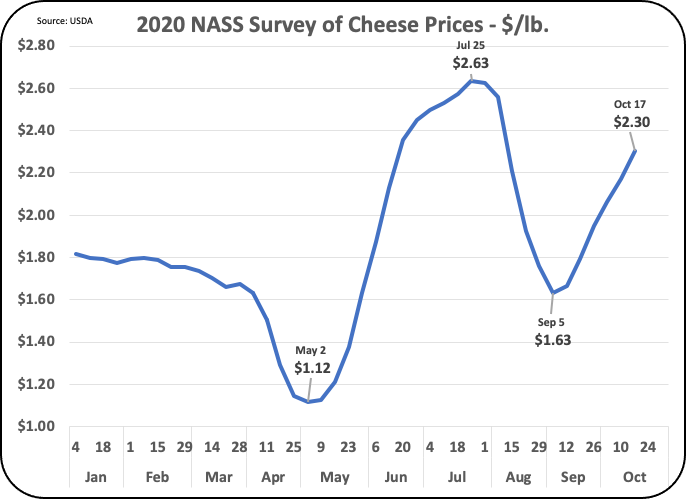
During this time NASS prices for cheese and butter followed a similar pattern.  In April, as COVID-19 deaths spiked and quarantining was implemented, the prices of both cheese and butter first took a major drop and then increased to higher prices than before the drop. The cheese prices that followed were record setting highs for cheese.  Chart II shows the progression of cheese prices from a low of $1.12 per pound to $2.63 per pound within a few weeks.  The low prices brought some major buys at bargain prices which then resulted in shortages in some channels leading to the record setting prices.   

Chart II – NASS Cheese Prices


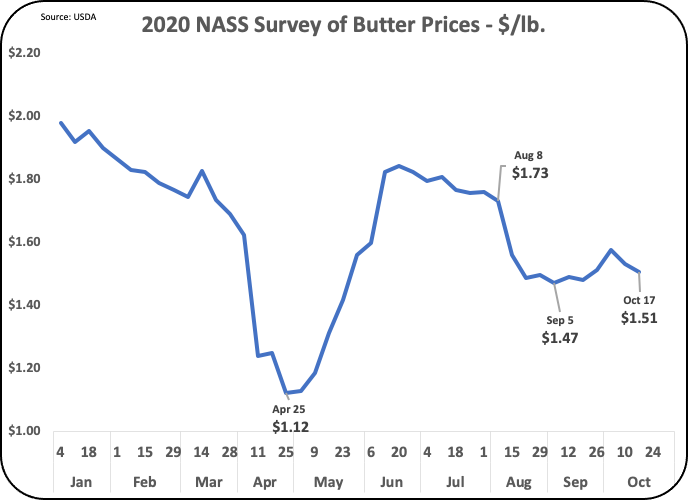
The butter price shown in Chart III follows a similar pattern but without record setting high prices.  The reason for this will be coved later in this post.

Chart III – NASS Butter Prices


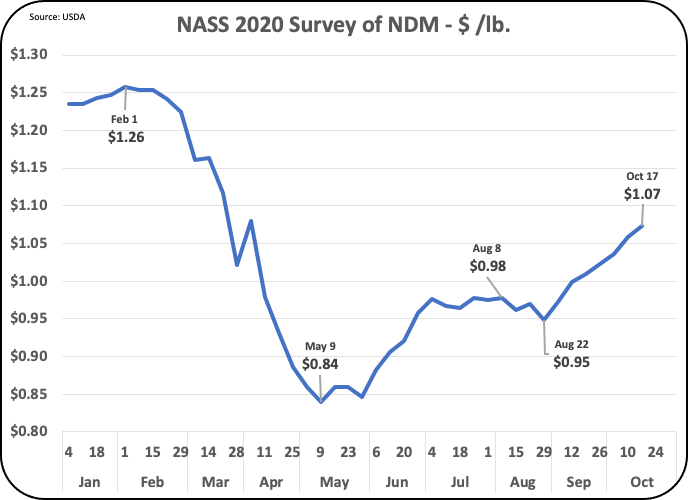
The prices of NDM and dry whey follow different patterns from cheese and butter.  Chart IV shows a major drop in NDM prices in May with a fairly steady increase to its current price.  These prices result from international supply and demand and are only slightly impacted by domestic supply and demand.  NDM prices are used to price Class IV skim milk.

Chart IV – NASS NDM Prices


The prices of dry whey took an entirely different pattern with highs during the first four months of COVID-19 in the U.S.,  but then prices fell by nearly 20 percent. Dry whey prices are used to set the value of “Other Solids” in the Class III milk price.

Chart V – NASS Dry Whey prices


What did not change?  

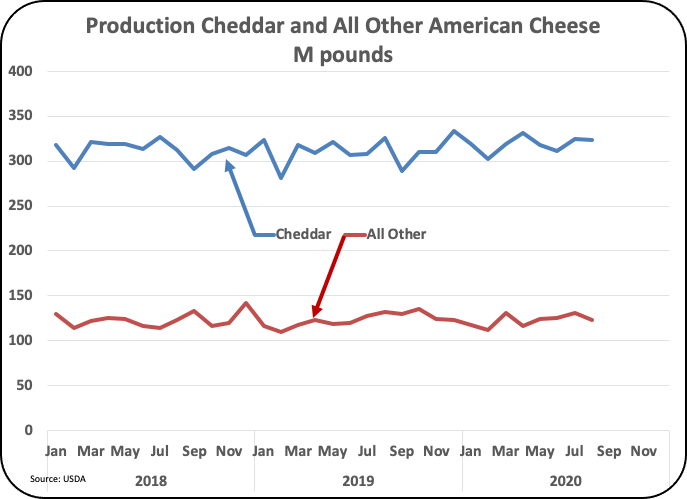
The product used to represent the NASS cheese is Cheddar cheese.  USDA data separates cheese into two categories, American Cheese and “Other” cheese.  Cheddar cheese is considered an American cheese.  Chart VI shows the production of Cheddar cheese and other American cheeses.  Unlike many of the above charts, this chart shows no variation during the time of COVID-19 lifestyle changes.

Chart VI – Production of American Cheeses


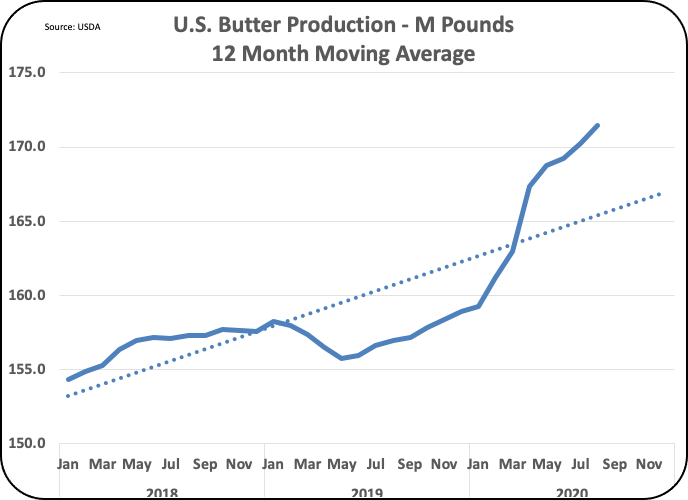
Production of Butter is shown in Chart VII.  This is shown as a 12-month moving average as there are annual cycles of butter production that make trends more difficult to follow.  Butter production has been increasing in 2019 and 2020, after years of minimal changes in butter churning.  In 2020, the increases have been very significant, and with little impact from COVID-19.  

Chart VII – Production of Butter


The “bottom line is that the COVID-19 pandemic had little impact on the production of cheese and butter.

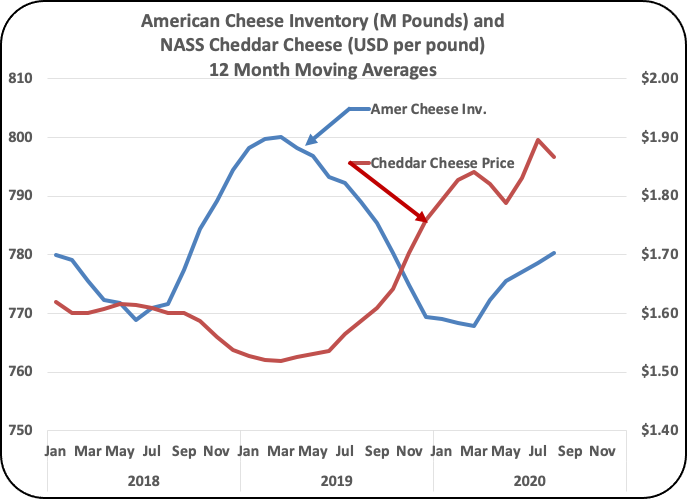
Inventories and prices of cheese and butter have made some major increases and decreases during the COVID-19 pandemic.  The changes for cheese are shown in Chart VIII.  As shown in Chart VI above, production of American Cheese has not changed much in the last three years.  In early 2019, American cheese inventories were high and cheese prices were low.  In late 2019, American cheese inventories fell, and prices increased.  In 2020, American cheese inventories found a bottom and have increased during the COVID-19 restrictions.  The current prices are likely to continue as long as American cheese inventories do not significantly increase in the near future.

Chart VIII – Inventories and NASS price of Cheese

Butter inventories and prices have taken a different path. As shown in Chart VII, butter churning has increased.  Butter disappearance from cold storage has been steady through the COVID-19 pandemic and the increased churning has therefore increased cold storage supplies.  With increased inventories, lower prices have prevailed and will probably continue for some time.

Chart IX – Inventories and NASS price of Butter


In conclusion, the “crisis” of COVID-19 has had a very significant impact especially on cheese prices.  Cheese prices are the most influential variable in producer milk prices.  While the COVID-19 pandemic continues to be a threat to the U.S. lifestyle, it appears that the worst of deaths and price volatility is behind us.  American cheese inventories are at a 50 to 55 days’ supply which is “normal.”  

The CFAP program has delivered some nice cash support for the dairy industry.  Now the problem that may arise will likely be the familiar one of too much milk.

Source: Milkprice

FDA must enforce fake-dairy rules

With FDA giving little indication of promised action on proper labeling of imitation dairy products, the National Milk Producers Federation asked the agency’s ombudsman to ensure that rules are properly enforced.

“Allowing unlawfully labeled ‘plant-based’ imitation dairy foods to proliferate poses an immediate and growing risk to public health; it is a clear dereliction of the FDA’s duty to enforce federal law and agency regulations,” wrote NMPF President and CEO Jim Mulhern in the letter, sent to Laurie Lenkel, ombudsman for the U.S. Food and Drug Administration. “The FDA’s Office of the Ombudsman must intervene to break the bureaucratic logjam that is adversely affecting consumers. Doing so would fit squarely within the office’s own mission to ensure even-handed application of FDA policy and procedures.”

The FDA ombudsman, based in the agency commissioner’s office, “serves as a neutral and independent resource for members of FDA-regulated industries when they experience problems with the regulatory process,” according to the agency. NMPF is urging the ombudsman’s office to take appropriate action to remedy the FDA’s lax approach to enforcing its own rules on the use of dairy terms on products containing no dairy ingredients, which have proven impacts on public health – a new phase of advocacy brought about by the agency’s regrettable inaction. The American Academy of Pediatrics and other organizations have offered evidence of nutritional deficiencies caused by confusion over the contents of plant-based versus dairy beverages.

NMPF last year released its own road map offering solutions to how public health, product integrity and free speech could be protected through updated regulations. NMPF also supports the DAIRY PRIDE Act, a potential legislative prod for FDA action, and has asked FDA commissioner Stephen Hahn to follow up on the pledge he made nearly one year ago to make fake-dairy labeling a high-priority issue at FDA.

Global Milk Production Update – Oct ’20

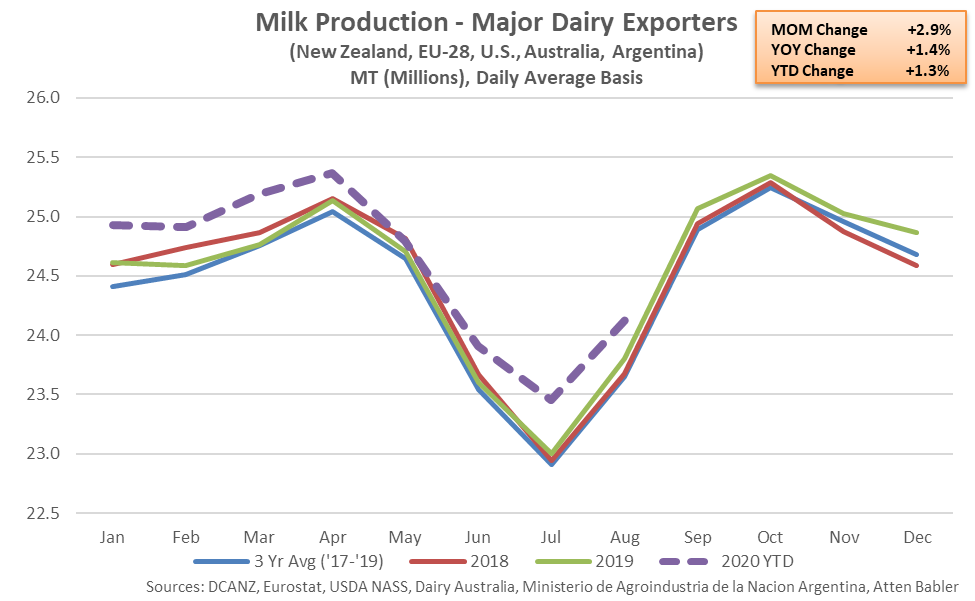
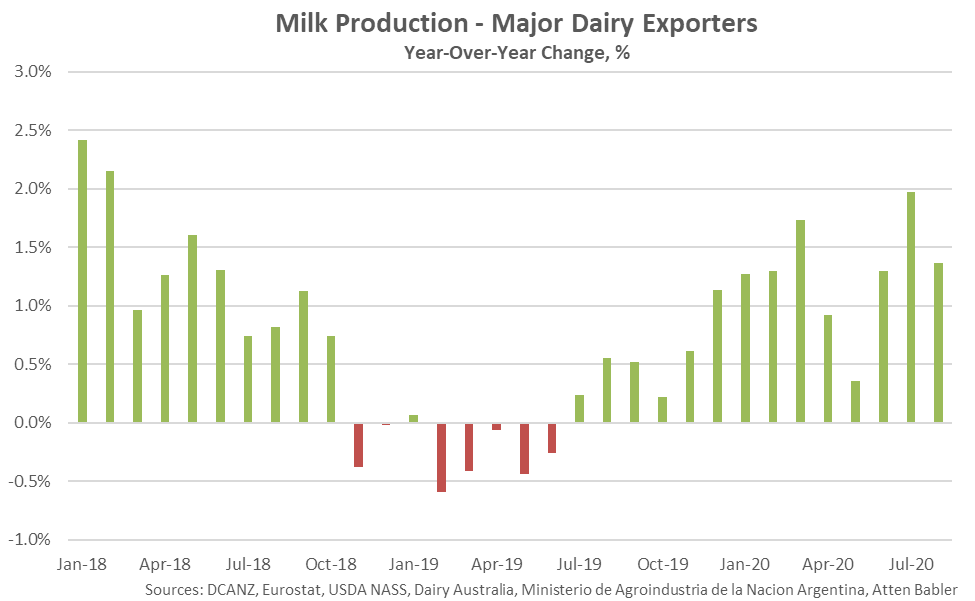
Combined milk production within the major dairy exporting regions of New Zealand, the EU-28, the U.S., Australia and Argentina finished 1.4% higher on a YOY basis during Aug ’20, reaching a record high seasonal level. The aforementioned regions combined to account for over 90% of global butter, cheese, whole milk powder and nonfat dry milk export volumes throughout 2019.

Combined milk production growth rates experienced throughout the major dairy exporting regions decelerated over much of 2018 but remained positive until Nov ’18, when production volumes declined on a YOY basis for the first time in the past 22 months. Combined milk production volumes finished largely flat or lower on a YOY basis over eight consecutive months through Jul ’19, prior to finishing higher throughout each of the past 14 months through Aug ’20.

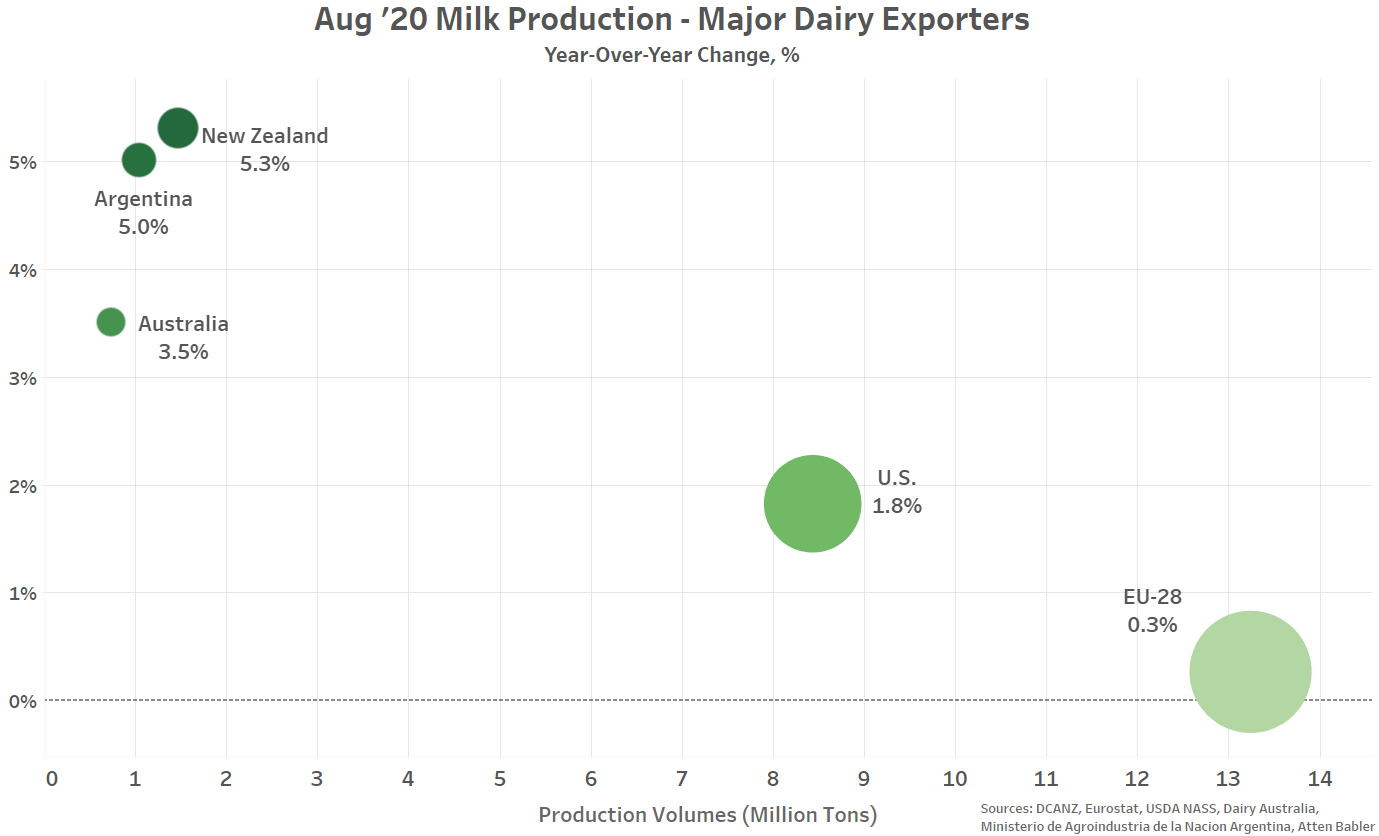
Aug ’20 YOY increases in milk production were widespread across the major dairy exporting regions and led on a percentage basis by New Zealand (+5.3%), followed by Argentina (+5.0%), Australia (+3.5%), the U.S. (+1.8%) and the EU-28 (+0.3%). The EU-28 produces significantly more milk than the other dairy exporting regions, accounting for over half of the combined production within the five exporting regions during Aug ’20. Production gains have been widespread across the major dairy exporting regions for three consecutive months through Aug ’20, the longest consecutive streak experienced throughout the past five years.

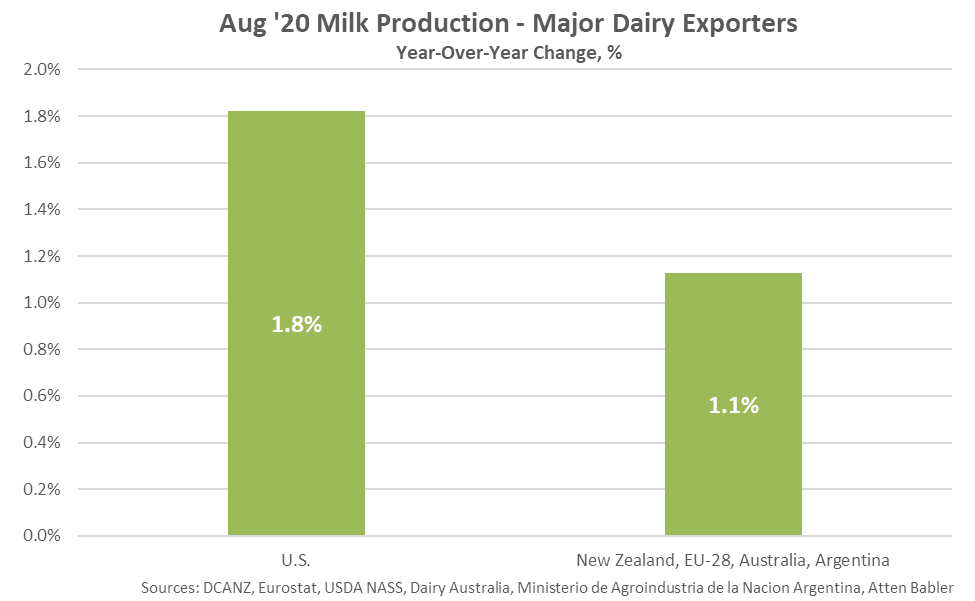
Excluding the U.S., milk production within the major dairy exporting regions increased by 1.1% on a YOY basis throughout the month of August, finishing below the growth rate exhibited within the U.S. for the first time in the past four months.


Source: AttenBabler

Dairy Industry Expected To Return To Normal Next Year

The USDA is forecasting a reduction of volatility for the dairy industry, and a return to normalcy next year. World Ag Outlook Board Chair Mark Jekanowski said the dairy industry, has suffered a lot of volatility this year. It started he noted with the large scale lock down, then some re-opening of food service, food service industry closing again, and then uncertainty about schools and colleges.

“So there’s been a ton of volatility in terms of demand for many of these products,” Jekanowski said. “Especially cheese and butter products that are used in the food service industry.  In our forecast, we assume that that’s going to settle down a bit in 2021 and things are going to turn around to a bit more of a normal situation suggesting stronger prices for all of these products.

Source: pnwag.net

Today’s dairy industry is creating tomorrow’s environmental solutions

I have been a dairy farmer all my life. I was raised on a dairy farm, I married a dairy farmer and my husband, Duane, and I run the Ar-Joy Farms in Cochranville, Pennsylvania, where we milk 800 cows.

As our communities continue to manage the unprecedented change resulting from the COVID-19 pandemic, a topic that continues to be top of mind is the environment.

In fact, many see climate change as the next global pandemic, believing the long-term health of people is directly related to the health of the planet. A Futerra survey showed 58 percent of Americans believe we should respond to climate change with the same urgency as we have responded to coronavirus.

The Innovation Center for U.S. Dairy has set new environmental stewardship goals to further the progress and commitment that dairy farmers and the broader dairy community have always had to responsible production. Goals to be achieved by 2050 focus on: 

  • Becoming carbon-neutral or better
  • Optimizing water use while maximizing recycling
  • Improving water quality by enhancing use of manure and nutrients

The Net Zero Initiative is an industry-wide effort that will play a key role in helping U.S. dairy continue to make progress toward greenhouse gas emissions reductions and significant improvements in water from field to farmgate through new technologies and practices in feed production, cow care, energy efficiency and manure management. In other words, Net Zero is the “how” behind the goals, especially when it comes to helping all size farms continue to adopt sustainable practices.

Whenever I share the vision of this work, I find that it’s effective to emphasize what the Net Zero Initiative is. 

The Net Zero Initiative is:

  • A pathway for all farms to contribute in ways that are right for their business. 
  • About providing opportunities for farms of all sizes to benefit and adopt technologies and practices while creating revenue streams.
  • An effort that considers a range of technologies and practices on farms of varying sizes, designs and geographies — it is not a one-size-fits-all approach.

Every day as dairy farmers we impact the land, water and air. But, as good environmental stewards, we use practices and technologies not just to minimize our impact but to sequester carbon, reduce water loss and improve water quality.

That’s our vision: Dairy is an environmental solution. 

We don’t yet have all the answers, but we know we must start working today to build our collective path toward this brighter future. That’s why the Net Zero Initiative matters. It will focus on enabling farmers to expand the use of practices and technologies that can benefit their farm and the environment, while strengthening our position in the global marketplace. Together, dairy farmers have put a solid stake in the ground around sustainability, and together the U.S. dairy industry will become a sustainability success story for other industries to follow. 

Source: The Innovation Center for U.S. Diary.

“Milk Your Moments” campaign delivers for UK dairy sector

The UK’s first national dairy TV campaign for 20 years helped drive an estimated 11.2 million litres of additional liquid milk sales during the Coronavirus pandemic earlier this year, as well as raising £100,000 for mental health charities.

According to Kantar, the UK-wide “Milk Your Moments” campaign, which ran for 12 weeks from mid-May, resulted in an additional 212,000 consumers buying milk who would not otherwise have purchased it. This was against a challenging background of milk already being bought by 98 percent of UK households prior to the pandemic.

The campaign also saw positive shifts in attitudes towards dairy in the target audience, with more consumers claiming that dairy was an important part of their diet and perfect for a growing family.

Funded with £1 million from AHDB, Dairy UK, Department for Environment, Food and Rural Affairs, as well as the Scottish, Welsh and Northern Ireland governments, the campaign aimed to address the drop in liquid milk demand caused by the closure of foodservice outlets due to Coronavirus.

Working with Dairy UK, processors helped to bring multiple retailers on board with the campaign and drove additional engagement on social media through dairy brands and industry organisations.

Paul Flanagan, AHDB Dairy Strategy Director: said: “The campaign was a brilliant example of industry and government pulling together during a crisis with fantastic results. Every £1 spent on media, turned into £13.99 of retail sales.

“It shows just how much can be achieved when industry and government are all pulling in the same direction with a hard-hitting campaign which struck a chord with consumers in very uncertain times.”

Milk Your Moments” was created to inspire moments of connection as people were forced to stay apart due to coronavirus. It highlighted the role fresh milk and dairy plays during difficult times, with people encouraged to visit the campaign website to receive an “inspirational moment of connection” to share on social media with £1 donated to mental health charities Mind, SAMH and Inspire. £100,000 was raised overall.

Consisting of social media, website, billboards outside supermarkets and, for the first time in 20 years, television advertising, the campaign contributed £6.6 million of milk sales, equivalent to 11.2 million litres, to the overall uplift.

Dr Judith Bryans, Chief Executive of Dairy UK said: “Everyone involved in the development and funding of this campaign went into it with a very positive mindset wanting to connect with our consumers and reassure them that dairy has always been with them and would continue to be with them through this crisis.

“The uplift in sales that was achieved and the positive behaviour changes evidenced by the results reflect the fact that the campaign’s messages resonated with consumers.”

Milk Your Moments also targeted a shift in consumer attitudes to build the industry’s reputation and build upon previous work by AHDB and Dairy UK over the previous four years with the Department for Dairy Related Scrumptious Affairs.

Source: thecattlesite.com

Chinese demand pushing prices up

A resurging Chinese economy is helping boost returns for New Zealand dairy farmers.

Two banks – BNZ and Westpac – are following Fonterra and lifting their forecast milk price for the season.

The positive sentiment among economists is reflecting on the Global Dairy Trade (GDT) auction. Last week’s event recorded a slight increase in dairy prices, GDT’s third consecutive price rise.

Westpac has lifted its forecast price by 50c to $7/kgMS, sitting above Fonterra’s new mid-point of $6.80/kgMS ($6.30 to $7.30 range).

Senior agri economist Nathan Penny says the forecast change is due to better than expected global dairy demand, especially from China.

Penny says the Chinese economy has rebounded strongly post Covid. 

“The Chinese economy is on track to post modest growth over 2020, the only major global economy likely to do so.”

BNZ has lifted its forecast payout by 30c to $6.80/kgMS.

Senior economist Doug Steel attributes the recent GDT gains to improving demand from China. 

“This has coincided with macroeconomic indicators suggesting that the Chinese consumer is starting to follow the country’s industrial recovery that has been evident for months,” he says.

“This is a good macro backdrop for the demand pickup to be sustained. At the same time, Chinese purchasing power has been improving with an appreciating Chinese yen.”

Apart from China, most countries are still dealing with Covid-19.

Earlier this year there were fears of a price slump as the global recession, triggered by Covid, weighed on global dairy demand.

But Penny says China and some other Asian dairy markets are faring better than expected. 

“More broadly, New Zealand agricultural exports, including dairy, have proved more resilient than we expected earlier in the year. In this vein, we now expect global dairy prices to hold at or around current levels over the remainder of the season. 

“This updated view contrasts with our previous view that prices would weaken as the global recession weighed on global dairy demand.

“The strength in demand has seen prices firm over three consecutive auctions. Importantly, this sets up the milk price well for the season as this price strength has coincided with the peak in spring production and similarly high auction volumes.”

ASB, which is sticking to its $6.75 forecast, also notes that downside risks to the forecast have receded.

Economist Nathaniel Keall says after three decent GDT auctions, there is now an upside risk.

Rabobank, which will update its milk forecast payout in December, is hinting of a rise.

RaboResearch senior dairy analyst Emma Higgins notes that Chinese buyers stepped back into the market more actively last GDT event following more quiet activity in the previous auction earlier this month, which coincided with Golden Week celebrations. 

“This increased activity was reflected in the steady powder results, with Chinese demand noticeably higher for WMP compared to last month and also compared to this time last year,” she says.

“We forecast on a quarterly basis and we are set to revise our current $6.35/kgMS milk price in early December. 

“If dairy prices remain resilient, ceteris paribus, we will be lifting our forecast.”

  However, despite the positive outlook, some potential roadblocks remain.

Covid uncertainties are ongoing and developments on this front still have the ability to surprise, he adds.

Milk production continues to grow in most parts of the globe and this could tip the balance in favour of supply and impact prices.

Source: ruralnewsgroup.co.nz

IDF launches World Dairy Situation Report 2020

The World Dairy Situation Report 2020 is the latest edition of the publication produced annually by IDF as part of its mission to represent and support the dairy sector globally.

The 2020 edition is the result of collaboration between dairy experts and organizations around the globe and within the IDF. The report contains information about the international dairy sector – including data tables, graphs, country reports and analyses for more than 50 dairy-producing countries from all five continents.

It also provides an in-depth understanding of the current macro supply and demand trends affecting the dairy sector.

IDF Director General Caroline Emond, said, “The World Dairy Situation 2020 is an essential read for decision-makers and dairy sector stakeholders concerned with continuously changing global dairy market conditions. To further meet the needs of our sector in this challenging period, the 2020 edition of the report also features a special chapter dedicated to the preliminary impacts of the COVID-19 pandemic on the dairy sector, including details on how the sector is adapting its practices to continue to produce safe and sustainable milk and dairy products.”

The IDF World Dairy Situation 2020 report not only consists of written chapters on production, processing, prices, consumption, and trade but is expanded with 30 tables that give the reader a comprehensive overview of global dairy developments.

For the added convenience of the reader these tables, which cover all aspects of the dairy sector, and are accompanied by illustrative graphs, are available in electronic format – enabling direct use in the reader’s own documents. In this year’s issue, a full chapter is dedicated to the preliminary impact of the coronavirus crisis (COVID-19) on the global dairy sector in 2020.

The World Dairy Situation Report 2020 is available to purchase in the IDF e-shop.

Top performing Australia dairy businesses under the microscope

Seasonal conditions across the three Victorian dairying regions were characterised by challenges throughout winter and spring 2019, followed by a mild summer and good autumn 2020 rains.

The latest Victorian Dairy Farm Monitor Report found farms in each of the regions responded differently depending on the relative positions heading into 2019-20.

While nearly all Dairy Farm Monitor Project farms experienced positive profits in 2019-20, with consistent performance reported across the regions, many farms have not fully recovered from the recent years of challenging conditions and lower performance.

Following are some points identified by the Dairy Farm Monitor Report that contributed towards the success of the top performing farms in the regions.

NORTHERN VICTORIA

The top 25 per cent of participants in the north had a higher proportion of homegrown feed as percentage of metabolised energy consumed at 57 per cent compared to the regional average, but lower than the top performing farms last year (68 per cent).

The higher percentage of homegrown feed used by the top 25 per cent was reflected in the total water use for these farms (826mm/usable ha), which was eight per cent higher than the average of all participant farms in the north.

They produced 20 per cent more homegrown feed (one tonne DM/100mm/ha) compared to the average (0.8 tonne DM/100mm/ha).

They had a lower water use efficiency of 3.9 tonne DM/Ml of irrigation water compared to 4.1 tonne DM/Ml for the average.

The top 25 per cent farms spent $3.96/kg MS on variable costs in 2019-20, 14 per cent lower than the average of northern Victoria farms and slightly higher (five per cent) than last year’s top performing farms.

Generally, they spent similar amounts on herd and homegrown feed costs and less on shed costs and purchased feed than the average of all participant farms.

Compared to the northern Victorian average, they had higher feed inventory change and lower water inventory change.

The top performing farms spent less on overhead costs than the average due mainly to their lower labour cost (employed and imputed labour).

Their imputed and employed labour costs were 24 per cent and five per cent less than the average, respectively, as supported by their higher labour efficiency on a per cow and kg MS bases.

SOUTH-WEST VICTORIA

Farms in the top 25 per cent (ranked according to return on total assets) were characteristic of higher milk production measured per cow and per hectare, and higher labour efficiency, based on cows/FTE and kg MS/FTE.

The homegrown feed cost categories that contributed most to the increase were fertiliser costs. This increased by 15 per cent to $0.58/kg MS as farmers applied greater quantities of fertiliser in 2019-20 than the previous year, taking advantage of the consistent rainfall events.

They were rewarded with pasture grazed increasing by 0.4 tonne DM/ha to 4.7 tonne DM/ha and conserved fodder totals remaining stable at 2.2 tonne DM/ha on the milking area.

Farms in the top 25 per cent had lower overhead costs, compared to the average. The average overhead costs for the top 25 per cent was $2.29/kg MS in 2019-20, slightly higher than $2.25/kg for the top 25 per cent group in 2018-19.

The top performing group recorded an EBIT of $2.87/kg MS, up from $1.93/kg MS the previous year. The top 25 per cent recorded a higher milk price and demonstrated more efficient milk production with higher milk solids sold at lower costs, compared to the average.

Farms in the top performing group had greater pasture consumption compared to the average.

When compared with the top performing group last year, grazed pasture increased while conserved feed decreased.

Grazed pasture was 5.6 tonne DM/ha in 2019-20, up from 4.8 tonne DM/ha for the top performing group in 2018-19. Conserved feed was 1.7 tonne DM/ha in 2019-20, down from 3.4 tonne DM/ha in 2018-19.

GIPPSLAND

The top 25 per cent of farms in Gippsland had similar physical characteristics to the region average for rainfall, water use and labour efficiency.

There were noticeable differences for herd size, stocking rate, production per cow and per hectare and estimated grazed pasture per hectare.

The top performers appeared to have utilised their physical resources to similar advantage to that of the average for the region, with the key performance differences being in homegrown feed utilisation and cost control.

The top 25 per cent participants received an average milk price of $7.11/kg MS, an improvement of 19 per cent from last year with a range of between $6.74/kg MS and $7.69/kg MS.

There was a large proportion of farms in the Gippsland sample that changed milk processors during the year.

This was either to find a payment system that better suited their milk supply pattern or looking for companies that were offering a higher payment for their milk.

In the top 25 per cent and the average of the sample, milk income accounted for 92 per cent of gross farm income.

The top 25 per cent also experienced a 12 per cent decline in grain and concentrate feeding, with a similar 11 per cent decline in variable costs to $2.95/kg MS.

The second largest variable cost was fertiliser at $0.57/kg MS, six per cent higher than in 2018-19 at $0.54/kg MS. The elevated fertiliser price per tonne this year can account for the increase in this cost category rather than an increase in quantity applied.

Overhead costs for the top 25 per cent remained similar to that of last year at $1.65/kg MS. The top 25 per cent were lower in all overhead cost categories per kg MS compared to the average.

The slightly larger herd size, better labour efficiency and mix of imputed and paid labour enabled a better ability to spread costs this year.

Source: dairynewsaustralia.com.au

Dairy Farmers of Canada Launches New Online Classroom Marketing Campaign

The Canadian dairy sector’s latest marketing campaign connects dairy farmers with young and inquisitive consumers.

Dairy Farmers of Canada’s (DFC’s) Hey Dairy Farmer – Online Classroom Edition features farmers from Saskatchewan and Ontario answering questions from elementary students.

Jasmin Benoit, a dairy farmer from St. Albert, Ont., answers the questions in French and Michael McLeod, a producer from Caronport, Sask., provides answers in English.

In the first videos, students ask what dairy farmers do to help the planet.

The producers explain how Canadian dairy farmers are global leaders in sustainable farming and have low carbon footprints.

Teaching young minds about agriculture and the faces behind their food is crucial.

Without that kind of connection, it’s difficult to build trust between farmers and young consumers, McLeod said.

“If (people) don’t understand where food comes from and how farms work, they won’t have the confidence in us and what we do,” he told Farms.com. “It’s important for all farmers to take those opportunities to educate people every chance we get.”

Teaching kids about agriculture isn’t new to the McLeod family.

Their farm is situated across the road from an elementary school. So, during recess, students can see grazing cows and other farm activities.

Prior to the COVID-19 pandemic, kindergarten classes often visited the farm for tours and education.

Those kinds of tours are good for farmers because they can provide opportunities for farmers to learn about their operations.

“If you think you’ve arrived, you probably haven’t,” McLeod said. “You should always push yourself to learn more and make sure that what you’re saying is accurate. There are less farms, meaning more responsibility is falling onto fewer people’s shoulders. So, we need to take that seriously.”

Source: Farms.com 

Alice in Dairyland talks health benefits of chocolate milk

With Halloween coming up fast, many people will be eating all kinds of candy and chocolate. But there is one kind of chocolate that’s actually good for you!

This year’s Alice in Dairyland, Julia Nunes, took time to chat with us live on Daybreak to explain to us the health benefits of chocolate milk. She says chocolate milk is packed with nutrients like Calcium, Vitamin D, and Protein. In fact, each 8-ounce serving has a total of 8 grams of protein to help build strong muscles. The Dietary Guidelines for Americans also say those 9-years-old and older, should have three servings of low-fat and fat-free dairy foods like cheese, yogurt, and milk. And chocolate milk isn’t considered a sugary drink by both the American Academy of Pediatrics and the American Heart Association.

But not only is chocolate milk good for young kids, it’s also a versatile snack. Nunes says you can serve it hot or cold and use it in recipes like Chocolate Milk Overnight Oats or Chocolate Pumpkin Pancakes. And when you have drunk all your chocolate milk, you can turn the carton into a spooky decoration, just in time for Halloween.

Best of all, Nunes says buying chocolate milk can also benefit our local dairy farmers. All you have to do is look for the Proudly Wisconsin Badge or the number 55 on milk cartons to make sure you are buying fresh and local milk.

For more information on this year’s Alice in Dairyland, check out her website.

Buy Australian: The secret to Maleny Dairies’ success

For family owned and operated Maleny Dairies, a passion for supporting the local community has only been reinforced since the COVID-19 pandemic began.

Founded by the Hopper family who have been farming in the Maleny Hinterland north of Brisbane for generations, Maleny Dairies was established following the deregulation of the milk industry in 2000.

Maleny Dairies owner Ross Hopper with wife Sally and children Rescue 12, Cheeky 11, and Ruckus, 9, and calf Hercules. Picture: Brad Fleet

With the COVID-19 pandemic leaving many businesses in dire straits, Mr Falcongreen said it was initiatives like Buy Australian that has encouraged consumers to become more aware of the benefits of supporting their local farmers.

“It has been a strong message that consumers have responded to regarding the importance of what Maleny Dairies has to offer Queenslanders,” Maleny Dairies general manager Peter Falcongreen.

MORE FROM BUY AUSTRALIAN

Sydney family create ultimate kids’ cubby furniture

Aussies go crazy for more eggs

Struggling Aussies turn into home furniture kings

Aussie move sends sales up 300 per cent

Australian made cookware so tough you can run truck over it

Heavily invested in supporting local families, the company’s McCarthy Rd factory directly employs 50 staff members from the community and an additional 30 staff members who are employed in sales and distribution.

“The reciprocal benefit is that the Maleny Dairies indirectly supports 12 farming families and their staff, which is estimated at around 50 people,” Mr Falcongreen said.

“Care for the land, cows and farmers is at the heart of our business and we’re proud to support, purchase and process milk from other local dairy farmers, as well as our own.”

Rescue, Cheeky and Ruckus love helping out with feeding Hercules the calf. Picture: Brad Fleet

Regarded as one of the most productive rural communities in Queensland, Maleny’s population has relied on local farmers for centuries, with Maleny Dairies not shying away from the fact their success comes down to quality of the products and relationships they have built since their inception.

“The investment and support from our consumers, enables us to continue doing what we do best, (producing) award-winning products,” Mr Falcongreen said.

“By buying local you support your local economy and there is also the added guarantee that the produce is delivered fresh,” Mr Falcongreen said.

“Local rural communities play a fundamental role in strengthening our economy.”

Buy Australian is a News Corp Initiative – in partnership with Woolworths and Australian Made Campaign and supported by Red Energy – to help put money back in to our economy by supporting our producers, makers and manufacturers.

Buy Australian is a News Corp Initiative – in partnership with Woolworths and Australian Made Campaign and supported by Red Energy – to help put money back in to our economy by supporting our producers, makers and manufacturers.

Source: couriermail.com.au

New project looks to pandemic-proof dairy industry

The project, Smart-ET, is funded by EIT Food and will develop digital tools working with farmers and dairy sellers to help them adapt their business models to rapid changes in consumer’s demand in case of extreme events that disrupt their normal ways of working.

Smart-ET stands for Simultaneous Market Adjustments during pandemics: Running Technological Economic Tools to mitigate disruption along food supply chain.

The digital tools will allow economic agents in the dairy system to react to changing conditions and issue stock ‘alerts’ that will help reduce waste, and the economic damage caused by destroying otherwise good dairy products.

Dr Giuseppe Nocella, from the School of Agriculture, Policy and Development at the University of Reading said, “In February and March of 2020, Northern Italy saw significant outbreaks of covid-19 leading to widespread restrictions to keep people safe. One of the economic impacts of this lockdown was that dairy farmers who normally rely on rapid movement in the supply chain found that they lost income and had to throw away vast quantities particularly of milk.

“This was costly for dairy businesses because the hotel, restaurant and catering sector was shut down and they had to identify alternative channels in hyper local markets to sell their products. In response, a team set out to see how the industry could adapt to rapid changes and cope with future extreme events.

“What we quickly found was that there was no reactive model that can help farmers and food producers communicate with each other to adapt to changing demands. It could have been possible for dairy farmers to stockpile their produce and use it for cheese rather than dump their milk when as it began to go off, but without a centrally available system the farmers had no way of knowing that producers would have used it.”

As well as the University of Reading, the project consists of other European partners: Università Cattolica (coordinator), Agricolus, Associazione Italiana Allevatori, Centro Ricerche Produzioni Animali and System Dynamics Italian Chapter.

Source: dairyreporter.com

Half of Canada’s dairy farms could disappear by 2030: report

Supply management needs a massive overhaul in Canada to help the dairy industry.

That’s according to a joint report from Dalhousie University and the University of Guelph that warns half of the dairy farms in Canada could disappear by 2030.

The study notes that major coffee chains are serving less dairy, younger Canadians have mixed feelings about whether dairy is good for the environment and are concerned about animal welfare, plus dairy alternatives are becoming more popular.

Sylvain Charlebois is the director of the Agri-Food Analytics Lab at Dalhousie University and co-authored the report.

He says farmers are on the receiving end of compensation from trade deals ratified by the federal government, but argues that by overcapitalizing the system, these funds will hurt farmers in long run.

The report calls for the implementation of what they call Supply Management 2.0, which is comprised of four steps.

“The first step would be to provide an incentive for some farmers to leave the industry altogether. There are farmers out there that are really not investing and don’t necessarily want to compete,” he says.

Other steps include making significant changes to the Canadian Dairy Commission, removing interprovincial trade barriers on dairy products and creating an innovation fund for the sector, and starting a 20-year plan to reduce general tariffs, develop an exporting strategy, create a Canadian brand, and incentivize innovation.

The report was originally slated to be released in March but was only released yesterday because delays due to COVID-19. 

However, Charlebois says the ongoing pandemic meant there was even more information to add about how it has taken a toll on the industry.

“That’s why we went back to the report and added an extra layer related to COVID and pandemics and what may happen in the future, because this could happen again.”

Source: HalifaxToday

Wisconsin Milk Production Rises for Second Time in 2020

For only the second time since the beginning of the year, Wisconsin dairy cows were able to produce more milk during September when compared to a year earlier. The USDA reports that output in America’s Dairyland totaled 2.51 billion pounds during the month–up a fractional 0.7 percent from last September, but lower than the 2.62 billion made in August 2020 (which had more days on the calendar).

Nationally, 17.2 billion pounds of milk was produced in the 24 major dairy states for the month. That was a 2.4 percent increase from 2019, but lower than the previous month’s 17.8 billion.

California continues to have the highest total production with about 3.31 billion pounds. South Dakota had the greatest percent-increase in output as that state produced 264 million pounds of milk–about 12.3 percent more from the same period last year. Sixteen of the top 24 states had higher year-to-year production last month.

Meanwhile, the number of milk cows on farms in the 24 major states was 8.85 million head, 46,000 head more than September 2019, and 6,000 more August 2020. The average number of milk cows on Wisconsin farms for the month was 1.26 million head, down 1,000 head from last month, and 10,000 fewer than last year. Monthly production per cow averaged 2,005 pounds, which was 30 pounds per cow more than last year’s figures.

Source: Wisconsin Ag Connection 

Dairy farms in The Netherlands will decrease by 33% by 2030

In the next ten years, the number of dairy farms in the Netherlands will decrease by 33%, from 16,000 in 2018 to approximately 10,600 in 2030.

The total amount of milk produced will remain the same until 2024 and then increase slightly towards 2030. This is evident from a basic scenario of an exploration of development directions for Dutch dairy farming for 2030 carried out by Wageningen University and Research. Four scenarios are juxtaposed. The study was carried out by Wageningen Economic Research on behalf of Friesland-Campina.

Baseline scenario

The basic scenario is based on established and implemented policy and continuation of past behavior in the dairy farming sector. Policy that has not yet been fleshed out in concrete terms, such as external netting and the proposed new fertilizer policy, for example, has not been included. In the basic scenario it is assumed that the dairy farmers will use the financial scope available to invest in the growth of the dairy farm. In this scenario, the number of dairy cows will drop to just under 1.5 million over the next ten years. The total milk production will increase by 4% because the milk production per cow continues to increase autonomously in line with the trend of the past period. The average farm size of a Dutch dairy farm will increase in the basic scenario from 101 to 139 dairy cows.

Wageningen University & Research is relying on a newly developed economic model that enables a cohesive study of the effect of economic, policy and social changes on the structure of the Dutch dairy sector. The model uses data from the CBS Agricultural Census and the Business Information Network of Wageningen Economic Research.

The model explorations show that some of the dairy farmers will stop in the next ten years due to age and the lack of a successor, but there is also a proportion of the farmers who are expected to have to stop because they can no longer meet their financial obligations .

in the basic scenario, dairy farming remains within the phosphate ceiling and the nitrogen ceiling and the agreements from the Climate Agreement appear to be feasible. However, there still seems to be a challenge on the theme of ammonia. The research also shows that the results of the baseline scenario are sensitive to changes in the assumptions of the model, such as the milk price, technical results or the level of interest to be paid.

Exploratory Scenarios

In addition to the basic scenario, the study also explored three exploratory scenarios in which the question was asked: what would happen if …? These scenarios are based on possible future societal changes and aim to explore which development directions the sector could go through in the coming decade.

In the first exploratory scenario, there is more attention from the market and society for ‘nature-inclusive’ dairy farming. In the second scenario, ‘the free market’, the emphasis is on the production of reliable and cheap food and there are no additional requirements for nature and the environment. In the third scenario (‘focus on social requirements and returns’), dairy farmers do not make the most of growth, but the dairy farmer sets requirements for the income from the company and other investment opportunities within and outside the company are also considered.

In all three of these exploratory scenarios, the number of dairy farms decreased further in 2030 than in the base scenario. In addition, these scenarios lead to on average larger companies, which are on average clearly larger and more intensive in the free market scenario and on average more extensive in the nature-inclusive scenario. In the scenario in which dairy farmers focus less on growth, total milk production decreases the most.

An important result of the study is also that a model has been developed with which the effect of changes in the economy, policy and investment behavior on the structure of the dairy farming sector can be explored in conjunction. The model can also be used to calculate new scenarios and circumstances.

Simultaneously improving the sustainability and economic perspective of dairy farming is not an easy task and should not be approached too one-sidedly. It is important that all relevant stakeholders, such as dairy farmers, banks, dairy companies, regional and national policymakers, develop appropriate measures, management and economic perspective, aimed at the long term
Alfons Beldman, project leader at Wageningen University & Research, about what the research means for Dutch dairy farming.

Source: thedairysite.com

Trudeau says dairy farmers facing new losses due to CUSMA will be compensated

Prime Minister Justin Trudeau said Tuesday he is committed to honouring past promises to compensate dairy farmers who have suffered losses due to trade deals.

Trudeau made the comment in response to a demand by Canadian dairy farmers for compensation from the government because of losses they say have been caused by a series of agreements that have subjected them to more competition.

Dairy Farmers of Canada representatives say they have received a multi-year commitment for $1.75 billion in compensation from the government for losses they have incurred due to Canada’s trade deals with Europe and with Pacific Rim countries.

But they have yet to be compensated for a third trade deal: the new North American trade pact with the United States and Mexico that came into force July 1.

Trudeau said his government is working with dairy farmers to compensate them for the recent Canada-U.S.-Mexico Agreement, or CUSMA, that replaced the North American Free Trade Agreement.

“We are right now working with dairy farmers and others on compensation for NAFTA,” Trudeau said.

“We recognize how many families and communities have been hit hard by this pandemic and we will always be there to support people, including with compensations that we have long promised and will deliver.”

The Dairy Farmers say that by 2024 trade concessions will mean that 18 per cent of domestic milk will be outsourced to foreign dairy farmers.

“When the pandemic started here in Canada, we were very careful not to be pushing hard. We knew that the government had their hands full in trying to deal with the pandemic to ensure that Canadians were well-looked-after,” said David Wiens, the vice-president of the organization.

“It’s eight months later, and we’re saying, you know, those commitments were made.”

Access to Canada’s supply-managed dairy sector was a thorny issue during the negotiations for the Comprehensive Economic and Trade Agreement (CETA) with Europe that went into force in 2017, the Comprehensive and Progressive Agreement for Trans-Pacific Partnership (CPTPP) that took effect in 2018 and the recent CUSMA.

Wiens said the dairy farmers received their first instalment of compensation payments last year for CETA and CPTPP. But it wants the government to set up a schedule to start payments to compensate for losses due to CUSMA.

“Without the compensation that has been promised to us, dairy farmers may have to postpone or forego investments, which will have serious consequences for rural communities across the country,” he said.

This report by The Canadian Press was first published Oct. 20, 2020

Mind the megatrends for future success in dairy

Each year, Dairy Foods takes a deep dive into trends (both current and emerging), as well as opportunities and challenges, within a variety of dairy-product and related segments. The result is our annual State of the Industry report, published in our November issue.

The report is a must-read for understanding the dairy industry picture — category-by-category and subcategory-by-subcategory. However, dairy processors also should be cognizant of larger trends influencing the entire U.S. food and beverage industry.

A new report from New York-based Lux Research, “The Food Company of 2050,” points to six megatrends shaping the industry and outlines what food companies must do now to survive and thrive over the next 30 years. Those megatrends are:

Food for health. People are demanding more than convenience and enjoyment from their food choices, the report notes, focusing more on increasing cognitive function, athletic performance and the overall health of both themselves and the environment. This trend is so “mega,” in fact, that Lux Research predicts almost all products sold will pivot to making health-related claims with the aim of reducing dependence on medical intervention.

Mastering the role of the microbiome. From production methods to diagnostics, mastering this realm — essentially the genetic material of all the microbes that live on and inside the human body — will be make-or-break for food companies, Lux Research says.

Increasing sustainability. Products will need to up their sustainability quotient in terms of reducing food waste, working toward decarbonization efforts and offering more sustainable packaging.

Incorporating ubiquitous sensing. This trend is gaining ground as sensors become smaller, cheaper and more capable, Lux Research says. Sensors increasingly are monitoring food quality, food safety and even consumer health — and the COVID-19 pandemic is generating renewed urgency here.

Adapting to new industry structures. Subscription and delivery options, personalization, food safety and traceability, and the incorporation of digital tools to drive faster, cheaper food innovation will be critical to the ability of major food companies to compete with their smaller, more agile competitors.

Understanding the future of consumption habits. The COVID-19 pandemic has accelerated some changes, Lux Research says, but others were already underway; both will fundamentally alter consumption patterns.

“Food companies will need to adjust and adapt to the six trends in order to truly thrive,” says Thomas Hayes, an analyst with Lux Research and the report’s author.

Indeed, the entire food and beverage industry is on a journey to a “new normal” that is not yet clearly defined. However, dairy processors that are willing to transform themselves as needed to meet these megatrends will be much better situated for continued success.

Legal notice on Intellectual Property in digital content

All information contained in these pages that is NOT the property of eDairy News and is NOT considered “in the public domain” by legal regulations, are trademarks of their respective owners and recognized by our company as such. The publication on the eDairy News website is made for the purpose of gathering information, respecting the norms contained in the Berne Convention for the Protection of Literary and Artistic Works; in Law 11.723 and other applicable norms.

Any claim arising from the information contained on the eDairy News website will be submitted to the jurisdiction of the Ordinary Courts of the First Judicial District of the Province of Córdoba, Argentine Republic, with a seat in the City of Córdoba, to the exclusion of any another jurisdiction, including the Federal.

Source Dairy Foods

UK dairy producer numbers down 4.7% on last year

The AHDB’s most recent survey of major milk buyers indicates a drop in UK dairy producers of almost 5% while milk volume per farm goes up.

According to the October survey, there were an estimated 8,310 dairy producers in Great Britain. This is a reduction of 410 producers (4.7%) compared with the survey AHDB conducted in at the same time in 2019, writes Chris Gooderham, AHDB Head of Market Specialists – Dairy & Livestock.

The latest numbers suggests that the average volume per farm in GB has now risen above 1.5 million litres per year.

Why do we carry out the survey?

Getting a true picture of the number of dairy producers in the country is often difficult due to the different reporting methods used.

  • The Food Standards Agency (FSA) is often used to track producer numbers across England and Wales, based on the number of farmers registered to produce milk. However, the FSA database will be updated quickly when a new farmer starts up production, but not necessarily when a farmer exits. Deregistering is voluntary, and therefore unlikely to be top of the “to do” list for a farmer leaving the industry. The FSA will often only capture this cessation when a regular check is carried out. These checks occur on a 10-year basis (for those registered with Red Tractor) or a 2-year basis otherwise. This means FSA numbers will often over-state the number of dairy farmers in the country.
  • Defra carry out a survey on the number of dairy holdings. This includes all farms with a dairy cow over 2 years old with offspring. The latest data, for 2018, showed there were 19,272 dairy holdings in the UK. This is a much larger number than our estimate, even after taking into consideration the difference between UK and GB. However, nearly 33% of these holdings had fewer than 10 cows, meaning they are unlikely to be commercial dairy farms.

AHDB’s estimate represents the number of producers actively contributing to Great Britain’s milk production. It is based on the number of active producers and temporary inactive producers from the milk buyers that contribute to the Daily Milk Deliveries survey. This covers approximately 76% of volumes in Great Britain, so the estimate has been adjusted accordingly. A figure based on levy data has been used to account for direct suppliers.

Source: thedairysite.com

Cooperatives absorb Covid shock, help Indian milk farmers beat crisis

Like many other sectors in India, the dairy sector faced the heat of Covid-19. But farmer-owned cooperatives shielded dairy farmers from the brunt of a drop in demand from bulk consumers by absorbing the shock at a time when small and big private players, including milk processors, left the field waiting for the market to recover.
Though milk as farm commodity can’t be compared with food grains, the management of this perishable liquid through cooperatives may offer farmers and policy makers some insights. The milk cooperative model can be an apt example when the sector, backed by newly enacted farm laws, looks to offer options for small and marginal farmers, accounting for 86% of India’s farming community, through promoting an additional 10,000 farmer producers’ organisations (FPOs) over next five years.

“The FPOs may be a game-changer for farmers the way milk cooperatives in different states changed the dairy sector landscape over the years. The model may not only save crop farmers in crisis as we had seen for dairy farmers during Covid-19, but can also ensure economies of scale even in normal situation for getting better price of their produce,” said an official.

Data of first six months (April-September) of current and previous financial years show that dairy cooperatives did not stop procurement despite selling less during the six months in 2020 compared to the corresponding months last year. Ideally, the procurement of cooperatives and sale could have been higher. But, data from milk unions and dairy federations shows procurement remained higher even as sales dipped below the previous year due to Covid crisis. Dairy cooperatives could not sell due to massive drop in demand from bulk consumers — requiring conversion into long shelf life milk powder. This conversion, however, won’t give them immediate returns. Nevertheless, they managed to maintain supply chain for daily retail domestic consumers.

“If supply of milk and milk products were not interrupted during this period of crisis, we should thank the dairy cooperatives and other producer centric organisations who have been resilient enough to work tirelessly as Covid warriors during this emergency to minimise the disruptions in the dairy supply chain,” said Dilip Rath, chairman, National Dairy Development Board which promotes, finances and supports producer-owned and controlled organisations.

Rath said the Centre responded to the need of the dairy sector and announced an interest subvention scheme on working capital loans to address the liquidity problem. Most of the private players, including processors, had significantly reduced milk procurement as demand dipped due to closure of hotels, restaurant and catering (HORECA) segment, lack of purchasing power with consumers and aversion to the chilled milk beverages and ice creams during Covid-19. Though the economy is now getting progressively unlocked, the HORECA segment is expected to remain subdued as people will prefer in-home eating.
“We should take this crisis head-on and convert these into an opportunity to undertake structural reforms to bring about efficiencies, effectiveness and sustainability across the dairy value chain. On the consumer side, rather than waiting for consumer to reach to us, we will have to reach to consumers through doorstep delivery, use of e-commerce portal, innovations for nutritious and immunity boosting products, and building awareness about the quality of the packaged milk and milk products,” Rath said.

Source: timesofindia.indiatimes.com

Free meat, milk and firewood: New Zealand’s dairy farms try to lure local workers

New Zealand farmers are so desperate for workers that they are offering unlimited supplies of free meat, milk, honey and firewood to tempt employees onto remote properties.

The prime minister, Jacinda Ardern, ordered the closure of her country’s borders in mid-March, sparing New Zealand the worst of Covid-19.

Despite being hailed as a global success story for fighting and managing the disease, the hard border shutdown and multiple lockdowns have taken a toll on the economy, with the country now officially in recession after the economy contracted 12%.

With a population of just 5 million, many New Zealand industries are heavily reliant on migrant labour, including in tourism, horticulture and farming.

The dairy industry contributes more than NZ$15bn (US$10bn) in export dollars to the New Zealand economy. The country is also the world’s largest exporter of dairy, producing 3% of all the world’s milk, from its 6.6 million dairy cows. But farms around New Zealand are struggling, with more than 800 jobs urgently needing to be filled.

Farmers say that despite their best efforts – including offering free accommodation, free meat, free milk, free honey, free firewood and free warm clothing – Kiwis are reluctant to apply.

“It’s a tough job; we’re out in the elements, and farms can be quite isolated and away from the urban centres,” said Wayne Langford, the dairy spokesperson for Federated Farmers.

“They’re the main challenges. We did have quite a reliance on overseas staff and it has been quite a strain on the system. The foreign staff in the country are also wanting to get home.”

Cows stand in a rotary milking machine on a farm near Oxford, New Zealand
Cows stand in a rotary milking machine on a farm near Oxford, New Zealand Photograph: Mark Baker/AP

Langford said farmers were prioritising animal welfare above other jobs on farms, and using machinery and automation instead of humans where possible.

The shortages are worst in the dairying hot-spots of Southland, the Waikato and Canterbury and range from hundreds of entry-level positions to senior management roles which pay six-figure sums.

“Everyone is looking for employees at the moment. We haven’t fared as badly as the tourism industry, but we’re not out of the woods yet, businesses are battling.” Langford says.

Chris Lewis owns a dairy farm in the Waikato and is the board member for employment and immigration issues at Federated Farmers.

He said the shortages could be “significantly higher” than 800 and would like to talk to the new government about gradually allowing more overseas workers in.

Entry-level workers at Lewis’ farm are offered a starting package of NZ$58,000 (US$38,000), which includes free accommodation, free meat, free milk and free honey.

“My wife has been very busy and the kids have been working on their school holidays – it’s certainly been very stressful,” says Lewis, who currently has two part-time vacancies, but no time to fill them.

“Farmers are hunkering down to get the job done but it’s not great for wellbeing or mental health.”

One upside of Covid-19 has been the gradual return of community on large farms, says Langford, with many farmers putting concerted efforts in to retain and keep staff happy, including cutting down their working hours.

“We’re seeing a lot more focus on looking after who’ve you’ve got on-farm – treating them like part of the family, and that’s a cool result of Covid,” saod Langford.

Calls for the government to loosen its border restriction are growing louder as other farming industries around the country struggle to find workers.

The horticulture industry said it is short 50,000 people for the up-coming fruit harvest, while some in the hospitality industry have been forced to reduce their opening hours because they can’t find staff to keep the doors open.

Source: theguardian.com

Major reform needed to buoy Canada’s dairy supply management system: report

Canada needs to make major changes to its dairy supply management system to help the industry combat declining milk consumption and the incursion of more foreign dairy products through free trade agreements, according to a new report.

The report, released on Thursday by a group of agri-food researchers at Dalhousie University and the University of Guelph, argues that supply management has held back innovation in the dairy sector by providing a steady price and relieving the pressure to respond to shifting consumer habits and industry trends.

Both the number of dairy farms in Canada and sales of fluid milk have been steadily declining for decades, the report notes, and the dairy farming sector could contract by as much as half in the next decade, to roughly 5,500 farms.

“We can actually grow the dairy sector, instead of just managing its decline,” said Sylvain Charlebois, the director of Dalhousie’s Agri-Food Analytics Lab, who co-authored the report with Dalhousie research associate Jean-Luc Lemieux and Simon Somogyi, who holds the University of Guelph’s Arrell Chair in the Business of Food.

Related

To grow the sector, the report is calling for a 20-year plan to establish “Supply Management 2.0” by slowly reducing tariffs and opening up the domestic dairy market to more imports, while also voluntarily buying out struggling farmers and building up an international brand for Canadian dairy to give the strongest operators a bigger market for their products.

But Charlebois said they are not advocating for an end to supply management, a divisive system used in the dairy, egg and poultry sectors to control the domestic output and price of a commodity while limiting the amount of imports allowed into the market.

Proponents of that system argue it protects farmers from dramatic price fluctuations, while allowing for a steady supply of safe milk. Opponents note the system has also led to higher prices, compared to markets such as the United States, while also hampering Canada in free trade negotiations.

“Dismantling supply management is not a viable solution currently,” the report said. “If trade were liberalized tomorrow, cheaper American milk would likely flood the Canadian market, our farmers would not be able to compete, and eventually the entire dairy industry would be dependent on imported milk.”

Dismantling supply management is not a viable solution currently

Dairy supply management report

But the Dairy Farmers of Canada, the main industry association, called Charlebois’ recommendations “theoretical” and “hard to reconcile” with the existing environment.

“After being one of supply management’s staunchest opponents, Mr. Charlebois now admits there is value in this model, including for consumers,” Jacques Lefebvre, the association’s chief executive, said in an emailed statement provided by the organization’s spokesperson.

Charlebois said he has been critical of the supply management system, but hasn’t advocated for its demise.

“It’s important that we talk about the future,” he said.

Canada’s recent free trade agreements — including the Canada-European Union’s Comprehensive Economic and Trade Agreement (CETA) and the Comprehensive and Progressive Agreement for Trans-Pacific Partnership (CPTPP)  — will collectively open up about eight per cent of the dairy market to international exporters, according to the report.

To compensate, the federal government has pledged $1.75 billion in support for farmers over eight years, with more support promised following the ratification of the Canada-United States-Mexico Agreement (CUSMA).

It’s very complicated for a farmer and processor to get a new artisanal product into the system, the report says.

But the funding only amounts to “a Band-Aid on a wound that needs sutures,” the report said. “The reality is unpleasant for farmers and, unfortunately, if we are to act appropriately, some farmers will have to exit the industry to make room for new foreign competitors.”

The report’s authors recommend the government offer a voluntary buyback program that would compensate farmers for their dairy quota and provide an off-ramp for those struggling to turn a profit. The report also calls for reforms to the Canadian Dairy Commission, specifically to make the governing body’s decisions on setting dairy quotas and prices more transparent and focused on processors and retailers, not just farmers.

To boost innovation in the sector, the report suggests significantly reducing barriers to interprovincial trade to give upstart regional operations offering innovative or niche products access to a broader market to sell their wares. Currently, dairy production is heavily consolidated in Ontario and Quebec.

“A dairy farm and a processor who want to come together to produce an artisanal cultured grass-fed butter that they can then sell into specialty grocery stores … it’s extremely complicated for them to do that,” Simon Somogyi, the report’s co-author, said.

The report also calls for a gradual reduction in protectionist measures, opening up the Canadian market to imports while also allowing domestic producers to have more access to international markets. More export opportunities, the report argues, would give more reason for dairy farmers and producers to innovate.

“It’s very difficult to support a (research and development) agenda when you only have 38 million mouths to feed,” Charlebois said.

But the Dairy Farmers of Canada said the call to expand exports for Canadian dairy products “ignores the fact that the federal government has imposed the equivalent of worldwide caps on exports of key Canadian dairy products in response to U.S. demands in CUSMA.”

Source: thewhig.com

Removal of dairy cows may reduce essential nutrient supply with little effect on greenhouse gas emissions

The US dairy industry contributes roughly 1.58 percent of the total US greenhouse gas emissions; however, it also supplies the protein requirements of 169 million people, calcium requirements of 254 million people, and energy requirements of 71.2 million people. A suggested solution to increasing food production worldwide while reducing greenhouse gas emissions has been to eliminate or reduce animal production in favor of plant production. In an article appearing in the Journal of Dairy Science, scientists from Virginia Tech and the US Dairy Forage Research Center studied the effects of dairy product removal on greenhouse gas emissions and nutrient availability in US diets under various removal scenarios.

The authors of this study assessed three removal scenarios—depopulation, current management (export dairy), and retirement. In depopulation, consumers would stop consuming , resulting in depopulation of the animals; in current management (export dairy), the cattle management would remain the same and milk produced would be used for products other than human food or exported for human consumption; in retirement, the cattle would be retired to a pasture-based system but reduced to numbers that could be supported by available pastureland.

“Land use was a focus in all animal removal scenarios because the assumptions surrounding how to use land made available if we remove dairy cattle greatly influence results of the simulations,” said lead investigator Robin R. White, Ph.D., Department of Animal and Poultry Science, Virginia Tech, Blacksburg, VA, USA. “If dairy cattle are no longer present in US agriculture, we must consider downstream effects such as handling of pasture and grain land previously used for producing dairy feed, disposition of byproduct feeds, and sourcing fertilizer.”

Greenhouse gas emissions were unchanged in the current management (export dairy) scenario, with a decrease in nutrient supplies, as expected. Emissions declined 11.97 percent for the retired scenario and 7.2 percent for the depopulation scenario compared to current emissions. All 39 nutrients considered in human diet quality were decreased for the retired scenario, and although 30 of 39 nutrients increased for the depopulation scenario, several declined.

The results of the study suggest that the removal of dairy cattle from US agriculture would only reduce greenhouse gas emissions by 0.7 percent and lower the available supply of essential nutrients for the human population.

Professor White added, “Production of some essential nutrients, such as calcium and many vitamins, decreased under all reallocation scenarios that decreased greenhouse gas emissions, making the dairy removal scenarios suboptimal for feeding the US population.”

This study illustrates the difficulties in increasing supplies of critically limiting nutrients while decreasing .


More information: D.L. Liebe et al, Contributions of dairy products to environmental impacts and nutritional supplies from United States agriculture, Journal of Dairy Science (2020). DOI: 10.3168/jds.2020-18570

Problems On The Farm: Pandemic Impacting Dairy Farmers Ability To Move Product

The pandemic has taken a toll across all spectrums of our lives and had trickle-down effects to places most of us don’t even think about.

When the schools and restaurants shut down during the “stay at home” months earlier this year, the impact hit like a hammer on dairy farms.

Suddenly there was nowhere for their milk to flow but it was still coming out of the cows.

So farmers were forced to dump milk and lose thousands of dollars.

On the Clayholm Farm just outside Worthington in Armstrong County, they were having to dump milk a couple of times a week to the tune of about $10,000 lost each time.

Six months later Rebecca Claypoole says: “It didn’t get any worse for us but I think instead of dumping after that we just got the really really low prices and they are going on they are not ending.”

Her sister-in-law Margaret adding: “It’s not even enough to break even.”

Margaret goes on to say: “The government programs have helped a lot to offset these bad prices.”

More specifically Rebecca adds, “A lot of the COVID relief that President Trump gave really saved us. If we didn’t have that we’d probably be out of business by now.”

With the restaurants partially reopened and schools back in session, Margaret says: “Fluid consumption sales are up but it hasn’t helped with level everything else out.”

Rebecca says: “I think the bulk cheese and bulk stuff from the restaurants, even though the restaurants are going. It’s just not enough to move all that backed up product that we had and I think cheese plants aren’t making near what they used to take in.”

Meanwhile, costs on the farm are not easing up.

Rebecca says: “Feed actually came up since the pandemic so our big cost are up.”

Margaret points out: “A lot of that is we haven’t had the rain this year there’s not going to be the hay and crops there usually is that we can bank on that we’re going to have to buy.”

But so far, Margaret says the Claypooles and their neighbors are holding on.

“Everybody’s hunkering down and hanging on. I think those payments from President Trump really helped that was our saving grace.”

Source: pittsburgh.cbslocal.com

Why Dairy May Actually Help Ease Eczema

It’s a familiar story that many people with eczema have heard: To manage your eczema, you have to stop eating dairy.

This is often the go-to advice for treating eczema. The problem is that many people don’t experience any change in their eczema symptoms even when they eliminate dairy from their diets.

This is because the advice is oversimplified. Not all dairy is the same.

In fact, new research shows fermented dairy could actually help to treat eczema and reduce the chances of developing eczema in childhood, adding another side to the argument.

Dairy products are a common source of food allergies, and consuming dairy may make eczema symptoms worse if you’re allergic.

As a result, many people who experience eczema exclude dairy from their diet. However, the story is more complicatedthan that.

Dairy foods are nutrient-rich, providing a range of vitamins and minerals that are vital to a healthy diet. These include vitamin D, potassium, and magnesium.

A high-dairy diet has also been linkedTrusted Source to lower blood pressure in middle-aged adults.

Dairy is a key source of calcium for children and adolescents. A 2019 study has shown that when dairy is excluded, many people don’t increase their intake of other calcium-rich foods to compensate.

On top of that, simply cutting out dairy completely may not be the most effective way to treat eczema.

While dairy can aggravate symptoms of eczema for some people, a 2019 study has shown that some types of fermented dairy can actually help eczema.

Fermented dairy, such as yogurt, is an important source of probiotics, which can treat eczema by improving the gut and skin microbiome. Daily consumption of yogurt has also been linked to reduced inflammation.

Additional researchTrusted Source supports this theory, showing that children whose mothers consumed fermented dairy during pregnancy were less likely to experience eczema.

Some types of dairy could be more effective at treating eczema than others. A 2020 study has suggested that goat’s milk is easier to digest than cow’s milk and may be linked to a reduced chance of allergic diseases in infants.

Researchers in Turkey found that children living with a cow’s milk allergy and atopic dermatitis were also sensitive to goat and sheep’s milk but had no reaction to camel’s milk.

A Polish study showed that drinking mare’s milk could be beneficial for a range of chronic conditions, such as eczema. This included drinking fresh mare’s milk or fermented mare’s milk, known as kumis, a traditional drink in Central Asia.

Kefir and yogurt are the types of probiotic-rich fermented dairy that have been studied the most.

While not strictly a fermented food, there’s also evidence that raw milk could be beneficial for treating eczema.

There are many types of traditional fermented dairy foods and drinks that are an integral part of folk medicine around the world, including:

  • smen in Algeria
  • kurut in Tibet
  • dadih in Indonesia
  • amasi in Zimbabwe and South Africa

These foods haven’t received a lot of scientific attention. As a result, the evidence for their influence on eczema is only just starting to be explored.

In most modern western diets, there tends to be a limited understanding of fermented dairy products. Most people are familiar with yogurt and kefir, but there’s actually a whole range of fermented dairy products out there.

Many of these foods and drinks have a completely different texture and flavor to most of the products you can find in your local store.

Some fermented dairy products that may be beneficial for your health and your eczema include:

I developed eczema in my first year of college, but over time I’ve learned how to manage my symptoms through my diet. I chose not to cut out dairy, but I do make sure that most of the dairy I eat is fermented.

If you’re looking to increase the amount of fermented dairy in your diet, I recommend looking for some diverse fermented products. Eating yogurt with every meal would definitely get boring!

I like to make my own yogurt, labneh, kefir, and clabber. I also find loads of ways to use whey, a byproduct of making strained yogurt and cheese. I use it for baking, smoothies, and salad dressings.

Try to find artisanal products that haven’t been pasteurized. Make sure you read the label so you know what you’re buying.

You can also get inventive with how you eat fermented dairy by including both sweet and savory dishes. Some ideas include:

Look for these phrases when buying

  • “Raw”
  • “Live and active cultures”
  • “Contains probiotics”

Many popular foods are fermented. However, the beneficial microbes may have been killed off through pasteurization.

In the United States, most of the dairy you can find in stores has been heat-treated to help extend the shelf life and eliminate the risk of potentially pathogenic bacteria.

The downside of this is your body doesn’t benefit from the probiotic bacteria that naturally occur in fermented dairy and help to support gut health.

How can you get around this?

For starters, you can try making your own fermented dairy products at home, including yogurt, kefir, and sour cream.

It’s easier than you think!

Everyone’s body is different, and it’s important to find a diet that works for you. If the chance of a dairy allergy or intolerance has been ruled out, dairy can be enjoyed as part of a balanced diet.

You may find that eating more fermented dairy could help treat your eczema.

Source: healthline.com

Dairy farmers need to register for coverage

With the ongoing COVID-19 crisis teaching hard lessons on risk management throughout agriculture, and with dairy margins expected to be volatile during the next year, the National Milk Producers Federation is urging farmers to register for maximum 2021 coverage under the U.S. Department of Agriculture’s Dairy Margin Coverage program. Registration begins today.

The Dairy Margin Coverage emphatically proved its worth this year as payouts rapidly reacted to unprecedented price plunges and protected farmers exactly when they most needed help. Coronavirus-related volatility in dairy markets is expected to continue well into 2021, with Dairy Margin Coverage payments a possibility. That makes it essential that farmers include the coverage in the robust risk-management plans they will need to ensure financial stability.

Dairy Margin Coverage, the main risk-protection tool for dairy farmers enacted in the 2018 farm bill, is designed to promote stable revenues and protect against financial catastrophe on some or all of a farmer’s milk. Despite forecasts in late 2019 predicting that Dairy Margin Coverage assistance wouldn’t be needed by farmers in 2020, margins instead decreased to their worst levels in more than a decade in the first half of this year. That triggered payments that undoubtedly kept many participating dairies afloat. And unlike difficult-to-predict federal disaster assistance that’s provided via specific legislation or administrative action, Dairy Margin Coverage offers certainty in times of need, allowing for better financial planning and faster payment when necessary.

Dairy Margin Coverage offers extra options.

Affordable increased coverage levels permit all dairy producers to insure margins to as much as $9.50 per hundred on Tier 1 production history – first 5 million pounds. Recent margin trends in reference to that $9.50 threshold are included in the graphic.

Affordable $5 coverage offers meaningful catastrophic coverage for farms of all sizes.

Visit www.nmpf.org/policy_tags/dairy-margin-coverage for more information.

Trump’s trade war hurts dairy farmers

During last week’s debate, Vice President Mike Pence mentioned an improved dairy market because of the United States-Mexico-Canada Agreement, the new North American Free Trade Agreement.

It should be noted that the USMCA, for farmers, was similar to deals with Mexico and Canada as in the Trans Pacific Partnership or TPP. The TPP was negotiated partly by President George W. Bush and finalized by the Obama administration in February 2016. While’s it’s true that Trump’s deal opened up some markets in Canada for Wisconsin dairy farmers, the improvement of the USMCA over the TPP was minimal — equal to the amount of milk produced by just a handful of average Wisconsin dairy farms. Wisconsin lost 818 dairy farms in 2019, alone.

Over the last three years the “trade war” with China resulted in a large decrease in the United State’s share of China’s dairy imports. China’s population of 1.4 billion people was expanding its dairy consumption while we lost out.

Carlton Austin, Fennimore

Source: madison.com

UK dairy farmers successful in dismissing injunction

A group of 16 dairy farmers had a significant win in the High Court earlier last week following a dispute with milk processor, Watson’s Dairies Ltd. 

The Judge, The Honourable Mr Justice Smith, comprehensively dismissed an application for an interim injunction brought by Watson’s Dairies (part of the Medina group) against Meadow Milk, a milk production cooperative.

The application was made by Watson’s Dairies as part of a wider dispute between the milk processor and the farmers. This litigation was initiated by Watson’s Dairies following the farmers’ service of notices to terminate their milk supply contracts with the processor.   These notices expired on 30 September and Watson’s Dairies sought and obtained on Wednesday 30 September a short interim injunction restraining the farmers from selling their milk elsewhere, causing significant difficulties for the farmers who had signed new milk supply contracts. However, on return to the court on Tuesday 6 October the Judge refused to allow that injunction to continue to trial and dismissed the application leaving the farmers free to supply their milk to their new processors.

Agriculture specialists at national law firm Clarke Willmott LLP, an NFU Panel Firm, are representing the group of 16 farmers.

Dispute Resolution Partner Esther Woolford said: “We are delighted with this result for our clients.

“The applicant’s case for the injunction was that its long-term financial viability depended on the supply of milk from our clients. The judge did not accept this argument pointing to the fact that the applicant could obtain the milk that it needs from elsewhere in the market. 

“The Judge also noted that a deal had been reached between two of the members of Meadow Milk who had also given notice (and against whom the litigation had not been brought) on better terms and that tying the remaining 16 farmers to a more disadvantageous relationship would be to subvert the free market.  The Judge commented that this underlined the pernicious nature of granting an injunction.

“The on-going litigation between Watson’s Dairies and our clients is a reflection of the unfairness that prevails in the dairy industry today. Dairy farmers are expected to bear the risk of contracts that are weighted heavily in favour of the milk processors who unilaterally introduce revised contract terms, pricing mechanisms and price cuts without negotiation. In the case of our clients, when the notified milk price went below a safety net basket of prices, they served three months’ notice in accordance with the terms of their contracts. The validity of these notices is being contested by Watson’s Dairies in the main litigation which our clients wholeheartedly defend.”

Esther continued: “Whilst we are delighted that the injunction has been dismissed, we must now focus our attention on continuing to robustly defend our clients’ case in the continuing litigation but we are relieved that our clients are no longer tied into unfavourable contracts with Watson’s Dairies and are free to send their milk elsewhere and under better terms and conditions.

“The farmers have received significant financial assistance from the NFU and its Legal Assistance Scheme in defending their position.  This support was given in part due to the nature of the application for injunctive relief (having been issued on the very last day of supply on a without notice basis) and also due to concerns in relation to fairness in the dairy industry more generally, which has been subject to a recent government consultation.  In addition to financial support, the NFU also supported the farmers by their Chief Dairy Advisor, James Osman, giving witness evidence explaining the operation of the dairy industry and the NFU’s concerns as to fairness in contracts, particularly in relation to pricing and the length of notice periods.”

Mr Proctor of Meadow Milk Limited said: “We would like to thank our legal team, the NFU and its Legal Assistance Scheme for their support and input, without which we could not have successfully achieved this fantastic outcome in pursuing these injunctive proceedings for the benefit of both Meadow Milk Limited and the many other dairy farmers.”

For more information visit www.clarkewillmott.com

Source: farming.co.uk

Government of Canada funds Ontario dairy processors

The Canadian government has announced more than $2.5 million in its latest funding to support Ontario dairy processors in enhancing productivity and protecting their workers’ health.

The Government will support Empire Cheese Co-operative, the only cheese manufacturing plant operating in Northumberland County, Kawartha Dairy – which operates ten retail stores and specialises in ice cream and fluid milk manufacturing – and Ontario’s second largest manufacturer of goat cheese, Mariposa Dairy.

There are currently over 500 dairy processors in Canada with 164 based in Ontario, accounting for almost 40% of total Canadian dairy sales and more than 8,000 jobs.

Through the Dairy Processing Investment Fund, the Canadian government has approved over $28 million in funding for 29 projects across Ontario that will benefit cheese, yogurt, cream and butter processors.

The fund is designed to help dairy processors modernise their operations and improve productivity and competitiveness.

Kawartha Dairy and Mariposa Dairy will also receive a total of more than $85,000 under the Emergency Processing Fund to enhance worker safety in their facilities in response to the Covid-19 pandemic.

“These investments will help to modernise Ontario’s dairy processing operations, which will increase productivity and enhance competitiveness,” said Neil Ellis, member of parliament for Bay of Quinte and parliamentary secretary to the minister of agriculture and agri-food.

He added: “By providing for the urgent health and safety needs of workers in these facilities, we are helping these essential operations maintain food production and meet new public health protocol requirements.”

Brian Kerr, CEO and general manager of Kawartha Dairy, said: “Kawartha Dairy is proud to partner with Agriculture and Agri-Food Canada to bring more of our products to Ontarians, strengthen Canada’s food supply and create more jobs in the rural communities of Bobcaygeon and surrounding area.

“This support is especially important to our farming partners, our employees and communities during these uncertain times.”

Source FoodBev

A Strong Relationship With Your Elective Officials Is Key in Protecting the Future of Dairy

The Animal Agriculture Alliance released their report outlining observations from the “Taking Action for Animals Conference” (TAFA),” which took place September 19-20th. The event, featuring speakers from the Humane Society of the United States (HSUS), Humane Society International and the Humane Society Legislative Fund, stressed the need for attendees who pride themselves as animal activists to become highly engaged in changing current legislation throughout the U.S. by working directly with legislators to pursue “animal-friendly” legislation in federal, state, and local government levels.

Attendees were urged by HSUS leadership to become one of the “go-to people” in the legislator’s district, who he or she will reach out to when they have a question about animal protection.

HSUS is deceitful, preying on emotions and the good intentions of Americans to fund the HSUS agenda of ending animal agriculture and putting farmers out of business. According to HumaneWatch, “HSUS raises millions of dollars from American animal lovers through manipulative advertising… However, HSUS doesn’t run a single pet shelter and only gives 1 percent of the money it raises to pet shelters while sucking money out of local communities. HSUS’s own donors and local shelters feel wronged.”

Animal activists, who intend to end animal agriculture, are using this new strategy to position themselves to provide direct input on the policies which regulate how you operate your dairy operation. It is more important than ever to ensure you have a strong relationship with your officials at all levels of government, regardless of their political affiliation. Your legislator must hear directly from you to better understand the care you provide to your animals, the methods that keep your employees and the environment safe, and the direct contribution your hard work provides to the economy and to your local community. We cannot let those who wish to end animal agriculture have a stronger voice than us regarding agriculture legislative policy.

These same activists are blaming animal agriculture for the pandemic and destroying the “livability” of our planet. While activists accuse farmers of ruining the environment, dairy and livestock producers are hard at work growing and raising quality, affordable and safe food to nourish families across the nation. There are many who do not know where their next meal will come from and who do not have the luxury of excluding affordable complete protein sources like dairy and meat.

Find out who your federal and state legislators are below. Take a minute and send an e-mail, tell them about what you do and ask them to contact you anytime with questions they may have. Monthly emails and repetitive contact are critical to building and maintaining relationships with your legislators. YOU need to be their resource on information regarding the dairy industry.

Maintaining a close dialogue with your representatives is key in influencing the narrative and ensuring ideological beliefs are not mistaken for scientific facts.

Dairy margin coverage enrollment for 2021 opens

The U.S. Department of Agriculture has started accepting applications for the Dairy Margin Coverage (DMC) program as of Oct. 13 for 2021 enrollment.

“This year has been a market roller coaster for the dairy industry, and the Dairy Margin Coverage program is a valuable tool dairy producers can use to manage risk,” said Bill Northey, USDA’s under secretary for Farm Production and Conservation, during a roundtable at a dairy in Chippewa Falls. “We were excited to roll out this new and improved program through the 2018 Farm Bill, and if you haven’t enrolled in previous years, we highly encourage you to check it out.”

Signup runs through Dec. 11. DMC is a voluntary risk management program that offers protection to dairy producers when the difference between the all-milk price and the average feed price (the margin) falls below a certain dollar amount selected by the producer. DMC payments triggered for seven months in 2019 and three months so far in 2020. More than 23,000 operations enrolled in DMC in 2019, and more than 13,000 in 2020.

Find more signup details.

The Importance of the Dairy Industry in 2020 With Leading Experts in the Era of COVID-19

Tell our readers about the reach of the dairy industry, what they might not be aware of in terms of populations served and livelihoods supported?

Donald Moore (Executive Director of the Global Dairy Platform, which works to promote the nutrient richness of dairy products, bring balance and research to the role of milk fat in the diet and provide clarity on how dairy is managing its relationship with the environment):

In 2015, Global Dairy Platform (GDP) worked with the Food and Agriculture Organization (FAO) of the United Nations to determine just how far the dairy sector reaches, the people’s lives we impact. We all knew it was a big industry, but we didn’t know just how big.

They [the FAO] determined that there were 133 million dairy farms in the world. That’s a big number and it also conveys a lot in terms of the families that rely on the industry and the importance behind the nutrition dairy provides.

However, beyond the numbers, let’s talk scale – Based here in the U.S., we tend to think of dairy farms as reasonably large-scale, but in reality, the average dairy farm around the world hosts about three cows. Dairy farms are located in virtually every country in the world, including some small island nations and countries in the Middle East where you would assume the conditions weren’t viable for dairy, yet there they are.

There are some 600 million people living on those dairy farms around the world and if you take into account people who work upstream and downstream from the dairy farm, there’s another 400 million people whose livelihoods depend upon dairy.

We often talk about dairy as being a ‘billion-person community’, so suffice it to say, we support the livelihoods of one billion people, plus.

There are some 240 million full time jobs created by the dairy sector; of those jobs, approximately 80 million are held by women, so it’s a sector that actually has quite a large gender population balance. Of the 133 million dairy farms, 37 million are led by women. One of the things that we like to talk about is the role that dairy can play in bringing gender equality to the global agriculture and livestock sectors.

Jay Waldvogel (Senior Vice President, Strategy- Dairy Farmers of America): Around the world, annually, there are some six billion people who consume dairy. Now obviously, some consume more than others, but six billion people from a consumer perspective are aware of, are touched by, or have some relationship with dairy when it comes to their nutritional intake.

Donald Moore: Roughly ten percent of the world’s protein comes from the dairy sector. In many parts of the world, people lack protein in their diets. One of the things about the dairy sector that I admire is that it provides high-quality protein as well as many other micronutrients that are essential for healthy growth.

Margaret Munene (Co-founder of Palmhouse Dairies and a founding trustee of the Palmhouse Foundation): The Global Dairy Platform ultimately brings the global dairy sector together on a pre-competitive basis, to build evidence on dairy’s impact in a sustainable food system and significant role in the future of food. GDP membership includes more than 95 leading corporations, companies, associations, scientific bodies and other partners. GDP’s members have operations in more than 150 countries around the world and it’s important to note also, that GDP members collectively produce a third of all the world’s milk.

In times of crisis, such as this ongoing COVID-19 pandemic, we often talk about maintaining security by maintaining supply. Tell me about the security of supply pertaining to the dairy industry and its commitment to sustainable food systems…

Donald Moore: Sustainable food systems is a term very much de rigueur at the moment. We’ve been promoting the idea that you need to think about a food system in its totality. Some people started maybe six, seven years ago talking about sustainable diets. Yet diet is just one piece of the food system puzzle.

If you think about agricultural land around the world,  approximately 70 percent of agricultural land is regarded as marginal land. In other words, it’s not land where you can plough and plant beans, corn, wheat, or anything else. It’s land that only becomes part of a productive food system when it’s grazed. So, the way we make that a useful contributor to the food system is by grazing it, either with dairy cows or buffalo, goat, sheep, a herd of some form. Those animals then turn that land into nutritious food that humans can consume.

In many parts of the developing world, livestock ownership can be the difference between dietary security / nutritional security and nutritional insecurity. We as a sector remain concerned about some of the discussions that go on at the moment about plants versus animals. We need to leverage all the tools that are available to secure nutrition for future generations. That includes making sure that all of this marginal land is being used as optimally as possible. Food security requires both plants AND animals.

That doesn’t mean that we as a dairy sector have not got our challenges. We recognize our sustainability challenges and have done a lot of work to improve the sustainability performance and the sustainability credentials of the dairy sector.

What is the Global Daily Platform’s approach then to this commitment to sustainability?

Jay Waldvogel: Let’s start at the very beginning when the Global Dairy Platform was created nearly 15 years ago. At that point in time, we were, fairly, being criticized for our environmental footprint. There wasn’t a lot of attention globally on it and it wasn’t that dairy farming necessarily was consciously bad, we just weren’t being as consciously good as we could have been.

Donald Moore: Since GDP’s inception, we’ve been doing a lot of work on how we improve dairy’s sustainability performance.

Together with the global dairy sector, we developed the Dairy Sustainability Framework (DSF) to track 11 strategic criteria to report on the progress dairy is making in areas such as greenhouse gas emissions, animal care, water quality, soil nutrients, among others.

The really good news is that we are seeing continuous improvement in dairy’s sustainability performance. For instance, analysis conducted by FAO found dairy’s emission intensity, or the volume of greenhouse gas emitted per kilogram of product, declined 11% from 2005-2015.

GDP has also been tackling how best we can help the developing world improve similar to, or perhaps even more so than the so-called developed world. If you think about greenhouse gasses, from here in the U.S. or in Europe, we produce roughly 1.2 to 1.4 kilograms of greenhouse gas per kilogram of dairy product produced. In parts of Africa, that’s somewhere between 12 to 18 kilograms of greenhouse gas per kilogram of product produced. So we recognize the opportunity for us to enhance the practices in the developing world and in doing so, reduce the environmental impacts of the dairy sector as a whole while improving farmer livelihoods and farm outcomes.

Margaret Munene: The dairy industry is also truly committed to taking the United Nations Sustainable Development Goals (SDGs) from theory to reality.

Clearly, when farmers have cows, they have milk, which is nutritious and provides them with Vitamin A and protein, among other impactful nutrients. From the milk those farmers sell, they now have the capital to purchase other foods. A cow also, importantly, produces manure which farmers use to fertilize their land, to produce other crops.

So, dairy farmers are often not hungry farmers. I have seen it with the many farmers I work with; they have money in their pockets. They can do many, many things, and actually have better livelihoods. Because they have money, they can take their children to school. Then they have bank accounts and from them, can acquire micro-credit loans. They can improve their herds and therefore, their lives cyclically actually become much better.

I see dairy as a very important sector, driving sustainable development in the developing world and also in the developed world.

Jay Waldvogel: We have an incredible commitment to improving collectively as an industry across numerous metrics. I think if you were to talk to the people at the UN and other agencies about how dairy is pursuing this versus other sectors, you’ll find we’re quite ahead of the curve.

It doesn’t mean we’re perfect at it. It doesn’t mean we’ve got it all solved, but we know our challenges, we know what we need to do, and we’re really actively engaged in measuring and understanding how we can get better.

How has the COVID-19 (coronavirus) pandemic impacted the operations of the global dairy sector?

Donald Moore: In some of the more developed countries, there have been challenges to our value chain because of the amount of dairy product that was previously going into food service; in restaurants, hotels, schools, etc. So, in that channel, the impact has been significant.

On the other side of the coin, however, consumer buying at a retail level had increased quite markedly. It hasn’t made up for losses in the food service area, mind you.

It is difficult for the sector to transition quickly from making 25-kilogram boxes of shredded cheese intended for the foodservice channel, for example, to putting that cheese into consumer-friendly sized packages for retail shelves.

The developing world didn’t really feel the challenge in the same way that those in the more developed world marketsdid. In the developing world, their challenges were probably more around transporting milk to processing facilities and so on.

Jay Waldvogel: While we had this rather painful moment immediately after COVID-19 broke out here in the U.S., today, we’re actually seeing a forward trajectory that is in fact quite positive, as people are reintroduced to dairy, reintroduced to its flexibility and nutrition and are reintroduced to the fact that there’s an awful lot of dairy products that actually taste quite good!

Margaret Munene: I think for me, COVID-19 has shown us how fragile supply chains can be within the global food system. It has spotlighted that disruption in one link can hurt many other links of the supply chain. And this is not just relegated to the dairy industry. This is, I think, applicable to all sectors for food and nutrition, including meat, fruits, and vegetables.

We run a dairy processing company in rural Kenya, for example. There, we partner with 500 small-scale farmers. Notably, 85% of those farmers are women. We collect milk, process it to make yogurt, and send that yogurt to the very high-end markets of Nairobi. However, at the moment, Nairobi’s five-star hotels and major restaurants have almost come to a standstill. And therefore there has been market disruption throughout, especially for processing companies.

But all is not lost, because we remain adaptive and very innovative. The dairy sector is well-positioned for the future because we are dealing with a product with a high nutritional value and now, more than ever, we need nutritional products like milk to boost our immune systems.

Milk is safe, it is nutritious, it is affordable, and therefore, looking into the future and past COVID-19, though there has been a disruption today, tomorrow still looks bright for the dairy industry.

Where do you envision the global dairy sector in the future?

Donald Moore: I see the dairy sector becoming more effective, more efficient.

From an industry perspective, we really see a bright future for the role that dairy plays. Milk consumption around the world continues to grow at just under two percent per annum. When you consider the size of the dairy sector, two percent is enormous growth in terms of volume.

We’re also actively involved in an initiative we call, “Dairy Nourishes Africa (‘DNA’)”. The idea behind this initiative is to use the dairy sector in such a way that we can tackle the issues of childhood malnutrition.

About 30% of children under the age of five in certain African countries suffer from malnutrition and particularly stunting and wasting. Wasting you can recover from, with appropriate intervention, but stunting is something that has very long-term effects.

Making sure that a child under the age of five has adequate nutrition and high-quality protein in their diet is extremely important to alleviate stunting. We’re looking at how we can use the dairy sector to help tackle those kinds of issues of malnutrition.

We have a series of pilots, which we’ve just literally in the last few weeks signed off on, which will happen in Tanzania and those pilots are intended to enhance the productivity of the sector, make milk more available locally, and for it to then be directed into school nutrition programs.

[To Margaret’s previous point], we are focused on the United Nations Sustainable Development Goals (SDGs) and how the dairy sector can help to address those key challenges. With regard to our ongoing collaboration with FAO, we [GDP] developed a research paper in conjunction with them 18 months ago about the impact that the dairy sector has on reducing poverty, which is SDG-1. Earlier this year, GDP again collaborated with FAO to publish a paper on SDG-2, emphasizing dairy’s role in ending hunger.  And we’re in the process at the moment of preparing a paper on the impact that dairy has on disadvantaged groups; in particular, women and youth, and the role that dairy can [and already] plays in reducing inequalities.

So, there’s quite an active role that we think the dairy sector can take in helping to deliver on some of the key issues that are affecting society at large.

Jay Waldvogel: Dairy will play a lead role going forward. The question is, how big a role?

If dairy continues to improve on its environmental footprint, and I believe it will, if we can help explain to people the holistic impact dairy provides, this food system approach where you take into account, not just the impact you have environmentally, not just the nutritional benefits you bring, but those greater, critical societal issues, those economic issues, then dairy has an opportunity to remain a vital part of society going forward.

Margaret Munene: When you consider all that dairy provides, the nutrition and its health benefits, serving as a driving force for social and economic development in the process and taking into account further the progress that the sector is making in terms of reducing its impact on the planet; for me, I see the future of dairy looking extremely positive.

Dairy is a critically important sector in many ways; I really can’t imagine a future without dairy.

Source: globaltrademag.com

U.S. Dairy Advances Journey to Net Zero Carbon Emissions by 2050

Signaling bold climate change action, the Innovation Center for U.S. Dairy today unveiled the Net Zero Initiative, an industry-wide effort that will help U.S. dairy farms of all sizes and geographies implement new technologies and adopt economically viable practices. The initiative is a critical component of U.S. dairy’s environmental stewardship goals, endorsed by dairy industry leaders and farmers, to achieve carbon neutrality, optimized water usage and improved water quality by 2050.

Experience the interactive Multichannel News Release here:

https://www.multivu.com/players/English/8794951-us-dairy-nestle-net-zero-carbon-emissions-by-2050/

“The U.S. dairy community has been working together to provide the world with responsibly-produced, nutritious dairy foods,” said Mike Haddad, chairman, Innovation Center for U.S. Dairy. “With the entire dairy community at the table – from farmers and cooperatives to processors, household brands and retailers – we’re leveraging U.S. dairy’s innovation, diversity and scale to drive continued environmental progress and create a more sustainable planet for future generations.”

The Innovation Center for U.S. Dairy also announced a key milestone on its journey toward carbon neutrality – an up to $10MM commitment and multi-year partnership with Nestlé to support the Net Zero Initiative and scale access to environmental practices and resources on farms across the country.

“Supporting and enabling farmers through the Net Zero Initiative has the potential to transform the dairy industry,” said Jim Wells, chief supply chain officer for Nestlé USA. “Scaling up climate-smart agricultural initiatives is key to Nestlé’s ambition to achieve net zero greenhouse gas emissions by 2050 and will help reduce the carbon footprint of many of our brands. We are excited to collaborate with U.S. dairy and our suppliers to contribute to an even more sustainable dairy supply chain.”

2050 Environmental Stewardship Goals

The Innovation Center for U.S. Dairy – a forum that convenes dairy farmers and industry stakeholders across the value chain to align on shared social responsibility priorities – built on a decades-long commitment to responsible dairy production in developing the 2050 Environmental Stewardship Goals. Leveraging a rigorous, third-party reviewed materiality assessment, the industry prioritized the most pressing areas of environmental sustainability as the foundation for its goals:

  1. Become carbon neutral or better;
  2. Optimize water use while maximizing recycling;
  3. Improve water quality by optimizing utilization of manure and nutrients.

In 2008, U.S. dairy was the first agricultural sector to commission a life cycle assessment on fluid milk, which showed that dairy accounts for 2% of total GHG emissions in the U.S.

In fact, due to innovative practices in cow health, improved feed and genetics, and modern management practices, the environmental impact of producing a gallon of milk in 2017 has shrunk significantly from 2007, requiring 30% less water, 21% less land and a 19% smaller carbon footprint1.

Bringing Net Zero to Life

The Net Zero Initiative is a collaboration of dairy organizations and represents a critical pathway on U.S. dairy’s sustainability journey. Many of the practices and technologies needed to reach the industry’s goals largely exist but require further research and development and overall greater accessibility across farms of all sizes and geographies. Through foundational science, on-farm pilots and development of new product markets, the Net Zero Initiative aims to knock down barriers and create incentives for farmers that will lead to economic viability and positive environmental impact.

“As part of a 5th-generation dairy farming family, we pride ourselves on sustaining our land, caring for our animals and preserving our business for the next generation,” said Tara Vander Dussen, a New Mexico dairy farmer. “We want to be at the table, testing new practices and accessing innovative technology to go further, faster. Because in the end, we all want the same thing – a healthy planet for our families and our children.”

Nestlé is the first of what the U.S. dairy community hopes will be many partners joining the Net Zero Initiative, contributing funding and expertise to help propel the entire industry’s progress toward a more sustainable future. With brands like Carnation®, Stouffer’s® and DiGiorno®, Nestlé brings a wealth of knowledge and industry leadership to the table, and an earnest commitment to supporting U.S. dairy farmers in environmental advancements and technology adoption.

Dairy companies and farms in every single state are already contributing to the goals in individual ways and each year a select number are recognized for their positive impact with the U.S. Dairy Sustainability Award.

The dairy community will continue to demonstrate its progress in the environment, animal care, food safety/traceability and community contributions through the U.S. Dairy Stewardship Commitment. As of October 2020, 27 dairy companies representing 70 percent of the nation’s milk production have voluntarily adopted the U.S. Dairy Stewardship Commitment and contribute to U.S. dairy’s ability to track, aggregate and report on progress.

“We know a lot more is possible – proven science and evidence from dairy’s existing best practices tells us we can get to net zero. This is not only good for dairy farmers, it’s also good for all businesses that serve dairy, the communities where we farm and the millions of people who enjoy dairy every day,” added Haddad.

For more information on U.S. dairy’s sustainability journey, please visit USDairy.com/Sustainability.

The Innovation Center for U.S. Dairy® is a forum that brings together the dairy community to address the changing needs and expectations of consumers through a framework of shared best practices and accountability. Initiated in 2008 by dairy farmers through the dairy checkoff, we collaborate on efforts that are important both to us and our valued customers – in areas like animal care, food safety, nutrition and health, the environment and community contributions. Through the Innovation Center, the U.S. dairy community demonstrates its commitment to continuous improvement from farm to table, striving to ensure a socially responsible and economically viable dairy community.

Send this to a friend