







A shipping container system is flipping the script on emissions—turning a huge liability into a potential revenue stream.
EXECUTIVE SUMMARY: Look, I’ve got to share something that’s blowing my mind. There’s this Danish tech called MEPS that’s neutralizing up to 90% of methane right at your barn’s exhaust—not the measly 25-30% you get from feed additives costing you 30 cents per cow every day. We’re talking real numbers here: a 1,500-cow operation could face $258,000 in carbon taxes by 2030 without this kind of solution, jumping to $642,000 by 2035. But here’s the kicker—carbon credit markets are projecting $75-120 per tonne for verified neutralization, so you’re actually looking at potential revenue streams of $150,000-240,000 annually. This isn’t just Denmark anymore… major players like Danone are already piloting this stuff in Indiana. With feed costs sitting at $285/ton and milk futures hovering around $18.82/cwt this August, you need every edge you can get. Bottom line: if you’re not evaluating methane tech now, you’re planning to pay penalties later.
KEY TAKEAWAYS:
- Slash methane by 90% at the barn exhaust using modular MEPS containers—way better than the 25-30% you get from daily feed additives, and it could save your 500-cow herd from $86,000 in carbon taxes by 2030.
- Install without tearing up your barn—these shipping container units just need power and ventilation hookups, so you’re not disrupting your milking routine or stressing fresh cows.
- Cut ammonia 94% and hydrogen sulfide 80%—that means fewer neighbor complaints and better community relations, which is worth its weight in gold these days.
- Start planning your ROI now with current feed costs at $285/ton and Class III futures at $18.82/cwt—this tech turns a carbon liability into potential revenue when commercialization hits 2026-2027.
- Get ahead of the curve by talking to providers today—early adopters always get better deals, and you want to be ready when this rolls out commercially.
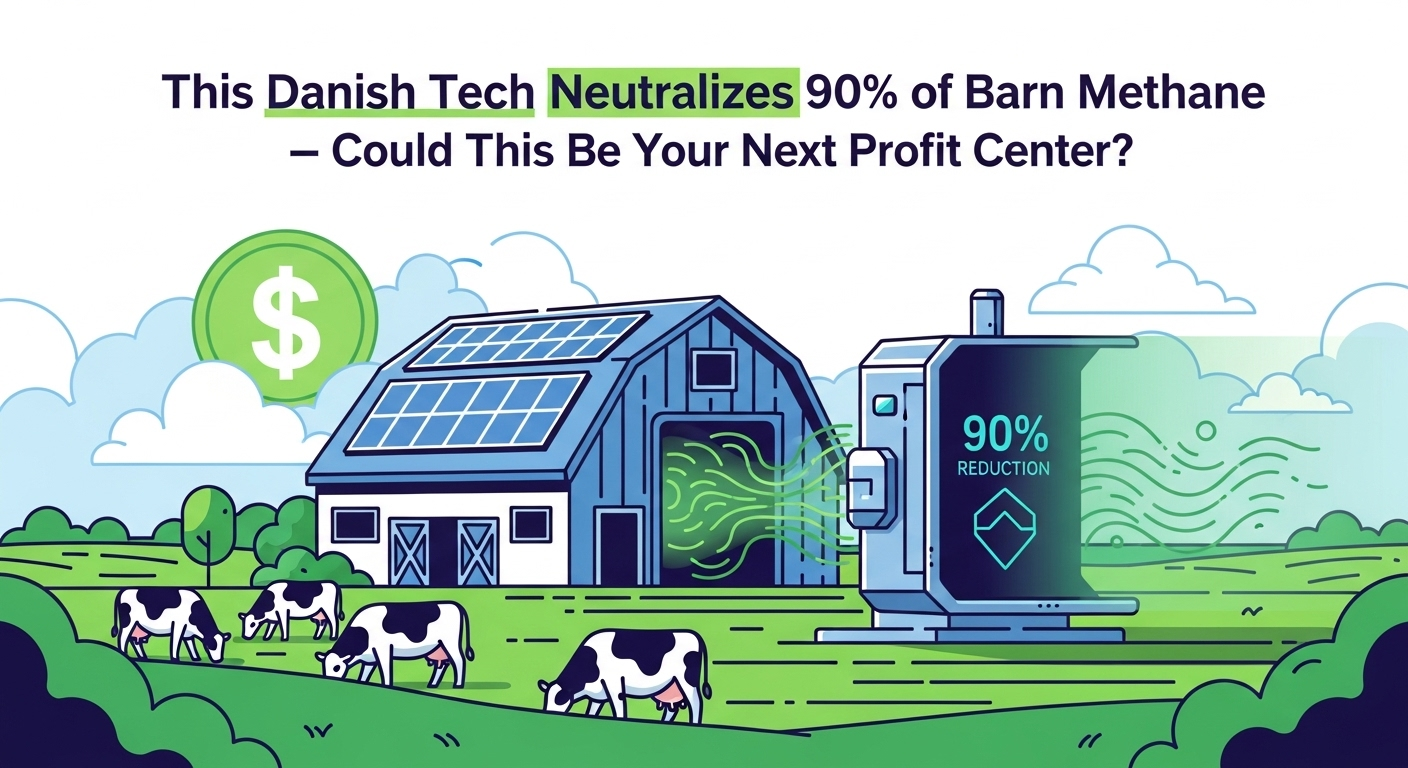
The thing about methane is it’s the stubborn problem that’s been hanging over us for years—finally, it looks like that’s changing. For dairy farmers, the hunt for a methane solution that actually makes financial sense has been relentless. However, the recent results emerging from Denmark’s PERMA project are turning heads. They’re achieving methane neutralization rates of nearly 90% using a modular container system at a 250-cow operation.
The system, known as MEPS (Methane Eradication and Photochemical System), is the product of innovation from Ambient Carbon—a spinoff from the University of Copenhagen. What’s notable here is that it focuses on capturing emissions as the air leaves the barn via ventilation, rather than trying to capture them inside the cow or the feed.
The numbers dairy producers really need to understand
Here’s the real story—MEPS targets almost all airborne emissions leaving the barn, not just reductions at the cow level. This is a big shift from biological strategies.
Think about feed additives like Bovaer. They typically reduce emissions by 25 to 30%, at a cost of $0.15 to $0.30 per cow per day. In contrast, while exact numbers are proprietary, the PERMA project suggests MEPS’s operating costs hover around $500 per tonne of CO₂ equivalent neutralized.
Dr. Matthew Johnson, Ambient Carbon’s chief science officer and co-founder, puts it simply: “Most technologies focus on methane inside the rumen, but key emissions still escape from manure and barns. Our approach captures and breaks down methane right at the barn’s exhaust.”
Talking money, Denmark’s new carbon tax kicks off at roughly $43 per tonne of CO₂ equivalent in 2030, rising to $107 by 2035—a serious cost to producers already facing feed prices north of $285 per ton and milk prices fluctuating around $18.82 per cwt as of August 2025.
Just to visualize that:
| Herd Size | Estimated Methane (tonnes CO₂e/year) | Tax at $43 (2030) | Tax at $107 (2035) |
| 500 cows | 2,000 | $86,000 | $214,000 |
| 1,500 cows | 6,000 | $258,000 | $642,000 |
| 3,000 cows | 12,000 | $516,000 | $1,284,000 |
Furthermore, carbon credit markets are evolving rapidly. Early projections suggest that verified neutralization could garner premiums between $75 and $120 per tonne—potentially turning what looks like a cost into a revenue stream.
Under the hood of the MEPS system
One of the things that makes this technology stand out is that it can handle ultra-low methane concentrations typically found in barn air—between 4 and 44 parts per million—which is significantly diluted for conventional thermal oxidation technologies that require emissions closer to 1,000 ppm.
MEPS utilizes a photochemical reactor that accelerates the natural breakdown of methane by approximately 100 million times. It harnesses chlorine atoms activated by UV light at 368 nanometers and cleverly produces chlorine onsite using saltwater electrolysis within a closed-loop system, thereby minimizing waste.
Professor Lars Stoumann Jensen from the University of Copenhagen, who led the integration studies, says, “The beauty of this system is that it fits into existing barns without the need for structural changes or disruptions to animal care.”
Supported by Innovation Fund Denmark, their trials—with partners including Aarhus University, Arla, and SKOV—confirmed no impact on barn conditions or milk quality. Furthermore, the system delivered huge co-benefits for odor management:
Ammonia (NH₃) Reduction: 94%
Hydrogen Sulfide (H₂S) Reduction: 80%
For any producer dealing with odor complaints or concerned about community relations, those numbers are game-changers.
The reality check: what this means for installation and costs
MEPS modules are container-based and modular, allowing you to scale them to your herd size—whether you manage single farms, cooperatives, or regional setups. Installation requires just power and straightforward ventilation hookups on level land.
That said, financing is a factor. Given current agricultural loan interest rates ranging from 6 to 8 percent, producers should anticipate longer payback periods compared to times of more favorable rates.
Danone’s partnership with Benton Group Dairies in Indiana is already progressing with field trials, with commercialization anticipated in 2026 or 2027. Ambient Carbon aims for scaling production to offset over a gigaton of CO₂ annually by 2030—a bold target.
With the European Union investing €1.7 billion in renewable energy projects and major food companies increasing demand for methane mitigation, the pressure and support for these technologies are real and growing.
Assessing the risks and things to consider
While MEPS relies on solid chemistry and appears less variable than biological approaches, there are still risks to consider.
Dr. Amanda Stone from Cornell’s PRO-DAIRY program flags that durability, maintenance, and overall cost of ownership will be key to adoption success.
From a producer’s perspective, it’s crucial to have clear answers on:
- Overall power consumption and how that impacts operating expenses
- Replacement timelines and costs for UV lamps and catalysts
- Maintenance requirements for the saltwater electrolysis system
Compared to the hefty capital demands and infrastructure overhaul of digesters—which can be several million dollars—MEPS offers a more accessible option that’s flexible enough for various housing types, from freestall barns to pasture-based systems.
What this means strategically for the future
This technology shifts the whole approach. Instead of focusing on changing cow biology, it targets emissions from the barn’s exhaust air.
Beyond reducing methane, the reductions in ammonia and hydrogen sulfide also help with odor mitigation—a significant community relations benefit.
Market guidance from organizations like the University of Wisconsin Extension suggests that verified neutralization credits could command premiums of 20 to 30 percent.
Its modularity means you can add capacity as your operation grows or as technology advances.
The bottom line
This Danish tech shows promise in delivering near-total barn methane neutralization.
With regulatory landscapes tightening and market demands increasing, the incentive to adopt is growing.
If you manage 500 or more cows and do not want to be caught off-guard by carbon regulations or buyer expectations, now’s the time to begin evaluating.
Sure, early adoption comes with risks—but the opportunity to reduce liabilities and unlock new revenue streams is compelling.
This industry is changing fast. The big question isn’t whether change is coming—it’s whether you’ll be ready when it does.
Complete references and supporting documentation are available upon request by contacting the editorial team at editor@thebullvine.com.
Learn More:
- 7 Ways to Cut Your Dairy’s Feed Costs Without Cutting Corners – This article offers practical strategies for optimizing feed rations and reducing waste. It provides actionable steps to lower your largest expense category now, complementing the long-term capital investment strategy discussed in the main piece.
- Is Your Dairy Business Built to Withstand the Coming Economic Storm? – Explore essential strategies for building financial resilience against market volatility. This piece reveals methods for stress-testing your business model, ensuring you can capitalize on new opportunities like carbon credits instead of being threatened by new costs.
- The Low-Methane Cow is Coming: What Will it Take to Breed Her? – Discover the genetic side of sustainability. This article explores how new genomic traits for feed efficiency and low methane can fundamentally change your herd’s environmental footprint, offering a long-term biological strategy to pair with technological solutions.
 The Sunday Read Dairy Professionals Don’t Skip.
 The Sunday Read Dairy Professionals Don’t Skip.
Every week, thousands of producers, breeders, and industry insiders open Bullvine Weekly for genetics insights, market shifts, and profit strategies they won’t find anywhere else. One email. Five minutes. Smarter decisions all week.




