







Breed low-methane cows, not feed additives: Genetics slash emissions 30% by 2050. Permanent gains, zero added costs-why isn’t every farmer doing this?

The dairy industry has been chasing methane solutions through the feed bunk for years, burning millions in research dollars on additives that work only when you feed them. Meanwhile, the real game-changer has been hiding in your semen tank. Multiple countries are now implementing genetic evaluations for methane efficiency that could deliver a 20-30% reduction in emissions by 2050 while potentially improving your bottom line. Unlike expensive additives that vanish when you stop feeding them, genetic improvements compound every generation like the gains you’ve already banked for production and type. Isn’t it time we stopped treating symptoms and started breeding the problem away?
The Methane Reality You Can’t Ignore

Let’s cut through the bull: your cows are methane factories. The average Holstein belches out approximately 180kg of methane annually, with up to 30% variation between individual animals in the same barn. That’s a difference of up to 110kg of methane per cow annually between your highest and lowest emitters in the same free stall, eating the same TMR, under identical management.
Why should you care? Methane packs a 25-27 times more potent climate punch than carbon dioxide, making it a primary target for regulators eyeing agriculture. But here’s what your feed rep won’t tell you: that belched methane doesn’t just impact the environment but represents wasted feed dollars. Every time your cows burp, they lose 4-12% of their gross energy intake.
Think about that for a second. You’re watching that TMR mixer wagon deliver $7-8 per cow of feed daily, and up to 12% of your investment is being burped into thin air. Would you tolerate a milk parlor that spilled 12% of your production on the floor? Of course not. Yet we’ve accepted this energy loss as inevitable rather than breeding it away.
The Genetic Opportunity Your AI Company Should Be Shouting About

If a feed company discovered a product that could permanently reduce methane emissions by 20% and potentially improve feed efficiency, they’d be marketing it with Super Bowl ads. Yet, genetics companies have been surprisingly quiet about what might be their most valuable product.
The most revolutionary aspect of this entire conversation is surprisingly straightforward: the amount of methane a cow produces is partly determined by her genetics, just as heritable as components or type traits you’ve been selecting for decades.
Research has conclusively established that methane emission traits have moderate heritability (0.11 to 0.45), like the fertility traits you’ve selected successfully. In practical terms, selecting for lower-methane genetics works as effectively as selecting for production, components, or conformation.
“But won’t selecting for lower methane wreck my production?” This is exactly where outdated thinking needs correction. Countries implementing methane evaluations aren’t measuring raw methane output- they’re measuring methane efficiency, defined as methane production that’s genetically independent of milk, fat, and protein yields.
This critical distinction means you can select for lower methane emissions without compromising productivity. It’s like how we’ve managed to choose for both production and fertility simultaneously despite their natural antagonism. You can have environmentally friendly cows that still fill the bulk tank.
While You’ve Been Mixing Additives, These Countries Have Been Changing Genetics
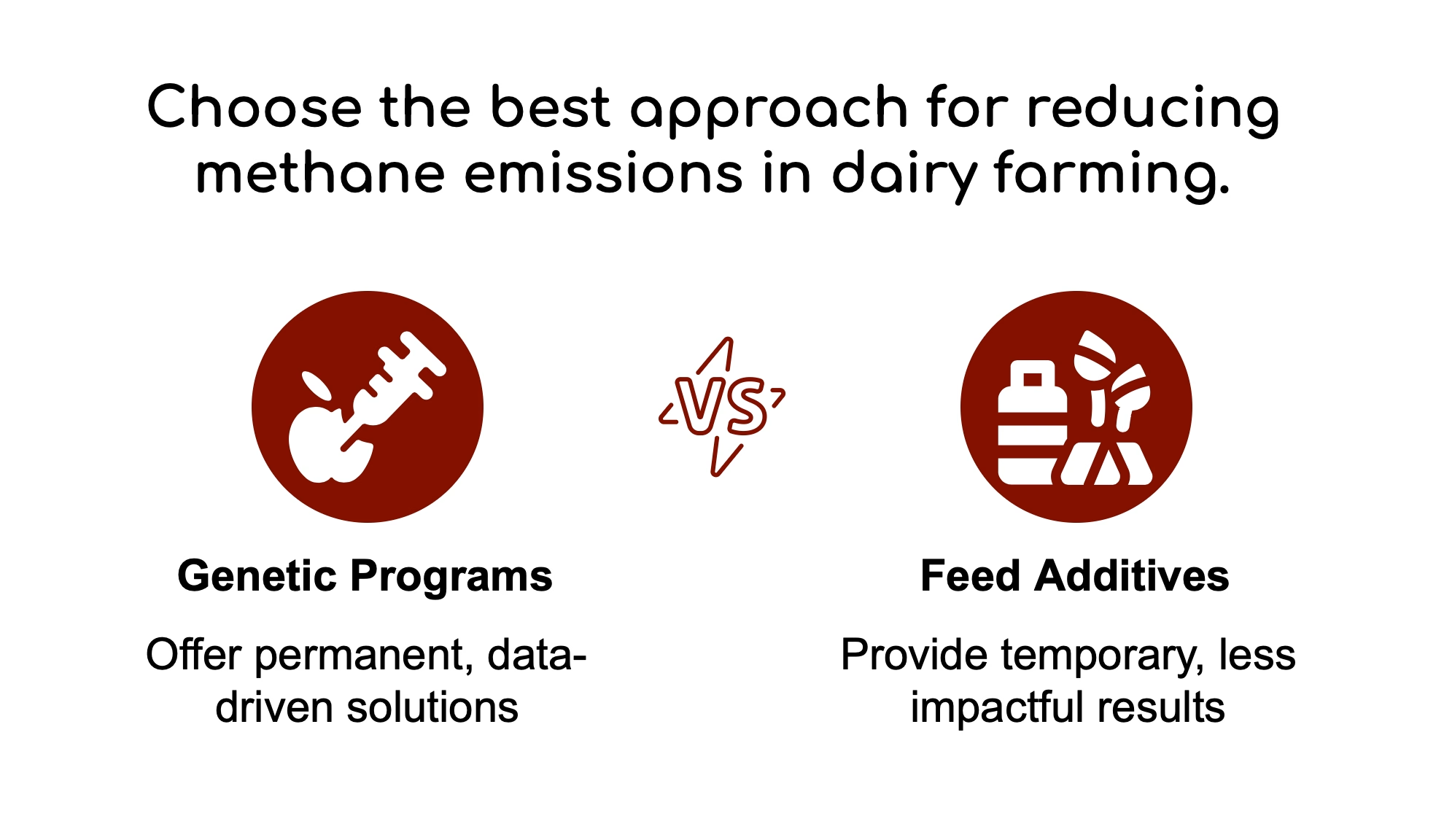
While feed companies have been selling you expensive methane-reducing additives with temporary effects, several countries have quietly revolutionized their genetic programs to address methane permanently.
Canada: First to Market While Others Hesitated
In April 2023, Lactanet Canada became the first country to publish official Methane Efficiency genetic evaluations for Holsteins. Their system expresses breeding values on a scale 100, with higher values indicating more desirable (lower) emissions. Each 5-point increase represents approximately 3 kg less methane per cow per year.
What does this mean in your breeding program? Selecting sires with a Methane Efficiency RBV of 105 or higher will produce approximately 8 g/day (3 kg/year) less methane than daughters of average sires. Stack that advantage over three generations, and you’re looking at significant reductions-like the way three generations of selecting for DPR finally pulled your herd’s preg rate up by 10 points.
Spain: Getting Real Data While Others Theorized
Spain became the second country to implement methane evaluations in 2023 but with a significant difference: the system is based on direct measurements using sniffer technology in commercial herds. While more logistically challenging, this approach provides evaluations using on-farm measurements rather than predicted values.
Why does this matter? Because the Spanish system proves, these differences exist in real-world barns, not just research facilities with fancy equipment.
The Netherlands: Taking Climate Smart from Slogan to Reality
The Netherlands launched its methane breeding value in April 2025, based on extensive data collected through the “Climate Smart Cattle Breeding” project. Their evaluation shows moderate heritability (~0.35) and aims for an annual reduction of about 1% in methane emissions.
Each point on their methane index represents about 9 grams per day of methane-roughly the exact amount your cows release during a single rumination cycle. Dutch farmers aren’t just discussing sustainability- they’re breeding for it.
Denmark and the Nordic Countries: Business as Usual Innovation
Denmark, through VikingGenetics, published methane evaluations in April 2025 based on sniffer data collected across the three Nordic countries. Suppose you’ve used Viking bulls in your herd. In that case, you might already be breeding for lower methane without realizing it, like how you’ve been indirectly selecting for feed efficiency when choosing higher-production bulls.
But here’s the uncomfortable truth: American breeders and AI companies have been frustratingly slow to adopt these innovations, leaving U.S. dairy farmers behind the curve on this valuable trait. Will we wait until regulations force our hand or lead the way by choice?
The Great Measurement Debate: Perfect Data vs. Practical Progress
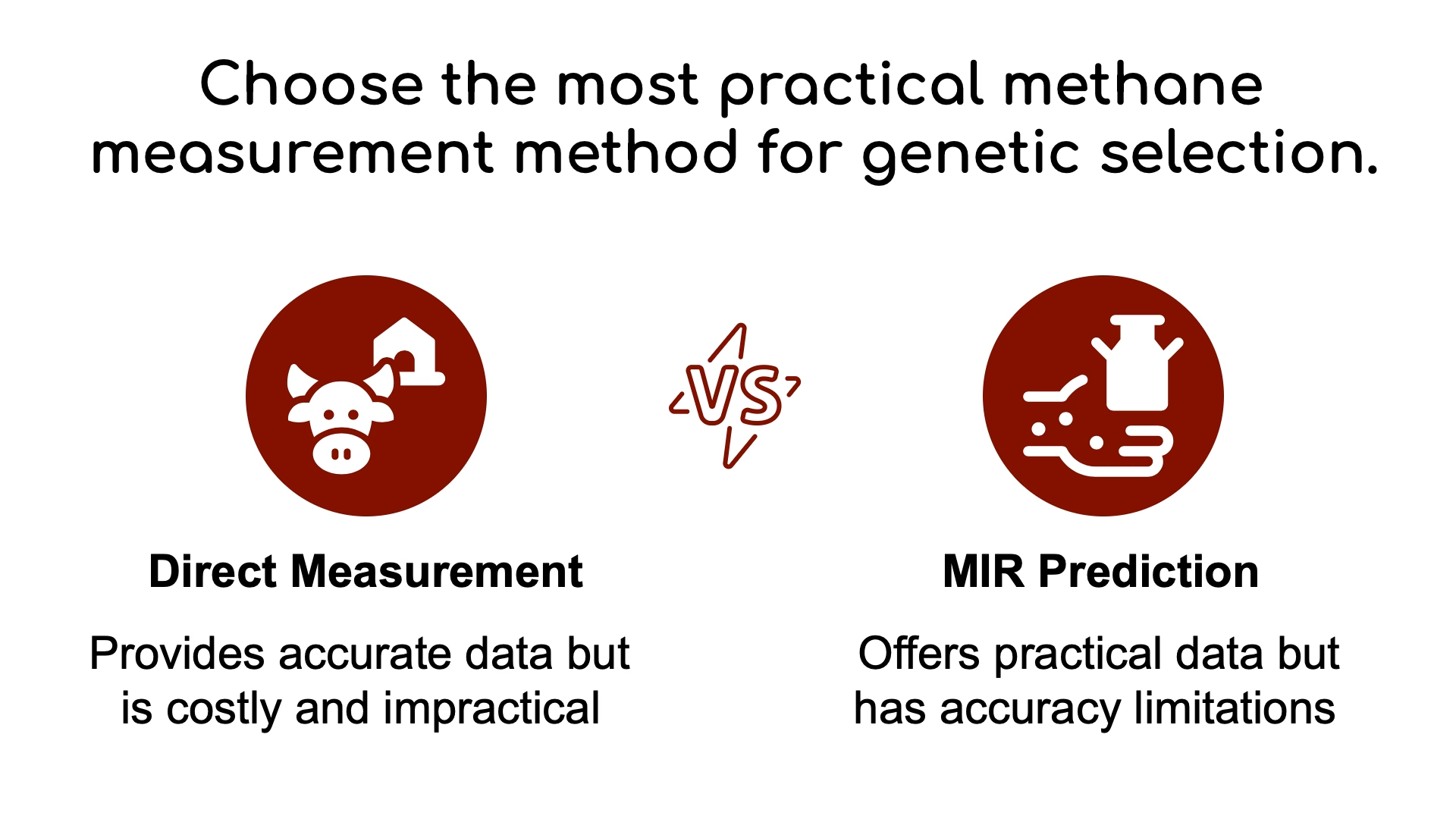
The expansion of national methane evaluations has sparked an ongoing debate about measurement methods as heated as the TMR mixer argument between vertical and horizontal.
Direct Measurement: Getting Real Data
Direct measurement technologies include:
- Respiration Chambers: The gold standard for accuracy but impossibly expensive for commercial use. Think of these as the equivalent of individual cow feed efficiency testing- incredibly accurate but impractical.
- GreenFeed Systems: Commercial systems that measure emissions while cows visit a feed station. These C-Lock Inc. units work like out-of-parlor feeders for robotic dairies-cows voluntarily visit for a treat while emissions are measured.
- Sniffer Systems: More affordable sensors installed in milking robots or feeding stations. If you have robots, your facility could be equipped with these systems, capturing data every time a cow visits for milking.
Direct measurement provides the most accurate data but faces significant challenges in cost, limited throughput, and specialized equipment that isn’t practical on most commercial farms. It’s like saying every dairy should measure individual cow intake daily in theory, but it is impossible in practice.
MIR Prediction: The Controversial Shortcut That Works
The alternative approach by Canada, which several countries have adopted, uses milk mid-infrared (MIR) spectroscopy to predict methane emissions.
The primary advantage? You’re already collecting milk samples for your monthly DHI testing. The data exists. It’s just a matter of analyzing it differently. Your milk samples generate component percentages, SCC, MUN, and fatty acid profiles. Now, they can predict methane, too.
Critics argue that MIR provides only an indirect prediction with limitations in accuracy. But here’s the critical point they’re missing genetic correlation between MIR-predicted methane and directly measured methane has been reported to be high (around 0.85), making it more than adequate for genetic selection purposes.
The debate ultimately comes down to a practical trade-off: perfect data from a few thousand cows or good enough data from millions. The latter approach certainly has its advantages for genetic selection to work at scale. For example, we’ve been selecting for DPR using 60-day pregnancy checks rather than directly measuring individual conception rates.
Why Feed Additives Are a Band-Aid, not a Cure

Let’s be brutally honest about what the industry isn’t telling you: Feed additives will never solve the methane problem long-term. Here’s why:
Permanence vs. Temporary
Feed additives work only when you feed them. Stop the additive, and methane goes right back to baseline levels. Genetic progress, by contrast, is permanent and cumulative. Each generation builds on the gains of the previous one, with no ongoing cost after implementation. It’s like the difference between feeding buffers to combat acidosis versus breeding cows with stronger feet and legs-one requires continuous input. At the same time, the other becomes part of your herd’s genetic foundation.
Cost Structure: Upfront vs. Perpetual
The economics dramatically favor genetic approaches in the long run. Feed additives add a perpetual cost to your ration. With tight margins squeezing dairy profits, adding $0.05-0.15/cow/day for an additive with no production benefit makes little economic sense without carbon pricing or premiums for low-emission milk.
At $0.10/cow/day, you’re looking at $3,650 annually for a 100-cow, enough to pay for genomic testing of your entire heifer crop and some. What would you rather have: a temporary solution that costs you daily or a permanent one that compounds over generations?
Practical Implementation: Theory vs. Reality
Feed additives face serious practical challenges. Have you ever tried to supplement grazing cows? Then you know the frustration of variable intake. Even in confinement, ensuring consistent consumption presents challenges. Genetic selection works regardless of your feeding system or management approach, just like selecting for smaller body size works whether your cows are in tie-stalls or on pasture.
The Bottom-Line Comparison
| Strategy | Reduction Potential | Cost Structure | Permanence | Practical Challenges |
| Genetic Selection | 20-30% by 2050 | High initial research cost; minimal ongoing farmer cost | Permanent, cumulative | Slower initial impact; requires industry-wide adoption |
| Feed Additives (e.g., Bovaer, Asparagopsis) | 10-30% immediately | Ongoing daily feeding cost ($0.05-0.15/cow/day) | Temporary; stops when feeding stops | Delivery challenges; regulatory approval; variable response |
| Management (e.g., longevity) | 5-15% | Variable | Semi-permanent | Requires consistent implementation |
When you look at this comparison, the choice becomes obvious. So why are we still pouring millions into temporary solutions?
Beyond Environmental: The Efficiency Your Nutritionist Missed

Here’s where the story gets even more compelling for your bottom line. Remember that methane represents lost energy up to 12% of gross energy intake. That’s like filling your milk tank but having a valve leaking 12% onto the floor before the truck arrives.
While the relationship is complex, research has found moderately favorable genetic correlations between feed efficiency (measured as Residual Feed Intake) and methane production. This makes intuitive sense: animals that convert more feed energy into milk rather than methane are inherently more efficient.
Ask yourself this question: What would that mean for your profitability if breeding could eventually redirect even a portion of that 4-12% lost energy toward productive purposes? That’s like getting an extra 2-6% of your feed bill back in the bulk tank. At today’s feed costs, can you afford to ignore that potential?
What This Means for Your Operation-Today, Not Tomorrow
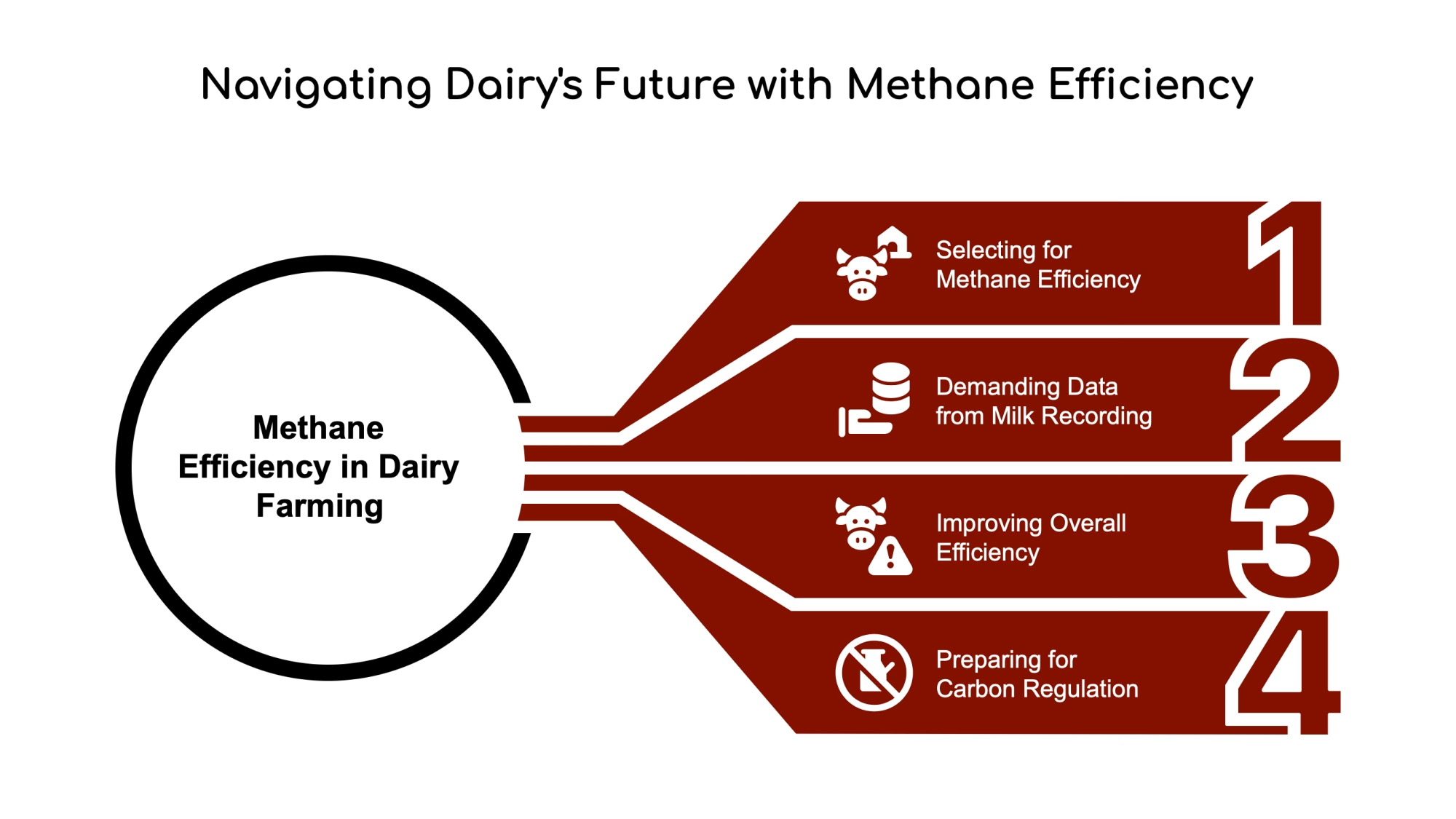
So, how does this emerging science translate to practical action on your farm? Here are the key takeaways:
1. Start Selecting for Methane Efficiency Now, Not Later
If you’re in a country with methane evaluations already available (Canada currently, with several others launching in 2025), start considering methane efficiency in your selection decisions. Look for bulls with Methane Efficiency RBVs of 105 or higher to make steady progress.
Don’t abandon your current selection priorities. The beauty of the trait definition is that you can select for lower methane without sacrificing production, components, health, or fertility. Add it to your selection criteria, such as you might have added immune response or feed efficiency in recent years.
2. Demand Data from Your Milk Recording Service
The accuracy of genetic evaluations depends on quality data. If your milk recording organization isn’t collecting valuable MIR data for methane predictions, it’s time to ask why not. Participate in specialized testing programs if offered- the data helps the entire industry. If you can participate in direct measurement research (sniffers or GreenFeed), consider it an investment in the industry’s future.
3. Look at the Broader Efficiency Picture
While direct methane selection is powerful, remember that overall efficiency improvements, such as better fertility, improved health, and extended longevity, also reduce your environmental footprint. A cow that produces six lactations instead of three spreads its ecological impact across twice as much lifetime production. Keep pushing those metrics that extend productive life, just like you’ve been doing with Productive Life or Daughter Pregnancy Rate.
4. Get Ahead of Regulation Before It Gets Ahead of You
Make no mistake- carbon regulation is coming into play in dairy. The EU is already moving toward carbon labeling for food products. Markets like California are implementing carbon pricing that affects agriculture. Isn’t it better to position your herd ahead of these trends rather than scrambling to comply after regulations are imposed?
The forward-thinking producers who started selecting for A2A2 beta-casein years before it commanded a premium are now reaping the rewards. The same opportunity exists with methane efficiency.
What’s Next: Innovations You’ll See Soon
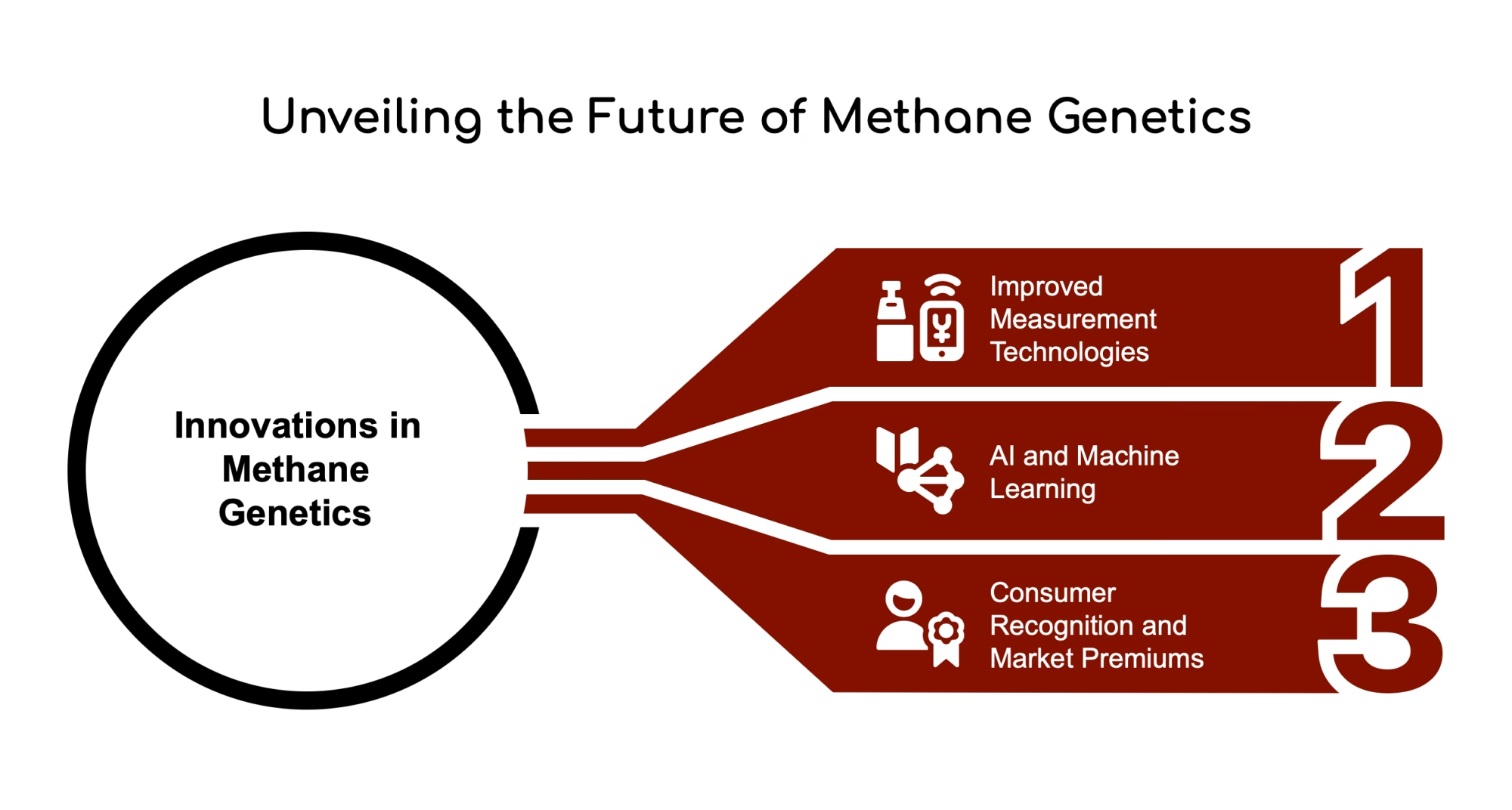
The field of methane genetics is rapidly evolving. Here’s what to watch for:
Improved Measurement Technologies
Research continues more affordable, robust sensors for on-farm methane measurement. Technologies like wearable collars or rumen boluses for continuous monitoring are in development, potentially making direct measurement far more accessible to how rumination monitoring evolved from research tools to standard equipment.
AI and Machine Learning
Advanced artificial intelligence and machine learning algorithms are being employed to improve the accuracy of predicting methane emissions from proxy data like milk MIR spectra. These technological advances could dramatically enhance our ability to identify low-methane genetics, like how genomic evaluation has evolved from low-reliability predictions to standard practice in just a decade.
Consumer Recognition and Market Premiums
As climate awareness grows, processors and retailers should develop programs around low-carbon dairy products. Forward-thinking producers who’ve already started breeding for methane efficiency will be positioned to capture premium opportunities when they emerge-just like organic or grass-fed programs rewarded early adopters.
The Bottom Line
Be clear: Breeding for reduced methane emissions represents a fundamental shift in how we approach dairy’s environmental footprint. Unlike expensive additives or complex management changes, genetic selection offers a simple, permanent solution that compounds over generations-like compound interest in your retirement account.
The real power of this approach is its integration with your already-making breeding decisions. You don’t need special equipment, daily implementation, or ongoing costs the willingness to consider one more trait when you open that semen catalog.
The global dairy industry stands at a critical juncture. We can continue treating symptoms through additives and interventions or address the root cause through genetics. The countries pioneering methane efficiency evaluations show us that breeding for fewer burps isn’t just possible- it’s practical and increasingly necessary.
Here’s my challenge: Look at your following sire selection and ask whether you’re planning for the regulatory environment of 2030 or just trying to get through another breeding season. Are you selecting bulls that will position your herd for the future, or are you still breeding the same way you did in 2010?
The genetics you select today will determine not just your production and profitability tomorrow but also your environmental footprint and regulatory compliance for generations. When it comes to methane, the best solution might not be what you feed your cows, but which bulls you choose to breed them.
Now that’s something worth ruminating on while pulling those 2 AM fresh cow treatments.
Key Takeaways:
- Global Shift: Canada, Spain, and Netherlands lead methane genetics-using milk data, sniffers, and sensors to slash emissions without sacrificing milk yield.
- Genetic > Additives: Breeding delivers permanent cuts (1-2%/year) vs. additives’ fleeting effects-no daily costs or compliance headaches.
- Milk’s Hidden Data: Mid-infrared spectroscopy turns routine milk tests into methane predictors, enabling mass-scale genetic evaluations.
- Efficiency Bonus: Low-methane cows redirect 4-12% wasted feed energy to production, aligning sustainability with profitability.
- Farmer Action Needed: Early adopters gain carbon-market edges-select sires with 105+ methane RBVs and demand MIR testing from co-ops.
Executive Summary:
Dairy farmers worldwide are adopting genetic evaluations to breed cows that produce 20-30% less methane by 2050, leveraging methods like milk spectroscopy (Canada), sniffer tech (Spain), and GreenFeed systems (Netherlands). These programs target heritable methane traits while maintaining productivity, offering permanent emission cuts versus temporary fixes like additives. With methane efficiency now in national breeding indexes, selecting top sires could save 3kg methane/cow/year-compounding over generations. The industry’s pivot to genetics challenges reliance on costly feed solutions, positioning breeding as the most scalable, cost-effective climate tool for modern dairies.
Learn more:
- Reducing Methane Emissions from Dairy Cows: Practical Strategies for Mitigating Rumen Methane Production
Explores actionable methods like feed additives, dietary adjustments, and rumen modifiers to reduce methane emissions alongside genetic strategies. - Milking Progress: The Green Revolution in US Dairy Farming
Highlights broader sustainability initiatives, including methane capture technologies and renewable energy integration, contextualizing genetic improvements within holistic farm practices. - Dairy Cattle Genomics is Quietly Improving Sustainability
Details how genomic advancements since 2008 have boosted feed efficiency, longevity, and emissions reduction, reinforcing the long-term impact of genetic selection.
 Join the Revolution!
 Join the Revolution!
Join over 30,000 successful dairy professionals who rely on Bullvine Weekly for their competitive edge. Delivered directly to your inbox each week, our exclusive industry insights help you make smarter decisions while saving precious hours every week. Never miss critical updates on milk production trends, breakthrough technologies, and profit-boosting strategies that top producers are already implementing. Subscribe now to transform your dairy operation’s efficiency and profitability—your future success is just one click away.




