






Six workers dead in a manure pit. A $75M dairy bankrupt. A cow sells for $1M. One industry. One year. Ten lessons you can’t afford to skip.
What farmers need to know: The year 2025 brought record-breaking highs and gut-wrenching lows to dairy operations across North America. From a single cow selling for $1 million at the International Intrigue Sale to six workers dying in a Colorado manure pit, this year exposed the stark divide between those thriving and those struggling to survive. North Dakota’s collapse from 1,810 dairy farms in 1987 to just 24 today offers a sobering preview of what’s coming for operations that fail to adapt. Whether you’re milking 100 cows or 5,000, this analysis breaks down the 10 stories that shaped our industry—and what they mean for your operation heading into 2026.
A Year That Demanded Answers
Look, I’ve been covering this industry for a while, and I can’t remember a year quite like this one. The headlines of 2025 felt like they were written by someone with a cruel sense of irony—one day we’re celebrating million-dollar genetics, the next we’re mourning families torn apart by preventable tragedies.
What’s interesting here is how interconnected these stories actually are. The financial pressures driving consolidation in North Dakota aren’t separate from the safety lapses in Colorado or the infrastructure failures in Quebec. They’re all threads in the same fabric. When margins tighten, something gives. Sometimes it’s a maintenance schedule. Sometimes it’s a safety protocol. Sometimes it’s a family’s entire future.
Here’s something the industry doesn’t want to admit: our obsession with scale is killing us. Literally. The pressure to grow bigger, milk more cows, and cut more costs has created conditions in which safety equipment becomes “optional,” and electrical inspections are pushed to “next quarter.” We saw the consequences play out in real time this year.
These aren’t just news items to scroll past. They’re lessons—expensive ones paid for by our neighbors—that every dairy professional needs to internalize before the calendar flips to 2026.
The Countdown: What 2025 Taught Us
#10. External Threats: The Lancaster County Livestock Shootings

Here’s something that shouldn’t happen in America: dairy farmers waking up to find their cows shot dead in their barns.
In a coordinated pre-dawn attack on March 15, shooters targeted multiple dairy farms in Lancaster County, Pennsylvania, killing productive Holstein cows and injuring a horse. Pennsylvania State Police confirmed the attacks hit operations in both Colerain Township and Sadsbury Township within hours of each other.
The economic impact goes way beyond what most people realize. Each slain cow didn’t just represent her $2,000-2,500 replacement cost—she represented up to $92,000 in lifetime milk production potential. Years of careful breeding decisions. Gone in seconds.
What really struck me about this story was the community response. Within days, local farmers had organized a GiveSendGo fundraiser for the affected families, demonstrating what agricultural solidarity actually looks like when the chips are down.
The uncomfortable truth? Rural security can’t be an afterthought anymore. Isolated locations and limited law enforcement presence make dairy operations uniquely vulnerable. If you haven’t evaluated your surveillance systems and community alert networks lately, this is your wake-up call.
Read more: Senseless Livestock Shootings Rock Lancaster County: Community Rallies Behind Affected Farmers
#9. Infrastructure Risk: The Buckland Holsteins Barn Fire
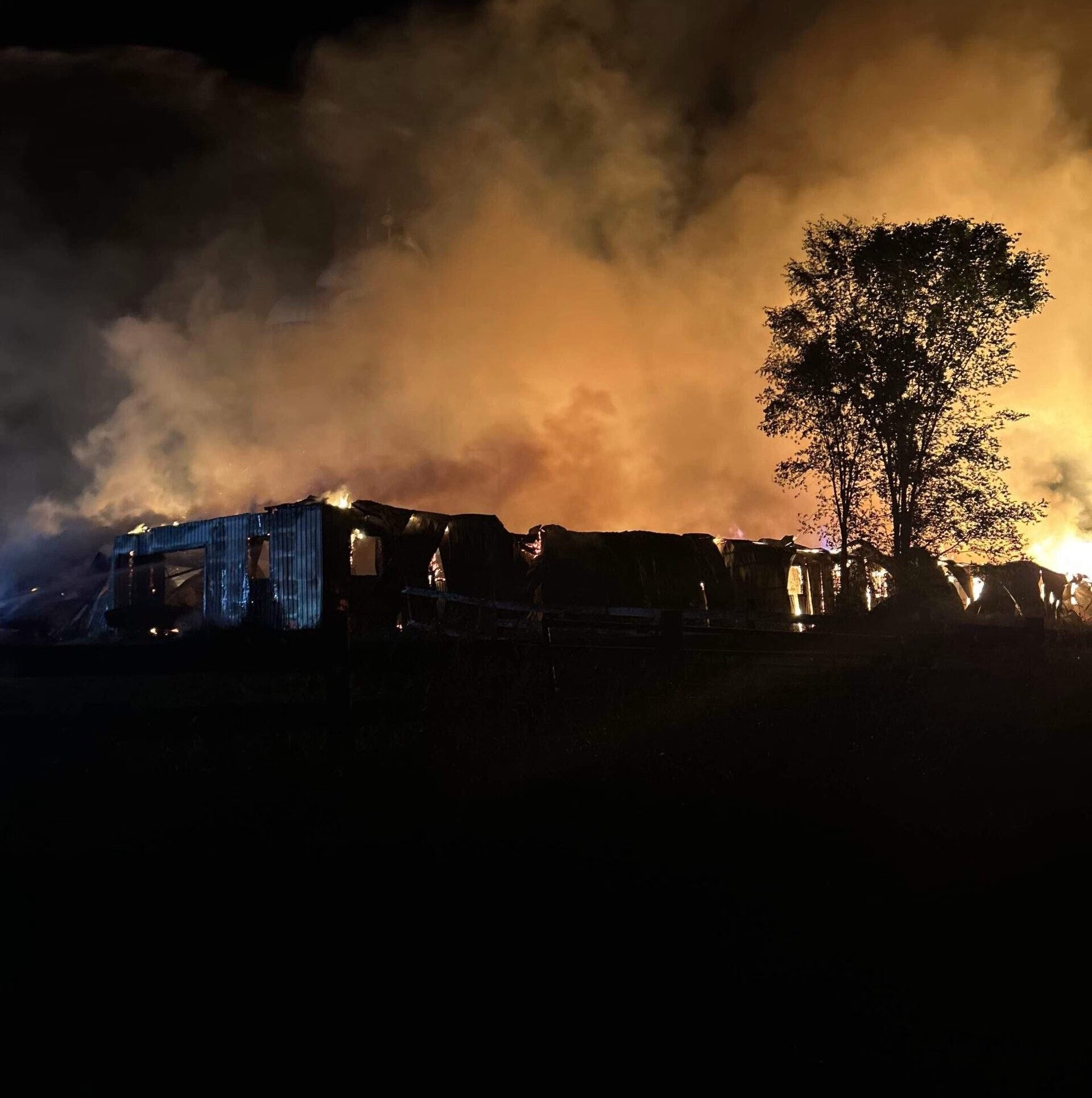
On June 26, a seven-generation dairy operation near Coaticook, Quebec, went up in flames. Over 160 Holstein cattle—including approximately 100 milking cows and 65 bred heifers—perished in the early-morning blaze at Buckland Holsteins.
Angus MacKinnon, owner and seventh-generation operator of Buckland Holsteins, told reporters the family’s electrical monitoring system detected a spike at 1:35 AM—nearly 30 minutes before anyone noticed the fire. By the time his brother alerted him just after 2:00 AM, “the building was entirely consumed. There was nothing we could do.”
This development suggests a troubling aspect of our industry’s approach to risk management. The MacKinnon family had monitoring equipment in place. They were doing things right. But detection without automated response only gets you so far.
The financial losses are staggering. Based on current Holstein replacement costs of $1,500-2,000 per head, the livestock losses alone represent $240,000-320,000 (The Bullvine, June 26, 2025). But that’s just the cows. A concrete silo containing 400 tons of silage continues to smolder and is expected to burn for approximately 6 months due to its inaccessibility—another $100,000-plus in losses.
Here’s what farmers are finding: when financial margins tighten, infrastructure investment gets deferred. Electrical systems in livestock facilities are constantly exposed to humid, corrosive atmospheres that accelerate degradation. And only five U.S. states mandate agricultural fire protection (National Fire Protection Association data, 2024). That gap between what we should be doing and what we can afford to do? That’s where catastrophes happen.
Read more: Devastating Quebec Barn Fire at Buckland Holsteins Claims 160+ Holstein Cattle
#8. Farm Safety: Reed Hostetler’s Final Legacy
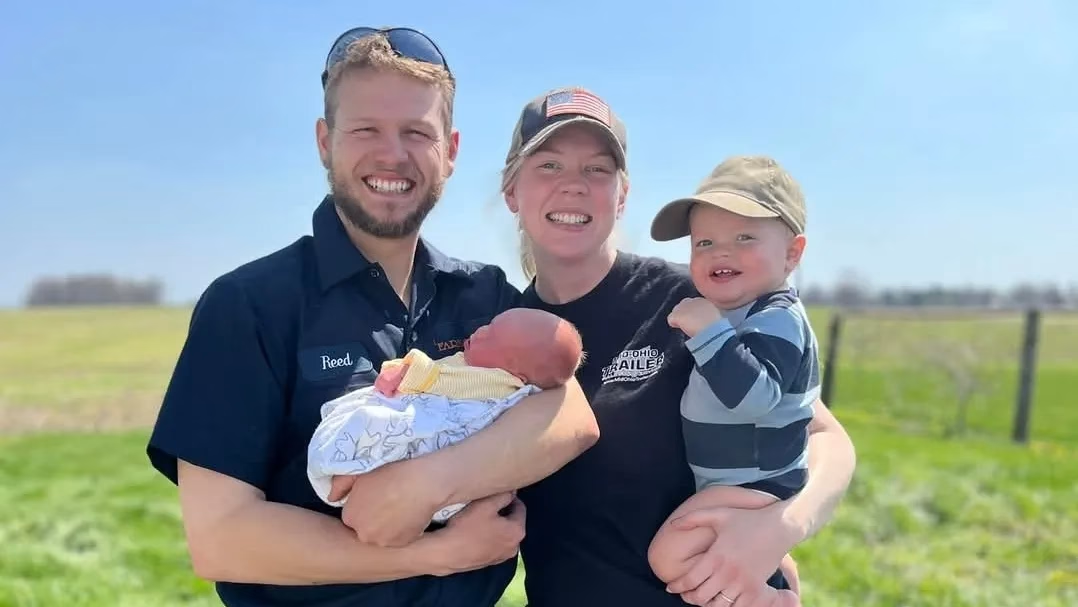
On March 5, 2025, the dairy community lost Reed Hostetler—a 31-year-old Ohio dairy farmer, husband, and father of three young children—in a farm accident at his family’s operation in Marshallville.
According to news reports, Reed drowned in a manure pit after the tractor he was operating tipped over. His two brothers acted immediately to try to save him, but the lagoon proved impossible to navigate in time.
What makes this loss especially heartbreaking isn’t just the statistics—though they’re damning enough. It’s who Reed was. He had hiked the entire Appalachian Trail. Rode bulls. Did mission work in Thailand. He was co-owner of L&R Dairy Farm and, by all accounts, one of those people who made everyone around him better.
He leaves behind his wife, Abby, and their children: Baer (4), Claire (2), and Axe (1).
I’ve noticed that we tend to talk about farm safety in abstract terms—statistics, protocols, equipment recommendations. But behind every number is a family like the Hostetlers. The Marshallville community rallied around them, organizing support and holding Reed’s funeral service right there on the family dairy. That’s beautiful. It’s also a reminder that these aren’t distant tragedies. They’re our neighbors.
Read more: A Father’s Final Legacy: What Reed Hostetler’s Tragic Loss Can Teach Every Dairy Farm
#7. Financial Peril: Dykman Dairy’s $75 Million Collapse

When one of British Columbia’s largest dairy operations buckled under $75 million in debt, it sent shockwaves through an industry already grappling with rising interest rates and tightening margins.
In late 2024, a B.C. Supreme Court judge placed Dykman Dairy into creditor protection following a default application from the Bank of Nova Scotia (CBC News, December 10, 2024). By early 2025, the case had become a cautionary tale studied across the industry.
The numbers tell a story of ambition outpacing discipline. For decades, the farm’s debt increased by approximately $800,000 annually as it expanded facilities and acquired quota. When interest rates climbed from 2% to 7%, monthly interest payments soared to $465,000, against income from 27,000 liters of daily milk production that couldn’t keep pace (The Bullvine, January 3, 2025).
Then came the 2021 floods. The Sumas Lake disaster added unexpected costs to an already stretched operation, exposing just how thin the margins had become.
The case ignited fierce debate about lender responsibility. Critics argued Scotiabank engaged in over-lending that enabled the farm’s precarious expansion (The Bullvine Industry Analysis, January 2025). But here’s the thing: pointing fingers doesn’t fix broken balance sheets. What Dykman’s collapse really demonstrates is how quickly aggressive growth strategies can unravel when external conditions shift.
This is the microeconomic reality behind the consolidation trend. When the average producer sees mega-dairies struggling with debt loads like this, it raises uncomfortable questions about scale itself.
Read more: Dykman Dairy’s $75 Million Debt Crisis: Mismanagement or Misfortune?
#6. Genetic Gold Rush: Million-Dollar Madness at International Intrigue
And then there’s the other side of the coin.
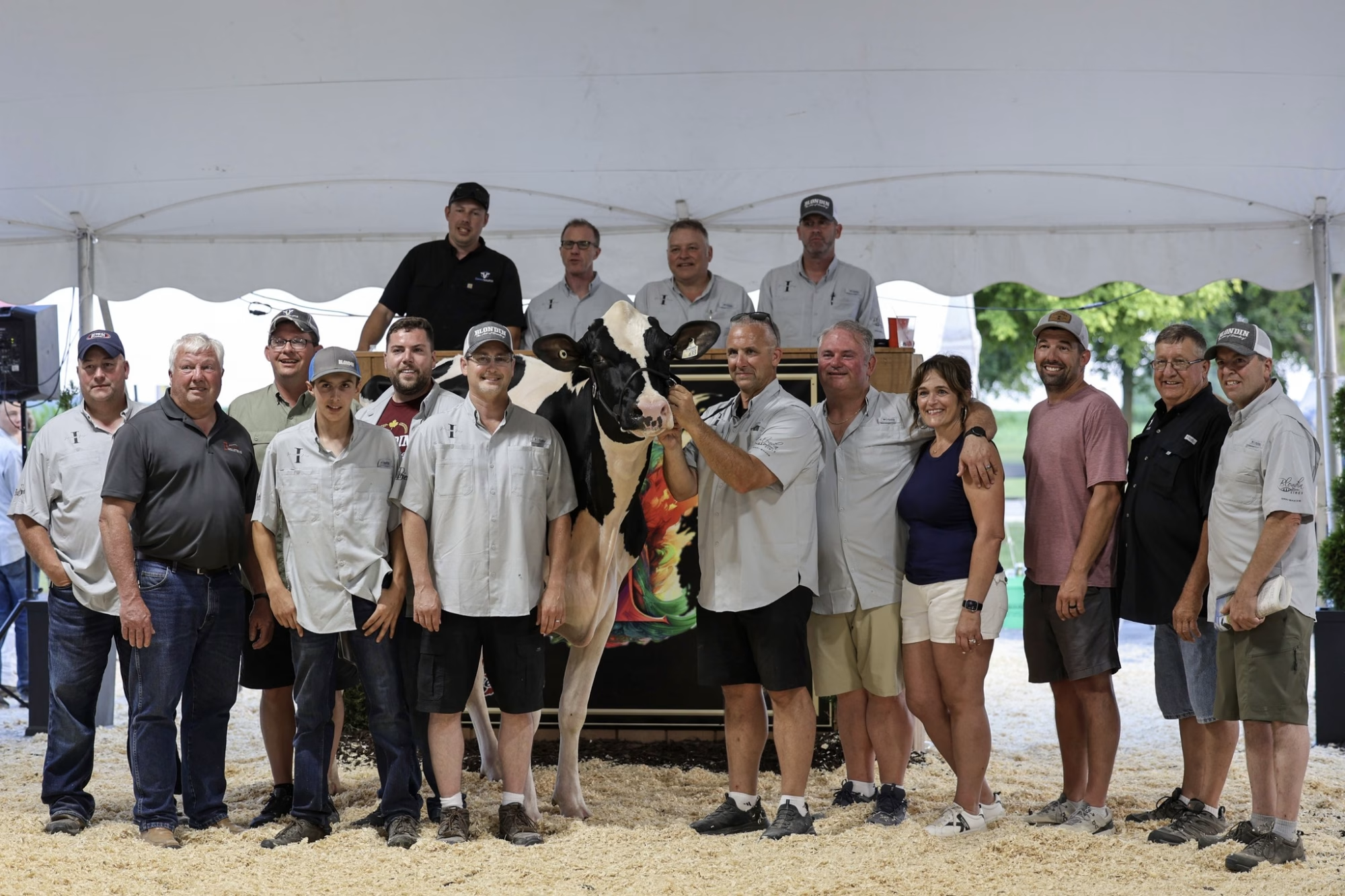
On July 2, the International Intrigue Sale at Butlerview Farm in Chebanse, Illinois, shattered expectations when 173 live lots sold for a combined $4.3 million—an average of over $25,000 per animal.
But the real headline came after the catalog closed. Olortine Avenger Design VG-89-CAN 2yr., an Ontario-bred senior three-year-old who had already won Grand Champion at Western Dairy Expo 2025, the All-Canadian Winter Two-Year-Old in 2024, and Intermediate Champion at the Royal Agricultural Winter Fair, received a substantial post-sale offer from GenoSource. Rather than accept privately, her owners opened bidding to the room.
GenoSource’s $1 million bid held. Just like that, Design became the newest million-dollar cow—and a symbol of the extreme polarization defining today’s dairy market.
What this tells us is pretty straightforward: the demand for elite, high-performance genetics has never been stronger. While operations like Dykman Dairy collapse under debt, buyers are writing seven-figure checks for animals with exceptional type scores and show-ring pedigrees.
The second-highest seller reinforced the point even more dramatically for genomics-focused buyers. Jacobs Lambda Baz commanded $320,000—and her appeal went far beyond the ring. Sired by the genomic powerhouse Farnear Delta-Lambda-ET (+753M, GTPI +2909), Lambda Baz represents everything today’s component-focused market demands: her production record of 128 pounds with 5.1% fat and 3.9% protein demonstrates the butterfat and protein premiums that drive modern milk checks (The Bullvine, July 2, 2025).
Two economies. Same industry. Pick which one you’re competing in.
Read more: Million-Dollar Madness Rocks International Intrigue Sale
#5. Strategic Success: What the USDA Study Revealed

When Farm Futures released their “Best Places to Farm” analysis—a comprehensive 20-year study examining financial performance across 3,056 U.S. counties—the results challenged some long-held assumptions about what makes agricultural regions successful.
The methodology was rigorous: counties were ranked by average weighted scores for return on assets, profit margins, and asset turnover, using USDA Census of Agriculture data from 2002 through 2022.
The winner? Kershaw County, South Carolina.
Not Iowa. Not Wisconsin. South Carolina.
Here’s why that matters: Kershaw County’s average farm size is just 175 acres, and fewer than one in five operations earns more than $100,000 annually. By conventional wisdom, that profile shouldn’t produce top financial performance.
But Kershaw’s farmers figured something out. Poultry accounts for 97% of the county’s agricultural sales, allowing operators to achieve remarkable returns on assets and superior profit margins through high turnover and lower land costs. They’ve insulated themselves from weather volatility and commodity price swings by specializing in exactly the right enterprise for their conditions.
The contrast with traditional Corn Belt regions is instructive. High land prices and weather exposure continue to pressure crop-focused counties, while Southeast operations excelling in cost-effective poultry and integrated livestock systems consistently outperform.
This isn’t an argument against dairy. It’s an argument for strategic adaptation—understanding your specific geographic, economic, and market context and optimizing accordingly rather than chasing scale for its own sake.
Read more: Top 10 Best Places to Farm in the U.S. Revealed by 20-Year USDA Study
#4. Systemic Shock: The FDA’s Milk Testing Suspension

On April 21, 2025, just days after the NCIMS Conference concluded, the FDA abruptly suspended its Grade A milk proficiency testing program—and most state regulators learned about it from media reports.
The program doesn’t test individual farms’ milk directly. Instead, it ensures that the hundreds of laboratories analyzing dairy samples across the country produce consistent, accurate results. It’s the federal quality assurance check that keeps the entire system calibrated.
An internal FDA email obtained by Reuters explained the suspension: the agency’s Moffett Center Proficiency Testing Laboratory “is no longer able to provide laboratory support for proficiency testing and data analysis” following workforce reductions at the Department of Health and Human Services that eliminated roughly 20,000 positions.
The timing couldn’t have been worse. Labs had already tested the 2025 annual proficiency samples—results were due April 11—but there was suddenly no capacity to analyze or validate them.
To be clear: milk remains safe. Jim Mulhern, President and CEO of the National Milk Producers Federation, issued a statement emphasizing that rigorous testing continues at state and processor levels. The International Dairy Foods Association echoed this assurance. But the lab oversight gap creates real risk. Without federal proficiency verification, laboratories may struggle to maintain accreditation, testing consistency could erode, and consumer confidence—hard-won over decades—could be damaged.
Here’s what the industry PR statements won’t tell you: we got lucky. If this suspension had coincided with another avian influenza outbreak in dairy herds, the confidence gap could have become a full-blown crisis. The H5N1 detections in dairy cattle throughout 2024-2025 prompted consumers to ask questions about milk safety (USDA APHIS, 2025). Removing the federal testing backstop at exactly that moment was playing with fire.
What this episode exposed is systemic vulnerability. Even well-managed farms that follow best practices are exposed when the regulatory infrastructure protecting the entire industry is dismantled. Some things you can control. Federal budget priorities aren’t one of them.
Read more: FDA Pulls Plug on Milk Testing: What You Need to Know Now
#3. The Human Spirit: Brady Martin’s Choice

In a year defined by crisis and loss, Brady Martin’s story offered something different: a reminder of why farming still matters.
The 18-year-old from Elmira, Ontario, was projected as a first-round pick in the 2025 NHL Draft. Scouts raved about his combination of skill and “farm strength”—natural power developed through years of physical labor rather than gym training. NHL Central Scouting ranked him 11th among North American skaters.
On draft night, Martin skipped the ceremony in Los Angeles. Instead, he listened from his family’s 250-cow dairy operation, exactly where he wanted to be.
“The cows don’t care if I’m drafted sixth or sixteenth,” Martin told NHL reporters. “The morning milking starts at 5:30 AM, whether I’m an NHL prospect or not, and we’ve got over 250 dairy cows that need tending to”.
The Nashville Predators selected him fifth overall. He celebrated on the farm with the people who’d been there all along.
What resonated about Martin’s story wasn’t just the headline. It was the context. The Martin operation represents exactly the kind of diversified family farm that consolidation pressure threatens: dairy cows, beef cattle, several thousand acres of crops, and a poultry operation all integrated under multi-generational management.
His long-term plan? “Hopefully I play in the NHL. But if that doesn’t work out, then the farm is definitely where I’ll be heading”.
That’s not hedging. That’s understanding what matters.
Read more: NHL Prospect Chooses Family Dairy Over Draft Night Fame
#2. Unthinkable Tragedy: The Colorado Disaster

On August 20, 2025, six workers died at Prospect Valley Dairy in Colorado after being overcome by hydrogen sulfide gas in a manure pit. It was, by every measure, the worst confined space tragedy our industry has ever seen.
Six people. One valve. Zero monitors.
The details are almost unbearable. A contractor working on an underground manure pit adjusted a valve that inadvertently released a surge of hydrogen sulfide. He collapsed almost instantly. Five others—including a 17-year-old high school student who was one worker’s son—rushed into the pit to save him, disregarding a supervisor’s warnings not to enter the dangerous space.
All six died trying to save each other.
Hydrogen sulfide is uniquely lethal. At concentrations of 1,000-2,000 ppm, exposure causes instant death. The gas is heavier than air, accumulates in low-lying spaces, and—critically—can cause olfactory fatigue, meaning workers may stop smelling the characteristic “rotten egg” odor even as concentrations climb to deadly levels.
Dr. Daniel Andersen, Associate Professor of Agricultural and Biosystems Engineering specializing in Manure Management and Water Quality at Iowa State University, has documented approximately 150 U.S. deaths from manure-related gas incidents since the 1960s. This single event added six more.
The coroner’s reports, released in late October, confirmed what everyone already knew: these were accidental deaths from toxic gas exposure in a confined space.
Here’s what keeps me up at night: proven safety precautions exist. A self-contained breathing apparatus costs a few hundred dollars. Continuous gas monitors run under $500. Strict no-entry protocols cost nothing but discipline.
Six people are dead because basic safety equipment and procedures weren’t in place—or weren’t followed. There’s no way to sugarcoat that.
Read more: Mourning the Six Men Lost in the Prospect Valley Dairy Tragedy
#1. An Industry at the Tipping Point: North Dakota’s Collapse

The top story of 2025 wasn’t a single event. It was a trend reaching its conclusion.
North Dakota’s dairy sector has gone from 1,810 farms in 1987 to just 24 today, according to USDA Census of Agriculture data. That’s a 98.7% decline in less than 40 years.
And it’s not stopping. The state recently approved what could become one of the largest dairy operations in the region—a development that prompted environmental protests in Winnipeg over potential impacts to the Red River watershed.
What’s happening in North Dakota is a preview of where the entire industry is headed. The economics are brutally simple: large operations enjoy transportation cost advantages of approximately $1.50 per hundredweight, while volume purchasing delivers 10-20% savings on feed—potentially $150,000 annually for a 5,000-cow dairy.
The rise of beef-on-dairy programs has further accelerated herd reduction as producers exit conventional dairy genetics. Farm Credit Canada projects a 35% reduction in beef-on-dairy calves relative to 2025 baselines if dairy expansion resumes—but for now, the cross-breeding trend gives marginal operations another reason to avoid replacement heifer investment. When you’re not sure your dairy has a future, why raise the next generation of milking cows?
Rural sociologists have documented consistent patterns when regions transition from many small farms to a few large ones. A 2023 Iowa State University Department of Sociology study found that counties experiencing rapid dairy consolidation saw average drops in school enrollment of 15-20% within a decade. Equipment dealers consolidate or close. Feed stores disappear. The social fabric frays.
Here’s the uncomfortable question: Can one mega-dairy replace 1,800 family farms?
In terms of milk volume? Probably. In terms of everything else, what does a farm community provides? Absolutely not.
But acknowledging that tension doesn’t make the economics go away. USDA baseline projections suggest that by 2035, 70% of milk production could come from operations with over 2,000 cows.
So what do you do?
Read more: 1,810 Dairy Farms to 24: Inside North Dakota’s Collapse – and Why You’re Next
Survival Strategies: A Comparison
The paths forward exist—but they require capital, risk tolerance, and strategic clarity. Here’s how the options stack up:
| Strategy | Initial Investment | Annual ROI Potential | Best Fit | Key Risk |
| Organic Transition | $15,000-50,000 (certification + feed adjustments) | ~$9.50/cwt premium above conventional; reflects current butterfat/protein component pricing | Pasture-based operations, smaller herds | 3-year transition period with no premium |
| Robotic Milking | $180,000-250,000 per unit | 15-20% labor cost reduction; improved cow comfort metrics | Operations struggling with labor; 100-250 cow herds | High upfront cost; technical learning curve |
| Anaerobic Digesters | $2-5 million (varies by scale) | $200-400/cow annually via RNG credits | Large operations in favorable regulatory states | Policy-dependent revenue; significant capital |
| Direct Sales/Agritourism | $25,000-100,000 (processing, licensing, marketing) | 40-50% profit margins possible | Operations near population centers | Labor-intensive; requires marketing skills |
| A2/Specialty Milk | $10,000-30,000 (testing, herd adjustments) | $2-4/cwt premium in established markets | Herds with favorable genetics; niche market access | Limited processor availability |
None of these paths are easy. All of them beat waiting for the economics to improve magically.
The Bottom Line
Three takeaways from 2025:
- Financial discipline, safety protocols, and infrastructure investment form a three-legged stool. When any one collapses—whether through aggressive over-leveraging like Dykman Dairy, deferred maintenance like Buckland Holsteins, or inadequate safety measures like Prospect Valley—the entire operation is at risk. You can’t cut corners on one without increasing exposure elsewhere.
- The market is splitting into two distinct economies. At the top, elite genetics command million-dollar prices, and specialized operations capture premium margins. At the foundation, average producers face relentless consolidation pressure. The middle ground is disappearing. Operations milking 200-800 cows without a clear differentiation strategy face the highest structural risk—too big for premium niche markets, too small for commodity scale advantages. Identify which economy you’re competing in and optimize accordingly.
- Adaptation beats scale. Kershaw County’s poultry specialists outperformed traditional dairy regions. Rockland County’s direct-to-consumer farms captured 45% profit margins on small acreages. Brady Martin’s diversified family operation is exactly the model that creates resilience. The survivors of the next decade won’t necessarily be the biggest—they’ll be the most strategically aligned with their specific circumstances.
Your action items for Q1 2026:
- Schedule a comprehensive electrical system inspection before spring
- Install continuous gas monitoring in all confined spaces—no exceptions
- Review your debt-to-asset ratio against industry benchmarks (Penn State Extension recommends below 30% for established dairies; Farm Financial Scorecard flags above 60% as vulnerable)
- Identify one differentiation strategy from the table above and build a 24-month implementation timeline
- Update your farm succession plan and emergency protocols
- Have an honest conversation with your lender about interest rate exposure
The future of this industry belongs to those who learn from 2025. The lessons are there in every headline—bought at terrible cost by our neighbors. Honor that cost by acting on what they’ve taught us.
What’s your operation doing differently heading into 2026? Share your strategies in the comments below—or tell us where we got it wrong. That’s how we all get better.
EXECUTIVE SUMMARY
Six workers dead in a manure pit. A $75 million dairy company went bankrupt. A single cow sells for $1 million. Same industry. Same year. The brutal contrast tells you exactly where dairy is headed—and 2025 made the split impossible to ignore. North Dakota’s collapse from 1,810 farms to 24 isn’t history; it’s a preview of what’s coming for operations stuck in the 200-800 cow middle zone without a differentiation strategy. Yet the year also revealed what works: elite genetics commanding record premiums, robotic dairies cutting labor costs 20%, diversified family farms building multi-generational resilience. This is the definitive breakdown of the 10 stories that defined dairy’s year of reckoning—and the survival playbook for landing on the right side of the divide before 2026 decides for you.
 The Sunday Read Dairy Professionals Don’t Skip.
 The Sunday Read Dairy Professionals Don’t Skip.
Every week, thousands of producers, breeders, and industry insiders open Bullvine Weekly for genetics insights, market shifts, and profit strategies they won’t find anywhere else. One email. Five minutes. Smarter decisions all week.





