







160+ Holstein cattle died in one night. Your operation could be next—here’s why $3M+ genetic losses are preventable with today’s technology.
EXECUTIVE SUMMARY: The devastating Buckland Holsteins fire that killed 160+ cattle isn’t just a tragedy—it’s a wake-up call exposing the dairy industry’s $48 million annual barn fire crisis that most operators are ignoring. While electrical monitoring detected the fault 30 minutes before anyone noticed flames, the MacKinnon family’s 100 milking cows and 65 bred heifers became casualties of this devastating fire.
KEY TAKEAWAYS
- Electrical System Audits Generate 300% ROI: Thermal imaging detection prevents the electrical faults causing 40% of barn fires, protecting average $1,500-2,000 per cow replacement costs plus irreplaceable genetic merit worth $200-400 annually per animal.
- Detection Technology Pays for Itself: Automated fire suppression systems responding within 15 seconds cost fraction of $2.4-3.2 million livestock losses, while electrical monitoring systems provide real-time alerts during off-peak hours when 60% of barn fires occur undetected.
- Genetic Setbacks Cost More Than Insurance Covers: Modern Holstein operations with 3,600+ GTPI genetic merit require 5-7 years to rebuild breeding programs, creating production losses and feed efficiency setbacks that standard insurance policies don’t address—making prevention the only viable risk management strategy.
- Building Code Gaps Create Systematic Vulnerability: Only five U.S. states mandate agricultural fire protection despite North American barn fires killing 30% more animals annually since 2022, while European regulations require suppression systems that could prevent 85% of livestock mortality events.
- Community Resilience Multiplies Recovery Success: Operations with strong local networks and multi-generational planning recover 40% faster from disasters, but prevention technology adoption remains the critical factor determining whether rebuilding becomes necessary or profitable expansion continues uninterrupted.
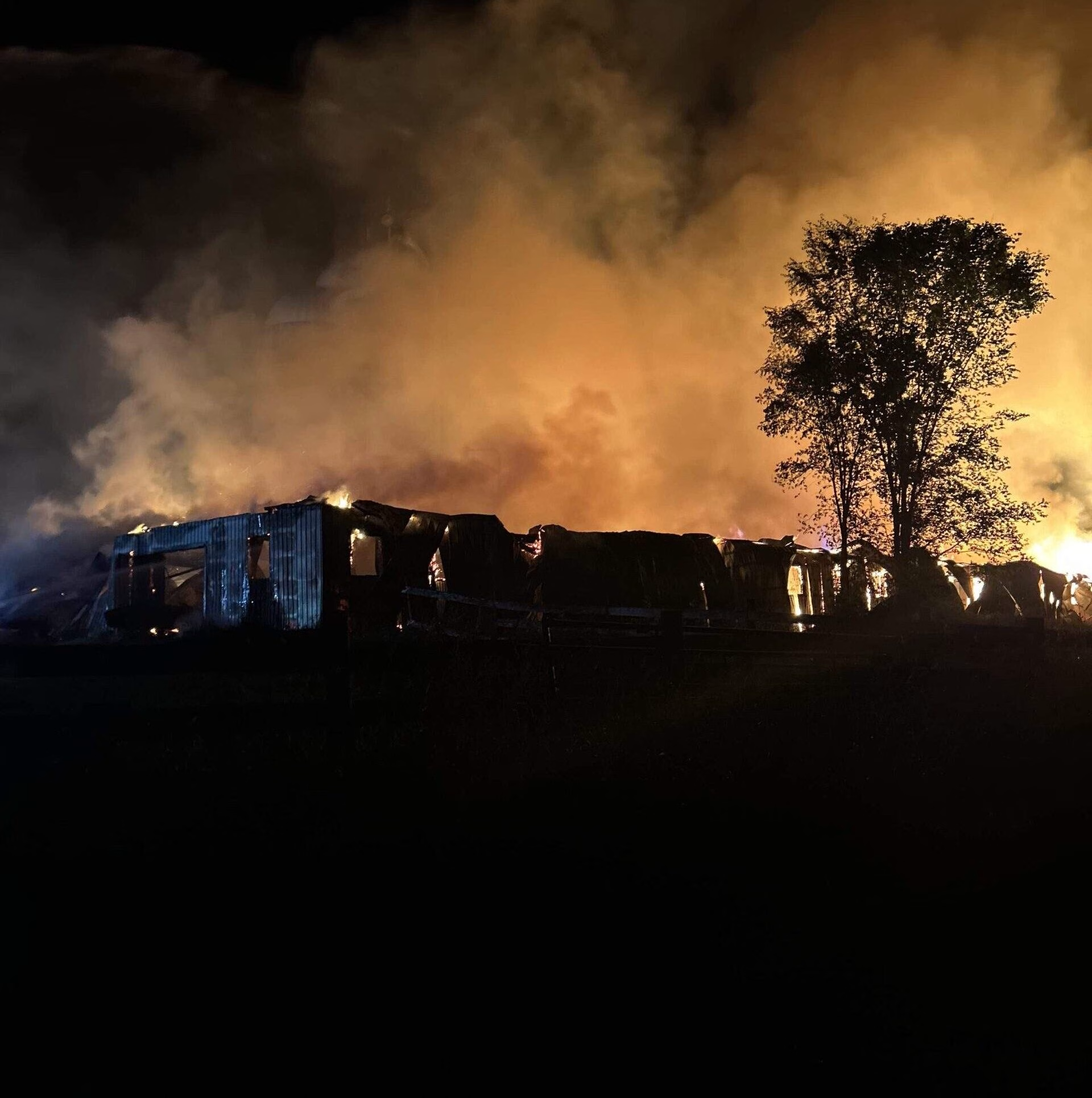
A catastrophic barn fire at Buckland Holsteins near Coaticook, Quebec, on June 26th killed over 160 Holstein cattle and destroyed the main dairy facility, representing the latest incident in a barn fire crisis that has claimed at least 2.5 million farm animals across North America since 2022.
The MacKinnon family’s seven-generation dairy operation suffered complete destruction of their primary milking facility, with approximately 100 milking cows and 65 bred heifers perishing in the early-morning blaze that began around 2:00 AM. The incident underscores systemic vulnerabilities in agricultural fire safety that continue to devastate livestock operations across the continent.
Multi-Department Response Overwhelmed by Fire’s Intensity
Ayer’s Cliff Fire Department received the emergency call at 2:02 AM, arriving to find the facility “completely engulfed in flames” and “fully evolved from one end to the other,” according to Battalion Chief Dany Brus. The coordinated response required five regional departments—Ayer’s Cliff, Stanstead, North Hatley, Coaticook, and Stanstead Township—battling the inferno for over seven hours before gaining control around 9:30 AM.
Farm owner Angus MacKinnon was alerted by his brother just after 2:00 AM, discovering the building entirely consumed by fire. “There was nothing we could do,” MacKinnon stated, as the rapid fire progression rendered internal rescue efforts impossible.
The emergency response succeeded in saving approximately twelve calves housed in outdoor hutches, but the scale of livestock losses places this incident among the most significant cattle mortality events in recent North American barn fire history.
Electrical Malfunction Suspected in Latest Industry Tragedy
Initial investigation points to electrical system failure as the probable cause, with MacKinnon reporting an electrical spike detected at 1:35 AM—nearly 30 minutes before fire discovery. “We have an electrical monitoring system, and there was a spike at 1:35 a.m. on one of the entrance panels,” MacKinnon explained. “There aren’t many motors working at that time of night, so we think that may have been the root cause.”
According to fire prevention specialists, this suspected electrical origin aligns with broader industry patterns, where electrical faults are responsible for approximately one-third of farm fires. The humid, corrosive atmosphere in livestock facilities accelerates electrical system degradation, creating conditions where faults can occur even during off-peak operational hours.
North American Barn Fire Crisis Reaches Critical Levels
The Buckland Holsteins incident occurs within a devastating broader crisis affecting agricultural operations. Data from the Animal Welfare Institute reveals that at least 2,534,800 farmed animals perished in barn fires between 2022 and 2024, representing 30% of the 8.35 million animals killed since systematic tracking began in 2013.
While poultry operations account for the majority of individual animal losses, cattle operations face significant single-incident mortality events, with one recorded fire resulting in 548 cattle deaths. The Buckland Holsteins fire, with over 160 animals lost, represents a major livestock mortality event within this statistical context.
The financial impact extends beyond immediate livestock losses. According to the National Fire Protection Association, barn fires caused an average of $48 million in property damage annually between 2014 and 2018. Individual incidents can reach staggering levels—fire officials estimated $12 million in damage from a single 2022 barn fire that killed 250,000 hens.
Prevention Technology Exists but Adoption Remains Limited
Few jurisdictions have adopted specific building codes mandating fire protection measures in agricultural buildings despite available fire prevention technologies. The absence of mandated fire protection in farmed animal housing “undoubtedly exacerbates this tragic situation,” according to animal welfare experts.
Electrical monitoring systems like those used at Buckland Holsteins are available but not widely implemented across the industry. PrevTech Innovations, a Quebec-based company, offers 24/7 electrical monitoring systems that can detect faults and notify farmers through real-time alerts. However, adoption remains limited despite electrical faults causing an estimated one-third of farm fires.
Automated fire suppression systems designed for agricultural facilities are also available, but are rarely installed. Companies like Tungus Corp. offer pressure-free, automatic extinguishing systems that can respond within 15 seconds of heat detection, covering areas up to 850 square feet. These systems require no maintenance and can operate in unheated areas, which are common in agricultural settings.
Regulatory Gaps Leave Agricultural Facilities Vulnerable
Current building codes reveal systematic gaps in agricultural fire protection. The National Building Code of Canada requires fire alarms and smoke detectors only in animal-housing facilities exceeding three stories and 600 square meters. Smaller facilities—representing the majority of operations—remain subject to relaxed requirements under the National Farm Building Code.
The codes themselves have no legal authority unless adopted by provincial or territorial governments, creating inconsistent protection across jurisdictions. This regulatory patchwork leaves many agricultural operations operating under outdated fire safety standards despite housing livestock worth millions of dollars.
Economic and Genetic Losses Extend Beyond Immediate Impact
The destroyed livestock at Buckland Holsteins represented more than immediate economic losses. Based on current Holstein replacement costs of $1,500-2,000 per milking cow, the livestock losses alone represent $2.4-3.2 million in replacement value. However, the genetic setback proves more devastating for long-term operations.
Beyond livestock losses, one concrete silo containing 400 tons of silage continues smoldering and is expected to burn for approximately six months due to inaccessibility. Current feed prices represent additional losses exceeding $100,000 while creating extended operational constraints during rebuilding.
Family Resilience Drives Rebuilding Determination
Despite devastating losses, the MacKinnon family remains committed to reconstruction. “We’re well insured, and the next generation was in place to take over the farm over the next four, five, six years,” Angus MacKinnon stated. “The master plan is to keep the eighth generation here and going.”
The family’s comprehensive insurance coverage and multi-generational vision position them for recovery, but the broader community impact extends beyond individual farm operations. Battalion Chief Brus emphasized the regional significance: “The McKinnon family is well known in the region. This is a big loss for them—it’s also a big loss for the community.”
Prevention Measures Require Industry-Wide Implementation
Fire prevention specialists recommend several critical measures that could prevent similar tragedies:
- Regular electrical system inspections with thermal imaging to identify hot spots before they cause ignitions
- Installation of smoke detectors with phone alert capabilities for early warning systems
- Implementation of fire safety plans, including livestock evacuation procedures and emergency access protocols
- Proper storage of equipment and flammable materials away from livestock areas
Thermal imaging equipment for electrical inspections is available free of charge through Farm & Food Care Ontario, yet many operations fail to utilize these resources. Regular barn inspections remain critical to identifying hidden electrical issues that standard visual inspections cannot detect.
The Latest: Systemic Change Required to Prevent Future Tragedies
The Buckland Holsteins fire represents both a devastating individual loss and a stark reminder of systemic vulnerabilities affecting North American agricultural infrastructure. With over 2.5 million farm animals killed in barn fires since 2022 and electrical faults causing approximately one-third of incidents, the dairy industry faces mounting pressure to implement comprehensive fire safety standards.
The MacKinnon family’s determination to rebuild for the eighth generation exemplifies agricultural resilience, but preventing future tragedies requires immediate industry-wide action on fire safety infrastructure, regulatory reform, and prevention technology adoption. The ongoing recovery at Buckland Holsteins will serve as a critical test case for comprehensive agricultural disaster response, demonstrating whether the industry can transform individual tragedy into systematic improvement, benefiting all dairy operations.
Current prevention technologies exist and have been proven effective, but adoption remains limited without regulatory mandates and industry-wide commitment to fire safety investment. The time for voluntary compliance has passed; the scale of losses demands mandatory implementation of fire protection measures across all agricultural facilities housing livestock.
Complete references and supporting documentation are available upon request by contacting the editorial team at editor@thebullvine.com.
Learn More:
- HOW TO DODGE DAIRY DISASTERS – 7 Ways to Be Ready for Almost Anything – Provides tactical implementation strategies for emergency preparedness, including livestock disaster boxes, evacuation planning, and facility protection measures that could have prevented tragedies like Buckland Holsteins.
- Embracing the Future: The Latest Innovations in Dairy Technology and Their Impact on the Industry – Explores cutting-edge dairy technologies including wearable monitoring systems and smart farm management solutions that could revolutionize fire detection and prevention through early warning systems and automated responses.
 The Sunday Read Dairy Professionals Don’t Skip.
 The Sunday Read Dairy Professionals Don’t Skip.
Every week, thousands of producers, breeders, and industry insiders open Bullvine Weekly for genetics insights, market shifts, and profit strategies they won’t find anywhere else. One email. Five minutes. Smarter decisions all week.




