








One exec’s $277K kickback scheme just exposed how much dairy farmers can lose to corruption
EXECUTIVE SUMMARY: So here’s what went down in New Zealand—and why it matters to every one of us. A former executive at Open Country Dairy was caught taking $276,668 in kickbacks over four years, selling pricing information to Indonesian traders. Those insider tips were worth $ 15,000-$ 25,000 per container—that’s serious money walking out the door. Dr. Jacqueline Rowarth from DairyNZ warns about “sticky discount pricing” where trust breaks can cost you for 3-5 years straight. With China cutting imports and global competition intensifying, we can’t afford reputation hits. The kicker? Buyers will pay 3-5% premiums for verified clean supply chains—the University of Guelph proved it. Lock down your data access now, because competitors are watching every move.
KEY TAKEAWAYS:
- Audit your info access immediately: Keep pricing data locked tight—one leak can cost you premium contracts worth thousands per load
- Invest in monitoring tech: Behavioral analytics catch sketchy patterns early, protecting margins that fraud could wipe out in days
- Get independent audits on major customers: Third-party verification strengthens your market position and prevents nasty surprises
- Leverage trust for premiums: Clean, transparent operations command 3-5% higher prices—that’s real money in your pocket monthly
- Eye the Asian markets: Indonesia imports 2.5 million tons yearly; even grabbing 2% market share means $160-200 million in potential revenue
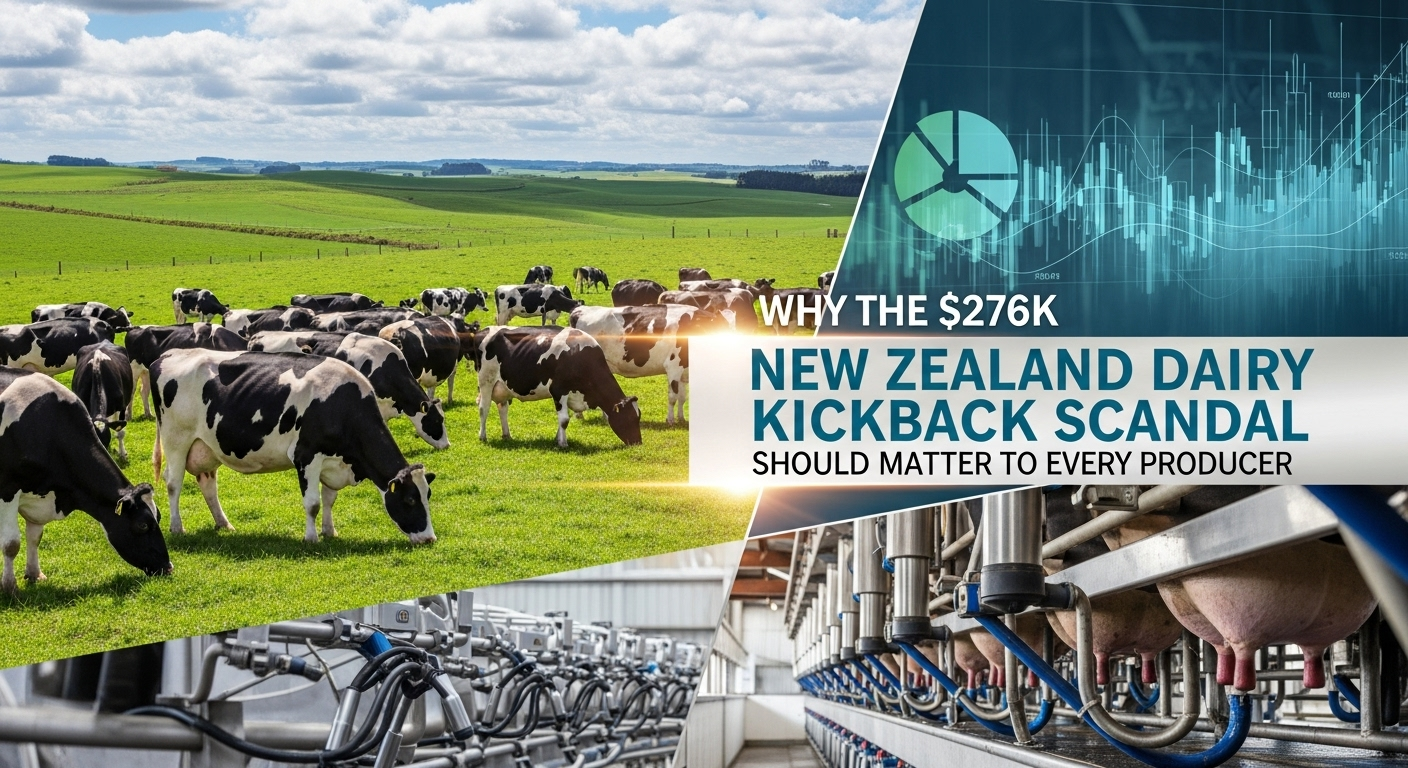
Trust is the foundation of the dairy industry. When insider pricing information leaks, the entire supply chain feels the impact. Recently, New Zealand’s Serious Fraud Office charged Simon Stewart, former group market manager at Open Country Dairy, with accepting $276,668.92 in kickbacks from Indonesian trader PT Anta Tirta Kirana. Over four-and-a-half years, 27 payments were made for insider pricing and other favors. Such breaches go beyond company losses—they shake global confidence. Open Country Dairy is New Zealand’s second-largest milk processor and the world’s second biggest exporter of whole milk powder. When trust cracks here, it sends ripples worldwide.
Global Ripples from a Local Crack
New Zealand dairy consistently earns price premiums because buyers trust the supply chain from farm to freight. In a DairyNZ interview, Dr. Jacqueline Rowarth, DairyNZ director and adjunct professor at Lincoln University, explained that such reputational damage creates “sticky discount pricing”—a penalty that can linger for three to five years. This reputational risk emerges as global demand continues to climb steadily and competition from European and U.S. exporters intensifies, according to Rabobank’s 2025 Global Dairy Quarterly.
China’s drop in imports—driven by growing domestic production—redirects New Zealand exporters to Southeast Asia. Indonesia imports roughly $300 million worth of New Zealand dairy annually, which is where this case hits hardest.
A Calculated Corruption Scheme
Stewart’s scheme was sophisticated. Analysts from HighGround Dairy estimate that having a 2-3 day price lead—prices that fluctuate by about $50 per ton—could boost profits by $15,000-$25,000 per container. PT Anta Tirta is a major Indonesian player spanning 17,000 islands, with deep ties in the pharmaceutical and food sectors. They structured payments to avoid detection—calculated corruption.
Processors are fighting back. European firms are now utilizing AI-powered analytics to identify suspicious communication patterns, while others are implementing blockchain trails, biometric logins, and strict data compartmentalization to keep pricing and sales teams separate, thereby drastically enhancing security.
Legal expert Gerald Podolsky of Russell McVeagh notes a 60% conviction rate in cross-border dairy fraud cases, highlighting that many evade penalties amid tight margins and rising industry pressures.
Producer’s Playbook: Taking Control
Farmers and processors, here’s your action plan:
Immediate Steps:
- Audit who has access to price data and monitor sales-customer communications strictly
- Implement behavioral monitoring technology—costs may seem steep, but they protect against million-dollar frauds
- Use independent “clean team” audits to verify major customer relationships
- Segregate pricing and customer information to prevent insider abuse
Strategic Opportunities: Open Country’s crisis creates openings for processors with bulletproof governance. Fonterra, despite past challenges, continues rebuilding its reputation as a trusted partner. With Indonesia importing 2.5 million metric tons of dairy annually, even a 2% market share gain (about 50,000 tons) could deliver $160-$200 million in additional revenue at current whole milk powder prices.
The reputation stakes are real everywhere. A Pennsylvania producer I know spent five years pushing his herd’s butterfat from 3.8% to 4.2% to land a lucrative contract with an artisanal cheesemaker. A single compliance issue with his processor—completely unrelated to his milk quality—resulted in his farm being flagged, and he lost access to that premium market overnight. That’s exactly what happens when trust breaks down, even far from New Zealand.
Buyers aren’t just evaluating butterfat numbers and somatic cell counts anymore. Ethics, transparency, and traceability drive premiums. A 2024 study from the University of Guelph found that consumers and B2B buyers are willing to pay 3-5% more for products with certified clean sourcing, emphasizing the real business case for transparency.
The key takeaway? Guard your reputation like your best cows in the dry lot. Once lost, trust takes years to rebuild—and competitors won’t wait.
Complete references and supporting documentation are available upon request by contacting the editorial team at editor@thebullvine.com.
Learn More:
- The Ultimate Guide to Improving Feed Efficiency in Dairy Cattle – This article provides tactical, on-farm strategies for optimizing your largest variable cost: feed. It details how to measure and improve feed conversion, directly impacting the razor-thin margins and rising cost pressures mentioned in the main article.
- The 5 Biggest Trends That Will Disrupt The Dairy Industry – For a strategic, market-focused view, this piece explores the long-term forces reshaping the industry beyond immediate fraud risks. It contextualizes the competitive pressures from U.S. and European exporters and helps producers anticipate future market dynamics.
- Is A.I. The Future of Dairy Farming? – Focusing on innovation, this article dives deeper into the AI-powered monitoring systems mentioned as a key defense against corruption. It showcases how technology is moving beyond security to optimize herd health, reproduction, and overall profitability.
 Join the Revolution!
 Join the Revolution!
Join over 30,000 successful dairy professionals who rely on Bullvine Weekly for their competitive edge. Delivered directly to your inbox each week, our exclusive industry insights help you make smarter decisions while saving precious hours every week. Never miss critical updates on milk production trends, breakthrough technologies, and profit-boosting strategies that top producers are already implementing. Subscribe now to transform your dairy operation’s efficiency and profitability—your future success is just one click away.




