






42% heritability for milking speed? That’s higher than most production traits. Your parlor throughput just got a genetic upgrade.
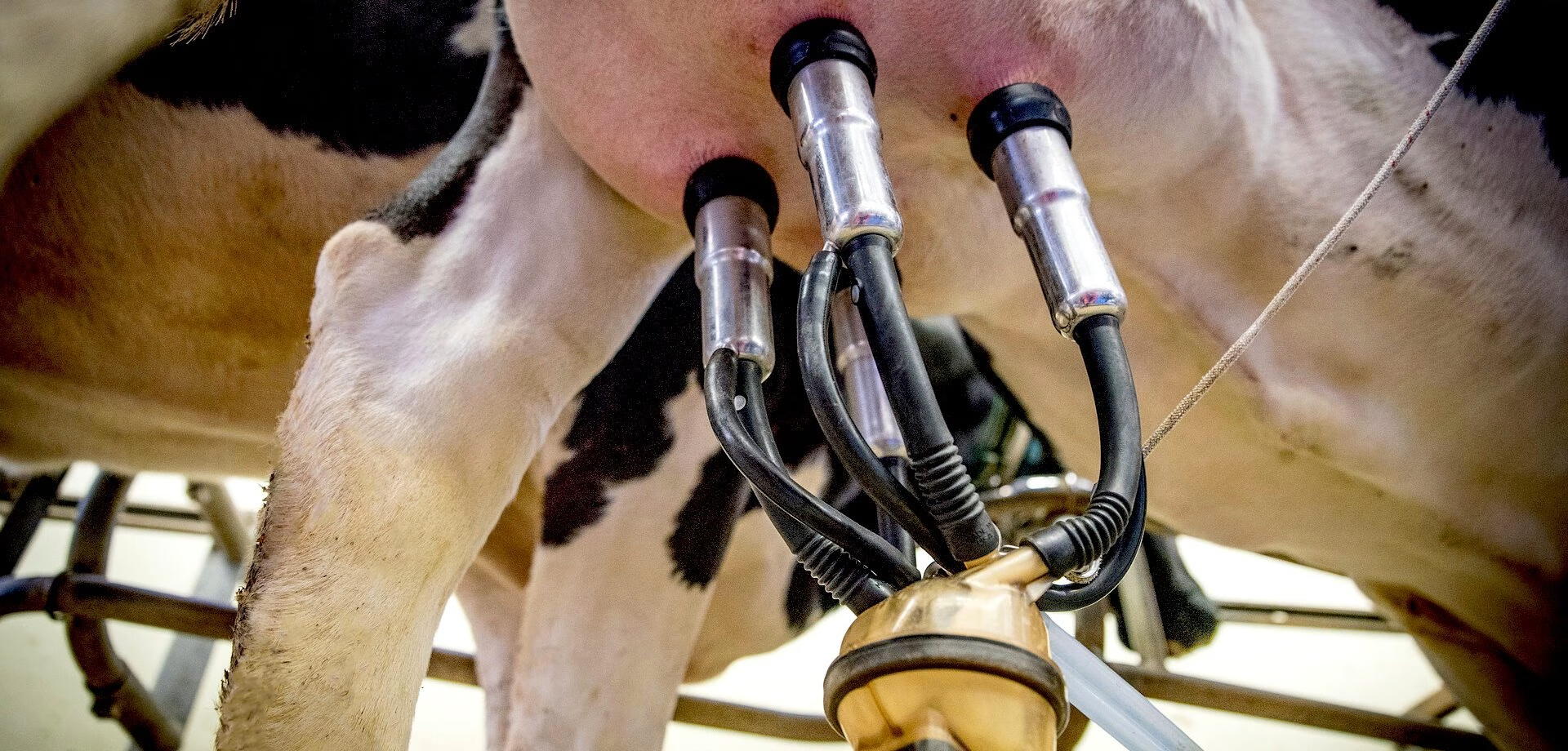
EXECUTIVE SUMMARY: So here’s the deal… the CDCB just dropped something that’s going to change how we think about efficiency. They’re launching a sensor-based milking speed trait that’s built on actual data, not someone’s opinion. We’re talking 50+ million milking observations from real farms, and the numbers are staggering – 42% heritability means you can actually breed for this trait and see results fast. A 1,000-cow operation could save $19,710 annually just from improved parlor throughput, and that’s before you factor in the labor shortage we’re all dealing with. The U.S. is leapfrogging countries like Canada (14% heritability) and Germany (28%) because we’re using pure sensor data while they’re still relying on subjective scoring. But here’s the catch – there’s a genetic correlation with somatic cell score that you need to understand before you start chasing the fastest milkers. This isn’t just another genetic tool… it’s a direct path to better profitability, and you should be planning how to use it before your competitors figure it out.
KEY TAKEAWAYS
- Labor Cost Reduction: 25 hours saved weekly for 1,000-cow dairies – Start tracking your parlor throughput now and identify bottleneck cows. With the August 2025 launch, you can use corrective mating to breed faster-milking replacements while labor costs keep climbing.
- Genetic Screening Strategy: Avoid bulls below 6.5 lbs/min or above 8.0 lbs/min – Screen your current bull lineup immediately and establish thresholds for 2025 breeding decisions. The +0.43 correlation with SCS means you can’t just chase speed without balancing udder health.
- Parlor Efficiency Gains: 4-5 turns per hour vs. current 3-4 turns – Calculate your current throughput and model the economic impact of a 30-second reduction in milking time per cow. In today’s tight margin environment, that extra turn per hour could be the difference between profit and loss.
- International Competitive Advantage: 42% heritability vs. 14-28% globally – Position your genetic program ahead of international competitors by adopting objective data-driven selection. As export markets demand efficiency-focused genetics, U.S. producers have a clear technological edge.
- AMS Preparation: Robot throughput directly tied to individual cow milking speed – Even though this trait targets parlor systems initially, start evaluating your herd’s milking speed variation now. The principles apply whether you’re planning an AMS transition or maximizing current robot efficiency.
The CDCB’s new sensor-based Milking Speed trait is launching next month? This isn’t just another line item on a genetic evaluation—this could be the most significant functional trait development we’ve seen since… well, maybe ever. Here’s what’s got everyone from Wisconsin to California talking, and why you need to understand this before your next sire selection meeting.
What’s Actually Happening on August 12th
The thing about this MSPD launch is that the timing couldn’t be better. The Council on Dairy Cattle Breeding officially drops their new Milking Speed (MSPD) evaluation on August 12th, and the numbers behind this development are genuinely staggering. We’re talking about a trait built on massive, real-world data that makes previous functional trait evaluations look like small-scale research projects.
According to the CDCB’s comprehensive research analysis, they’ve assembled over 50 million individual milking observations from roughly 300 herds spanning 31 states. That’s not some university trial—that’s data from actual commercial operations dealing with the same labor shortages and efficiency pressures you’re facing every day.
What strikes me most about this whole development is how they’ve completely abandoned the old subjective scoring methods. You know those type classification scores we’ve been living with for milking speed? Gone. Instead, they’re using pure sensor data from in-line milk meters, and the results are honestly incredible—they’re seeing a 42% heritability estimate.
“This represents a paradigm shift away from subjective, classifier-based scoring methods that have characterized previous milking speed evaluations.”
Compare that to what other countries are getting with their farmer-scored systems… Canada is at 14%, while Germany is at 28%, even with their mixed approach. The difference is massive, and it’s all because we’re finally measuring what actually matters instead of relying on someone’s opinion during a type classification visit.
The traits are expressed in pounds per minute—finally, something that makes immediate sense to producers instead of some abstract index number. The Holstein breed average is sitting around 7.1 lbs/min, and from what I’m seeing in the preliminary data, proven sires are ranging from 5.9 to 8.2 lbs/min. That’s real genetic variation you can actually work with.
The Economics That Are Making CFOs Take Notice
Here’s where this gets really interesting from a bottom-line perspective. I’ve been looking at the economic modeling work, and a 1,000-cow operation that reduces individual milking time by just 30 seconds could save about 25 labor hours per week. With current agricultural wages hovering around $17.55 per hour, that translates to roughly $19,710 in annual labor savings.
But here’s the thing… those numbers scale up fast. The research projections show:
Annual Labor Cost Savings by Herd Size:
- 250 cows: $3,456 annually
- 500 cows: $9,864 annually
- 1,000 cows: $19,710 annually
- 2,000 cows: $49,284 annually
And that’s just direct labor costs—doesn’t even account for the opportunity cost of reallocating that labor to higher-value tasks like fresh cow management or repro work.
What’s particularly noteworthy is how this addresses something every producer I talk to is dealing with right now: the labor crisis. I was just in Lancaster County last month, and producers there are struggling to find skilled milkers at any price. Being able to select for improved parlor throughput genetically? That’s addressing a real problem with a genetic solution.
Take a producer I know in Wisconsin—he’s been tracking his parlor throughput religiously in his double-12. His crew can handle about 4.2 turns per hour on a good day. If genetic improvement could bump that to 4.8 turns? That’s an extra 14 cows per hour through the same facility with the same people. Over a year, that adds up to serious money.
The Udder Health Reality Check Nobody Wants to Discuss
Now, here’s where it gets complicated—and this is something every producer needs to understand before jumping in headfirst. The CDCB research reveals a pretty significant genetic correlation of +0.43 between MSPD and Somatic Cell Score. Translation? If you go crazy selecting for the fastest milkers, you’re going to see udder health problems.
“Single-trait selection for milking speed alone would likely lead to a deterioration in udder health, offsetting the economic gains from improved efficiency.”
But there’s a fascinating twist that makes this even more interesting. The correlation with clinical mastitis is actually favorable at -0.28. So, faster milking might increase your SCC baseline, but it doesn’t necessarily mean more clinical cases. It’s complex… and that complexity is exactly why single-trait selection is such a dangerous game.
What this tells me is that optimal milking speed exists somewhere in the middle. Too slow and you’re hurting efficiency and creating parlor bottlenecks. Too fast and you’re risking udder health problems. From industry observations, I’ve heard from breeding consultants that the sweet spot is probably somewhere between 6.5 and 8.0 lbs/min, depending on your other genetics.
The breeding consultants I’ve been talking to—guys who’ve been doing this for decades—are already recommending screening strategies. Avoid bulls below 6.5 lbs/min to prevent parlor bottlenecks, but also be cautious with anything above 8.0 lbs/min unless they’ve got exceptional udder health proofs to compensate.
How the U.S. Just Leapfrogged the Global Competition
From a global competitive standpoint, this development puts U.S. genetics in an exciting position. The international comparison is fascinating when you dig into the details.
International Heritability Comparison:
- United States: 42% (sensor-only data)
- Germany: 28% (mixed sensor/subjective)
- Nordic countries: 22% (mixed approach)
- Canada: 14% (subjective scoring)
- Netherlands: 51% (robot-specific data)
What I find fascinating is how this positions American A.I. companies in the global market. They can now compete on a functional trait that’s becoming increasingly important worldwide, and they can do it with superior data backing their claims. That’s a marketing advantage that’s hard to argue with.
The Dutch approach is particularly interesting—they’re seeing 51% heritability for their robot-derived trait compared to 23% for their subjectively scored trait. That gives us a roadmap for where the U.S. could go next, and honestly, we’re positioned to leapfrog their advantage with our superior sensor data and genetic evaluation methodology.
The Robot Connection That’s Got Everyone’s Attention
While this initial MSPD trait applies to conventional parlor systems, the implications for Automated Milking Systems are huge. Here’s what’s got my attention: according to research from Lactanet in Canada, a herd with robot efficiency of 2.0 kg/minute can harvest over 700 kg more milk per robot per day compared to a 1.4 kg/minute herd.
“That’s massive money on the same piece of equipment.”
Think about it—if you’ve got $250,000 tied up in a single robot, you want to maximize what it can produce. The current MSPD trait is designed for parlors, but the underlying principle is the same. Individual cow milking speed directly impacts system throughput, whether you’re talking about parlor turns or robot box time.
I was talking to a producer in Minnesota who’s got six robots running, and he told me his biggest frustration is the variation in milking speed between cows. “Some of my cows are in and out in four minutes, others take eight. That variability kills my throughput.” Being able to breed for more consistent, optimal milking speed? That’s going to be huge for AMS operations.
The research confirms this—the initial MSPD evaluation is specifically designed for conventional milking systems and doesn’t include data from AMS operations. But I expect we’ll see an AMS-specific MSPD evaluation within the next few years. The framework’s already there.
Implementation Strategy—What Actually Works on Real Farms
The thing about new genetic tools is they’re only as good as how producers use them. And with MSPD, there are some pretty clear strategies emerging based on what I’m hearing from early discussions and industry observations.
By Operation Size:
Large Commercial Dairies (500+ cows): These operations make sense for aggressive adoption. They’ve got the scale to capture maximum labor savings and usually the management sophistication to handle multi-trait selection strategies. They’re also most likely to develop custom indexes that weight MSPD appropriately for their specific cost structure.
Medium-Sized Operations (100-500 cows): This is where it gets interesting. Many of these operations are transitioning to automated milking systems, where individual cow milking speed directly impacts robot throughput. The quality-of-life improvements alone can be significant—cutting 30-45 minutes off daily milking time adds up over a year.
Small Dairies (<100 cows): The direct economic benefits are less dramatic, but don’t overlook the operational improvements. These producers will probably derive the most benefit from MSPD once it’s eventually incorporated into a comprehensive index like Net Merit.
Recommended Selection Strategies:
What I’m hearing from the breeding consultants is pretty consistent:
- Screening Approach: Avoid bulls below 6.5 lbs/min or above 8.0 lbs/min without exceptional udder health
- Custom Index Integration: Weight MSPD against SCS for balanced improvement
- Corrective Mating: Use high-MSPD bulls with good udder health on slow-milking cow families
The Data Pipeline Challenge—Your Stake in This Success Story
Here’s something that doesn’t get talked about enough—the success of this trait depends entirely on farms continuing to submit high-quality data. The CDCB’s new Format 6 data submission process requires farms to consistently report milking duration, yield, equipment manufacturer, and session timing.
“The long-term success of this and future data-intensive traits are entirely dependent on the consistent flow of high-quality data from farms into the National Cooperator Database.”
According to CDCB officials, the National Cooperator Database processes data from thousands of herds, but data quality varies dramatically between operations. Farms with robust data management are going to see higher reliability breeding values and better genetic progress.
What’s encouraging is that they’ve built this evaluation around data from 11 different equipment manufacturers, which means they can account for the systematic differences between OEMs. That’s critical for maintaining evaluation integrity across different farm setups.
This is where producers have a real stake in the outcome. Your willingness to submit complete, accurate data doesn’t just help your own genetic evaluations—it strengthens the entire system for everyone. The CDCB manages the world’s largest animal database, containing over 10 million genotypes and evaluation data on 87 million animals. That’s the foundation that makes tools like MSPD possible.
Looking Forward—Where This Industry Goes Next
The August launch is really just the beginning. Industry talk suggests we’ll eventually see MSPD incorporated into Net Merit, but that requires developing a consensus economic weight for the trait. Given the complexity of the U.S. dairy industry—different regions, different cost structures, different milking systems—that’s not going to be a quick process.
What’s more likely in the short term is expansion to other breeds as sufficient data becomes available. The framework they’ve built is breed-agnostic, so Jersey and Brown Swiss evaluations could follow relatively quickly.
What’s Coming:
- Net Merit inclusion (likely 2027-2028)
- Other breed evaluations (Jersey, Brown Swiss)
- AMS-specific trait development
- Additional sensor-based traits (feed efficiency, lameness indicators, and methane emissions)
The bigger picture here is that this represents a fundamental shift toward sensor-based functional traits. According to the CDCB research, we’re looking at a future where farm technology seamlessly integrates with genetic evaluation to breed more efficient, profitable cows. Feed efficiency, lameness indicators, even methane emissions—it’s all on the table.
The Bottom Line for Your Operation
What we’re seeing with MSPD is the industry finally catching up to what progressive producers have been asking for—genetic tools that directly address operational challenges. The science is solid, the economic case is compelling, and the competitive advantages are real.
“The producers who figure out how to use this trait strategically—balancing efficiency gains with udder health, screening for extremes while maintaining genetic diversity—are going to have a significant edge.”
You know, after covering this industry for as long as I have, you get pretty good at spotting which developments are going to matter in five years. This one? This one’s going to matter. The question isn’t whether MSPD will change how we select bulls—it’s whether your operation will be leading that change or watching it happen from the sidelines.
I’ve seen too many producers wait for someone else to figure out new genetic tools, only to realize later they could’ve had a two or three-year head start. Don’t be that producer this time. The data is clear, the science is sound, and the economic impact is massive.
The sensor-based breeding revolution starts August 12th. Are you ready to make it work for your operation?
Complete references and supporting documentation are available upon request by contacting the editorial team at editor@thebullvine.com.
Learn More:
- Understanding the New LPI Formula Implementing April 2025 – Reveals practical strategies for integrating milking speed into comprehensive breeding decisions using Canada’s updated Lifetime Performance Index, demonstrating how to balance efficiency traits with health and production goals for maximum genetic progress.
- Unlock Hidden Dairy Profits Through Lifetime Efficiency – How Modern Genetics and Strategic Nutrition Can Cut Feed Costs by $251 Per Cow – Demonstrates how to combine genetic selection with precision management strategies, showing producers methods for capturing $25,100 in annual feed savings while maximizing the economic impact of efficiency-focused breeding programs beyond just milking speed.
- 5 Technologies That Will Make or Break Your Dairy Farm in 2025 – Explores cutting-edge dairy technologies including robotic milkers and AI analytics that complement genetic improvements, revealing how smart farms integrate sensor-based breeding data with automated systems to boost yields 20% and achieve ROI within seven months.
 The Sunday Read Dairy Professionals Don’t Skip.
 The Sunday Read Dairy Professionals Don’t Skip.
Every week, thousands of producers, breeders, and industry insiders open Bullvine Weekly for genetics insights, market shifts, and profit strategies they won’t find anywhere else. One email. Five minutes. Smarter decisions all week.




