






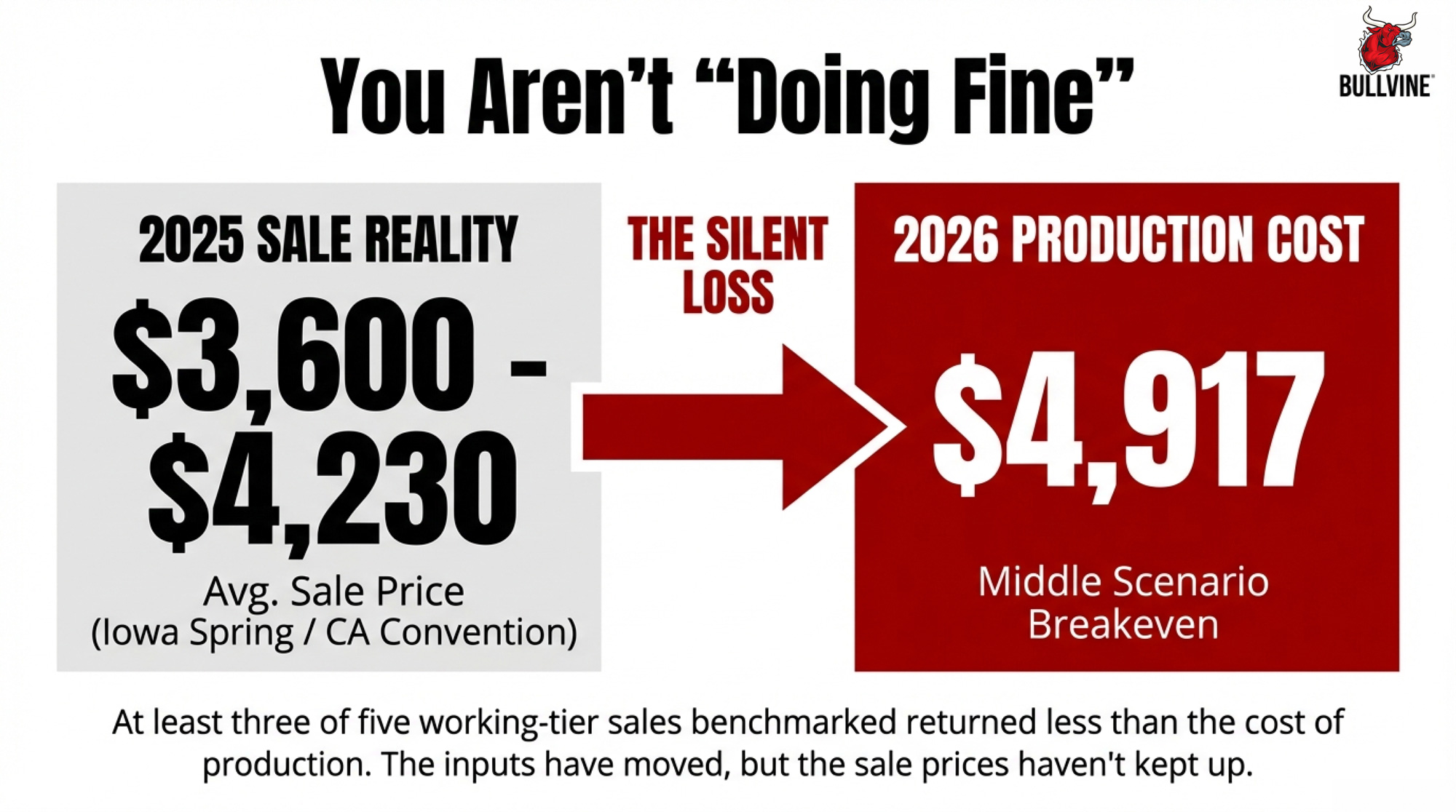
If your ET Holstein calves are bringing $3,600 while the breakeven sits at $4,917, you’re not “doing fine” — you’re quietly selling at a loss.
Executive Summary: The middle-scenario cost to produce a single ET Holstein show heifer in 2026 is $4,917. At least three of the five working-tier Holstein sales benchmarked here returned less than that — including Iowa’s spring sale at $3,600 and California’s Convention at $4,230, down $1,618 from the year before. Commercial beef calves at $480/cwt have repriced recipient cows to $2,000-plus, the line item that moved the entire cost structure, while dairy replacement heifer inventories have dropped to their lowest level since 1978. The elite tier remains strong — Mount Elgin averaged $9,797, the World Classic cleared $30,245 — but the working tier is now operating at or below breakeven before commission. For every ET breeder consigning this spring, the math has changed: the old assumption that a $3,600 catalog average covers production costs no longer holds.
The middle-scenario production cost on an ET Holstein show heifer — 30% live heifer rate, $500 embryo, $2,000 recipient, 125 days on feed — is $4,917. The Iowa Holstein Spring Sale averaged $3,600 on 73 lots last year. California’s Holstein Convention averaged $4,230 on 48 — down $1,618 from $5,848 the year before. At the Legacy of Legends Vol II in Tillamook, Oregon, averaged $3,626 across 77 female lots and one IVF session.
At least three of those five working-tier sales returned less than it costs to produce the calf. Spring consignment catalogs are already dropping. And the cost inputs behind that $4,917 haven’t softened since fall.
Matt Steiner knows the math as well as anyone. His Pine-Tree Dairy in Marshallville, Ohio, runs over 1,400 head across Holstein, Jersey, and organic herds — milked through parlors and robots, managed by six siblings with the next generation already involved. Steiner hosts the “Spring into Opportunity” sale, which averaged $5,000 in April 2024. He consigns nationally — his $10,500 IVF lot from an Outcome daughter at +3049 GTPI, purchased by Siemers Holsteins, was one of the California Convention’s marquee offerings in 2023. Pine-Tree also consigned three of the top-selling lots at the 2016 Ohio Holstein Fall Sale, topped at $5,500, and the operation was selected as a 2025 Ohio Holstein Convention tour farm.
That $5,000 average at Spring into Opportunity? It clears the $4,917 breakeven by $83. Before commission. An operation like Pine-Tree — deep pedigrees, the Rudolph Missy cow family headlining the herd, national consignment reach — is the kind of program that should be comfortably above water. Instead, the margin is razor-thin. For operations without Pine-Tree’s genetic depth or marketing reach, the math is worse.
Why $480 Steers Repriced Your Recipient Herd
Oklahoma 500-lb. steer calves ended 2025 at $480.48/cwt — up 35.9% for the year, per Oklahoma State Extension. Fed-steer prices averaged $224/cwt nationally, up from $187 in 2024. In North Dakota, 550- to 600-lb. calves opened at $335/cwt — already $40 above 2024 — and climbed another $114 by mid-fall.
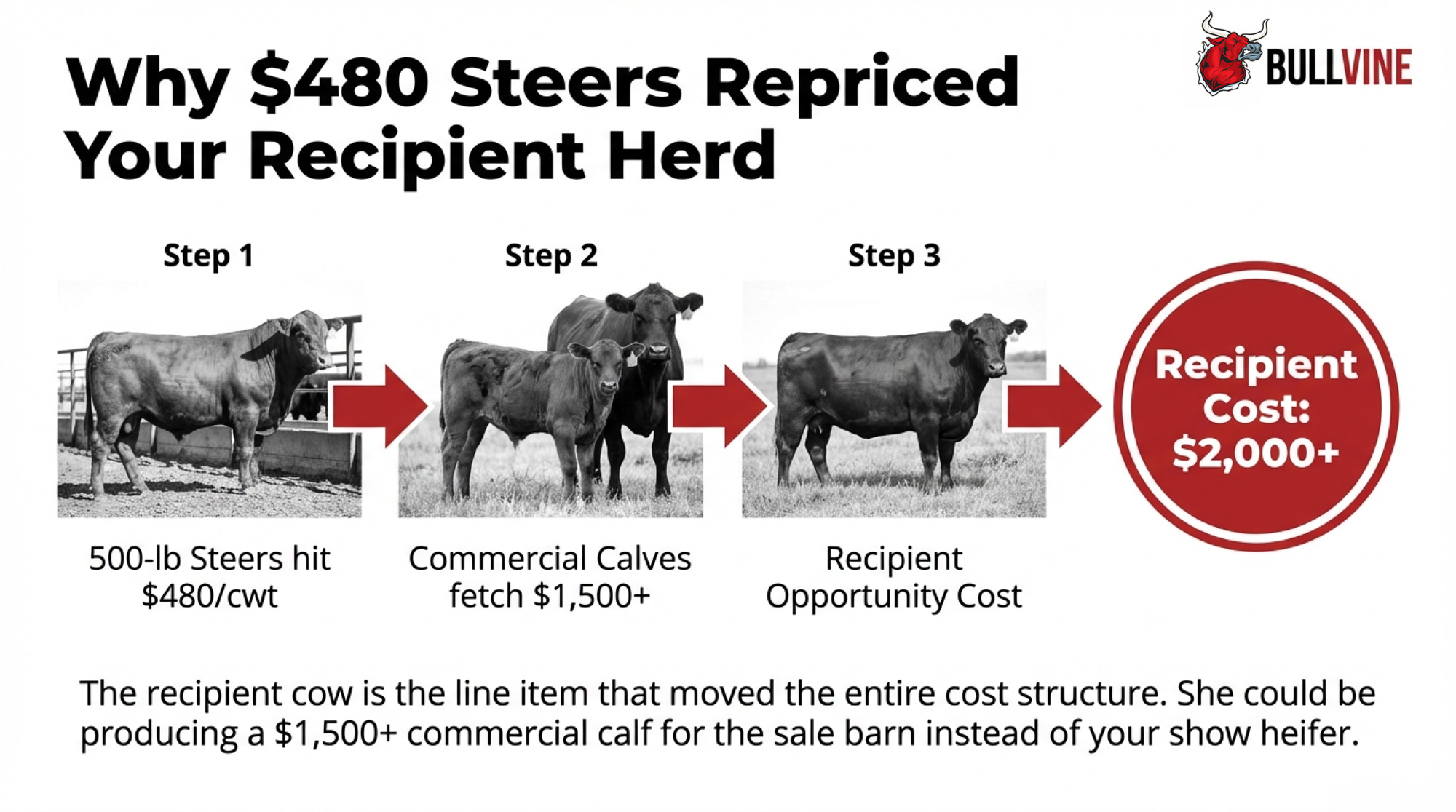
Those are commercial beef numbers. But they land on your ET program because of one animal: the recipient cow.
Trans Ova Genetics — a leading IVF provider in North American dairy — uses predominantly Angus-based beef cows aged two to six years as their recipient herd. When a day-old beef-cross calf fetches over $1,500 at auction, and a 500-lb. commercial steer brings $2,400, every one of those recipients carrying your next show heifer has a real opportunity cost. She could be producing a $1,500+ calf for the sale barn instead. That’s the cost that moved.
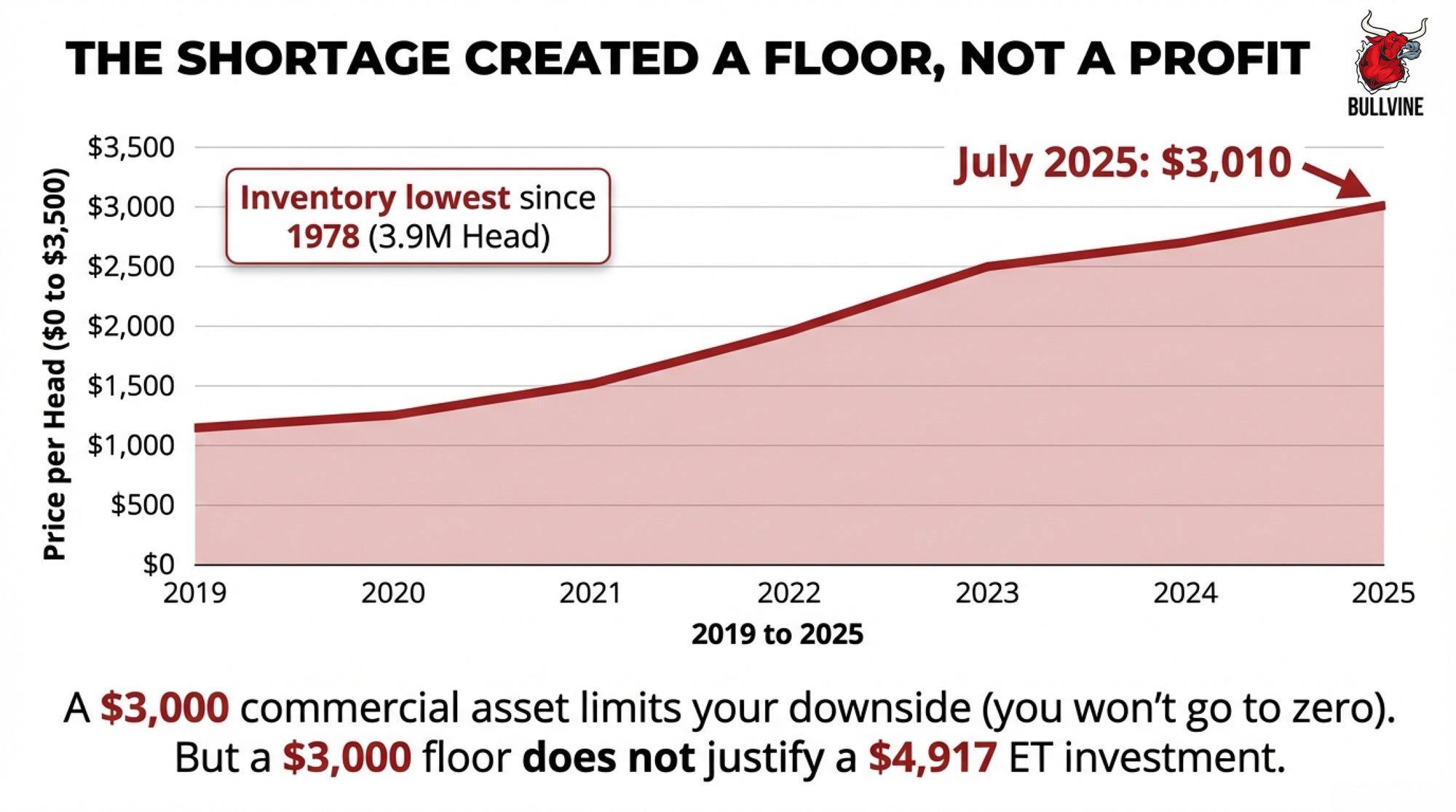
The dairy replacement shortage is compounding it. USDA’s January 2025 cattle report put dairy replacement heifer inventories at 3.914 million head — the lowest since 1978, when the count was 3.886 million. Replacement heifer prices hit $3,010 per head by July 2025 — a 164% jump from $1,140 in April 2019, according to CoBank’s Corey Geiger. Through 2024, springing Holstein heifers were already moving at $2,250–$2,775 at commercial auction.
How Much Does It Cost to Produce an ET Holstein Show Calf in 2026?
Here’s the barn math. Plug in your own numbers where yours differ — and be honest about it.
Embryo cost. Two paths: flush your own donor or buy finished embryos. Neither is cheap, and both are climbing.
For conventional flush, dairy-specific data puts superovulation drugs at $232–$330 per donor cow, vet services at $280–$462, and embryo freezing at $23–$33 per embryo. At ReproLogix — now part of Trans Ova following a September 2025 acquisition — in-clinic donor management runs $100 per donor, plus daily board and FSH; collection is $250/donor; and freezing is $50/embryo, capped at $500/donor. Champion Genetics in Texas publishes a comparable schedule: $290 for sync and superovulation, $50 breeding, $250 collection, and $65 per embryo — on an average flush of six, that’s roughly $155/embryo before housing at $9/day. Across facilities, expect $125–$175 per embryo fully loaded on a conventional flush.
IVF runs a different cost structure. Trans Ova typically collects 18–22 oocytes per aspiration, with about 30% developing into viable embryos, expect 5–6 transferable embryos per cycle. ReproLogix’s published IVF pricing: embryo production at $140 each for one through five, $110 for six through ten, $55 for eleven-plus, plus aspiration ($75/donor in-clinic) and reverse-sorted semen fertilization at $275/mating. Champion’s IVF collection fee is $500/donor.
Buying finished embryos? Wide range. At recent embryo sales, lots moved from $400 per embryo for standard IVF packages up to $3,100 for sexed female embryos from top donors. Innovation Ag Marketing’s February 2026 sale averaged $1,063 per embryo across 183 lots. We’ll use $500 for this walkthrough. If you’re buying from high-demand cow families, double it.
The conception math. Not every embryo becomes a live calf. Fresh conventional embryos deliver pregnancy rates around 50–60%. RuAnn Genetics — a California Holstein operation running one of the largest documented IVP programs in North America — produced and transferred over 32,503 in vivo embryos, recording a 63% pregnancy rate in virgin heifer recipients across 23,488 transfers and 51% in lactating cow recipients across 9,015 transfers.
IVF historically ran lower, but the gap is closing. A 2019 review pegged the live-calf rate at roughly 27%. Current well-managed programs are significantly better: Trans Ova reports pregnancy rates of 40–50% with frozen IVF embryos in their managed recipient herds.
Now the heifer question. If you need show heifers, only half your live calves will be female. Using Trans Ova’s current IVF rates — 40–50% pregnancy, 50% female — you’re at 20–25% live heifer calves per embryo. Good conventional embryos might push 40%. The middle ground — and the scenario behind the headline number — is 30%.
| Scenario | Live Heifer Rate | Embryo Cost per Heifer (at $500/embryo) |
| Optimistic (conventional) | 40% | $1,250 |
| Middle (blended) | 30% | $1,667 |
| Realistic (IVF) | 20–25% | $2,000–$2,500 |
Recipient cow. Opportunity cost at today’s commercial prices: $1,500–$2,000. Beef-on-dairy calves alone are cashing cheques up to $1,750, with Holstein bull calves commonly in the $700–$1,000 range, and Premier’s January 2026 report listed beef-dairy crosses at $1,000–$1,750. Recipient prep adds $18–$28 per cow. Transfer fees: $65–$80 per recipient. But the cow herself is the line item that moved. At $2,000 per sound recipient, you’re in the range most programs pay.
Feed and development. Pre-weaning costs alone run $259–$583 per calf, depending on housing, milk program, and labor. Post-weaning on a standard ration, basic cattle feeding runs roughly $5–$6/day per head. Professional ET facilities like Champion Genetics charge $9/day for housing alone — before feed. A show calf on a competitive fitting program — premium developer ration, daily handling, supplements, bedding, grooming — pushes total cost to approximately $10/day. Keep that calf 100 days minimum, 125 if you’re fitting for a spring sale. That’s $1,000–$1,250.
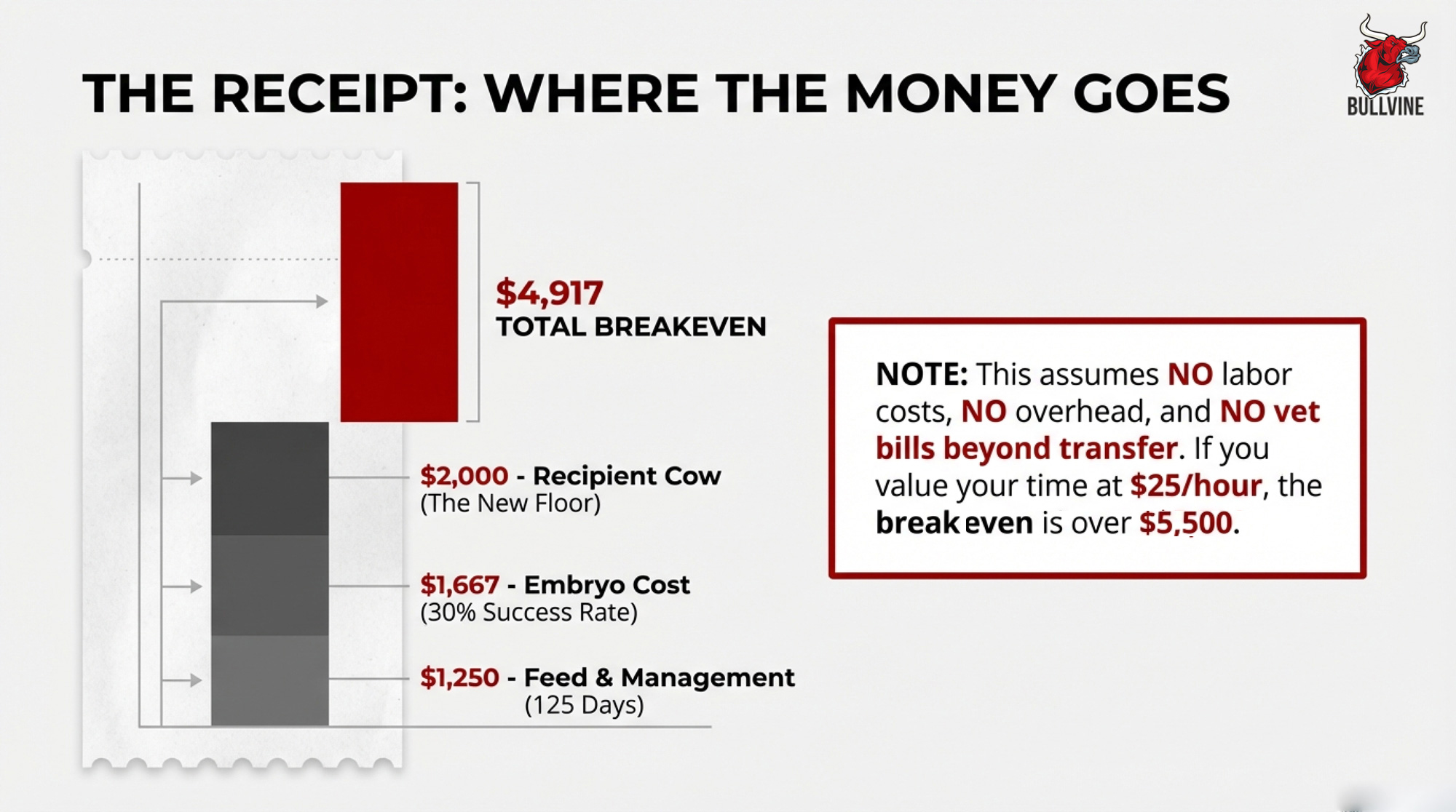
The full stack:
| Line Item | Optimistic (40%) | Middle (30%) | Realistic (20–25%) |
| Embryo cost per live heifer | $1,250 | $1,667 | $2,000–$2,500 |
| Recipient cow | $2,000 | $2,000 | $2,000 |
| Feed & management | $1,000 | $1,250 | $1,500 |
| Subtotal | $4,250 | $4,917 | $5,500–$6,000 |
| Commission (3–5%) | $128–$213 | $148–$246 | $165–$300 |
| Breakeven sale price | $4,378–$4,463 | $5,065–$5,163 | $5,665–$6,300 |
No labor. No vet bills beyond the transfer. No semen costs for the donor. No fuel, no bedding markup, no overhead. Bare bones. If you value your own time at even $$25/hour, your breakeven is likely over
What Did Working-Tier Holstein Sales Actually Return?
The show cattle market operates in tiers. The question is which one you’re selling into.
The elite tier covers costs and then some. The 2024 World Classic Holstein Sale at WDE averaged $30,245 across 55 lots, topped by a $205,000 IVF session with OCD Sheepster 23614 purchased by Semex. The National Holstein Convention averaged $12,077 on 89 lots with a $91,000 high seller. Define Your Destiny moved 130 lots at $7,563 with an $89,000 top. North of the border, the Mount Elgin Dairy Spring Spectacular averaged $9,797 across 166 head in May 2025, shattering three Canadian breed records — top Holstein Kingsway A2P2 R2D2 brought $85,000.
At those prices, a $4,917 breakeven is invisible.
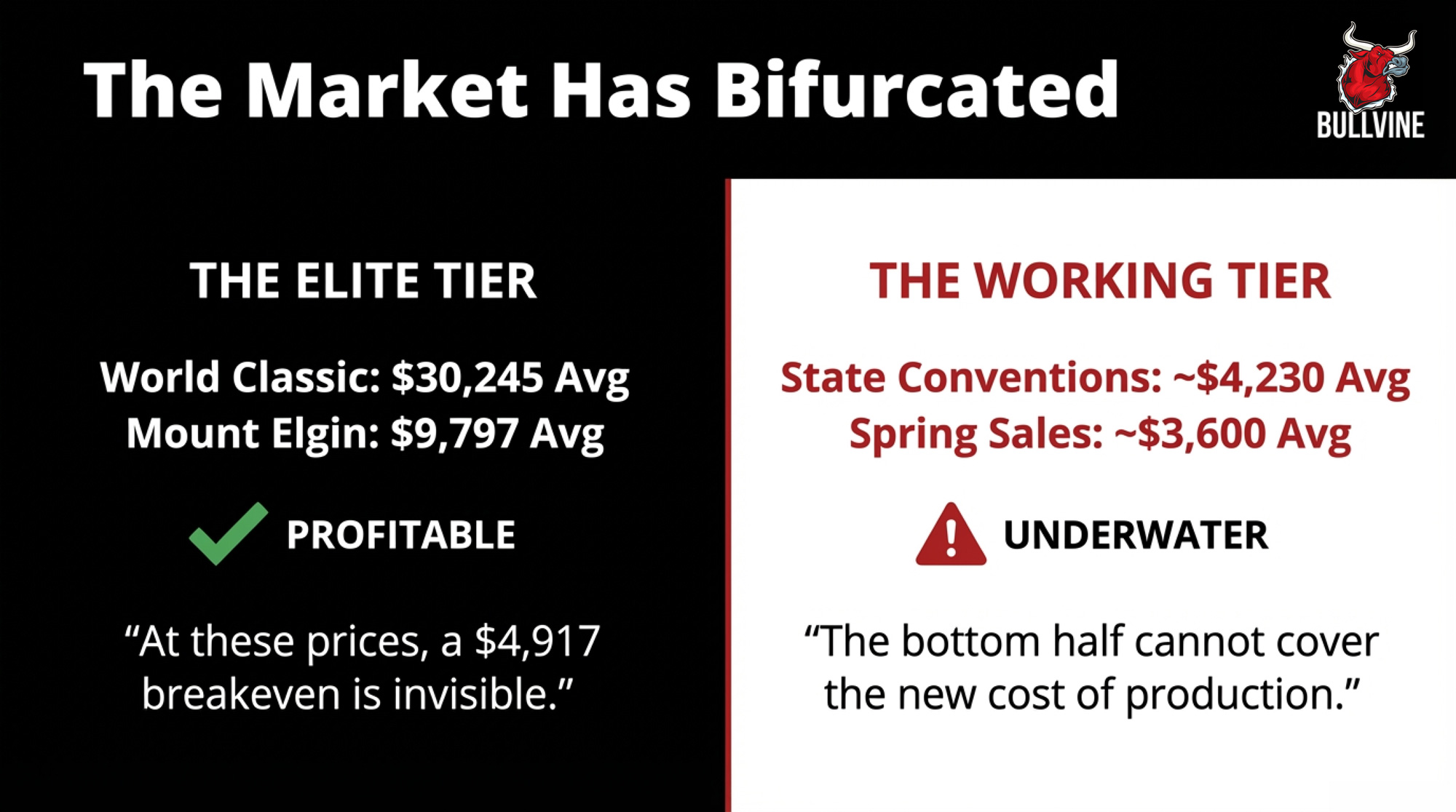
The working tier is where this breaks. State conventions, spring consignment events, regional on-farm sales:
That California Convention drop tells the story in miniature. In January 2023, lots from operations like RuAnn Genetics and Pine-Tree Dairy drove the average to $5,848. Steiner’s $10,500 IVF session from an Outcome daughter at +3049 GTPI was among the marquee offerings. One year later, the convention average fell to $4,230. The elite lots still moved well. The middle of the catalog didn’t.
And look at the Rockin@Retso breakdown. The all-breed average was $4,422 — but Holsteins specifically averaged $4,901. That’s $16 short of the $4,917 middle-scenario production cost. Essentially breakeven, before commission. Jerseys at Retso averaged $3,005, Red & Whites $3,458. The breed you’re selling matters for the math.
Against the $4,917 middle-scenario cost: Steiner’s Pine-Tree sale covers it. Retso Holsteins are razor-close. Every other average on this list falls short. Against the $5,500+ realistic scenario, every single one loses money.
| Market Tier | Sale Name | Average Price | Lots Sold |
| ELITE TIER | |||
| World Classic Holstein Sale (WDE) | $30,245 | 55 | |
| National Holstein Convention | $12,077 | 89 | |
| Mount Elgin Spring Spectacular | $9,797 | 166 | |
| Define Your Destiny | $7,563 | 130 | |
| WORKING TIER | |||
| Pine-Tree “Spring into Opportunity” | $5,000 | N/A | |
| Rockin@Retso (Holsteins) | $4,901 | N/A | |
| California Holstein Convention | $4,230 | 48 | |
| Iowa Holstein Spring Sale | $3,600 | 73 |
But there’s a floor. Replacement heifer prices hit $3,010 by mid-2025. Springing Holsteins moved at $2,250–$2,775 through 2024. Full heifer-raising costs through freshening sit in the low-to-mid $2,000s per head across most 2024–2025 North American budgets. A registered Holstein that misses the show ring but enters a milking string isn’t a total write-off — she’s a $2,500–$3,000 asset. That limits the downside. It doesn’t cover your ET costs.
Where’s the Money? Elite Sales vs. Working-Tier Reality
Costs aren’t the only thing that moved. The top of this market is stronger than it’s been in years.
CoBank projects the dairy replacement shortfall will reach roughly 800,000 head across 2025–2026 — 357,490 fewer in 2025, then 438,844 fewer in 2026 — before any recovery begins in 2027. An estimated $10 billion in new dairy processing capacity committed between 2023 and 2026, per National Milk Producers Federation analysis, needs cows to fill it. That scarcity is pushing registered Holstein values higher across the board — but unevenly.
The depth held across multiple recent elite sales — Mount Elgin moved 166 head at $9,797, Define Your Destiny cleared 130 at $7,563, and the National Convention averaged $12,077 on 89 lots.
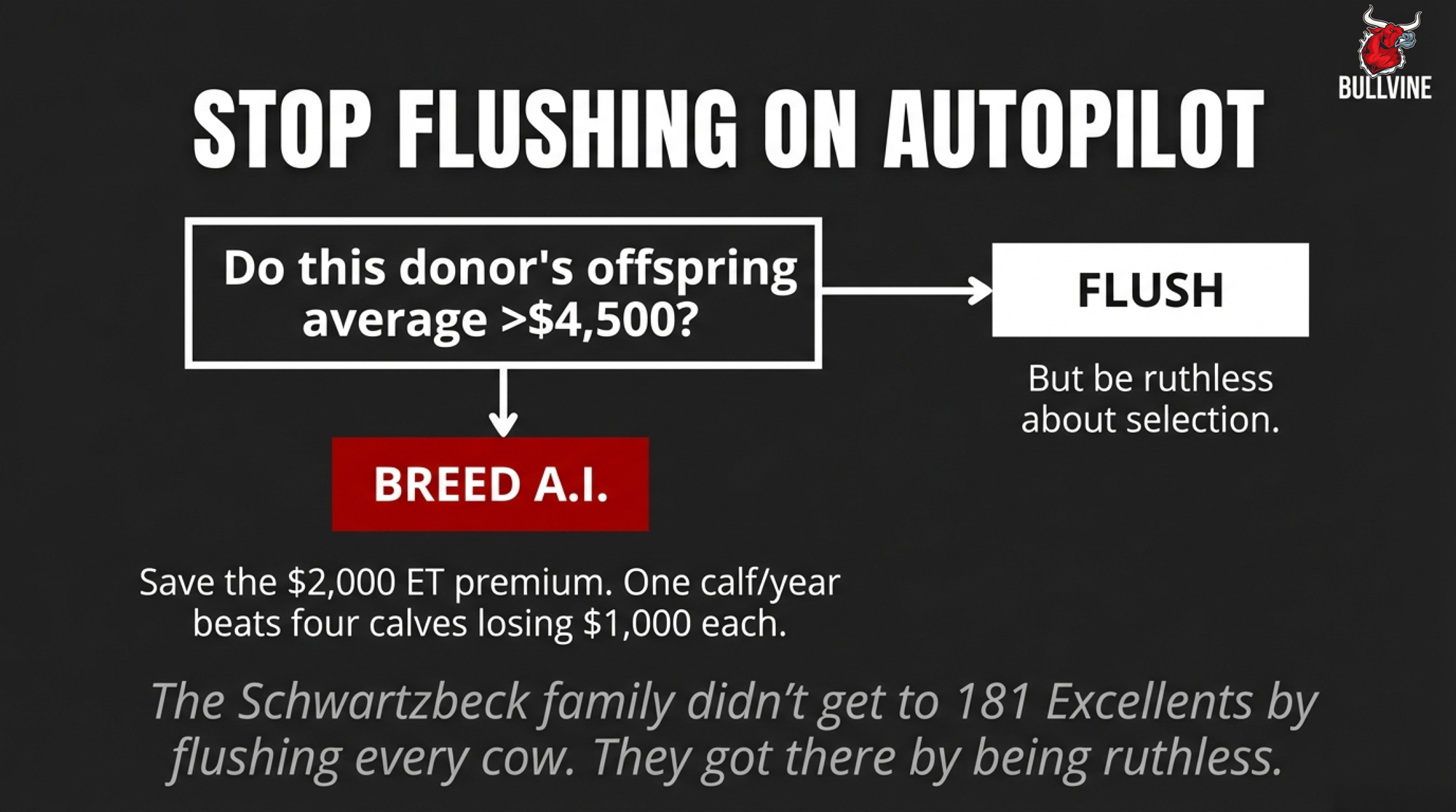
The Schwartzbeck family’s Peace & Plenty operation offers the clearest proof that elite genetics still command strong premiums. Their Springtime Jubilee Sale, co-hosted with Ducketts and Borderview, grossed over $1 million, averaging $8,635 per lot — nearly double the $4,917 breakeven. But that’s a program with 181 Excellents traced back to one foundation cow, seven All-Americans in a single year, and the 2025 McKown Master Breeder Award. The Schwartzbeck family didn’t get to 181 Excellents by flushing every cow in the barn. They got there by being ruthless about which genetics justified the investment.
That discipline is exactly what this market now demands from every ET program. The market isn’t dead — it’s bifurcating. The top half is stronger than ever. The bottom half can’t cover the new cost of producing what it sells.
An operation like Pine-Tree sits right on the fault line. Steiner’s own sale averaged $5,000 — above breakeven, but barely. His California Convention consignments hit five figures in a year when the catalog average fell by $1,618 to $4,230. The genetic depth is there. The national reach is there. The question facing operations like Pine-Tree — and every ET breeder consigning this spring — isn’t whether the market wants elite Holsteins. It’s whether the sale you’re consigning to can return enough on the calves that aren’t your best one.
Can the Sale Format Close the Gap?
When margins are this thin, how you sell matters.
TAG sales run for a week rather than a few hours. Buyers get time to evaluate genetics, classification records, and pedigrees before committing. Sellers keep control — they review an offered price before accepting, rather than watching an auctioneer hammer down a number that doesn’t cover costs.
“Being able to communicate with the buyer throughout the process is a huge plus.” — Frank Donkers, Fradon Farms
That communication can move money. When you need $5,065 to break even on a middle-scenario ET heifer and your buyer understands the EX dams, the pedigree depth, and the real production costs behind that calf, they bid differently than when they’re making a split-second call under an auctioneer. The extra week of buyer conversation isn’t a luxury at $4,917 per heifer. It’s a tool.
But format won’t create value that the genetics can’t support. A $4,917 calf needs to bring $5,100+ in a TAG sale just as much as in a live ring.
What This Means for Your Operation
- Run the cost ladder with your actual numbers before you consign. Every line item in the table above takes your inputs. Swap in your real embryo cost (flush vs. purchase), your real recipient cost, and your real days on feed. If your breakeven exceeds $5,000 and your calves historically sell in the $3,600–$4,200 range, you’ve got a gap that excitement won’t close.
- Apply the flush/don’t flush threshold. If your donor’s average offspring sale price over her last three sales falls below $4,500, she probably doesn’t justify an ET slot at current input costs. Breed her AI and save the $2,000+ per-calf ET premium. One calf per year beats four calves that each lose $1,000.
- Know your breed-level math. Multi-breed sales mask important differences. Rockin@Retso’s Holsteins averaged $4,901 while Jerseys brought $3,005 at the same event — same sale, wildly different economics. If you’re consigning to a multi-breed sale, your breed-specific average is the number that matters, not the catalog average.
- Watch for year-over-year compression. California’s Convention dropped from $5,848 in 2023 to $4,230 in 2024 — a $1,618 slide — even while elite lots held strong. If your sale’s average is trending down while your input costs are trending up, the scissors are closing on you.
- Use the replacement floor strategically. At $3,010 per replacement heifer, even your show rejects carry meaningful value. A registered Holstein that doesn’t make the ring but enters a milking string is a $2,500–$3,000 asset. Your ET gamble has a floor — just not one that covers the full cost.
- If you’re buying this spring, recalibrate. A well-bred ET show heifer at $5,000–$6,000 isn’t overpriced. It’s cost recovery for a breeder who invested $4,917+ to produce her. If you’re still anchored to 2023 prices, adjust.
- In the next 30 days, run your cost ladder for every donor you plan to flush this spring. In 90 days: Review your first sale results against this breakeven and adjust flush plans for fall.
Key Takeaways
- If your working-tier sale average falls below $4,917, you’re losing money on every ET heifer at current input costs. That’s the middle scenario. The realistic IVF scenario pushes past $5,500. The Rockin@Retso Holstein average of $4,901 landed $16 short—essentially breakeven before commission.
- The $2,000 recipient cow is the new floor, not the ceiling. Commercial beef calves at $1,500+ and 500-lb. steers at $480/cwt have repriced recipients structurally. Beef-on-dairy calves alone are cashing cheques up to $1,750. Recipients won’t come back down until beef markets soften.
- IVF efficiency is improving, but it doesn’t fix the math by itself. Trans Ova’s 40–50% frozen pregnancy rates are a real gain over older numbers. RuAnn Genetics has pushed conventional rates to 63% in virgin heifer recipients across 23,488 transfers. But at 50% female, even the best programs land at 20–32% live heifers per embryo. You still have to be selective about which donors and matings get the slot.
- The replacement shortage is your backstop, not your business model. Heifer inventories at their lowest point since 1978 put a floor under every registered Holstein. But a $3,010 replacement value doesn’t cover a $4,917 show calf production cost.
The Bottom Line
The spring sale season runs weekly through May. You don’t push $85,000 at Mount Elgin and $205,000 at WDE in a market that’s lost interest in elite Holsteins. Peace & Plenty doesn’t gross $1 million in a dead market. Pine-Tree doesn’t draw buyers from Siemers Holsteins to California for a $10,500 IVF lot without real demand for the right genetics.
But for ET-bred calves sold into working-tier sales, the old assumption that a $3,600 average covers the producer’s costs is no longer valid. Before you load the trailer this spring: where does your breakeven actually sit? And does the sale you’re consigning to — not the World Classic, but your sale — cover it?
Learn More
- $3,010 Per Heifer. 800,000 Short. Your Beef-on-Dairy Bill Is Due. – Gain concrete breeding and culling rulesto navigate the current replacement crisis. This guide exposes the 18% pregnancy rate threshold that determines if you can survive the heifer shortage while still capturing high-value beef-on-dairy premiums.
- $18.95 Milk, $1.6B in Cheese Plants: Why 2026 Forces Mid-Size Dairies to Scale, Go Premium, or Exit – Position your equity for the next five years by understanding the structural shifts in processing. This analysis breaks down the $1.6 billion processor bet on cheese and why choosing between scale or specialty contracts is now mandatory.
- Genetic Revolution: How Record-Breaking Milk Components Are Reshaping Dairy’s Future – Arm your operation with the next decade’s genetic edge by mastering the 2025 reset. This deep dive reveals how AI-powered neural networks are repricing feed efficiency and components to drive 2030s-level profitability today.
 The Sunday Read Dairy Professionals Don’t Skip.
 The Sunday Read Dairy Professionals Don’t Skip.
Every week, thousands of producers, breeders, and industry insiders open Bullvine Weekly for genetics insights, market shifts, and profit strategies they won’t find anywhere else. One email. Five minutes. Smarter decisions all week.




