






Think focusing only on fresh cows keeps your herd safe? Think again. Calf heat stress quietly kills future production.
EXECUTIVE SUMMARY: Here’s the deal: heat stress isn’t just about keeping your milking herd cool—it’s quietly stealing profits from your calf program too. We’re talking about $2.5 billion in annual losses across US dairies, with smaller operations getting hit hardest at 1.6% more yield loss than the big guys. When temps climb above 22°C, calf mortality doubles, and those survivors? They’ll produce 5-10 pounds less milk daily during their first lactation—that’s up to $3,600 lost per heifer. Feed efficiency drops 12-15% during heat waves, adding $85-$125 in extra costs per calf before weaning. Climate data shows this problem’s only getting worse globally, with European farms already seeing 100+ heat stress days annually. The good news? Simple fixes like proper shading and betaine supplementation can turn this around—and the ROI is solid. You really need to look at your calf setup this summer.
KEY TAKEAWAYS:
- Install shade structures now — 11-20 sq ft per calf with 80-85% UV-blocking cloth cuts heat stress by 86%. Walk your barn today and see where calves are getting hammered by direct sun.
- Try betaine supplementation — 15-25 grams daily during heat events can boost feed efficiency up to 15%. Call your nutritionist this week about sourcing and proper dosing for your herd.
- Get THI monitoring — these $300-$500 systems prevent doubled mortality when temps hit 22°C. It’s like having early warning radar for heat stress.
- Calculate your losses — heat-stressed calves lose $1,800-$3,600 in first lactation milk revenue alone. Managing this early is one of the smartest investments in 2025 dairy farming.
- Scale cooling by herd size — sprinkler/fan systems pay back in 1 year on 200+ cow herds, but smaller operations should start with shade and work up. Don’t blow your budget on the wrong tech.
Heat stress in calves often gets overshadowed by our focus on the milking herd, but this oversight is costing dairy producers real money—showing up as lost growth, higher mortality, and reduced milk production years down the line.
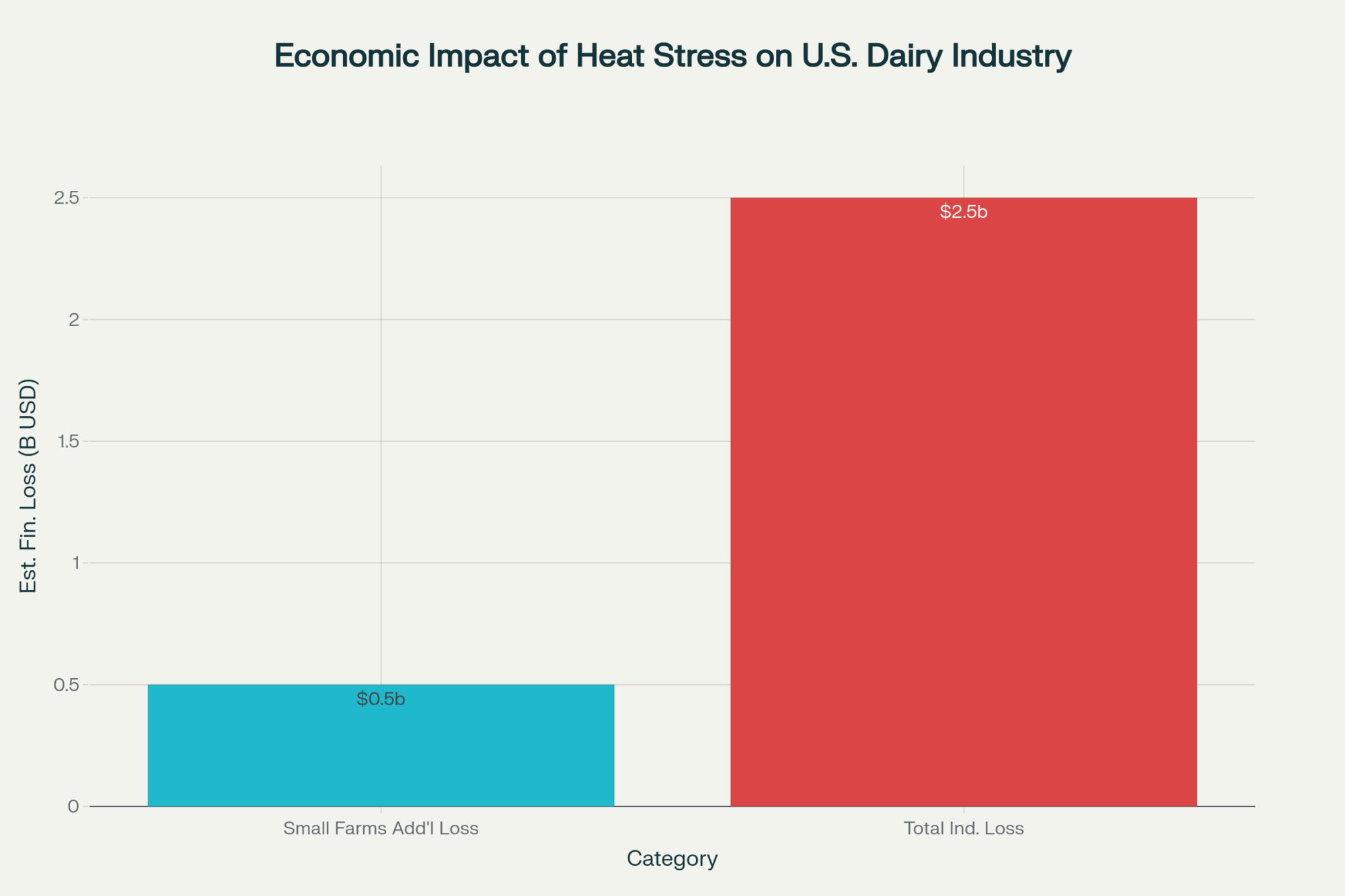
Here’s what’s really happening: recent research from leading dairy institutions suggests that heat stress is costing the US dairy industry $1.2 to $2.5 billion annually. Small farms—especially those with fewer than 100 cows—are facing significantly higher yield losses, about 1.6% more than larger operations. That comes from a University of Illinois meta-analysis of 56 million milk records across the country.
When Feed Efficiency Goes South
| Impact Category | Normal Conditions | Heat Stress (>22°C) | Financial Loss Per Calf |
|---|---|---|---|
| Feed Efficiency | 100% | 85-88% (12-15% drop) | $85-$125 extra feed cost |
| Mortality Rate | Baseline | 2x higher | $2,200-$2,800 replacement cost |
| First Lactation Daily Milk | Normal yield | 5-10 lbs less | $1,800-$3,600 revenue loss |
| Respiratory Rate | 25-50 breaths/min | 100+ breaths/min | Compromised nutrient absorption |
Heat messes with feed conversion in ways that’ll make your accountant cringe. Dr. Lance Baumgard’s research team at Iowa State indicates that feed efficiency can tank by 12-15% during those brutal summer stretches. With starter feed climbing north of $680 a ton—and that’s if you can even get it—you’re looking at an extra $85 to $125 per calf before weaning. That adds up fast.
However, here’s where it becomes particularly concerning: calf mortality. A 2024 Hungarian study by Dr. Ádám Kovács, tracking nearly 47,000 calves, found that mortality rates double once temperatures hit 22°C (72°F). Sure, that’s European data, but heat stress physiology doesn’t respect borders. When replacement heifers are running $2,200 to $2,800—and good luck finding quality genetics at the low end—every preventable death hurts.
The Silent Profit Killer You’re Not Measuring
What really keeps me up at night is the long-term damage. Dr. Geoffrey Dahl’s research at the University of Florida shows that calves stressed by heat early in life produce 5-10 pounds less milk daily during their first lactation. Think about that for a second. With Class III bouncing between $15 and $22 per hundredweight, you’re staring at $1,800 to $3,600 in lost revenue per heifer—just in their first lactation.
Why does this happen? Penn State Extension research shows that heat stress significantly increases respiratory rates, disrupting nutrient absorption and setting the stage for a lifetime of subpar performance. It’s programming failure into your future herd.
Here’s What Actually Works
| Solution | Cost Range | ROI | Payback Period | Best For | Implementation Difficulty |
|---|---|---|---|---|---|
| Shade Structures (80-85% UV blocking) | $8,000-$12,000 per 100 calves | Up to 86% stress reduction | 6-12 months | All farms | Low |
| Betaine Supplementation (15-25g daily) | $0.50-$1.50 per calf/day | 4:1 to 6:1 | Immediate | All farms | Very Low |
| THI Monitoring Systems | $300-$500 per barn | Early warning prevention | 3-6 months | All farms | Low |
| Sprinkler-Fan Systems | $15,000-$30,000+ | 1-year payback | 12 months | 200+ cow herds | High |
| Solar Ventilation | $5,000-$10,000 | 25-35% reduction | 24-30 months | Remote locations | Medium |
Now for the good news—and there is good news. Dr. Rebecca Smith’s 2023 work in the Journal of Animal Science on betaine supplementation documents returns of 4:1 to 6:1 on investment, helping calves maintain hydration and keep eating when the mercury climbs. Consult your nutritionist to determine the right dosage and source a quality product for your specific herd.
Don’t underestimate shade, either. Dr. Terry Mader’s Australian research demonstrates that 11-20 square feet of 80-85% shade cloth per calf, mounted high enough for airflow, reduces heat stress events by up to 86%. I’ve seen operations in Texas use everything from permanent structures to moveable high-quality shade cloth. The key is getting air moving underneath.
Technology That Pays (If You Do It Right)
For active cooling, the economics get interesting. Dr. Fernanda Ferreira’s UC Davis research shows that sprinkler-fan systems pay back in about a year for herds of over 200 cows. Smaller operations? You might be looking at 2-3 years, so crunch those numbers carefully.
Solar-powered ventilation is gaining traction, especially in areas where electrical infrastructure is limited. Early adopters report 25-35% reductions in heat stress indicators, though we’re still gathering long-term durability data.
Here’s the thing, though: measure before you invest. Temperature-Humidity Index (THI) monitors—running a few hundred bucks per barn—give you early warning before problems hit. Dr. Ken Nordlund, a leading expert on dairy housing at the University of Wisconsin, calls them essential tools for proactive management.
The Economics That Change Everything
Current market conditions are pushing decision-making. Agricultural loan rates are sitting around 7%, skilled dairy labor is commanding $16-19 an hour, and climate projections show European farms facing 100+ heat stress days annually by 2050—the Midwest isn’t far behind.
What’s fascinating is how bigger operations can absorb cooling infrastructure costs, while smaller farms are finding creative solutions. I know producers in Wisconsin who install shade first, monitor with THI, and then scale up as budgets allow. It’s about being strategic, not just throwing money at the problem.
Your Future Is in Those Hutches
So what’s your move going to be? Your calves aren’t just tomorrow’s milkers—they’re your pipeline to profitability. Every heat-stressed calf today becomes a lower-producing cow tomorrow. The research is clear, the economics are compelling, and the technology solutions exist.
Start simple: shade, betaine, monitoring. Scale up with active cooling as your numbers justify it. Because in this business, prevention isn’t just better than cure—it’s the difference between thriving and just surviving.
The producers who get ahead of this curve now will have a significant competitive advantage as summers continue to get longer and hotter. The question isn’t whether you can afford to invest in calf heat stress management—it’s whether you can afford not to.
This analysis draws on research from the University of Illinois, Iowa State University, the University of Florida, the University of Queensland, UC Davis, Penn State Extension, and other leading institutions. For tailored strategies, consult your nutritionist and extension agents.
Complete references and supporting documentation are available upon request by contacting the editorial team at editor@thebullvine.com.
Learn More:
- When Does Heat Stress Impact Calves? – This article provides a tactical, science-based breakdown of calf thermoneutral zones and key physiological indicators of stress. It reveals how to identify heat stress early and offers practical strategies for optimizing housing and nutrition to prevent performance losses before they start.
- Revolutionizing Calf Care: How Smart Pathogen Management Cuts Losses by $5,000 Per Calf While Boosting Lifetime Milk Yield by 525 kg – While focused on disease, this strategic piece highlights how holistic calf care—including stress reduction—generates massive, measurable long-term returns. It provides a financial roadmap for justifying investments in premium calf management, connecting immediate costs to staggering lifetime profitability gains.
- Heat Stress Isn’t Coming – It’s Already Robbing Your Milk Check. Here’s How Elite Dairies Are Fighting Back – This article takes a broad, innovative view of heat stress management across the entire herd. It explores advanced, data-driven solutions and operational protocols—like precision cooling, airflow management, and worker safety—that savvy farms are using to turn climate pressure into a competitive advantage.
 The Sunday Read Dairy Professionals Don’t Skip.
 The Sunday Read Dairy Professionals Don’t Skip.
Every week, thousands of producers, breeders, and industry insiders open Bullvine Weekly for genetics insights, market shifts, and profit strategies they won’t find anywhere else. One email. Five minutes. Smarter decisions all week.




