






Data-driven: Progressive farms cutting robot pellets 50% report $100/cow savings plus 5-8% production gains after adaptation
EXECUTIVE SUMMARY: What farmers are discovering about robot feeding is transforming how progressive operations think about automation economics. Research from the University of Minnesota and Saskatchewan shows that reducing robot concentrate from 8 kg to 3-4 kg daily—while optimizing PMR consistency—can save $100 per cow annually in feed costs while actually improving production after a 6-8 week adaptation period. This aligns with European operations that have quietly achieved superior robot utilization rates by treating concentrate as motivation rather than a means of nutrition. Dr. Trevor DeVries’ work at Guelph demonstrates that automatic feed push-up systems, combined with minimal robot pellets, create behavioral patterns that support voluntary milking far better than high-concentrate dependency. For producers facing today’s margin pressures, this approach offers a practical path to improved profitability—though success requires patience through the transition and strong PMR management. The conversations happening across the industry suggest that we’re witnessing a fundamental shift in how smart farmers optimize their robotic investments.

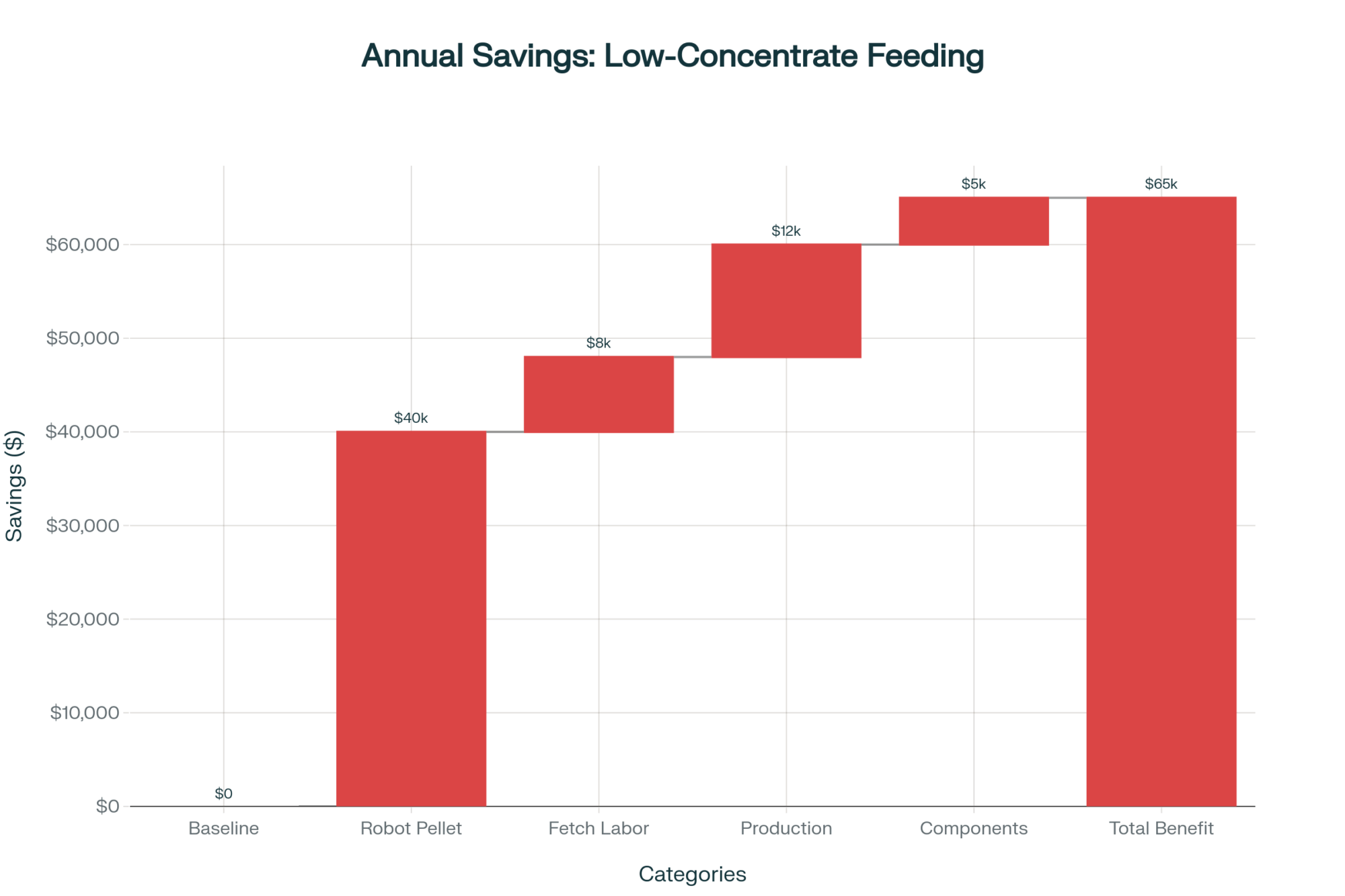
I recently spoke with a producer in eastern Ontario who completely changed my thinking about robot feeding. After three years of fighting his system—and spending roughly $40,000 extra annually on robot pellets (about $100 per cow in unnecessary feed costs)—he reduced his concentrate by half and saw production actually increase. Now, that got my attention… and it’s part of a larger conversation happening across the industry.
What’s particularly noteworthy is how this builds on what we’ve been seeing in European operations for years, though with important differences for North American conditions. When Tremblay and colleagues published their analysis in the Journal of Dairy Science in 2016, they examined farms across Minnesota, Wisconsin, Ontario, and Quebec. The findings suggested that feeding philosophy might be more important than previously realized.
Why Cows Visit Robots: Rethinking Motivation vs. Nutrition
Here’s something I find fascinating about robotic operations worldwide: the most successful systems often share a common insight—robots seem to work best when cows visit voluntarily for milking comfort rather than primarily for concentrate.
I was at a conference recently where Dr. Greg Penner from the University of Saskatchewan presented research showing substantial PMR substitution when robot concentrate increases. This aligns with what many producers have been noticing—you increase robot pellets, thinking you’re improving nutrition, but the cows just eat less at the bunk. The net effect? Often not what we intended.
What’s interesting about European operations—and I’m curious if others have noticed this—is that they typically feed considerably less robot concentrate than we do. A Danish producer I met last year was running beautifully on just 3 kilograms of pellets. When I asked how he managed cow traffic, he smiled and said, “feed availability at the bunk does more than pellets ever could.”
Now, that’s different from what most of us learned, but it’s worth considering…
The Hidden Premium: Why Robot Pellets Cost More Than You Think
I was reviewing feed costs with a Wisconsin producer last month, and something jumped out at both of us. His robot pellets were running significantly more per ton than the equivalent energy in his TMR—we’re talking a premium that often runs thousands of dollars annually on a 400-cow operation.
This builds on research Dr. Alex Bach has been publishing in the Journal of Dairy Science. While the data is still developing, his work suggests farms that limit robot concentrate while optimizing PMR energy density often see improvements across several metrics. Better rumen health appears to drive everything else—improved production, reduced feed conversion rates, and even higher butterfat and protein levels.
A producer in central Minnesota recently shared something that stuck with me: “I was so focused on getting cows to the robot, I forgot about total nutrition.” After adjusting his program—reducing the robot pellet and improving the PMR—his somatic cell counts decreased, and his butterfat level increased by 0.2%. Sometimes the indirect benefits surprise us more than the direct ones.
For high-heat California operations, the economics shift even more. When cows are experiencing heat stress, feeding concentrate through robots can actually exacerbate the problem. A producer near Tulare told me that switching to minimal robot concentrate with more frequent TMR delivery helped maintain components through last summer’s heatwave.
The 8-Week Reality: What Actually Happens During Transition
Why is making this change so difficult? Well, I think it’s partly psychological. Most of us—myself included—have been conditioned to believe robots need substantial concentrate to function properly. And honestly, for some operations, that might still be true.
Dr. Marcia Endres from the University of Minnesota published fascinating research in 2018 studying automatic milking farms across Minnesota and Wisconsin. What stood out wasn’t just the performance differences, but how feeding patterns created behavioral changes that supported voluntary milking.

Week-by-Week Breakdown
I recently worked with a producer transitioning to lower robot concentrate, and here’s what we observed:
Weeks 1-3: The Anxiety Phase Production dipped about 5-8%, fetch rates increased, and frankly, everyone was nervous. This seems typical based on what I’m hearing from others.
Weeks 4-5: The Stabilization Period Things started settling. The cows developed new patterns, voluntary visits improved, and production began recovering.
Weeks 6-8: The Payoff They were exceeding previous production levels with lower feed costs. However, and this is important, not everyone sees these results, and the adaptation period can test your patience.
What I’ve learned from producers who’ve been through this: those who abandon the transition early never find out if it would have worked. It’s a genuine dilemma when you’re watching that milk check…
Key Questions to Consider Before Making Changes:
□ What’s my current robot utilization rate compared to capacity?
□ How consistent is my PMR quality day-to-day?
□ Do I have labor available for the transition period?
□ What’s my risk tolerance for temporary production dips?
□ Have I documented baseline performance metrics?
□ Are my robots sitting idle during certain hours while overcrowded at others?
Beyond Milkings Per Day: Tracking What Really Matters
Something I’ve been discussing with progressive producers lately: we might be tracking the wrong things. Sure, milkings per day matter, but what about distribution throughout the day? Or total system economics?
A producer near Guelph recently showed me his tracking system. Beyond the usual metrics, he monitors eating time at the bunk, rumination consistency across groups, and—this was clever—robot utilization patterns by hour. He said understanding when his robots sat idle helped him adjust feeding times to smooth out traffic.

Dr. Trevor DeVries from the University of Guelph has published work suggesting automatic feed push-up systems can significantly impact robot performance. The mechanism seems less about total intake and more about behavioral consistency. Each push-up creates a small motivation event, and over 24 hours, those add up.
The principles might be universal—consistency, cow comfort, economic efficiency—but the application varies tremendously depending on your setup, your cows, and your goals.
Regional Realities: Adapting Strategies to Your Environment
Every operation is different—a point I can’t emphasize enough. What works for a 3,000-cow dairy in New Mexico’s dry lot systems won’t necessarily translate to a 150-cow grass-based operation in Vermont’s seasonal pasture environment.
Northern Climate Considerations
I recently visited a producer in Manitoba who made the transition over a period of four months. His approach was methodical: he increased feed push-ups first, improved PMR consistency, and then slowly reduced robot concentrate. He said the key was watching the cows, not just the numbers.
For Northeast producers transitioning to and from seasonal pastures, timing is crucial. Spring turnout creates natural feeding disruption. Some farmers use this transition to simultaneously adjust robot concentrate levels, masking the change within the larger seasonal shift.
Southern Heat Management
For western operations dealing with water restrictions and resulting forage variability, maintaining higher robot concentrate might provide necessary nutritional consistency. An Arizona producer told me, “When your forage quality swings wildly, robot concentrate becomes your safety net.”
Practical Starting Points
For those considering changes, here’s what seems to help:
- Start with feed bunk management before touching robot settings
- Document everything—you’ll want to know what worked and what didn’t
- Consider working with someone who’s done this before
- Be prepared for the adaptation period—it’s real and it’s challenging
Fresh cow management deserves special mention here. Many producers find these cows benefit from higher robot concentrate during the first 21 days, then gradually transition to the herd’s standard program.
Comparing Traditional vs. Optimized Approaches
| Factor | Traditional High-Concentrate | Optimized Low-Concentrate |
| Robot pellet amount | 7-9 kg/day | 3-4 kg/day |
| Feed cost premium | $100+ per cow annually | Minimal to none |
| Fetch rates | Often 15-20% | Typically <10% |
| Adaptation period | Immediate | 6-8 weeks |
| PMR quality requirements | Moderate | High consistency crucial |
| Best suited for | Variable forage quality | Consistent feed management |
Building Support: Getting Your Team on Board
One challenge producers mention is resistance from their support team. And honestly, I understand both sides. Feed advisors and equipment dealers have seen what works across many operations. They have valid concerns about dramatic changes.
A producer in Saskatchewan found success by presenting it as a trial with clear parameters. Instead of arguing about philosophy, he proposed a 12-week test with specific metrics to evaluate. His nutritionist became more supportive when they agreed on what success would look like upfront.
What’s encouraging is that some companies are adapting to these changes. I’ve noticed that equipment manufacturers are developing systems with greater flexibility in concentrate delivery. Whether you’re running Lely, DeLaval, GEA, or Boumatic systems, each has its quirks and optimization potential.
Global Lessons, Local Applications

The diversity of successful approaches worldwide is remarkable. Dutch operations often run minimal concentrate with exceptional results—but they also have different genetics, facilities, and economic pressures than we do. Danish systems leverage incredibly consistent forages. New Zealand producers work with seasonal variations that we don’t face.
What can we learn from this diversity? Maybe that there’s no single “right” way to feed robots. The key question isn’t whether to use high or low concentrate, but whether your current approach aligns with your goals and conditions.
Breed considerations matter too. Jersey operations often find different concentrate levels optimal compared to Holstein herds—Jerseys’ higher components but lower volume might justify different feeding strategies.
When Higher Concentrate Still Makes Sense
Let’s be clear: many successful operations achieve excellent results with traditional feeding programs. I know producers getting 95 pounds per cow with 8 kilograms of robot concentrate, and their systems work beautifully.
Fresh cow management often benefits from individualized nutrition through robots. Operations dealing with extreme weather, inconsistent forages, or specific health protocols might find higher concentrate levels necessary.
This season’s feed prices might influence your decision, too. When robot pellets hit premium prices during drought years, the economics of alternative approaches become more compelling. Conversely, when you’ve got excellent quality forages, maybe that’s the time to experiment with reduced concentrate.
The Evolution Continues: What’s Next for Robot Feeding
What excites me about current developments is the ongoing research. Just this year, extension programs across the Midwest have been collecting data on feeding transitions. Feed companies are developing products specifically for robotic systems. Producers are sharing experiences more openly than ever.
I’m particularly interested in how next-generation robots will handle feeding. Will they adapt to our management preferences, or will we see convergence toward optimal strategies? Early indications suggest more flexibility, not less.
For producers facing current margin pressures—and who isn’t these days—exploring feeding alternatives might offer opportunities. Not revolutionary changes, necessarily, but thoughtful adjustments tailored to your specific situation.
The conversation continues, and that’s healthy for our industry. Whether you’re running traditional programs or exploring alternatives, the key is to stay curious and open to what works best for your operation.
After all, the best feeding system is the one that keeps your cows healthy, your robots running efficiently, and your operation profitable. How you achieve that… well, that’s where the art meets the science.
KEY TAKEAWAYS:
- Economic opportunity: Reducing robot concentrate can save $40,000-50,000 annually for 400-500 cow operations while maintaining or improving production—that’s real money in today’s tight margins
- Regional adaptation matters: Northern operations benefit from gradual 4-month transitions during stable feed periods, while southern heat-stressed herds see improved components when eliminating slug-feeding through robots
- Track the right metrics: Focus on robot utilization patterns throughout the day and total system economics rather than just milkings per cow—understanding when robots sit idle reveals optimization opportunities
- The 8-week commitment: Expect temporary production dips (5-8%) during weeks 1-3, stabilization by week 5, and improved performance by week 8—producers who quit early never see the benefits
- Team approach wins: Present changes as 12-week trials with clear success metrics to gain nutritionist and dealer support, recognizing their valid concerns while demonstrating what works for your specific operation
Complete references and supporting documentation are available upon request by contacting the editorial team at editor@thebullvine.com.
Learn More:
- Stop Blaming Your Robots: The Million-Dollar Management Mistakes Killing Your Dairy’s Profitability – This practical guide reveals specific, data-backed management strategies for increasing robot profitability. It provides actionable metrics and focuses on key areas like feed push-ups, barn design, and data analysis, which complement the feeding philosophy discussed in the main article.
- The Robotics Revolution: Embracing Technology to Save the Family Dairy Farm – This strategic article provides a high-level economic analysis of robotic milking, detailing the ROI on a per-cow basis and its impact on labor. It helps producers facing today’s tight margins understand why automation is a long-term solution rather than a short-term luxury.
- UNDER-BELLY REVOLUTION: Afimilk’s Synergy Could Finally Solve the Mid-Sized Dairy Automation Dilemma – This innovative piece explores emerging technology that addresses the automation gap for mid-sized dairies. It demonstrates how companies are developing specialized solutions to overcome traditional investment barriers, providing a forward-looking perspective on the evolution of robotic systems beyond conventional VMS units.
 The Sunday Read Dairy Professionals Don’t Skip.
 The Sunday Read Dairy Professionals Don’t Skip.
Every week, thousands of producers, breeders, and industry insiders open Bullvine Weekly for genetics insights, market shifts, and profit strategies they won’t find anywhere else. One email. Five minutes. Smarter decisions all week.




