






Vaccination is the act of administering a vaccine; immunization is the animal’s response to vaccinating. A host of practices contribute to the success of vaccination and achieving proper immunization of your animals.
Successful immunization requires two factors. First, the vaccine must be correctly cared for and administered. Second, the animal must be in a physiological state that allows for vaccination response.
Here are the most important considerations to ensure effective immunization.
Train employees in best practices
Employee training is critical. With constant improvements to our collective knowledge of best practices in cow handling and care, make continuing education a priority for all employees.
Fully explain, demonstrate and reinforce protocols for proper vaccine handling and administration, as well as correct animal handling techniques.
Keep vaccination stress-free
For effective immunization, the animal must be healthy and physically able to respond to vaccination. Stress can negatively affect an animal’s immune response, reducing the success of vaccination. To help overcome this, make vaccination as stress-free as possible by using calm, quiet handling methods.
Proper nutrition and hygiene also are essential for optimal immune response. To gain a localized Immunoglobulin A (IgA) response in the upper respiratory tract, even in the face of maternal antibodies, intranasal vaccines are great options for young calves.
Not only do proper handling techniques help reduce stress, but they also ensure animals are calm for administering the injection. Cows also have a great memory of stressful situations, so avoid vaccinating in areas where you want cows to feel calm and relaxed, such as the milking parlor.
Use restraints for safety
Think through your facilities to identify areas where calves and cows can be effectively restrained for vaccination – for both animal and employee safety.
Damage at the injection site may lead to infection and/or decreased efficacy. When cattle are properly restrained, injections are more precise and accurate, limiting the potential for injection site damage and excessive inflammation.
Keeping animals properly restrained is also safer for employees administering the vaccination. While a calf can be securely held by two people, cows need proper head restraint to limit movement, so an ideal area may be in headlocks in the free stall barn. Limit the amount of time that animals are kept in headlocks to further reduce stress and let them get back to lying down and ruminating.
Store vaccines properly before use
Proper storage is critical to maintain vaccine product efficacy. During the manufacturing and shipping process, great attention and care is placed on practices to that maintain effectiveness. It’s important to take the same level of care on the farm.
Temperature extremes, both too hot or too cold, can greatly shorten or eliminate the effectiveness of the vaccine. Freezing a killed vaccine product can damage the vaccine and release endotoxins from bacterins, while modified live virus (MLV) vaccines can be deactivated if frozen after being reconstituted.
Unless otherwise stated on the product label, store vaccines in a well-functioning refrigerator at 35 F to 45 F in a controlled environment that’s not exposed to extreme temperatures. To be sure the appropriate temperature is maintained, a refrigerator thermometer is a wise investment. Don’t store vaccines in the refrigerator door, as temperatures may fluctuate when the door opens and closes.
Understand mixing techniques
Just as you must follow label directions for vaccine storage, the same is true for mixing. To avoid waste and efficacy issues, only mix what you need for a relatively short period of time (about 30 minutes to two hours).
For example, if you have 200 animals to vaccinate, don’t mix all 200 doses and then start vaccinating. In general, no more than 50 doses should be mixed and stored at a time. Mix as you go and allow for unexpected delays.
For modified live virus (MLV) vaccines, it’s important to store and handle both the vaccine cake and sterile diluent according to label directions. MLV vaccines require a swirling or rolling motion to mix (shaking can damage the MLV within the vaccine) and should be used within two hours. Mixing the cake with warm diluent can greatly shorten or eliminate the effectiveness of the vaccine.
Discard any unused, activated MLV vaccine at the end of the day, as well as any products that have expired.
Handle vaccines properly after mixing
After mixing, keep vaccines cool and out of direct sunlight to maintain efficacy. Setting a syringe down on a table or pen gate can cause the vaccine to warm up and lose effectiveness.
A portable cooler with ice packs for multi-dose vaccinations is a convenient, affordable way to keep them cool and effective.
If it’s going to be an extremely hot day, it’s best to avoid vaccination altogether due to the effect of heat stress on the animal’s immune response, as well as storage and temperature concerns.
Select appropriate syringes and needles
Syringe size should be chosen based on the dosing for the greatest accuracy. Try to match the syringe to the dose size as closely as possible – a 2 mL dose doesn’t need a 20 mL syringe. If you wish to administer multiple doses of a vaccine to a group of cattle, use a multi-dose syringe that is designed for it.
Needle size depends on the size of the animal, the viscosity of the product, and the type of administration (subcutaneously, intramuscularly, or intravenously). For subcutaneous injections, typically a larger gauge, shorter needle (5/8-3/4 inch) is needed. Older cows and heifers may need a 16-gauge needle while an 18-gauge needle should be used for younger animals.
Check needles and discard any that are bent or damaged. To make sure the syringe is functioning correctly, calibrate it from time to time during administration.
A blunt needle makes administering vaccines more difficult, causes more pain to the animal, and may result in irritation or tissue damage. It’s preferred to use a new needle for every animal, especially from a biosecurity and BLV control standpoint. If re-using needles, don’t use any needle more than 10 times before changing it out.
Prevent contamination
Introducing any contaminate (bacteria, blood, dirt, debris, etc.) or pathogen to the bottle could affect efficacy of the vaccine, as well as cause reactions or infections in animals.
When loading a syringe, only put a sterile needle into a mixed bottle of vaccine. To prevent contamination, never use a needle that’s been used in an animal to draw the vaccine.
Multi-dose syringes should be sanitized after use for killed vaccines. MLV vaccine syringes should be washed with hot water and not a disinfectant or chemical that could affect efficacy.
Disposable syringes offer advantages in reducing the likelihood of contamination while avoiding the need to sanitize syringes.
Know the injection zone
Administering injections in the correct area helps ensure higher beef quality and minimizes tissue damage.
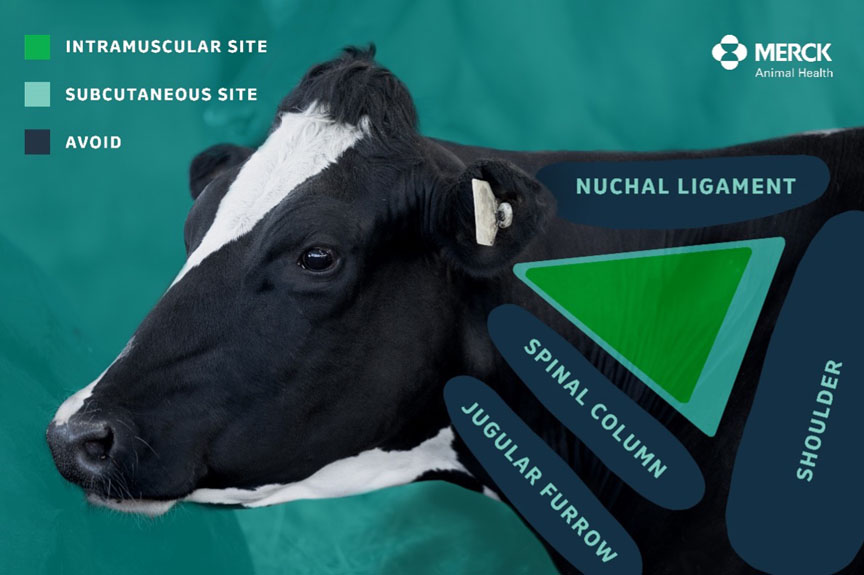
For intramuscular injections all injections should be given in an area of the neck, in the front of the shoulder, below the nuchal ligament and above the spinal column. Figure 1 shows this area, known as the “the injection zone triangle.”
Space injections at least four inches apart. If using a product that requires intramuscular injection, administer no more than 10 cc per injection site.
Keep detailed records
Accurate recordkeeping provides herd health insights and shows the correct and timely completion of vaccination procedures.
Keep records that include the following information of the animal being vaccinated:
- Identification
- Approximate weight
- Date, name and serial number of product used
- Dose
- Injection location
- Route of administration
- Name of person administering drug
- Prescribed withdrawal period
Consult your veterinarian
Advance your herd health plans by following vaccination best practices with guidance from your veterinarian. Your veterinarian can provide additional information and advice on proper vaccination products, protocols and timing.
For more information on cattle vaccination, visit MAHCattle.com.




