







What if your phone knows your next best cow before you do? Would you trust it—or fall behind?
EXECUTIVE SUMMARY: You know, here’s the thing nobody really wants to admit: AI just beat the “expert eye” at embryo grading with 95% agreement in real decisions—76% exact matches, too. That’s not someone’s fancy PowerPoint—those are Journal-of-IVF-Worldwide numbers, and the jump in conception rates is no joke. We’re talking herds picking up 10% better pregnancy rates and fresh cows putting $15,000 worth of top genetics in the tank every year.What’s remarkable is that this isn’t just Silicon Valley hype. Aussie barns, Brazilian crossbred herds over 4,500 kg, Iowa IVF labs—this tech is setting the pace. Even carbon credits are stacking up: $84,000+ for some of the smart operators cutting methane and those in their first calving age.Look, it isn’t magic beans, and you’ll need to fight through some training headaches—but if you’re tired of costly flush misses, this is the upgrade nobody else warned you about. Try it, track your own numbers, and see if your “eye” can really keep up. The future’s up for grabs, but you’ve gotta be in the race to win.
KEY TAKEAWAYS
- AI embryo selection jumps transfer success rates by 10%—think 54% fresh, 49% frozen, from real-world Vytelle benchmarks. Producers can start by calibrating their video protocols and benchmarking against last year’s results.
- Operational ROI isn’t theory—Brazilian dairies claim $84,000 in carbon credits and herds crossing 4,500 kg yields. (Embrapa, Animal Reproduction, JIVF) If you want to achieve those efficiencies, start logging carbon metrics with your extension specialist.
- Training and barn buy-in matter more than gadgets. Herds that succeed build feedback loops—so start with regular video review sessions and track pregnancy outcome by technician.
- 2025’s market rewards the daring—carbon, genetics, sustainability. That means now’s the time to invest in system upgrades, retrain your best people, and align with the right AI partners.
- Old-school “gut checks” just aren’t enough with $2,000+ per flush in play. If you haven’t updated your embryo game, you’re not just leaving money behind—you’re letting your neighbor’s genetics lap you by 2027.

Pull up a chair. Let’s talk shop. If you’re not asking hard questions and demanding higher ROIs from every flush, now’s your chance to get ahead before the next bull proof drops.
The buzz from my recent trip to Watertown, Wisconsin, wasn’t about the show ring—it was about an iPhone. Imagine this: the vet there snapped a video through her microscope and, before her coffee even steamed up her glasses, had an AI score predicting which embryo would actually become a calf. Meanwhile, her old-school embryologist with two decades in the trenches was still making the same calls he’s made since Butterfat was king.
Let’s be clear—what’s happening isn’t science fiction. The tools are here, and these little AI-assisted videos are stacking up more science than most of those old barn-bet “eyes” ever brought to the table. It’s working, and it’s quietly cutting through the noise.
In the Trenches: Is AI Just a Gimmick?
Some folks still think AI’s just for Silicon Valley. Truth is, it’s all over barns from Dodge County, Wisconsin, to Colac, Victoria. What’s smart about the new systems is how they pull from thousands of data points—embryo development speed, cell movements, not just the “good day/bad day” look. You don’t need to buy the marketing. Just ask around—guys are already quietly running more repeatable, more profitable flushes because of it.
Of course, producers talk. One fellow I bumped into over by Fox Lake admitted, “We ran by eye for years, but even our trusted ET guy says the numbers don’t lie anymore—if the data says ‘try it,’ we’re game.” That’s the way change actually happens on a U.S. Midwest dairy.
The Data That Turned the Tide (And Should Have Years Ago)
Here’s the meat: A well-done 2024 field trial stacked AI scoring against human grading using 558 bovine embryos. The AI’s exact-match agreement with the experts was 76%. But here’s what carried weight with me—on real, “should-I-transfer-or-not” decisions, AI and humans landed on the same call 95% of the time, even if they bickered about the details.
Now, if you’re wondering how sharp the “human eye” really is—average embryologist agreement is only about 60% when they’re staring at the exact same embryos. Let that roll around in your mind the next time two “experts” have different gut reactions to your $2,000 flush.
The ROI: How Data Outperforms “Gut Feel”
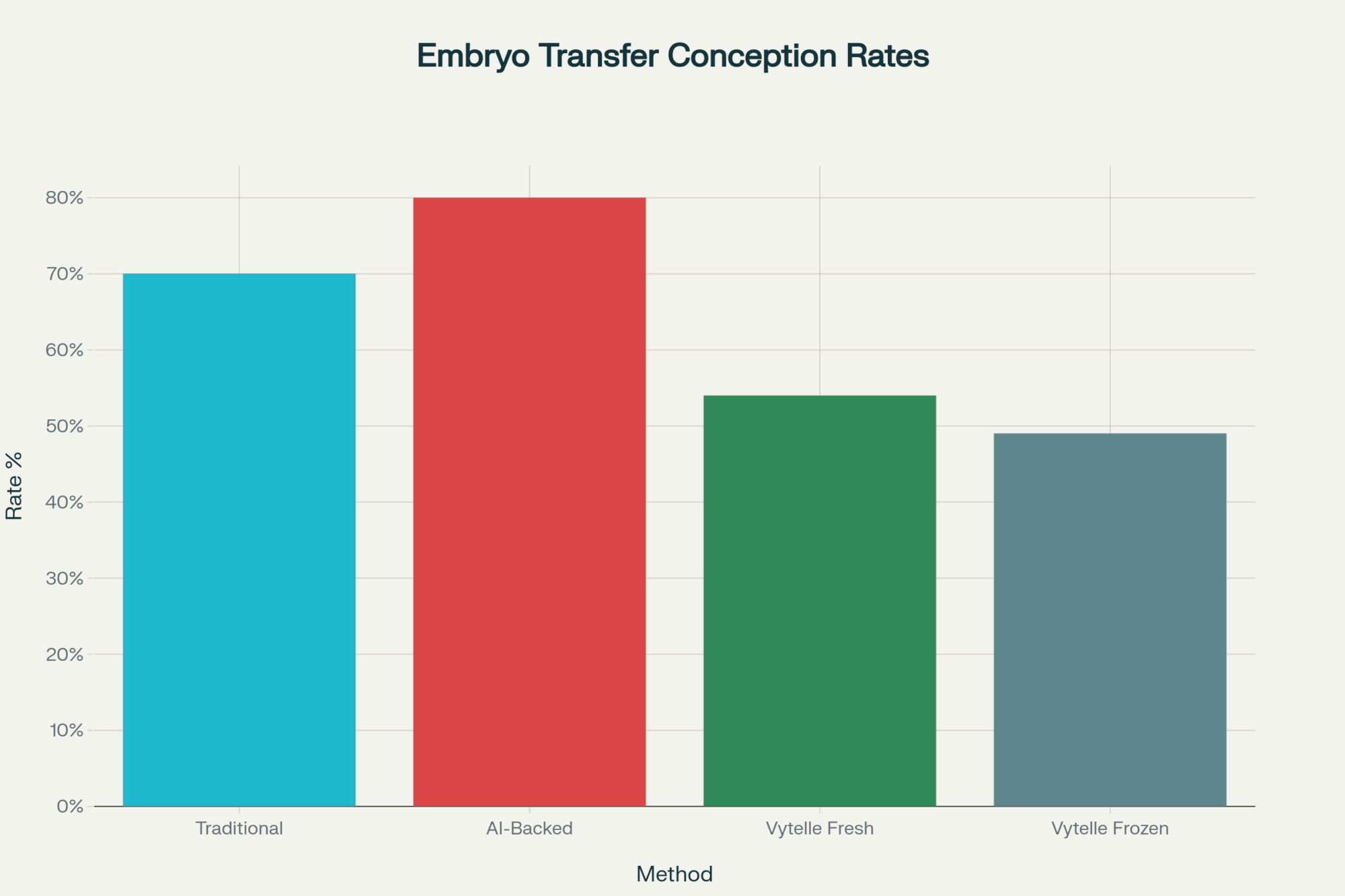
Traditional grading methods hover between 65-75% accuracy—if you’re lucky or using the best tech around. The newer AI-backed assessments are achieving exact matches in the upper 70s, and, in tandem with good management, reach into the mid-80s for practical agreement. You’re still spending the same 10-15 minutes per eval on the traditional side. Meanwhile, apps using routine smartphone videos and reliable barn data are getting cows bred for less money—and actually holding pregnancies.
Look, nobody’s running a check just for “cool factor.” You want results. The spillover? Some operations are seeing better call rates across bred cows, fewer repeats, and real dollars back in the system—especially when they’re replacing subjectivity with calibrated, farm-specific AI feedback.
The Implementation Reality
You probably heard, “AI is easy—just plug and play.” Let’s get real. There’s an upfront headache: if you aren’t investing in staff training, you’re begging for confusion. Every herd that succeeds in ramping up this data-driven approach told me the game changer wasn’t software—it was nailing the routine. Consistent video quality. Weekly troubleshooting. No shortcuts on feedback.
That learning curve, as Wisconsin Extension folks will point out, is where most folks lose their patience. Six months feels long, but for those who stick with it, results tick steadily upward.
Dialed-in herds—especially those in Iowa rolling through Vytelle’s Midwest lab—are logging fresh embryo conception rates right around 54% and frozen at 49%, which checks out globally. For most North American dairies, that’s a jump of 5-10 points over their “by-eye” baseline—not fantasy, but extra cash in the payout line.
When Climate, Region, or Protocols Make the Difference
| Region | Key Metric | AI Impact or Trend | Source |
|---|---|---|---|
| Midwest/USA | +10% conception rate, 54% fresh embryo, 49% frozen (Vytelle) | Benchmarking and calibration show improvement | Vytelle 2024, UW Extension |
| Victoria/Aus | >60% national milk, IVF fits with calving cycles | Affordable elite ET, fits seasonal herds | Agriculture Victoria, Holstein Australia |
| Brazil | 4500+ kg Girolando lactation, $84K carbon credits, 33% less methane | Selective breeding, environmental profit | Embrapa, Animal Reproduction, JIVF |
Here’s what’s wild about Victoria, Australia: farms there are putting out more than 60% of the country’s milk, and IVF is fitting perfectly into their controlled calving calendars. Take a look at Calderbrae Holsteins near Colac—165 cows, pedigree since before most of us even listened to ET podcasts. ET science didn’t just bump their production—it gave them affordability and access to top-line genetics.
Go one hemisphere over: Brazil. Over half a million embryos in a year, but the Girolando crossbreds are the big surprise. Modern, carefully selected Girolando herds are now pushing well past 4,500 kg a lactation, proving you don’t need to bend to heat stress—you can select for it.
The Stuff Nobody Tells You (But should)
Don’t get tricked by smooth marketers. AI’s not going to save you from sloppy barn habits. If your routine shifts don’t shoot quality video? Results will dive. Summer heat, fried Wi-Fi in the calving shed—AI can’t fix that. Your calving proof’s only as good as your record-keeping. That’s not me being picky; it’s what every extension agent worth their salt will tell you.
The Carbon, Credibility, and Competitive Edge
Serious point: this technology isn’t just about making more pregnancies. Brazilian teams reduced the first calving age from 48 to 24 months, resulting in over $84,000 in carbon credits and a 33% or more reduction in herd emissions. In the U.S., with co-ops and buyers wanting sustainability digits on your records, that leverage is starting to matter.
Not Every Farm Wins—And That’s the Reality
Here’s the straight dope: not every farm that tries AI holds on. Extension professionals will say a fair chunk drop out or fall flat on returns—mostly from poor training, muddled communication, or giving up at the first glitch. Upfront costs can sting, but the ones who plan, calibrate, and stick it out usually end up in the win column.
Successful herds? They make AI just another reliable tool—track every call, compare pregnancies, work hand-in-hand with their vet, and AI reps. The rest? They get left behind, plain and simple.
Here’s My Two Cents
Forget sci-fi headlines—this is the here and now. If you’re still grading embryos on gut and tradition while others let AI crunch their data, well… that’s all you, friend.
Want the tech to work? Treat barn data like a business, double down on staff training, and ride out the rough opening months. Expect hiccups. Learn from herds that didn’t bail. Remember, you don’t get windfall results overnight.
The bottom line is simple: producers building better systems, not just buying fancier apps, are the ones pulling ahead. It’s time to decide if you’re going to lead this change or wake up one day to find you’ve been left behind.
Complete references and supporting documentation are available upon request by contacting the editorial team at editor@thebullvine.com.
Learn More
- IVF Real World Results vs The Hype – This piece cuts through the marketing to deliver a tactical playbook, revealing the on-farm management and benchmarks required to turn IVF potential into measurable profit. It’s essential for building a program that actually works in the real world.
- The Index Wars: Is The Tail Wagging The Dog? – This strategic analysis challenges you to look beyond a single technology and question your entire genetic plan. It reveals how to leverage indexes for true profitability, ensuring your high-tech embryos build a resilient and economically sound herd for the future.
- Is Technology The Great Dairy Disruptor? – This article zooms out to show how AI embryo selection fits into the larger tech revolution reshaping dairy. It provides a forward-looking perspective on how data, automation, and genomics are creating the new winners and losers in the industry.
 Join the Revolution!
 Join the Revolution!
Join over 30,000 successful dairy professionals who rely on Bullvine Weekly for their competitive edge. Delivered directly to your inbox each week, our exclusive industry insights help you make smarter decisions while saving precious hours every week. Never miss critical updates on milk production trends, breakthrough technologies, and profit-boosting strategies that top producers are already implementing. Subscribe now to transform your dairy operation’s efficiency and profitability—your future success is just one click away.




