







Beef-on-dairy made your calf checks jump. At a 79% heifer completion rate, it can also leave your herd $108,000 short on replacements.
Executive Summary: NAAB’s 2025 semen report shows just under 66 million units sold and a record $327.6 million in export value, even as 63% of dairy semen left the U.S. market. In the same window, USDA replacement heifers climbed to roughly $3,010 per head, so every gap in your heifer pipeline now carries a five-figure price tag. Using NAAB’s domestic semen mix plus Mike Overton’s 79% heifer completion rate from 85 herds, the article walks a 400-cow herd through three breeding scenarios and shows how a “safe” 50–65% beef-on-dairy strategy can quietly turn into a 36-heifer, $108,000-per-year shortfall. CoBank’s Corey Geiger then zooms out to the national level, where semen-use patterns point to an 800,000-head heifer gap through 2026 and the need to “put the brakes on dairy cow culling” just to hold cow numbers. From there, the piece tees up a 30/90/365-day playbook: calculate your actual replacement and completion rates, stress-test your semen orders against $3,000 heifers, and decide how far you can really push beef-on-dairy before you’re buying your way out of trouble. If you breed for calf checks first and heifers second, this math shows exactly where that trade-off stops penciling out.
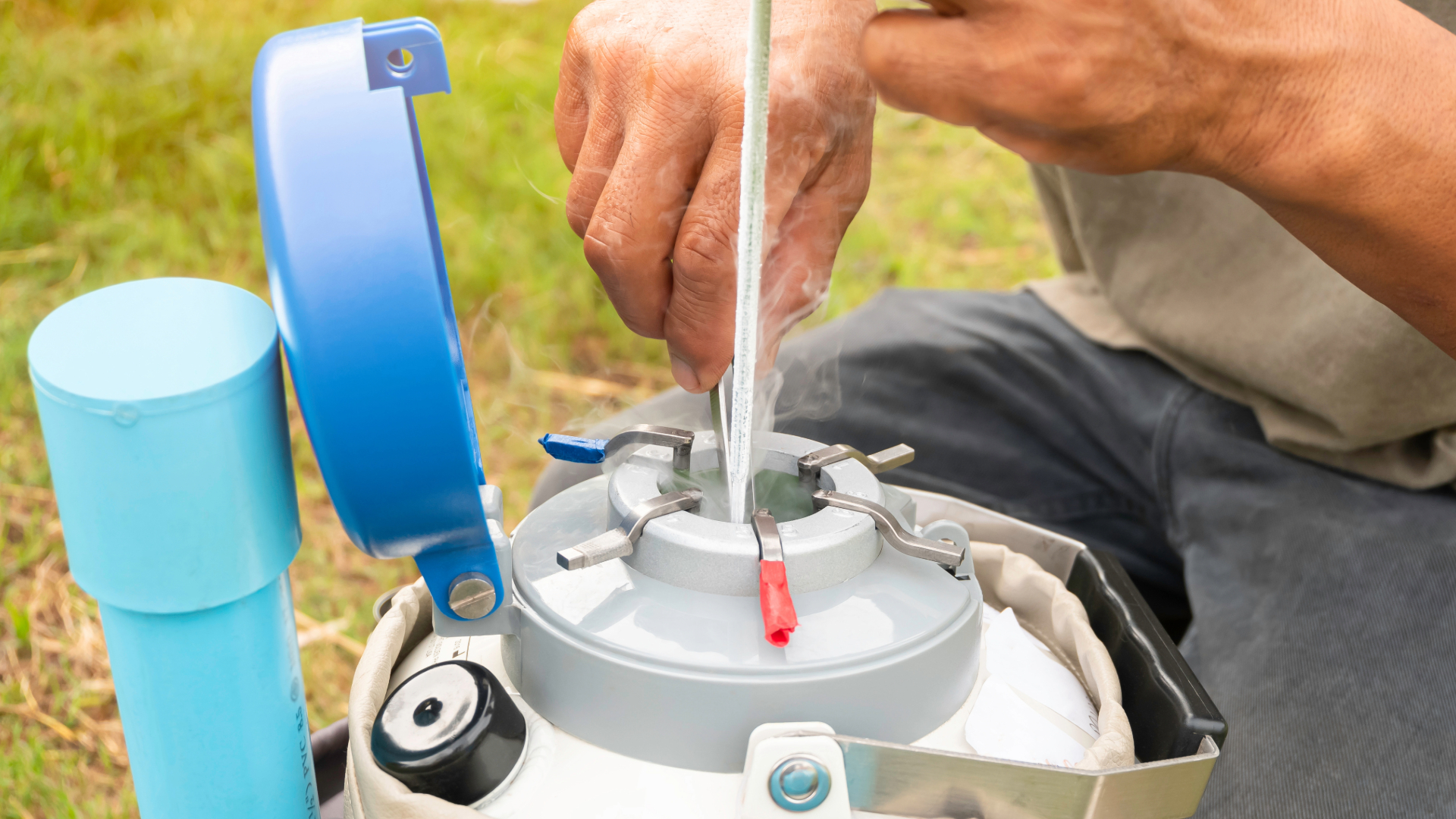
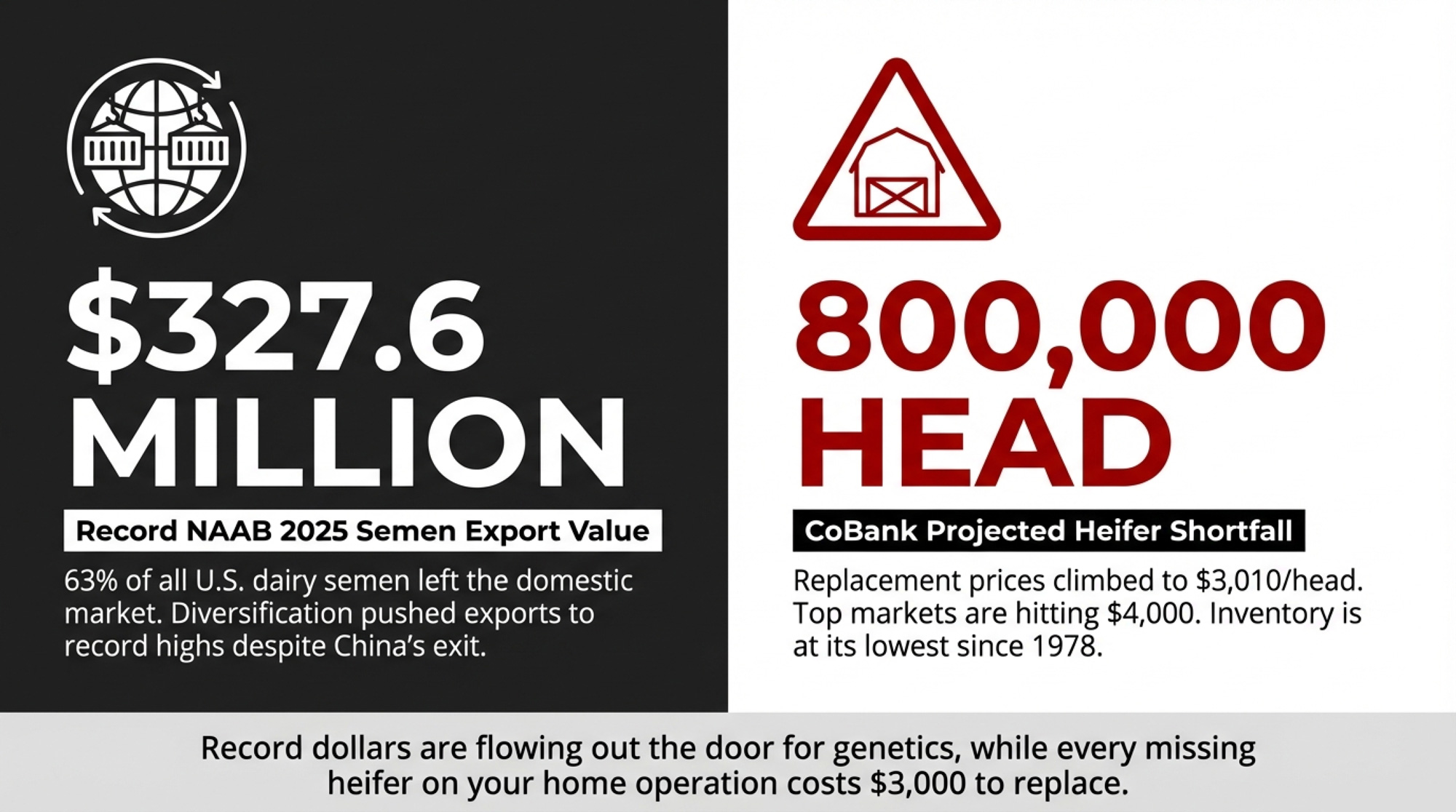
NAAB’s regular members — about 95% of the U.S. AI industry — moved just under 66 million bovine semen units in 2025, a 4% decline that erased the prior year’s 2.7 million unit gain (NAAB year-end report, March 11, 2026). Export value still nudged 0.6% higher to a record $327.6 million, even as total export units fell 6.6% and China exited the market in February.
At the same time, replacement heifer prices climbed to roughly $3,010 per head nationally based on USDA’s July 2025 Agricultural Prices data, with top dairy heifers in California and Minnesota auction barns bringing upwards of $4,000. That’s a mismatch. Record dollars flowing out the door for genetics, while every missing heifer on your home operation costs $3,000 to replace.
Think about a 400-cow Upper Midwest freestall that leaned into beef-on-dairy hard over the last three years. The F1 calf checks were strong. Sexed semen was supposed to cover replacements.
But when CoBank’s lead dairy economist Corey Geiger ran the numbers last August, his team projected that dairy heifer inventories would shrink by roughly 800,000 head over two years before rebounding in 2027. That’s the national backdrop. NAAB’s 2025 data lets you check whether your specific breeding plan is part of that problem — or ahead of it.
66 Million Units: Where the Semen Actually Went
Start with the top-line data from our 400-cow herd.
Total dairy semen sales — domestic, export, and non-member custom collection combined — fell 6%, a 3 million unit decline to 45.8 million units. Beef semen moved the other direction, up 1% to 20.2 million units, with beef-on-beef gaining 466,000 units after two years of declines.
The domestic picture was brighter. U.S. dairy units ticked up 2% — roughly 367,000 units — to 16.5 million, the second straight year of gains after a four-year domestic decline that ran from 2020 through 2023. Domestic beef totaled 9.8 million: 8.1 million on dairy herds, 1.7 million on beef herds.
Inside those 16.5 million dairy units, the shift is unmistakable. Gender-selected dairy semen grew 6% to 10.6 million units — now 64% of all dairy semen used by U.S. producers. Conventional dairy dropped 280,000 units to 6.0 million. Beef-on-dairy held steady at 8.1 million.
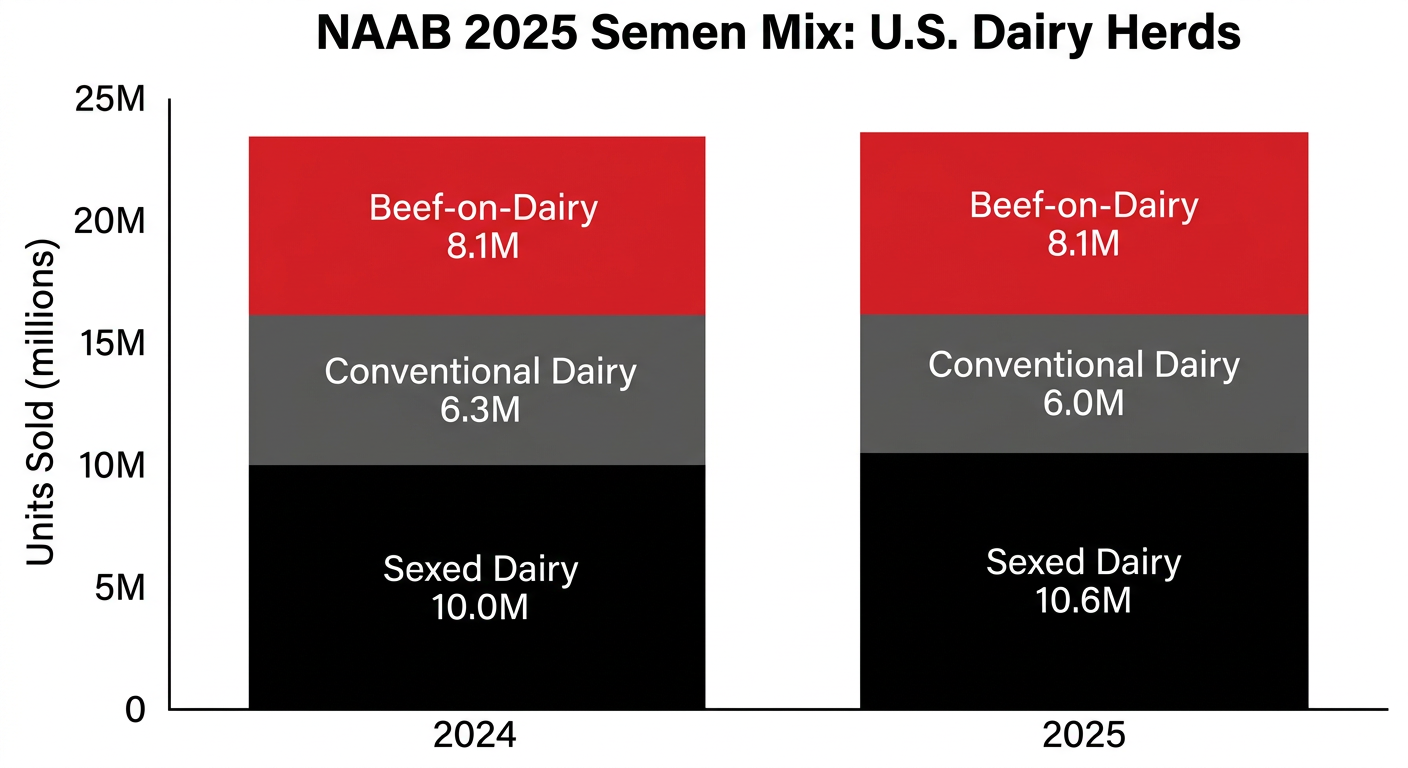
| Semen Type | 2024 Units (M) | 2025 Units (M) |
|---|---|---|
| Sexed Dairy | 10.0 | 10.6 |
| Conventional Dairy | 6.3 | 6.0 |
| Beef-on-Dairy | 8.1 | 8.1 |
| Total Domestic | 24.4 | 24.7 |
NAAB explains the logic: producers genomic-test more animals, sort their herds, and put sexed semen on their best cows to lock in replacements, then breed the rest to beef for higher-value F1 calves. For our 400-cow herd, the strategy sounds clean. Whether it actually works depends on the ratio — and on conception rates, no national report can tell you.
Is Your Semen Mix Producing Enough Replacement Heifers?
Here’s where to put your own numbers against the national pattern. The math isn’t complicated, but you need to run it with your actual data.
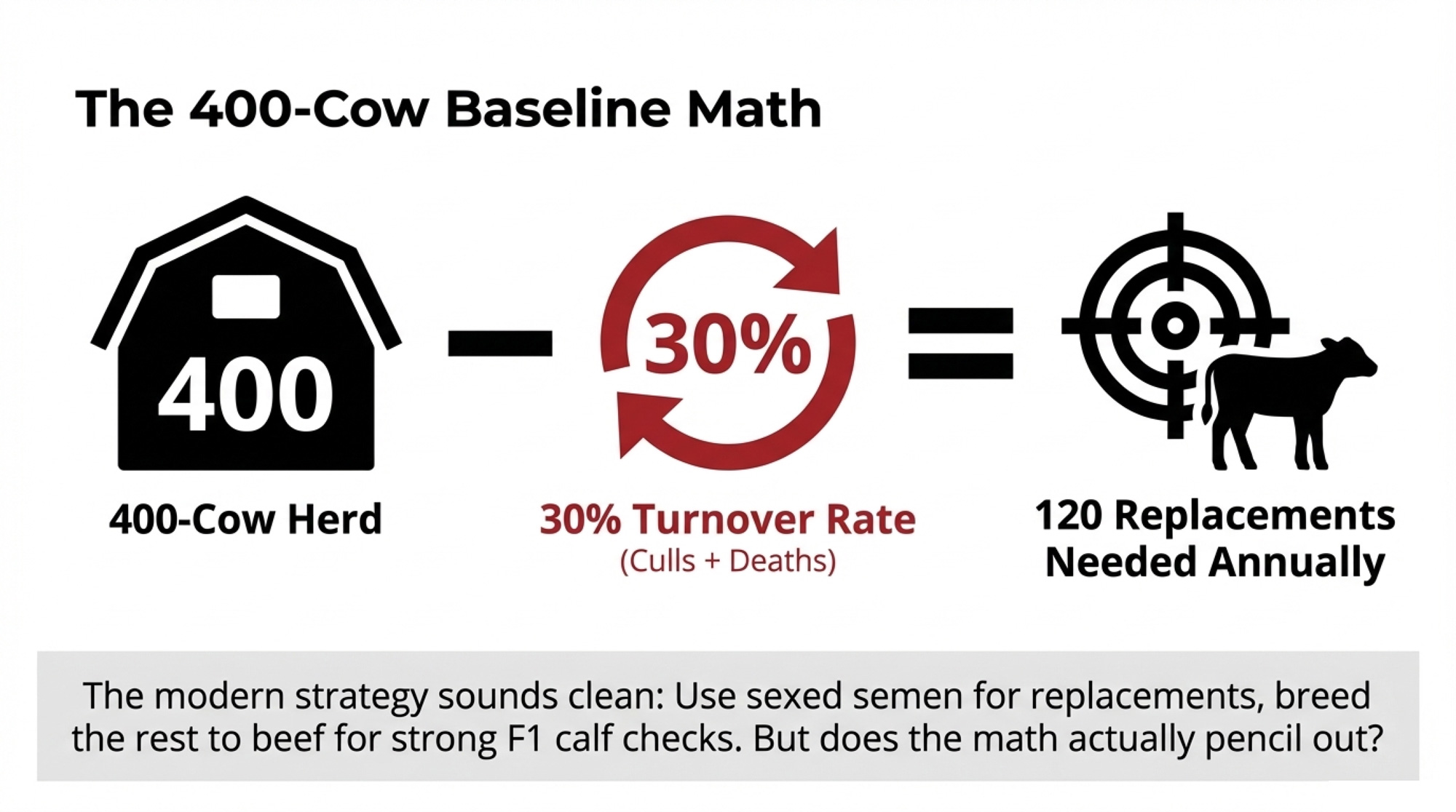
Step 1 — How many replacements do you need each year? For a 400-cow herd at 30% turnover, that’s 120 replacement heifers per year. Plug in your actual cull-plus-death rate. At 35%, you need 140.
Step 2 — Sort your calvings into three buckets by semen type. Sexed dairy calvings produce a heifer calf roughly 90% of the time (industry standard for gender-sorted semen, consistent with CoBank’s modeling). Conventional dairy calvings run about 50-50. Beef-on-dairy calvings produce zero dairy replacements.
Step 3 — Run the scenarios.
Using NAAB’s 2025 domestic data, the national service mix on dairy cows breaks out to roughly 43% sexed dairy, 24% conventional dairy, and 33% beef-on-dairy (derived from 10.6M + 6.0M + 8.1M = 24.7M total domestic units on dairy cows; actual service proportions may vary since NAAB reports units sold, not services delivered).
Scenario A — National average mix on 400 cows:
- 172 sexed dairy calvings × 0.90 = ~155 heifer calves
- 97 conventional calvings × 0.50 = ~48 heifer calves
- 131 beef-on-dairy calvings = 0 dairy heifers
- Total: ~203 heifer calves before mortality
- Buffer above 120 needed: 83 heifers — sellable surplus or safety margin
Scenario B — Heavy beef-on-dairy (50% beef, remaining dairy split 64/36 sexed/conventional):
- 128 sexed × 0.90 = ~115
- 72 conventional × 0.50 = ~36
- 200 beef-on-dairy = 0
- Total: ~151 heifer calves before mortality
- Buffer: 31 heifers — looks fine on paper. Keep reading.
Scenario C — Aggressive beef-on-dairy (65% beef):
- 90 sexed × 0.90 = ~81
- 50 conventional × 0.50 = ~25
- 260 beef-on-dairy = 0
- Total: ~106 heifer calves before mortality
- Short by 14 heifers — and that’s before a single calf dies.
Here’s how those scenarios look side-by-side, before and after real-world mortality:
| Scenario | Semen Mix | Heifer Calves Born | After 79% Completion | Buffer vs. 120 Needed | Annual Cost at $3,000/Head |
| A: National Avg | 43/24/33 | 203 | ~160 | +40 surplus | $0 |
| B: Heavy Beef×Dairy | 50% beef | 151 | ~119 | -1 short | ~$3,000 |
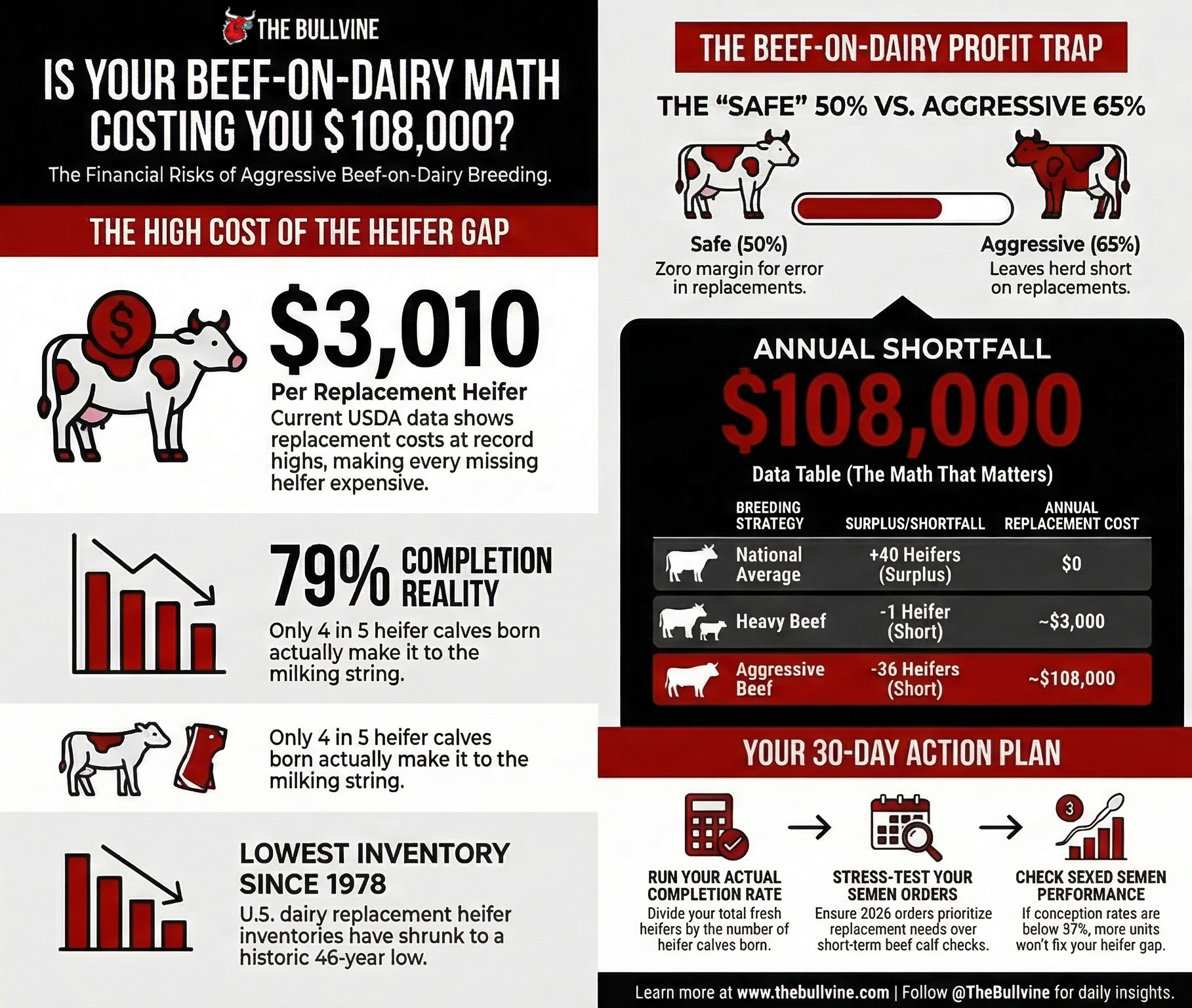
| C: Aggressive Beef×Dairy | 65% beef | 106 | ~84 | -36 short | ~$108,000 |
One more question worth asking on your beef semen orders: how much of what you’re buying represents structured terminal-cross programs with documented carcass merit, and how much is whatever carries a black hide? Angus holds a strong first place in NAAB’s breed rankings, followed by Crossbreeds, then heterospermic (down from 2.8 million units in 2024 to just over 2.0 million in 2025). If your name is on those F1 calves downstream, the distinction matters for premiums and buyer relationships.
The Number That Changes Everything: Overton’s 79%
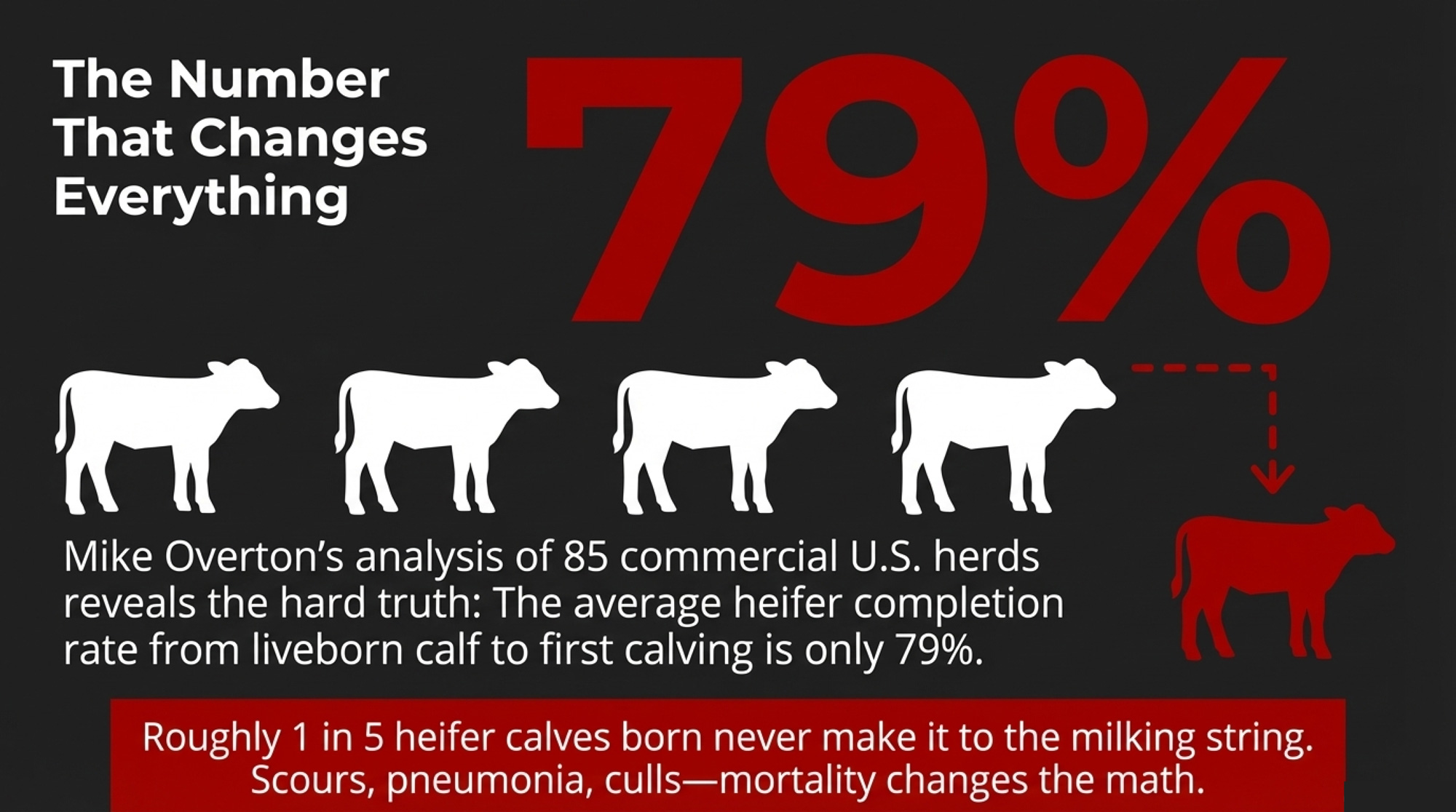
Those scenarios look manageable until you apply real-world mortality. Mike Overton analyzed 85 commercial U.S. herds and presented the results at the 2026 High Plains Dairy Conference: the average heifer completion rate from liveborn heifer calf to first calving was about 79%, with most herds ranging from 74% to 84%. Roughly 1 in 5 heifer calves born never make it to the milking string.
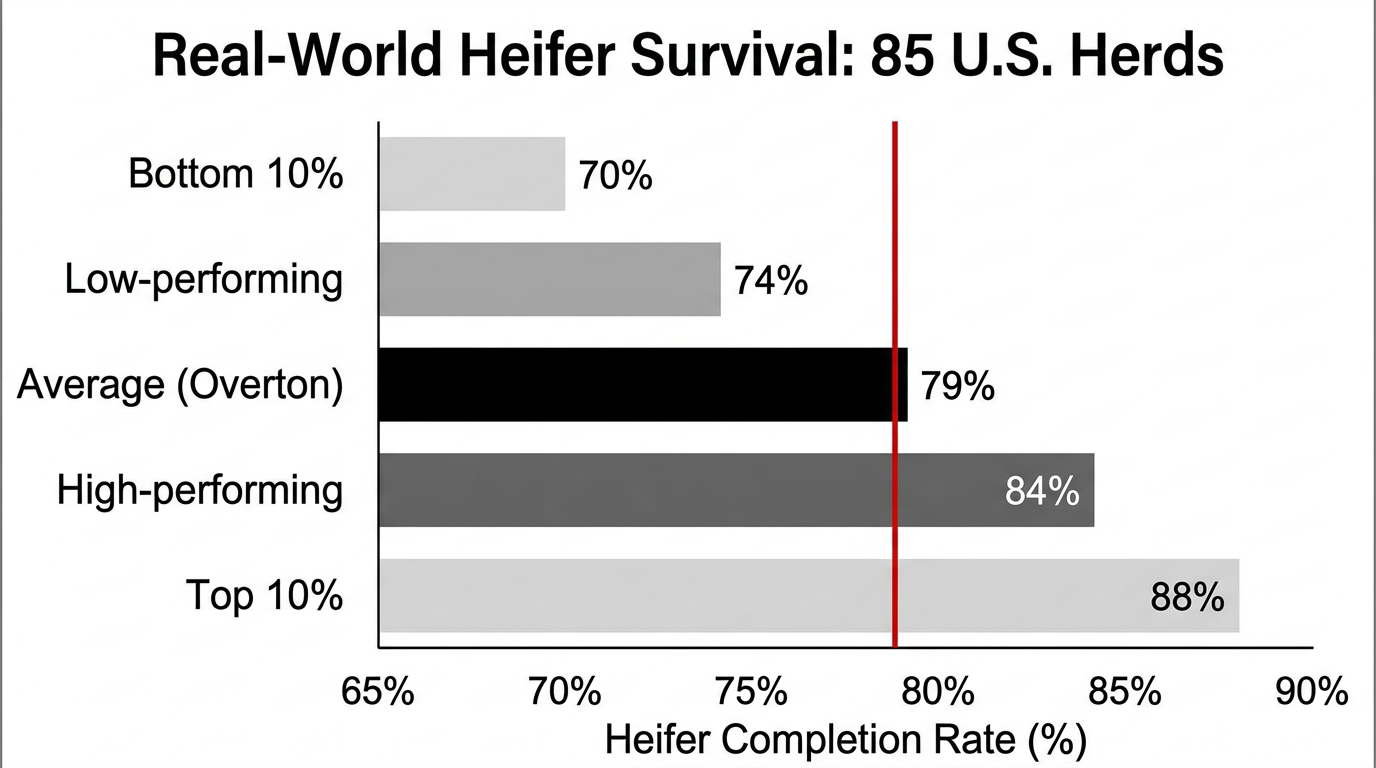
| Herd Performance | Completion Rate (%) |
|---|---|
| Bottom 10% | 70% |
| Low-performing (typical) | 74% |
| Average (Overton) | 79% |
| High-performing (typical) | 84% |
| Top 10% | 88% |
Apply that, and the table above tells the full story. Scenario A still holds a 40-heifer surplus. Comfortable.
But Scenario B — which plenty of herds are running right now — produces almost exactly zero surplus after Overton’s mortality rate. One heifer short of a 30% replacement rate. Your “comfortable buffer” of 31 heifers just evaporated.
Scenario C is where it gets expensive. After the 79% completion rate (~84 heifers freshen), 36 are short of the 120 needed. At $3,000 per head, that’s roughly $108,000 per year in purchased replacements.
That’s the number nobody puts in the breeding meeting. One bad month of calf scours, one pneumonia outbreak in the heifer barn, and even Scenario B herds are buying replacements at $3,000 a head. Based on this math, the buffer gets dangerously thin once beef-on-dairy crosses roughly 50% of all services — at least for a 30% turnover herd using Overton’s field-validated completion rate.
When National Data Confirmed the Spreadsheet
Geiger’s CoBank team didn’t just project forward. They modeled the 2022 semen sales year — which drives calvings around 2025 — and found the system-level version of Scenario C playing out across the entire national herd.
The cohort numbers: 221,625 more beef-on-dairy calves; 192,592 fewer dairy calves due to declining conventional semen use; and only 56,727 more dairy replacements from gender-sorted semen. Net result: a 357,490 dairy heifer shortfall in that single cohort.
That’s not a projection. That’s arithmetic based on semen already sold. And it feeds directly into Geiger’s broader outlook: heifer inventories are expected to shrink by an estimated 800,000 head over 2025–26, before a potential rebound in 2027.
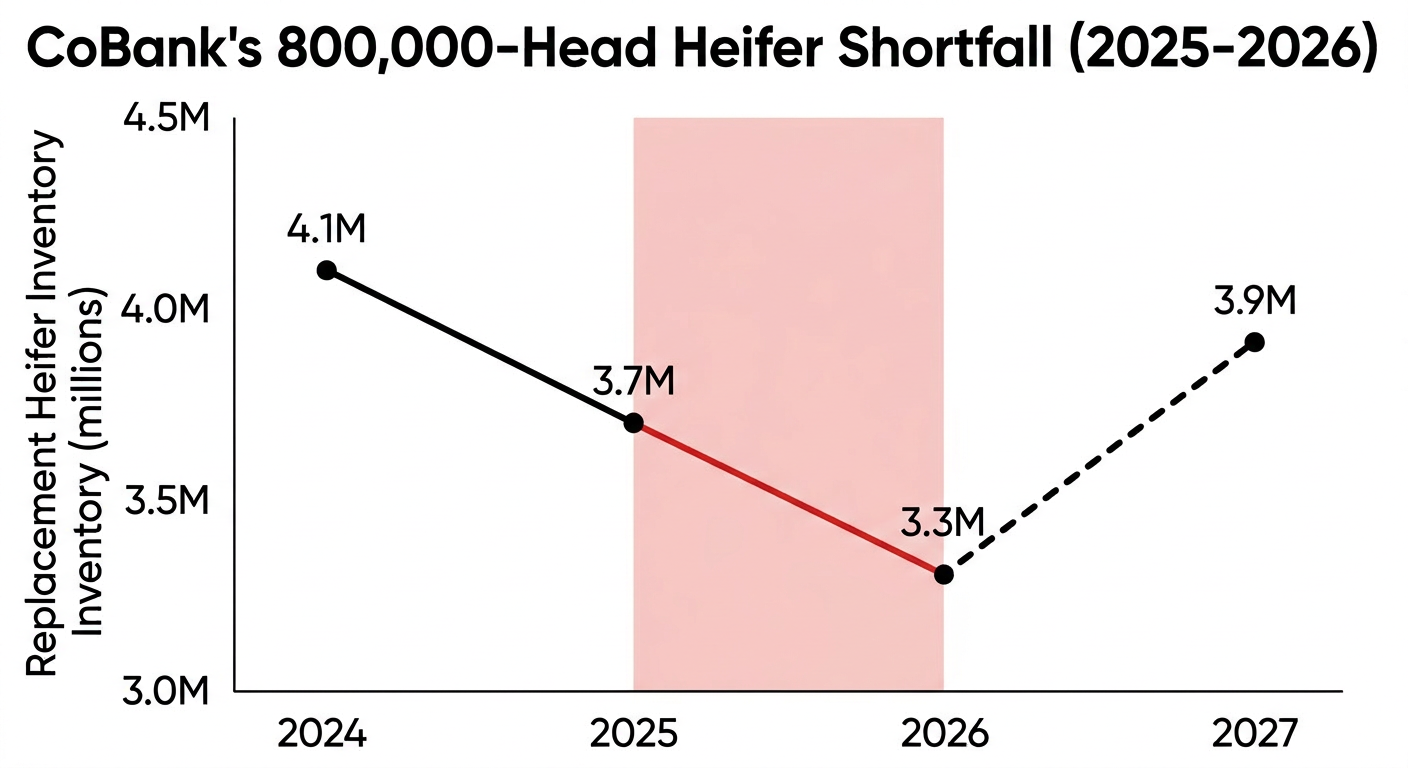
| Year | Replacement Heifer Inventory (millions) |
|---|---|
| 2024 | 4.1 |
| 2025 | 3.7 |
| 2026 | 3.3 |
| 2027 (projected) | 3.9 |
“The U.S. dairy industry stands at a unique inflection point,” Geiger said. “To maintain sufficient dairy cow numbers and milk production in the near term, dairy farmers will need to put the brakes on dairy cow culling.”
USDA’s January 2025 cattle report pegged dairy replacement heifers at 3.914 million head — the lowest since 1978. The breeding plan that worked when F1 calves were the hot commodity, and heifers cost $1,100? It now operates in a $3,000 heifer market.
China Out, Record Export Dollars In
China dropped out in February 2025, and dairy exports fell 2.5 million units to 28.3 million. But beef semen exports surged 13% to 5.5 million units, and total export value hit a record $327.6 million, driven by a higher average blend price. NAAB’s Dr. Sophie Eaglen pointed to broadening diversification — 124 countries, up from 108 — with Western Europe (28%), Eastern Europe (19%), and Brazil all showing strong growth.
Here’s the domestic implication worth sitting with: 63% of all dairy semen produced by NAAB members was exported, leaving 37% for U.S. herds. Export markets absorbed 19 million conventional dairy units — more than three times the 6 million used domestically. U.S. herds and export customers are functionally using different products from the same supply base.
And 46 markets accounted for 94% of export units and 95% of dollar value. Record dollars flowing through a relatively small group of countries — countries that just demonstrated how fast a major buyer can walk away.
What This Means for Your Operation
In the next 30 days, run the replacement math on your herd.
- Pull 12 months of breeding records. Break calvings into sexed dairy, conventional dairy, and beef-on-dairy. Calculate your proportions against the national benchmark: 43% sexed / 24% conventional / 33% beef-on-dairyas a share of all services on dairy cows.
- Calculate your actual replacement rate — culls plus deaths divided by average herd size. Real numbers, not estimates.
- Calculate your own heifer completion rate: take a recent calf crop, divide the number that actually calved in by the number of live heifer calves born in that group. If you’re at or below Overton’s ~79% average, your safe beef-on-dairy percentage is tighter than your breeding plan assumes.
- Run the three-scenario math from this article with your numbers. If your mix puts you in Scenario C territory, the gap isn’t $42,000 pre-mortality — with real-world completion rates, it’s closer to $108,000.
Over the next 90 days — stress-test against the heifer market.
- At $3,000-plus per head nationally and higher in tight regional markets, make sure your 2026 semen orders reflect replacement needs first, beef calf income second. Shifting 15% of services from beef back to sexed dairy costs you those F1 calf premiums — but at $3,000 per replacement heifer, it only takes a few purchased heifers to wipe out that beef-calf income.
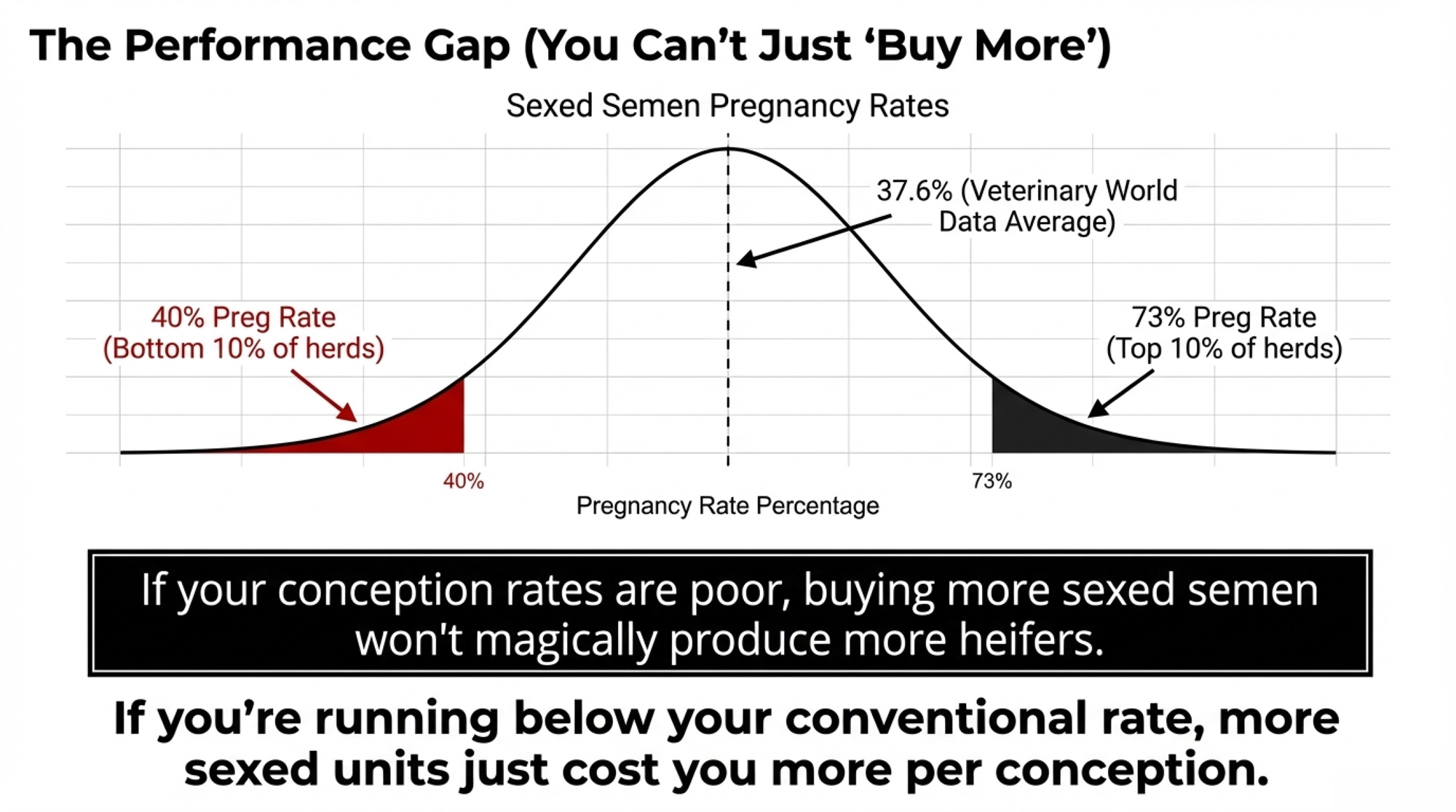
- Talk to your AI rep about actual sexed semen conception rates on your herd. A December 2025 meta-analysis in Veterinary World reported cattle sexed-semen pregnancy rates of 37.67% on average — but the spread between herds is massive: the top 10% hit 73%, while the bottom 10% sit at 40%. If you’re running well below your conventional rate, more sexed units won’t produce more heifers — they’ll just cost more per conception.
- If you market calves or heifers to buyers tied to export demand, ask how their business shifted after China’s exit. That answer tells you something about your own concentration risk.
Over the next 365 days, decide if this is a blip or the new normal.
- When NAAB releases 2026 data, line your updated breeding records against how the national mix moved. If sexed keeps growing, conventional keeps falling, and beef-on-dairy holds steady, this is structural — not a cycle.
- Watch CoBank’s heifer-inventory updates through 2026. Geiger’s team projected inventories shrinking further before rebounding in 2027. If that rebound is delayed, the $3,000 heifer is the floor, not the ceiling.
- By this time next year, compare your realized heifer inventory against what your 2025–26 semen mix was supposed to produce. That gap — or surplus — is the verdict on your breeding plan.
Key Takeaways
- If beef-on-dairy makes up more than half your services and sexed dairy sits well below 43%, you’re in the high replacement-risk band. After applying Overton’s 79% completion rate, the Scenario B herd — 50% beef-on-dairy — produces almost exactly the number of heifers it needs. Zero margin for error.
- NAAB’s 2025 data shows the industry sent 63% of dairy semen overseas and used sexed semen as the primary domestic replacement tool. CoBank projects heifer inventories won’t rebound until 2027. Every breeding decision you make in 2026 locks in what will be fresh in 2028.
- Beef-on-dairy is still a powerful tool — but only if your sexed-semen performance and heifer survival cover your replacement needs first. At a 65% beef-on-dairy mix, the shortfall after real-world mortality isn’t $42,000 — it’s $108,000 per year at current heifer prices.

The Bottom Line
NAAB President Jay Weiker says the industry deserves to be “complimented” for 2025’s results, and on export diversification and beef semen growth, that’s fair. But compliments don’t pay replacement bills. Stack your semen invoices against NAAB’s national mix, apply your own completion rate, and compare your heifer pipeline to what Geiger says is coming. That’s how you find out whether your operation is building resilience — or funding someone else’s.
Complete references and supporting documentation are available upon request by contacting the editorial team at editor@thebullvine.com.
Learn More
- Overton’s 85-Herd Beef-on-Dairy Study: Why a 79% Heifer Completion Rate Limits Beef to About One-Third of Your Pregnancies – This field-validated analysis reveals the “completion gap” that quietly starves your future herd. It delivers a hard ceiling for beef-on-dairy use, arming you with the precise math to stop scheduling a replacement shortage on Monday morning.
- Biology Repriced Dairy: $4,000 Heifers Created a 90-Day Window When You Have Leverage, Not Processors– This strategic breakdown exposes how record-low inventories flip the script on processor relationships. It reveals how to leverage your documented heifer pipeline to secure favorable multi-year contracts while competitors scramble for expensive replacements.
- The 3‑Lactation Trap: Are $3,010 Heifers Pushing You Toward Beef Checks Instead of Five‑Lactation Cows? – This forward-looking piece breaks down the massive ROI hidden in cow longevity. It reveals how shifting from a three-lactation to a five-lactation system saves $210,000 annually, fundamentally changing your herd’s genetic and economic trajectory.
 The Sunday Read Dairy Professionals Don’t Skip.
 The Sunday Read Dairy Professionals Don’t Skip.
Every week, thousands of producers, breeders, and industry insiders open Bullvine Weekly for genetics insights, market shifts, and profit strategies they won’t find anywhere else. One email. Five minutes. Smarter decisions all week.




