







Mexico’s buying $2B of our dairy products… but that’s about to change in ways that could make you money.
EXECUTIVE SUMMARY: You know, everyone’s freaking out about Mexico trying to cut dairy imports, but they’re missing the bigger picture here. The real story isn’t about losing commodity sales – it’s about Mexico creating a massive new market for exactly the kind of high-value genetics and technology we do best. Think about it… they’ve got northern dairies hitting 37 liters per cow while southern operations struggle with 9-10 liters. That’s not a trade problem, that’s a $500 million genetics opportunity right there. Their feed conversion ratio is 1.4:1, compared to our efficient herds at 1.2:1 – imagine the consulting fees required to close that gap. Mexico’s investing billions in processing infrastructure, but it can’t boost productivity with concrete and steel. They need our genomics, our automation systems, our expertise. Companies like Semex and ABS are already positioning themselves for this shift, and the processing equipment market alone is growing at a rate of 6% annually.
Here’s what I keep telling producers… while everyone else is worried about defending milk powder exports, smart operations are figuring out how to sell solutions instead. That’s where the real money is.
KEY TAKEAWAYS:
- Genetics goldmine: Mexico’s 300% productivity gap between regions creates immediate demand for superior genetics – genomic testing programs showing 10% accuracy improvements with 18-24 month paybacks are suddenly very attractive to Mexican producers getting guaranteed milk prices
- Technology export boom: Processing equipment market growing 6% annually to $517M by 2030, while automated milking systems delivering 25-30% labor savings make perfect sense for operations dealing with rising labor costs and government price supports
- Consulting opportunity explosion: Programs like the Margarita Project tripled small producer incomes through technical assistance – Mexico has 250,000+ small dairies that need exactly this kind of expertise, creating massive demand for North American dairy consultants
- Trade relationship evolution: Instead of defending commodity exports, position your genetics/technology business for Mexico’s transformation – they’re not ending trade, they’re upgrading it from bulk products to high-value solutions
- Environmental tech demand: Heat stress causing 15% production drops in key regions while water constraints limit expansion – creates premium market for cooling systems, water recycling, and climate management technologies with 3-5 year payback periods
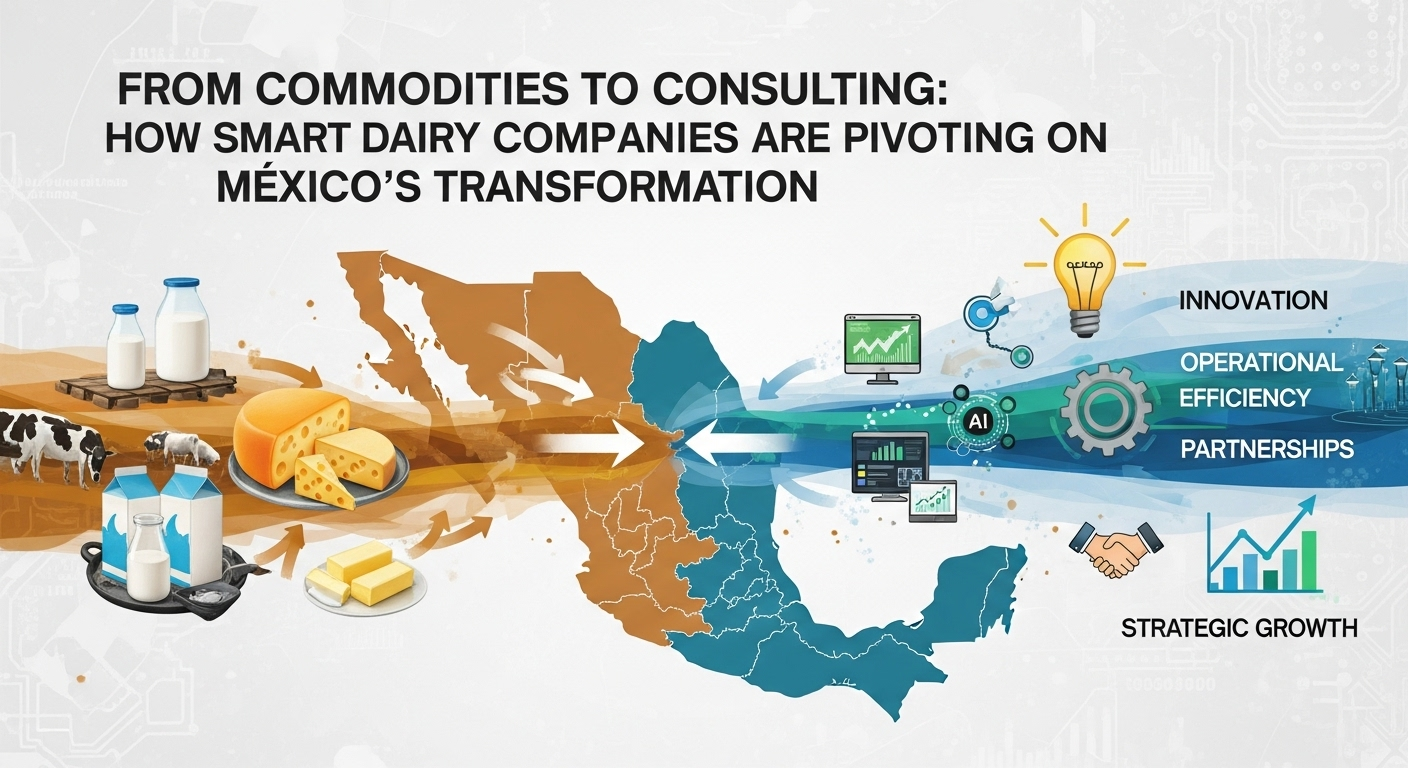
I’ve been watching the Mexican dairy situation evolve for a while now, and it’s becoming clear that something fundamental is shifting there. Mexico’s making a massive push toward dairy self-sufficiency – we’re talking billions in government investment over the next several years. But here’s the thing… this isn’t about cutting off trade with North America. It’s about changing what kind of trade we’re doing.
What strikes me most about this entire development is that while Mexico aims to reduce commodity imports, it is actually creating a huge market for the kind of high-value genetics, technology, and expertise that progressive dairy operations excel at providing.
The Trade Relationship That Everyone’s Watching
US-Mexico Dairy Trade Snapshot (2023)
| Trade Metric | Value | Significance |
|---|---|---|
| Total US Dairy Exports to Mexico | $2.0+ billion | 25% of all US dairy exports |
| Mexico’s Share of US SMP Exports | 51.5% | Largest single market |
| Mexico’s Import Dependency | 50%+ of deficit from US | Critical relationship |
| Per Capita Consumption Gap | 45% below US levels | Growth potential |
Look, the numbers tell you everything you need to know about why this matters. The US ships over $2 billion worth of dairy products to Mexico annually, making it our largest dairy customer by far. We’re talking about roughly a quarter of all US dairy exports flowing south of the border.
And here’s what’s particularly interesting… Mexico buys more than half of all the skim milk powder we export. That’s a massive concentration in one market, which explains why Mexico’s push for self-sufficiency has garnered so much attention in the industry.
However, industry economists continue to point out something that I think gets lost in all the trade war rhetoric – Mexico’s per capita dairy consumption remains significantly below US levels. Even as they boost domestic production, there is still room for the market to grow. It’s not necessarily a zero-sum game.
Why Mexico Can’t Get There Alone (The Gaps Are Real)
Mexico Dairy Technology Investment Opportunities
| Technology Sector | Market Size | Growth Rate | Payback Period | Implementation Cost |
|---|---|---|---|---|
| Processing Equipment | $517M by 2030 | 6% annually | 3-5 years | $500K-2M+ |
| Genomic Selection | $500M potential | 10% accuracy gain | 18-24 months | $35-50/animal |
| Automated Milking | Regional adoption | 25-30% labor savings | 5-7 years | $150K-200K |
| Environmental Tech | Premium pricing | Water/heat stress focus | 3-5 years | $50K-500K |
| Consulting Services | 250K+ operations | Triple income potential | 12-18 months | $50-200/cow |
The Genetics Reality Check
The productivity differences within Mexico’s dairy sector are honestly pretty staggering. You’ve got northern operations – think Chihuahua, Durango – where modern dairies are hitting production levels that would make any Wisconsin producer proud. But then you move south, and you’re looking at mixed-breed herds struggling to hit ten liters per cow per day.
That’s not a small gap. That’s the difference between a profitable operation and one that’s barely breaking even.
What really caught my attention recently was Mexico’s decision to import thousands of Australian Holstein heifers. Think about that for a second – they’re trying to achieve self-sufficiency, but they can’t get there without superior genetics. The Australians were reportedly producing double what the average Mexican cow delivers.
The Feed Efficiency Challenge
Here’s where things get really interesting from a nutrition standpoint. Mexican operations are averaging feed conversion ratios that would make most US nutritionists wince. We’re seeing 1.4 to 1.5 pounds of feed per pound of milk in many operations, while efficient US herds are running closer to 1.2 to 1.
That efficiency gap represents enormous potential for improvement through better nutrition programs and management practices. And the Mexican government knows it – they’ve created price supports that guarantee producers profitable milk prices, specifically to encourage these kinds of productivity investments.
The Water Reality (This Is Getting Serious)
Environmental constraints are becoming the real limiting factor, especially in Mexico’s prime dairy regions. Industrial agriculture already consumes the vast majority of available freshwater in many areas, and climate change isn’t making things easier.
I’ve been hearing from consultants working down there about significant production drops during heat stress periods – we’re talking 15% decreases in some regions during the worst weather. That’s not sustainable if you’re trying to boost national production by 20% or more.
Investment ROI Analysis for Mexico Market Entry
| Investment Type | Initial Cost | Annual Return | Break-even | Risk Level |
|---|---|---|---|---|
| Genetics Program | $100K-500K | 15-25% | 2-3 years | Low |
| Processing Equipment | $1M-5M | 12-18% | 4-6 years | Medium |
| Consulting Services | $50K-200K | 25-40% | 1-2 years | Low |
| Technology Licensing | $250K-1M | 20-30% | 2-4 years | Medium |
| Environmental Systems | $500K-2M | 15-20% | 3-5 years | Medium-High |
The Real Opportunity: Selling Solutions Instead of Powder
What’s fascinating about Mexico’s strategy is that while it targets commodity imports, it also creates massive opportunities for technology providers and genetic companies.
The processing equipment market is growing at a rate of approximately 6% annually, driven by significant investments in infrastructure. But more importantly, you’ve got producers who suddenly have economic incentives to invest in productivity improvements.
Genomic selection tools are generating serious interest because they can accelerate breeding progress by 10% or more compared to traditional methods. For Mexican producers dealing with significant genetic performance gaps, such acceleration could be transformative. The economics work too – implementation costs around $40-50 per animal with payback periods under two years.
Automated milking systems are becoming increasingly viable in regions where labor costs are rising and labor availability is becoming a concern. Sure, the upfront investment is substantial – you’re looking at $150,000 to $200,000 for a decent installation – but 25-30% labor savings can quickly justify that in the right situation.
What really excites me, though, is the consulting opportunity… programs like the Margarita Project have shown that you can triple the incomes of small producers through proper technical assistance and market integration. Mexico has hundreds of thousands of small dairy operations that could benefit from this kind of support. That’s a massive market for the right kind of expertise.
What About USMCA? (2026 Is Coming Fast)
The trade agreement framework actually works in favor of this transformation. USMCA preserves duty-free access for most dairy products and protects things like common cheese names. Still, Mexico’s self-sufficiency efforts are primarily focused on basic commodities, such as skim milk powder.
What’s interesting is that cheese imports are still growing – food service demand is driving increased imports of specialty products that Mexico doesn’t produce efficiently. You’re seeing a market bifurcation where basic commodities face pressure, but high-value products continue to grow.
Trade experts continually remind us that Mexico and Canada, combined, represent nearly half of the total US dairy export value, making the 2026 USMCA review absolutely critical for the industry’s future. However, I believe the companies that are positioning themselves for this new reality – focusing on genetics, technology, and expertise rather than just commodity volume – will be fine regardless of what happens in those negotiations.
The Bottom Line: Evolution, Not Elimination
Here’s what I keep telling people who ask about this… Mexico isn’t ending its relationship with North American dairy. They’re transforming it.
The winners are going to be the companies that can pivot from shipping bulk commodities to delivering high-value genetics, cutting-edge technology, and world-class expertise. There’s a clear market bifurcation happening – traditional commodity flows might face pressure, but the demand for solutions is exploding.
You’re looking at producers who need to close massive productivity gaps, adopt new technologies to deal with environmental constraints, and integrate hundreds of thousands of small operations into modern supply chains. That’s not something you solve by building more processing plants… that requires the kind of advanced genetics, sophisticated technology, and deep industry expertise that North American companies do better than anyone.
The question isn’t whether Mexico will achieve their production targets – they probably will, eventually. The question is whether we can adapt our business models quickly enough to profit from that transformation, rather than just watching traditional market shares disappear.
Are you thinking defensively about protecting existing commodity sales, or are you positioning your company to lead in this new market for solutions? Because that choice is going to determine who thrives in the next decade of the North American dairy trade.
Complete references and supporting documentation are available upon request by contacting the editorial team at editor@thebullvine.com.
Learn More:
- The 7-Day Plan For Fixing Your Herd’s Feed Efficiency – This article moves from strategy to action, delivering a tactical checklist for closing the feed efficiency gap mentioned in the main piece. It outlines practical steps you can take over seven days to immediately impact your herd’s profitability and reduce waste.
- The Great Dairy Bifurcation: Why The Global Market is Splitting in Two – For a deeper look at the global market dynamics driving Mexico’s strategy, this piece provides the strategic framework. It helps you understand the larger economic forces splitting the dairy world into commodity and high-value markets, sharpening your long-term planning.
- Beyond The Hype: How Top Herds Are Actually Making Money with Genomics – This article breaks down the real-world ROI of the genomic tools mentioned as a key opportunity in Mexico. It reveals methods for selecting traits that deliver tangible financial returns and helps you avoid common, costly mistakes in genetic investment strategies.
 The Sunday Read Dairy Professionals Don’t Skip.
 The Sunday Read Dairy Professionals Don’t Skip.
Every week, thousands of producers, breeders, and industry insiders open Bullvine Weekly for genetics insights, market shifts, and profit strategies they won’t find anywhere else. One email. Five minutes. Smarter decisions all week.




