






In a 93‑herd study, farms feeding pooled colostrum lost ~20 calves out of 220. Dam‑fed herds lost 14. The only change was which colostrum hit the gut first.
Executive Summary: A 93‑herd German study of 54,474 calves showed farms feeding dam‑sourced colostrum as the first meal had 6.2% mortality, while herds relying on pooled or random colostrum ran 8.9%. On a 200‑cow dairy, that gap pencils out to roughly six extra dead calves a year if you stay with pooled colostrum—before you add treatment costs and lost first‑lactation milk. The same dataset flagged two unglamorous but powerful levers: replacing bucket teats at the first sign of wear and knocking down dust with better calf‑barn ventilation, both tied to 3–4 point swings in mortality. Economically, sliding mortality from 8.9% toward 6.2% easily clears $2,000–3,000 per year in avoided dead‑calf costs on mid‑size herds, with much bigger upside once lifetime production is factored in. The practical play is to reserve pooled or bank colostrum for Johne’s‑high and problem cows, feed dam‑sourced first to low‑risk calves, tighten teat cleaning and replacement, and treat dust and air quality like you treat vaccines—non‑negotiable. If your pre‑weaning losses live closer to 9% than 6%, your fastest ROI isn’t another gadget; it’s whose colostrum fills the first bottle and how clean the rubber and air are when that calf takes its first drink.
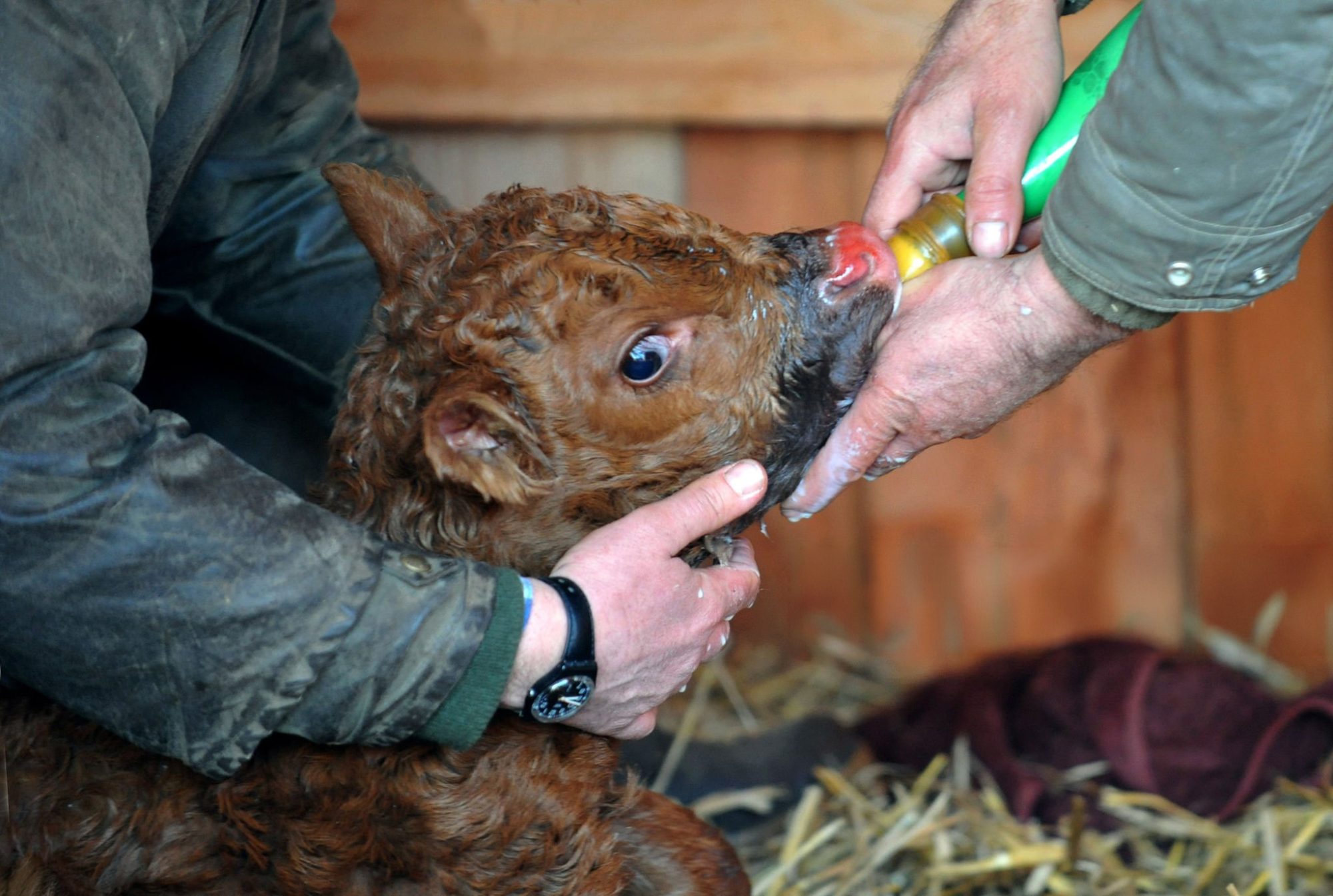
When Dr. Michael Steele stood before the Smart Calf Rearing Conference audience in January 2026, he didn’t mince words about what the industry has been getting wrong. “We’ve been so focused on IgG that we’ve missed half the story,” the University of Guelph calf nutrition researcher told the room. “Colostrum isn’t just a passive transfer vehicle. It’s programming the calf’s entire immune system—and whose colostrum matters more than we thought.”
A month earlier, a German study had landed that put hard numbers behind that claim. Steffi Keller and colleagues tracked 54,474 calves across 93 Thuringian dairy herds and found something that should make every calf manager pull their protocols off the wall and take a harder look. Farms that fed dam-sourced colostrum as the first meal averaged 6.2% calf mortality. Farms feeding pooled or random colostrum averaged 8.9% calf mortality.
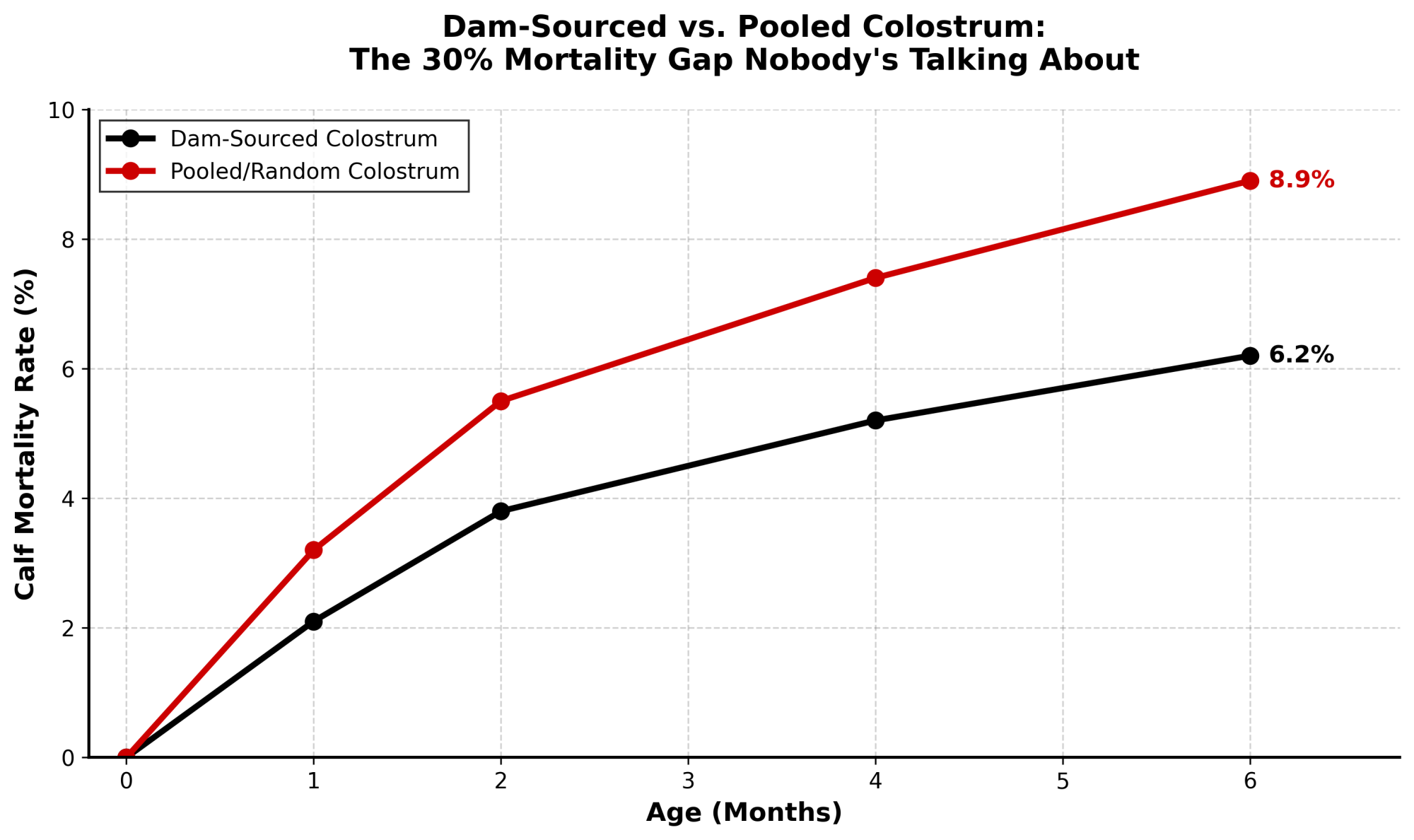
| Age (Months) | Dam-Sourced Mortality (%) | Pooled/Random Mortality (%) |
|---|---|---|
| 0 | 0.0 | 0.0 |
| 1 | 2.1 | 3.2 |
| 2 | 3.8 | 5.5 |
| 4 | 5.2 | 7.4 |
| 6 | 6.2 | 8.9 |
Same country. Same genetics. Similar scale. One management change. A 30% relative reduction in dead calves.
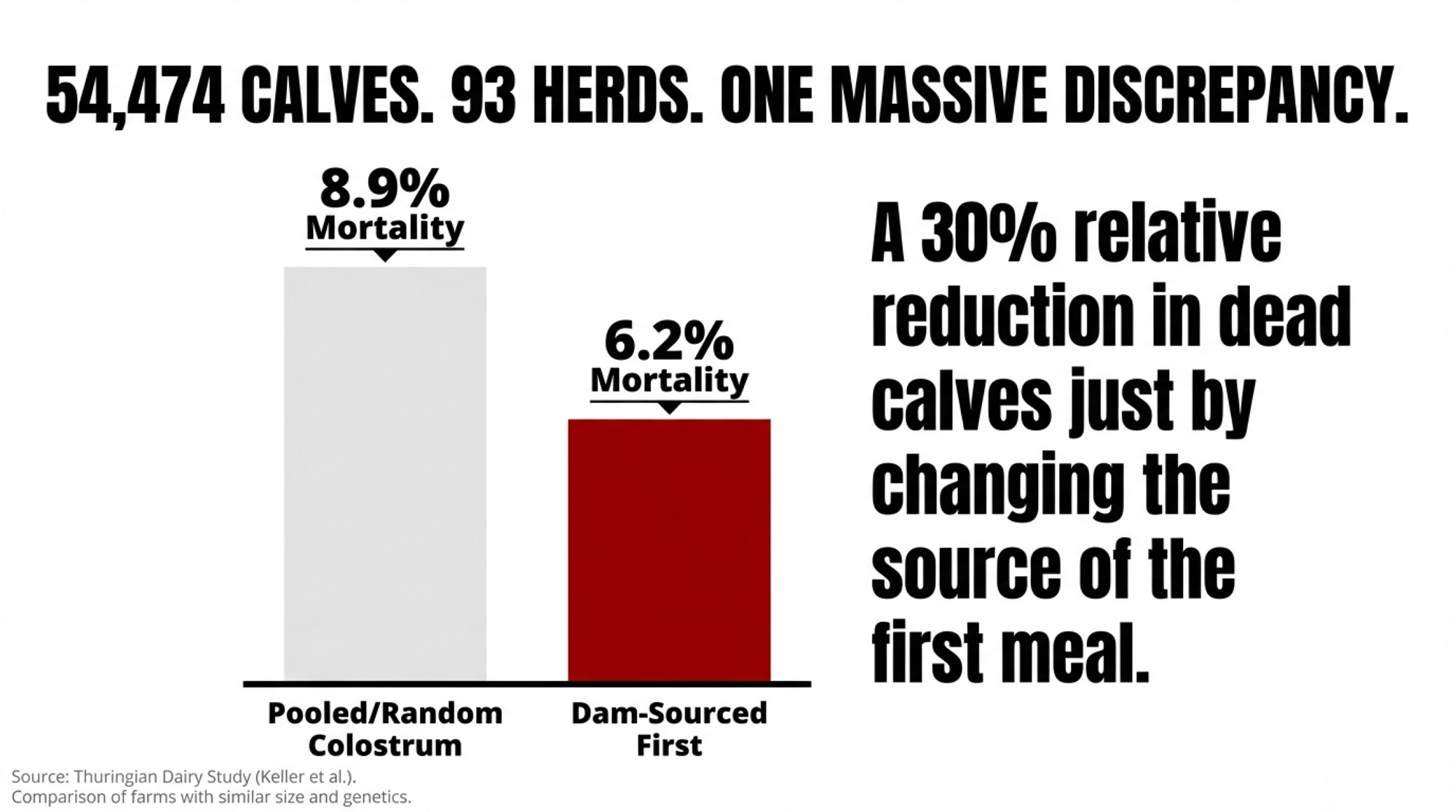
The uncomfortable part? According to USDA NAHMS data, the average U.S. dairy takes 3.6 hours to deliver first colostrum—and the majority still feed only two quarts at that first feeding. Timing and source are crucial; feeding dam‑sourced colostrum promptly maximizes immune benefits and reduces mortality.
The 54,474-Calf Study That Changed the Conversation
The Keller study wasn’t a boutique trial with 80 calves and ideal conditions. It was real-world, messy farm data: 93 large herds, all rearing their own replacements, almost all with 100+ cows. From March 2017 to March 2018, they tracked every live birth and every death for up to 6 months, then matched those numbers to management practices observed during farm visits.
Four things stood out in the mixed-model analysis:
- Dam-sourced colostrum for the first feeding
6.2% mortality vs. 8.9% when colostrum was pooled or randomly assigned. - Replacing bucket teats at the first sign of wear
5.4% mortality vs. 9.0% when teats were only swapped out once visible damage appeared. - Dust control as a respiratory trigger
Farms that didn’t see dust as a big deal averaged about 10% mortality; those that identified dust and acted on it ran closer to 6.5%. - Objective body condition scoring of cows
4.9% vs. 7.9% mortality where BCS was scored consistently, not just eyeballed.
| Management Practice | Low Mortality (%) | High Mortality (%) | Mortality Swing (points) |
|---|---|---|---|
| Dam-sourced colostrum (first feeding) | 6.2 | 8.9 | 2.7 |
| Teat replacement at first sign of wear | 5.4 | 9.0 | 3.6 |
| Dust recognized as respiratory trigger | 6.5 | ~10.0 | 3.5 |
| Objective body condition scoring (BCS) | 4.9 | 7.9 | 3.0 |
None of this needs new hardware or a subscription. It’s the kind of nuts‑and‑bolts management that calf people control already—if the barn is willing to actually change habits.
The most controversial of the four? Putting the dam’s own colostrum back at the center of the protocol in an era where pooled “colostrum banks” and replacers have become the safety net.
Why Dam-Sourced Colostrum Hits Harder Than Pooled
We’ve all spent 20 years talking about IgG levels, total volume, and the four-litres-within-two-hours rule. Those don’t go away. What the Thuringian study adds is a stronger push to identify who that colostrum comes from.

Here’s what stacks up behind it:
Maternal leukocytes carry “memory.” Maternal colostrum isn’t just protein and IgG. It’s loaded with viable leukocytes that carry the dam’s immune history into the calf. Those cells cross the gut, show up in the calf’s bloodstream, and start shaping how that immune system responds to the bugs actually on your farm.
Fresh beats stored for immune programming. Work comparing fresh vs. frozen colostrum has shown that calves fed fresh whole colostrum mount faster, exhibit more efficient innate responses, and avoid the prolonged inflammatory overdrive that hammered frozen-fed calves.
Maternal colostrum beats replacer on cell-mediated immunity. A recent Japanese Black calf study found maternal colostrum increased T- and B-cell populations and activated the immune system earlier and more effectively than a replacer, even when IgG transfer looked adequate on paper.
As Dr. Steele put it at the January conference: “The calf’s gut is only open to those maternal immune cells for about 24 hours. After that, the window closes. If you’re feeding pooled colostrum from three different cows, you’re diluting that targeted immune programming.”
| Immune Factor | Dam-Sourced Colostrum | Pooled Colostrum | Colostrum Replacer |
|---|---|---|---|
| Live maternal leukocytes | ✓ High (carry dam’s immune memory) | ⚠ Diluted (mixed from multiple cows) | ✗ None (heat-processed) |
| Targeted pathogen exposure | ✓ Farm-specific (dam’s exposure history) | ⚠ Mixed signals (multiple dams’ histories) | ✗ Generic (no farm-specific immunity) |
| Cell-mediated immunity (T/B cells) | ✓ Faster activation (research-backed) | ⚠ Moderate (depends on pool quality) | ⚠ Adequate IgG, weaker cell response |
| Bioactive factors (fresh vs. processed) | ✓ Maximum (if fed fresh) | ⚠ Reduced (if frozen/thawed) | ⚠ Reduced (heat treatment affects some) |
Layer that over Keller’s simple mortality math, and the picture is pretty blunt: dam-sourced colostrum appears to combine good IgG transfer with immune “software” tailored to that dam’s pathogen experience.
Pooling colostrum from multiple cows, or randomly grabbing “whatever’s thawed,” may hit your Brix target. But you’re stripping that tight dam-calf match out of the first meal.
The Gap Between Knowing and Doing
Here’s what makes the Keller findings sting: most producers already know colostrum quality matters. NAHMS 2014 data showed 79.7% of U.S. operations were not pooling colostrum—meaning most farms were already doing some version of individual cow sourcing.
But “not pooling” isn’t the same as “feeding dam-sourced first.”
The same NAHMS data revealed the friction points hiding in plain sight:
- Average time to first colostrum feeding: 3.6 hours (well past the ideal 1-2 hour window)
- The majority of operations feed only 2 quarts at first feeding (half the recommended volume)
- Only 10.6% of operations separating calves from the dam in less than 1 hour
| Colostrum Practice | U.S. Industry Average (NAHMS 2014) | Thuringian Protocol Target |
|---|---|---|
| Time to first colostrum feeding | 3.6 hours | <1 hour (dam milked), <2 hours (fed) |
| Volume at first feeding | 2 quarts (majority of farms) | 4 liters (~4.2 quarts) or 10% birthweight |
| Calf separation from dam | Only 10.6% separate in <1 hour | <1 hour (minimize disease exposure) |
The system was designed around convenience, not biology. Calves get born at 2 a.m., the fresh cow doesn’t get milked until morning chores, and whatever’s thawed or available becomes “good enough.”
“What we’re seeing in the German data,” says Dr. Steele, “is that ‘good enough’ might be costing farms 2-3 extra dead calves per hundred. That’s not a rounding error—that’s real money walking out the door.”
The Thuringian Colostrum Protocol in Plain English
Keller’s paper doesn’t read like an SOP. It reads like a regression model. But if you strip the statistics back to management decisions, the protocol is straightforward.
1. First meal: dam-sourced, fast, and enough
- Milk the fresh cow as soon as she can be safely moved—aim for within 1 hour of calving.
- Feed 4 litres (or 10% of birthweight) of that dam’s colostrum within the first 2 hours.
- Only reach for the bank or replacer when the dam is a known high-Johne’s risk, has obviously poor colostrum, or can’t be milked safely.
2. Second and third meals: high-quality, fresh or frozen
- Keep targeting 6-8 litres within the first 12-24 hours, but don’t stress if these meals come from banked colostrum.
- Prioritize fresh where practical—immune cell viability and some bioactives drop with heat treatment and storage, even if IgG holds.
3. Switch the cleaning standard for teats and buckets
Keller’s team didn’t just see a mortality difference with teat replacement. They highlighted a nearly 40% relative reduction when teats were replaced at the first sign of wear, rather than waiting for obvious damage (5.4% vs. 9.0%).
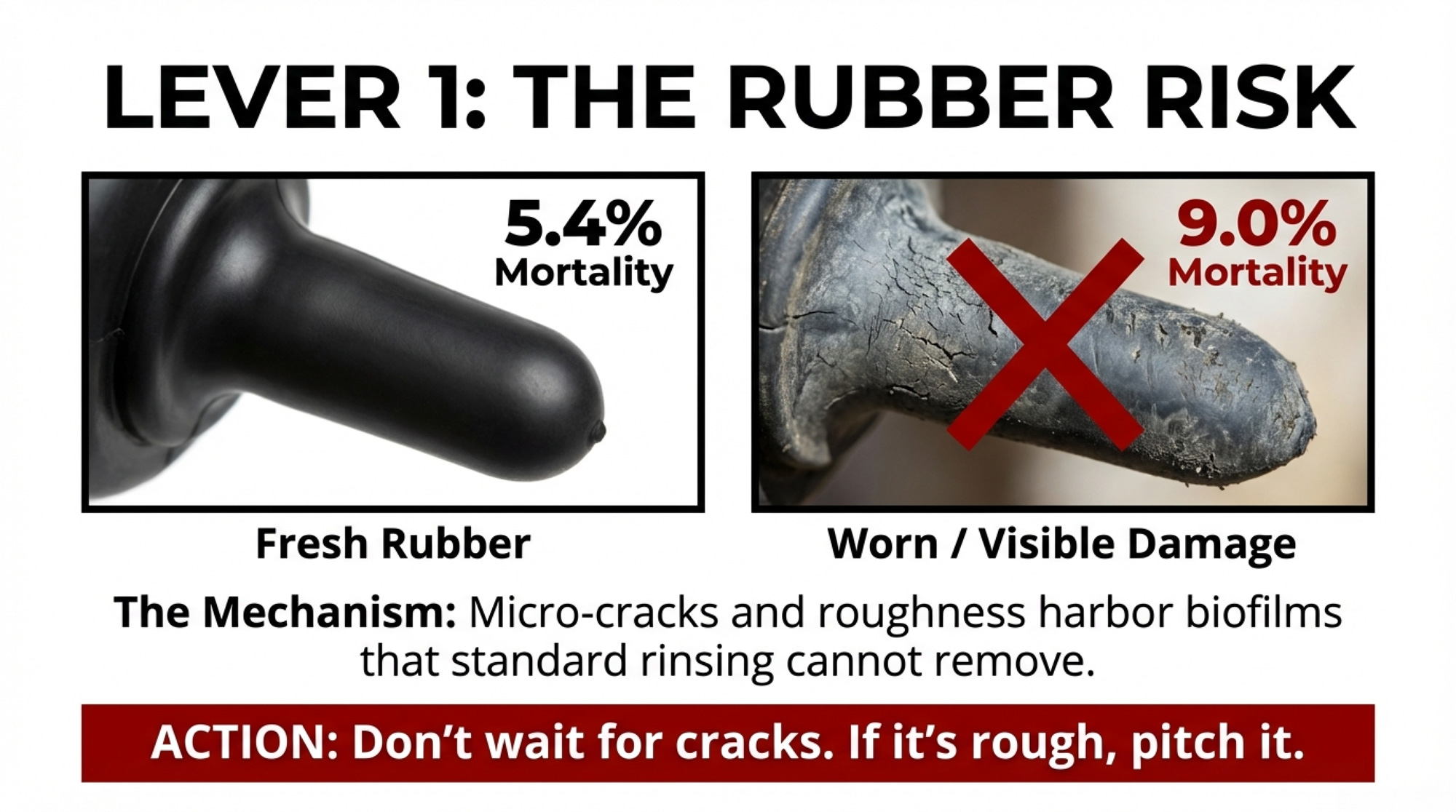
| Teat Replacement Protocol | Calf Mortality Rate (%) |
|---|---|
| First sign of wear | 5.4 |
| Obviously damaged | 9.0 |
| Difference (mortality swing) | 3.6 points |
That lines up with what hygiene work on calf feeding equipment keeps showing:
- Residues from colostrum and milk are ideal biofilm starters on rubber and plastic.
- Once biofilms establish, standard rinsing won’t touch them; they shed bacteria into every feed.
- Worn, roughened teats are prime real estate for biofilm.
The practical protocol most farms can live with:
- Rinse all teats and buckets in lukewarm water first, then wash with 60°C water and proper detergent, then disinfect and air-dry.
- Keep twice as many teats as you need in rotation; when a teat shows the first whitening, soft spots, or hairline cracks, it goes into the discard bin—not “one more week.”
- Budget to replace every teat at least every 2-4 weeks in heavy use.
4. Take dust personally in calf housing
In Keller’s model, dust perception wasn’t just a comfort issue. Farms that recognized dust as a respiratory trigger—and actually did something about it—had roughly 6.5% mortality vs. around 10% on farms where dust remained unchecked.

That matches what ventilation research and extension folks repeat every winter:
- Poor ventilation, humidity, and dust levels combine to increase the risk of pneumonia.
- Positive-pressure tube systems can deliver 4-6 air exchanges per hour without chilling calves if designed correctly.
- The “tell” is simple: if it smells stale, looks dusty, or your glasses fog up when walking in, calves are breathing that too.
You don’t need a European research grant to fix this. You need:
- A smoke bomb or fog test to find dead air zones.
- A simple positive-pressure tube design sized to your barn and pen layout.
- Someone walking the barn and asking, honestly, “Would I want to lie in this pen and breathe this air?”
The Economics: What Does a 30% Mortality Drop Actually Buy You?
Keller’s paper didn’t put a dollar figure on each dead calf. North American numbers do.
Recent economic analyses peg total cost per dead calf at around $395, including market value, invested treatment, labor, and disposal. Other Bullvine work has shown that prevention protocols costing $40-50 per calf routinely deliver 17-26x ROI when you look at lifetime production and culling risk.
Let’s keep it basic and stay on just the mortality math.
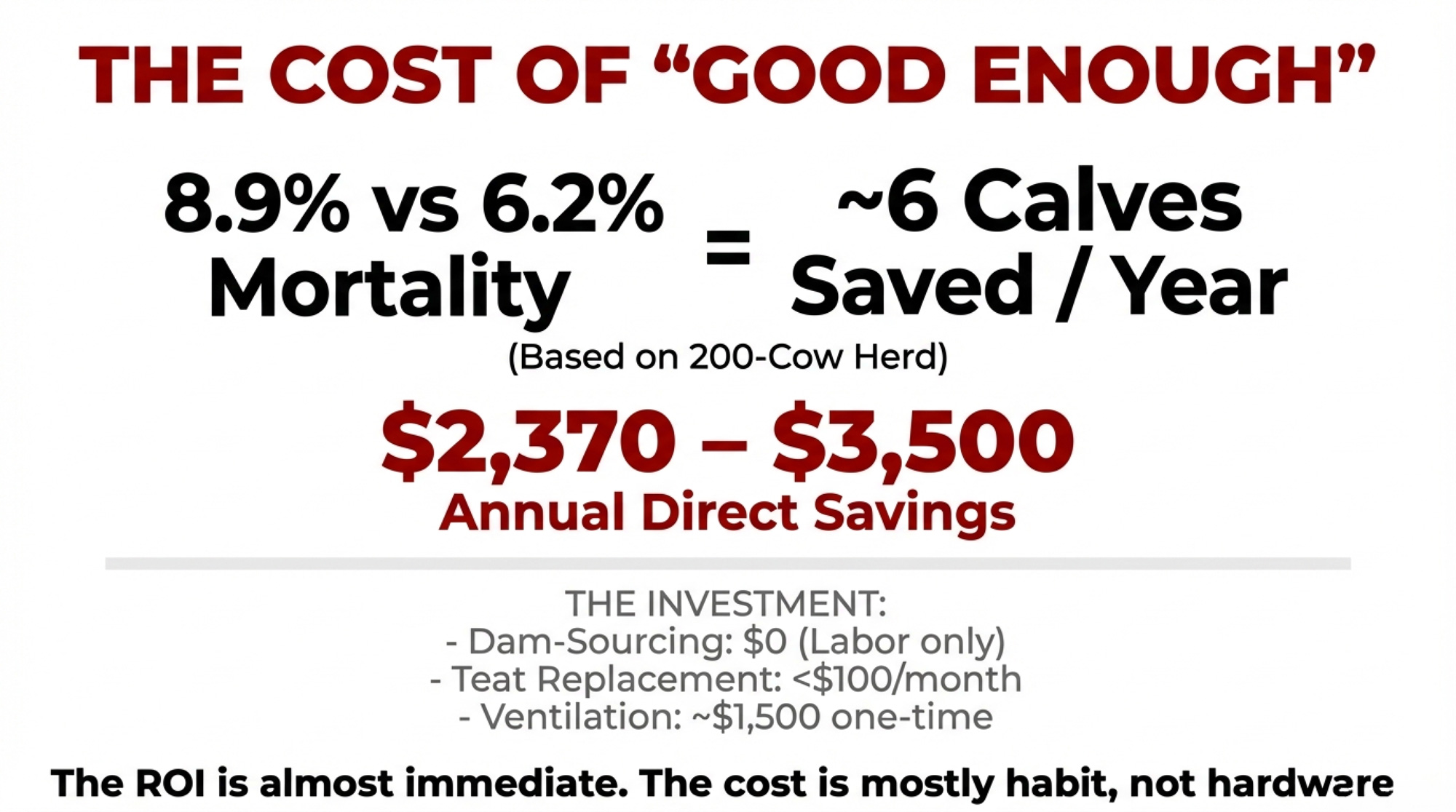
Take a 200-cow herd calving roughly 1.1 calves per cow per year:
- Calves born alive: 220 per year
- At 8.9% mortality (pooled group), you’d lose about 20 calves
- At 6.2% mortality (dam‑sourced group), you’d lose about 14 calves
- ”That’s 6 calves a year not dying before six months.
At $395 per dead calf, that’s $2,370 in direct, conservative savings. If you use higher all-in numbers, some systems now see (upwards of $500-600 when you factor lost first-lactation milk), the avoided loss climbs well past $3,000-$3,500.
| Colostrum Protocol | Direct Dead-Calf Cost | Treatment & Labor | Total Annual Cost |
|---|---|---|---|
| Pooled/Random Colostrum | $7,900 | $1,200 | $9,100 |
| Dam-Sourced Colostrum | $5,530 | $900 | $6,430 |
| Savings (Dam vs Pool) | $2,370 | $300 | $2,670 |
And the cost to unlock that?
- Teat replacement: even at $3 per teat, swapping 30 teats every two weeks costs <$100/month.
- Dust control: a basic positive-pressure tube system for a 40-calf barn runs $1,500-3,000 installed. Spread over 5-10 years, it disappears in the noise.
The dam-sourced colostrum shift itself? It’s mostly labor and habit. There’s no subscription fee.
Johne’s: The Objection Everyone Thinks First
The second you say “feed dam-sourced colostrum,” somebody in the room says “Johne’s.” And they’re not wrong to bring it up.
The Thuringian herds were, in a European context, subject to their own control programs. They didn’t exclude Johne’s-positive herds, but they weren’t feeding colostrum from obviously diseased cows either. The study wasn’t designed to settle the Johne’s debate once and for all.
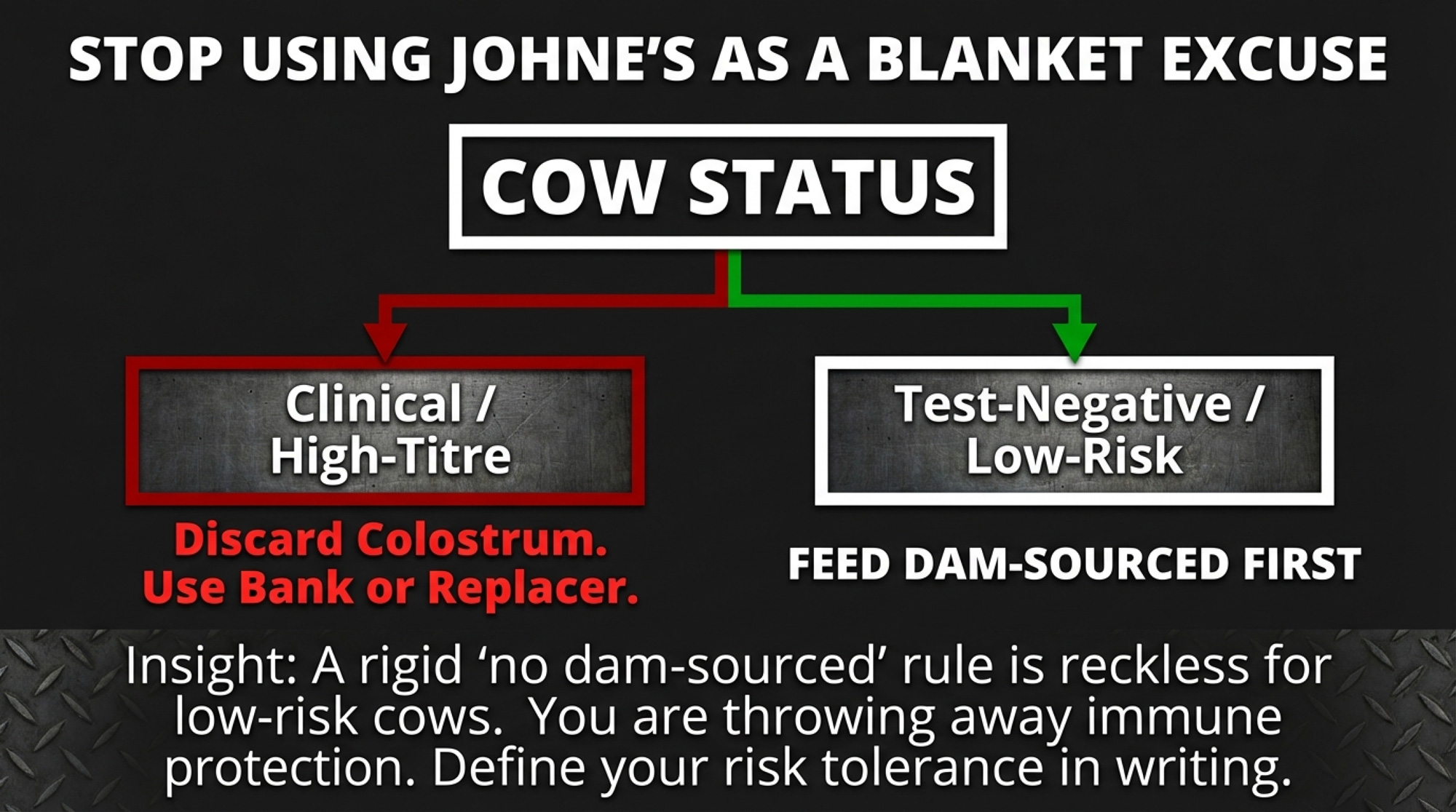
For herds with active Johne’s issues, a rigid “dam-only, no questions asked” protocol is reckless. But the answer isn’t to throw Keller’s mortality data in the garbage. It’s to sort cows differently:
- Test and classify cows by Johne’s status. High-titre or clinical cows are never colostrum donors. Full stop. Their calves receive high-quality banked colostrum or a replacer.
- Feed dam-sourced colostrum from low-risk cows. For test-negative, low-risk cows, the mortality and immune benefits of dam-sourced colostrum look hard to ignore.
- Pasteurize strategically where needed. Colostrum pasteurization can reduce bacterial load, including MAP risk, but can also affect some bioactives if done badly. Where Johne’s is a real concern, work with your vet to design which pools get pasteurized and how.
This is where your own risk tolerance and herd status matter more than any paper. The Thuringian study says “dam-sourced first feed is powerful.” Your Johne’s profile decides how wide you open that door.
What This Means for Your Operation
Here’s how to translate the Thuringian protocol into decisions in your own barn.
- Run your own mortality math in the next 30 days. Pull 3 years of calf records. What’s your 0-6 month mortality rate? If you’re at or above 8-9%, you’re functionally in the pooled-colostrum group Keller described.
- Audit where your first colostrum actually comes from. Don’t look at the SOP. Look at last week’s calves. How many got their own dam’s colostrum at the first feeding? How many got pooled or banked colostrum because it was easier?
- Trial dam-sourced only on low-risk cows for 60 days. Work with your vet to define Johne’s-low cows. For 2 months, commit to the idea that every eligible calf gets dam-sourced colostrum first, even if you’re tired or it’s 2 a.m. Track mortality, treatments, and growth. Don’t change anything else.
- Tighten your teat and bucket regime. If you’re honest and admit teats only get replaced when they’re obviously rough, move that line up. Start swapping at the first visual sign of wear. Hit equipment with the full rinse-wash-disinfect-dry cycle every feeding, not “when it looks bad.”
- Walk your calf barn with a dust and air lens. Use a cheap fog machine or smoke bomb to visualize airflow. If you have dead zones or heavy dust, get quotes on a simple positive-pressure tube system sized for your pen count. If $2,500 feels steep, compare it to your last bill for a pneumonia outbreak.
- Decide your Johne’s comfort zone in writing. With your vet, set a written policy: which cows’ colostrum is always discarded, which is always dam-fed, and which goes to the bank. If you’re going to bend the dam-sourced rule, make sure it’s a conscious, risk-based choice—not reflex.
Key Takeaways
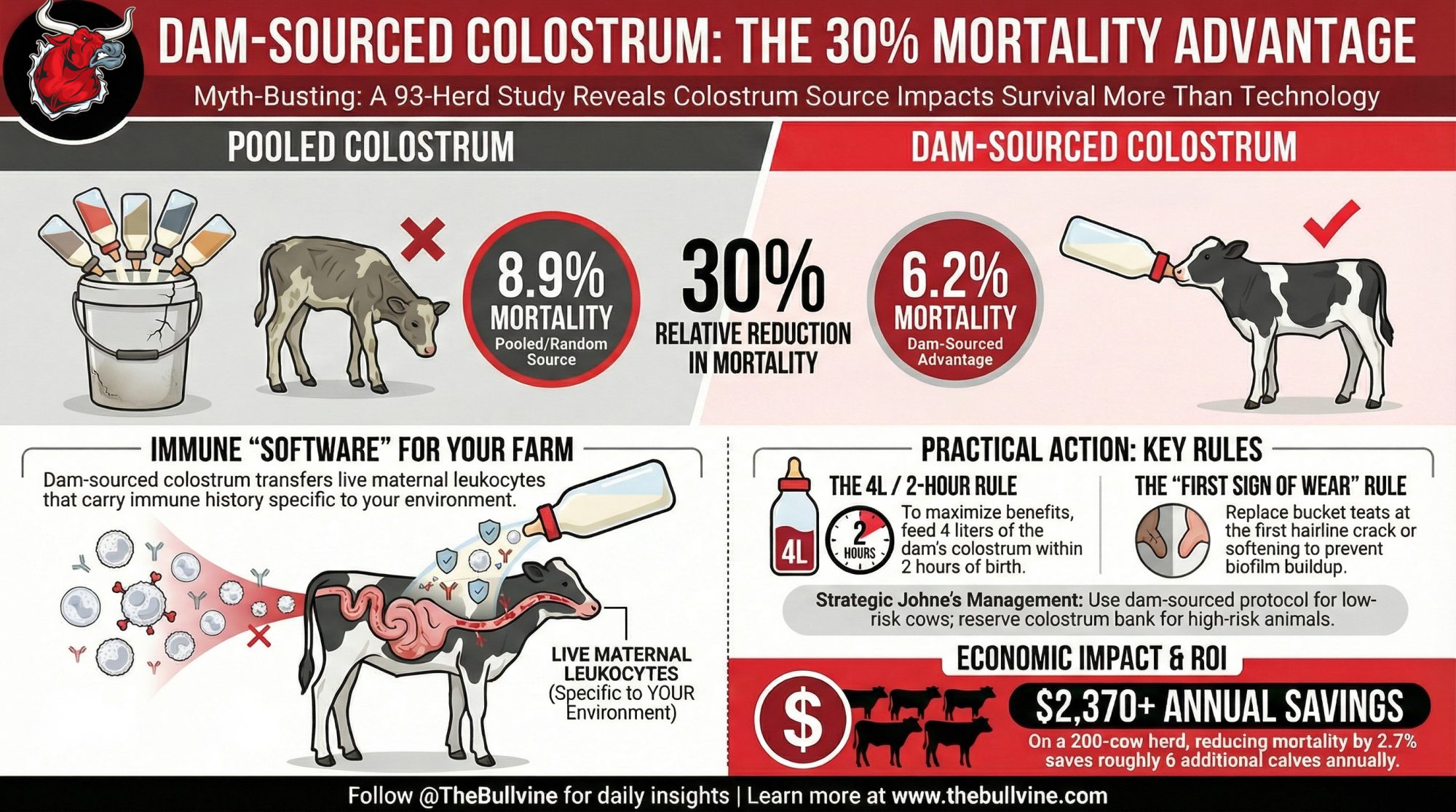
- If your pre-weaning calf mortality is hovering around 8-9%, you’re right where the pooled/random colostrum farms in Keller’s 93-herd study were—and about 30% worse than herds feeding dam-sourced first.
- The dam’s own colostrum brings more than IgG. It delivers an immune “starter kit” of live leukocytes and bioactives that seem to translate into fewer dead calves and less chronic disease in the first months.
- Regularly replacing bucket teats at the first hint of wear and treating dust like a real respiratory trigger aren’t nice-to-haves. In the Thuringian data, they’re tied to a 3-4 point swing in mortality.
- The protocol change that moves you from pooled to dam-sourced first feed doesn’t require a new building or a six-figure check. It requires different night-calving habits, slightly more disciplined milking of fresh cows, and a written plan for Johne’s risk.
The Bottom Line
The herds in Keller’s paper weren’t running 0% mortality fairy-tale calf programs. They were big, commercial dairy farms—just like yours. The difference between their 6.2% and 8.9% wasn’t magic. It was colostrum, rubber, and dust.
The question now is pretty simple: over the next 12 months, are you going to keep trusting the pooled colostrum bank model you built a decade ago, or are you willing to test whether your calves do better when they start life with their own dam’s immune story in the bucket?
Complete references and supporting documentation are available upon request by contacting the editorial team at editor@thebullvine.com.
Learn More
- 17-26x ROI: Why Top Dairies Stopped Saving Calves and Started Preventing Loss – Reveals the precision-math behind sub-3% mortality, arming you with a specific equipment list and protocol tweaks that return $800 more per head. It breaks down the transition from “treating” to “preventing” with unarguable cost-benefit clarity.
- $3,010 Per Heifer. 800,000 Short. Your Beef-on-Dairy Bill Is Due. – Exposes the structural 800,000-head heifer shortage through 2027, delivering the market intelligence you need to navigate $4,000 replacement costs. It secures your long-term position by defining the breeding thresholds that prevent a fatal inventory collapse.
- Revolutionary Colostrum Protocol Adding $500 Per Heifer to Your Bottom Line – Breaks down Dr. Michael Steele’s “Colostrum Therapy” method, extending immune programming beyond the first meal to generate an extra $500 per heifer. It delivers a science-backed blueprint for maintaining growth trajectories even during peak disease pressure.
 The Sunday Read Dairy Professionals Don’t Skip.
 The Sunday Read Dairy Professionals Don’t Skip.
Every week, thousands of producers, breeders, and industry insiders open Bullvine Weekly for genetics insights, market shifts, and profit strategies they won’t find anywhere else. One email. Five minutes. Smarter decisions all week.




