






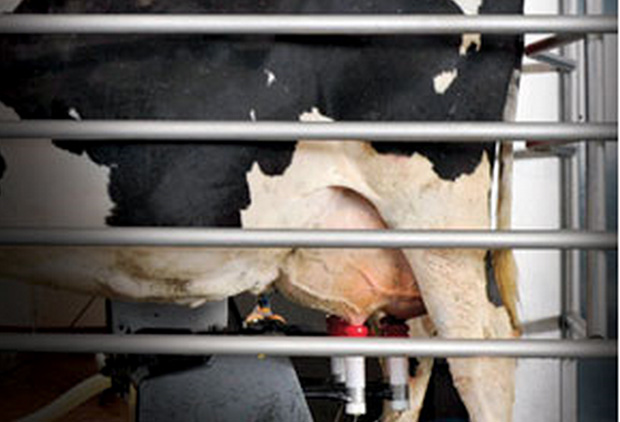
 “Robots change so many aspects of herd management. Dairy producers have to re-evaluate their nutrition program, how they sort animals, and how to manage somatic cell count, to name a few,” explains Michael Schmitt, Genetic Information Analyst for Accelerated Genetics. “It is just as important to prepare their herd’s genetics to ensure cows will thrive in this type of automated system.”
Accelerated Genetics has experience providing the specially tailored genetics needed to help a robot herd maximize results. Following is the perspective of two customers who are just beginning their transition into the robot world.
PLANNING FOR AN ADVANCED FUTURE
Averill Farms, Tillamook, Ore., has worked with Accelerated Genetics for more than 12 years. They recently added a robotic milking system to their program having converted from a 600 Holstein cow parallel parlor.
Don Averill, Jr. said the DeLaval Voluntary Milking System was implemented because there was adequate space for the number of cows they wanted on the new system. Plus, robotic milkers require less labor, which equals greater profitability.
Their new milking system consists of six robots on 300 cows. Each robot can handle up to 60 cows so they are not quite at full capacity. The Averills plan to increase their milking herd to 500 cows and eight robotic milkers in two years.
“We used to milk cows twice a day and the robotic milker changes that cycle,” Averill said. “Robotic milkers have a controlled flow system and once the cows get used to how it runs, the milking process will be much smoother.”
After the cows are adjusted to being milked more times a day, the Averills won’t need to push them towards the holding pen anymore. Averill states they are currently milking about 2.6 times a day, but once the cows adjust from the two times cycle it should be closer to the three range. This should help increase the profitability rate.
As Averill adjusted to the robotic milking system, he realized the importance of breeding for quality udders on his cows. Robotic milkers are challenged at times in finding all the teats if placed on the inside of the quarter. To help alleviate this challenge Averill looks for traits that can improve teat length, udder depth and teat placement.
“A wider udder is crucial to the robots,” Averill commented. “I am more concerned about that than milking speed being an issue.”
“Using bulls recommended by Accelerated Genetics for robotic milkers is a huge asset in creating an ideal cow,” Averill said. When the Averills moved to the new robotic facility, they brought 300 of their best uddered cows. Since a portion of their herd is still milked in a parallel parlor, the Averills have a back-up plan for cows that aren’t ideal for the robot. Hence, after three unsuccessful robot attachments, the cow is returned to the old parallel system.
“It was not a surprise to learn the Averills would be implementing robotic milkers into their program,” stated Allan Hanselman, District Sales Manager at Accelerated
HAPPIER COWS MAKE HAPPIER FARMERS
When Naedler Farms in Granton, Wis., began looking at expanding their herd, the first type of facility that came to mind was a parlor. Chad Naedler and his family visited farms that used robotic milkers and appreciated how comfortable the cows appeared in this type of system. They decided to install five robots for their 300-cow herd. In just two short months of operation, the Naedlers were amazed at the improvement they noticed.
“It is free choice for the cows,” Naedler said. “They eat when they want and can be milked when they want. That makes for happier cows that will produce more and, in turn, we are more profitable.”
In just two short weeks of using robotic milkers, the Naedlers witnessed an increase in milk production of 12 pounds per cow. Naedler said this improvement in milk production already justifies the robotic system investment.
“The milkers are great because it allows a fresh cow to be milked four times a day,” Naedler said. “We used to milk twice a day and now we get nearly three times a day per cow.” Naedler said proper teat placement has been a challenge for his milking herd. He plans to use bulls Accelerated Genetics recommends to throw wider teat placement, making the teats easier for the robots to find and attach. Another trait they are looking to improve is teat length since extremely short or long teats can be difficult for the robot to find.
Naedler Farms hopes as the robotic milkers become more advanced, the labor involved will lessen, allowing them more time to focus on animal health and take care of other jobs on the farm.
“The Naedler family is great to work with,” said Tony Mayer, District Sales Representative at Accelerated Genetics. “I have worked with this family for 27 years and they always make great decisions on herd improvement. It’s exciting to watch their success and to assist them in creating the perfect robot cow to achieve their goals.”




