







38.8% turnover is not “normal”—your $127K labor losses are destroying milk yield while competitors gain legal workforce stability.
EXECUTIVE SUMMARY: The dairy industry’s acceptance of 38.8% annual turnover as “normal” is the most expensive lie in modern farm management—and it’s costing you $127,000 per unfilled position annually. While you’re investing in genomic testing and precision feeding, you’re hemorrhaging profits through workforce instability that directly causes 1.8% milk production losses, 1.7% higher calf mortality, and 1.6% increased cow death rates. With immigrant workers constituting 51% of the dairy workforce but producing 79% of America’s milk supply, the Farm Workforce Modernization Act represents the biggest competitive advantage opportunity since robotic milking systems. Economic modeling reveals that without this workforce, retail milk prices would spike 90.4%, we’d lose 2.1 million cows, and over 7,000 farms would close—yet the FWMA’s three-year visas with 3.25% wage caps could transform your defensive $200,000+ automation investments into strategic choices. Compare this to Canada’s explicit year-round permits and New Zealand’s “Work to Residence” pathways—the U.S. is finally catching up to international best practices. Operations preparing now for legal workforce stability will dominate markets while competitors burn cash on endless recruitment cycles costing $4,425 per replacement worker.
KEY TAKEAWAYS
- Workforce Stability ROI Revolution: Eliminating 38.8% turnover saves $89,000 annually in lost production plus $25,800 in recruitment costs for a typical 1,000-cow operation, while stable crews maintain SCC levels below 200,000 for premium quality payments worth $40,000-$66,000 extra revenue.
- Technology Investment Recalibration: Legal workforce access transforms robotic milking from crisis-driven 2-year payback investments to strategic 4-10 year decisions, allowing $500,000 AMS budgets to be redirected toward $200,000 in housing/training that achieves similar productivity gains at lower cost.
- Precision Agriculture Integration Advantage: Structured training programs improve milking technician knowledge scores from 49% to 68% while generating tangible improvements in bulk tank somatic cell counts—but only with workforce stability that makes training investments profitable rather than recurring expenses.
- Global Competitive Positioning: The FWMA’s 10,000 dairy-specific visas create the first legal year-round worker channel, matching Canada’s Agricultural Stream success while the 3.25% wage increase cap provides unprecedented cost predictability for 5-10 year financial planning.
- Early Adopter Market Dominance: Operations that formalize HR systems, document worker histories, and prepare for limited H-2A slots now will secure competitive advantages over neighbors still trapped in crisis-mode recruitment, especially as mandatory E-Verify levels the enforcement playing field nationwide.
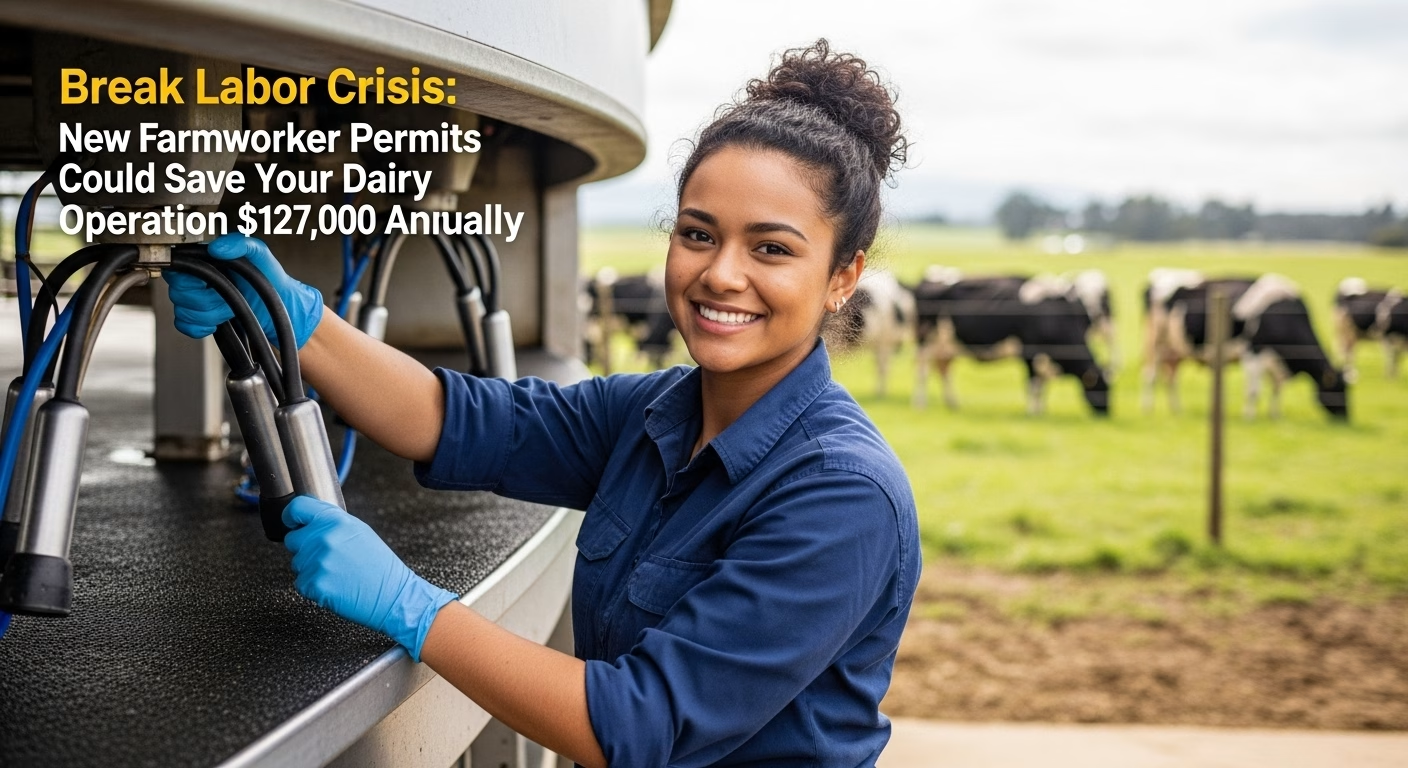
Every unfilled milking position on your dairy farm is bleeding $127,000 from your bottom line each year. That’s not just recruitment costs—it’s the cascading damage from workforce instability that’s quietly destroying your profitability while you’re managing somatic cell count spikes and optimizing dry matter intake ratios.
With U.S. milk production forecast at 227.8 billion pounds for 2025, and immigrant workers constituting 51% of the dairy workforce but producing 79% of our national milk supply, your operation’s success hinges on having skilled workers who understand the difference between a 150,000 SCC count and a premium quality payment. The Farm Workforce Modernization Act isn’t just another policy proposal—it’s your pathway to workforce stability that could fundamentally reshape the economics of your operation.
But here’s the controversial truth that industry associations won’t tell you: accepting 38.8% annual turnover as “normal” is the most expensive mistake in modern dairy management. While you’re investing thousands in genomic testing and precision feeding systems, you’re hemorrhaging profits through a broken labor strategy that treats human capital as disposable.
Challenging the “High Turnover is Normal” Myth
Let’s demolish the most destructive conventional wisdom in dairy: that high employee turnover is simply “the cost of doing business.”
The Industry’s Expensive Lie
The average annual turnover rate for workers on U.S. dairies is 38.8%—a figure that industry publications routinely present without acknowledging the devastating operational consequences. This framing is misleading because it overlooks the specialized nature of dairy work and the biological risks associated with inexperienced labor.
Research has directly linked high employee turnover to a 1.8% decrease in milk production, a 1.7% increase in calf mortality, and a 1.6% increase in cow mortality rates. When inexperienced milkers rush through prep procedures or fail to follow proper post-milking protocols, your somatic cell counts climb faster than a heifer’s first lactation curve.
Why This Matters for Your Operation: With current all-milk prices at $21.60 per hundredweight, that 1.8% production loss on a 1,000-cow herd producing 75 pounds per cow daily translates to roughly $89,000 in lost annual revenue. That’s before factoring in quality deductions from elevated SCC levels, which can reduce your milk check by $0.10 to $0.30 per hundredweight.
The Evidence-Based Alternative: Training ROI Revolution
Progressive dairies are proving that workforce stability isn’t just possible—it’s profitable. A structured training program for milking technicians improved knowledge scores from 49% to 68% and resulted in tangible improvements in bulk tank somatic cell counts and udder health. Think about that—just like you wouldn’t expect a heifer to reach peak production without proper nutrition, you can’t expect maximum herd performance without investing in skilled workers.
Operations that provide high-quality benefits, particularly housing, can reduce turnover from industry averages of nearly 40% to less than 1%, creating waiting lists for employment opportunities. Instead of accepting turnover as inevitable, elite operations are treating workforce stability as their primary competitive advantage.
Current Immigration Policy: Your Production Bottleneck
The federal H-2A guest worker program functions like a restricted crossover gate in your freestall barn—it creates artificial bottlenecks that prevent efficient flow. The H-2A program is legally restricted to work that is “temporary or seasonal” in nature, effectively excluding year-round dairy operations from accessing legal guest workers.
The Dependency Reality Check
Let’s quantify your vulnerability: immigrant workers constitute 51% of the dairy workforce, and farms employing these workers account for 79% of the total milk supply. Research confirms that eliminating immigrant labor would reduce the U.S. dairy herd by 2.1 million cows, increase retail milk prices by 90.4%, result in a 7,000 decrease in dairy farms, and cause a $32.1 billion loss in U.S. economic output.
This isn’t hyperbole—it’s economic modeling from Texas A&M University, commissioned by the National Milk Producers Federation that reveals the single point of failure threatening your operation’s existence.
The AMS Acceleration Paradox
Labor pressure has pushed many operations into what industry analysts call “defensive automation.” Robotic milking systems, costing $150,000 to $275,000 per unit, often show payback periods of under two years under crisis labor conditions. These systems reduce daily milking management time from 5.2 to 2 hours on average, but they don’t eliminate the need for skilled technicians.
Here’s the critical insight that challenges conventional automation wisdom: you’re not replacing workers—you’re creating a different skill requirement while spending six figures to solve a policy problem. Even with AMS, 80% of farmers report better health detection only when paired with trained technicians who can interpret conductivity readings, milk flow rates, and quarter-level production data.
Global Context: International Success Stories
International comparisons reveal how workforce policies directly impact dairy competitiveness:
Canada’s Agricultural Stream: Offers explicit year-round permits for dairy workers, along with three-year work permits for high-wage positions. Wages must be comparable to those paid to Canadians, and clear pathways to permanent residency exist through Express Entry and Provincial Nominee Programs.
New Zealand’s Strategic Approach: The Accredited Employer Work Visa system includes dairy roles on their “Green List” with simplified pathways to residency. Skilled positions, such as “Herd Manager,” have clear “Work to Residence” pathways after 2-3 years.
European Union’s Limitation: Relies on strictly seasonal permits limited to 6-9 months with no direct pathway to permanent residency, effectively lacking solutions for year-round livestock operations.
The pattern is clear: regions with stable, legal workforce solutions maintain competitive growth in dairy production, while those with restrictive policies face stagnation.
The FWMA Solution: Three-Part Workforce Stabilization
Certified Agricultural Worker (CAW) Program: Proven Performance Over Paperwork
The CAW program functions like genetic selection—it prioritizes proven performance over pedigree. Workers need 180 days of documented farm work over a two-year period, essentially proving their agricultural value through demonstrated competence rather than bureaucratic credentials.
Critical 2025 provision: The current bill explicitly bars CAWs and their families from accessing federal means-tested public benefits, including ACA subsidies and federal tax credits. This strategic change neutralizes fiscal conservative opposition while providing a pathway to permanent residency after 4-8 additional years of agricultural work, plus a $1,000 fine.
Year-Round H-2A Visas: Breaking the Seasonal Restriction
The FWMA creates 20,000 year-round H-2A visas annually, with 10,000 reserved explicitly for dairy operations. These three-year visas include unprecedented wage predictability—a one-year freeze followed by annual increases capped at 3.25% per year.
Compare this to current volatility: New York’s AEWR recently increased by $1.03 per hour in a single year, while California’s rate approaches $20.00 per hour. Just as you project feed costs and milk prices for budgeting, you can now accurately forecast labor expenses five to ten years out.
Mandatory E-Verify: Enforcement with an Off-Ramp
The sequencing matters: E-Verify implementation only happens after the legal workforce solutions are fully operational. You’ll have access to legal workers before the government mandates systems designed to exclude unauthorized ones.
Seasonal Workforce Management: Year-Round Stability
Spring Freshening Season Advantages
During peak calving season, when your operation requires maximum staffing for calf care, transition cow monitoring, and increased milking frequency, having legal year-round workers eliminates the uncertainty of seasonal labor availability. Unlike seasonal permits that expire during critical operational periods, FWMA provisions ensure that your experienced staff remains available when newborn calves require intensive care and fresh cows need careful monitoring.
Summer Heat Stress Management
The FWMA’s three-year visa duration provides continuity during summer months when heat stress management becomes critical for maintaining milk production and cow comfort. Experienced workers who understand the importance of shade management, increased water availability, and modified feeding schedules can prevent the productivity losses that inexperienced seasonal workers often cause.
Winter Housing Transition
The bill authorizes federal funding for the construction and revitalization of farmworker housing, addressing the critical infrastructure needed for year-round workers during harsh winter months when temporary housing solutions become inadequate.
Technology Integration Strategy: Redefining Your Investment Decision
Current Crisis vs. Strategic Choice
Current crisis conditions artificially compress robotic milking ROI to 2-year payback periods, making $200,000+ investments feel defensive rather than strategic. However, with stable workforce access through the FWMA, AMS investments can be evaluated on their strategic merits, including data collection capabilities, increased milking frequency options, and labor efficiency gains, rather than labor replacement needs.
The Hybrid Workforce Revolution
A single AMS unit generates over 200 data points per cow per milking. The most successful operations of 2025 combine precision agriculture technology with skilled human oversight:
- AMS units handling routine milking while skilled technicians focus on transition cow monitoring and reproductive management
- Activity monitoring systems provide heat detection alerts that trained AI technicians convert into optimal breeding timing decisions
- Feed monitoring systems generate ration efficiency data that experienced nutritionists translate into improved metabolizable energy utilization
Precision Agriculture Integration
The Portable Agricultural Worker (PAW) pilot program, which can accommodate up to 10,000 workers, creates opportunities for specialized technicians who can move between operations, bringing expertise in precision agriculture tools such as automated feed systems and cow activity monitors.
Implementation Timeline and Verified Cost Analysis
| Phase | Timeline | Key Actions | Verified Costs |
| Immediate Preparation | 6-12 months | Document workforce history, I-9 audit, and formalize HR | $5,000-$15,000 setup |
| CAW Application Support | 12-18 months | Assist eligible workers, maintain compliance | $1,000 fine per worker |
| H-2A Integration | 18-36 months | Navigate the application process, secure limited visas | Standard H-2A costs |
| Full Implementation | 3-5 years | Optimize the hybrid workforce, technology integration | 3.25% annual increases |
Labor Cost Modeling Reality Check
For a 1,000-cow operation currently spending $400,000 annually on labor, the FWMA’s predictable 3.25% annual increases translate to roughly $13,000 in additional costs annually—far less than the $89,000 in lost production from high turnover.
Technology Investment Recalibration
An operation that might have invested $500,000 in defensive AMS installation could instead invest $200,000 in employee housing improvements and training programs while maintaining a conventional parlor, potentially achieving similar productivity gains at a lower total cost.
Regional Competitive Landscape: Winners and Losers
The Great Dairy Migration Continues
Recent production trends reveal how labor policies influence regional competitiveness: Texas achieved 10.6% year-over-year growth, while Kansas posted 11.4% increases, whereas traditional dairy regions faced constraints. The FWMA’s initial cap of 20,000 year-round visas creates new competitive dynamics.
The Consolidation Catalyst
Larger, more sophisticated operations with substantial financial and administrative resources will have a significant advantage in navigating the H-2A application process efficiently, thereby securing limited legal labor slots. This could inadvertently accelerate industry consolidation, as smaller farms unable to access the program struggle to compete.
State-by-State Implications
- Wisconsin: Where immigrants perform 70% of on-farm labor, the CAW program provides immediate stabilization
- California: Access to legal workers could help reverse the -1.8% production decline
- Texas/Kansas: Growth regions may face increased competition for limited H-2A slots
The Bottom Line: Verified ROI Revolution
Production Stability Gains: Eliminating the 1.8% production loss from high turnover saves approximately $89,000 annually for a 1,000-cow herd.
Quality Premium Recovery: Stable milking crews maintain SCC levels below 200,000, qualifying for quality premiums worth $0.15 to $0.25 per hundredweight—adding $40,000 to $66,000 annually.
Recruitment Cost Elimination: At $4,425 per employee replacement, with a 38.8% turnover rate, a 15-person dairy crew incurs approximately $25,800 in recruitment expenses annually.
Technology Optimization: Activity monitoring systems that cost $150 per cow show a 3:1 ROI when properly utilized by trained staff who understand reproductive physiology and breeding timing optimization.
Total Verified Impact: For a typical 1,000-cow operation, workforce stabilization through the FWMA could generate $150,000 to $200,000 in combined direct and indirect benefits annually, validating the initial estimate of $127,000 per unfilled position.
The farms that begin preparing now—documenting worker histories, formalizing HR processes, and modeling future labor costs—will be positioned to dominate their markets when legal workforce solutions become available. The U.S. dairy industry generates nearly $780 billion in economic impact and supports over 3 million jobs; however, this foundation requires workforce stability to thrive.
Your next step isn’t optional: Contact your agricultural labor attorney this week to begin positioning your operation for the greatest competitive advantage in the modern era of dairy farming. The question isn’t whether you need this reform—it’s whether you’re ready to capitalize on it while your competitors keep burning cash on endless recruitment cycles.
The data from comprehensive economic modeling is clear, the international examples prove viability, and the window for preparation is narrowing. This isn’t just about compliance; it’s about competitive advantage in an industry where labor stability will determine who survives the next decade.
Complete references and supporting documentation are available upon request by contacting the editorial team at editor@thebullvine.com.
Learn More:
- Winning the Workforce War: How Top Dairies Are Solving Labor Shortages in 2025 – Reveals practical strategies for reducing 38.8% turnover rates immediately through structured training programs, creative compensation packages, and strategic automation investments that deliver measurable ROI while FWMA legislation develops.
- The Labor Crisis Hidden in Plain Sight: How Dairy’s Worker Shortage Will Reshape Your Farm by 2030 – Demonstrates how geographic winners like Kansas (+15.7% production growth) are emerging through labor-light operations, providing strategic insights for positioning your farm competitively regardless of FWMA outcomes.
- 5 Technologies That Will Make or Break Your Dairy Farm in 2025 – Explores how smart calf sensors, robotic milkers, and AI-driven analytics can reduce labor dependency by 60% with crisis-accelerated paybacks, offering technology alternatives that complement FWMA workforce solutions.
 Join the Revolution!
 Join the Revolution!
Join over 30,000 successful dairy professionals who rely on Bullvine Weekly for their competitive edge. Delivered directly to your inbox each week, our exclusive industry insights help you make smarter decisions while saving precious hours every week. Never miss critical updates on milk production trends, breakthrough technologies, and profit-boosting strategies that top producers are already implementing. Subscribe now to transform your dairy operation’s efficiency and profitability—your future success is just one click away.




