








GARZA tops, SHEEPSTER surges, CAPTAIN still king. See which sires to deploy now—and the 4 moves that cut SCC, boost FI, and pay this fall.
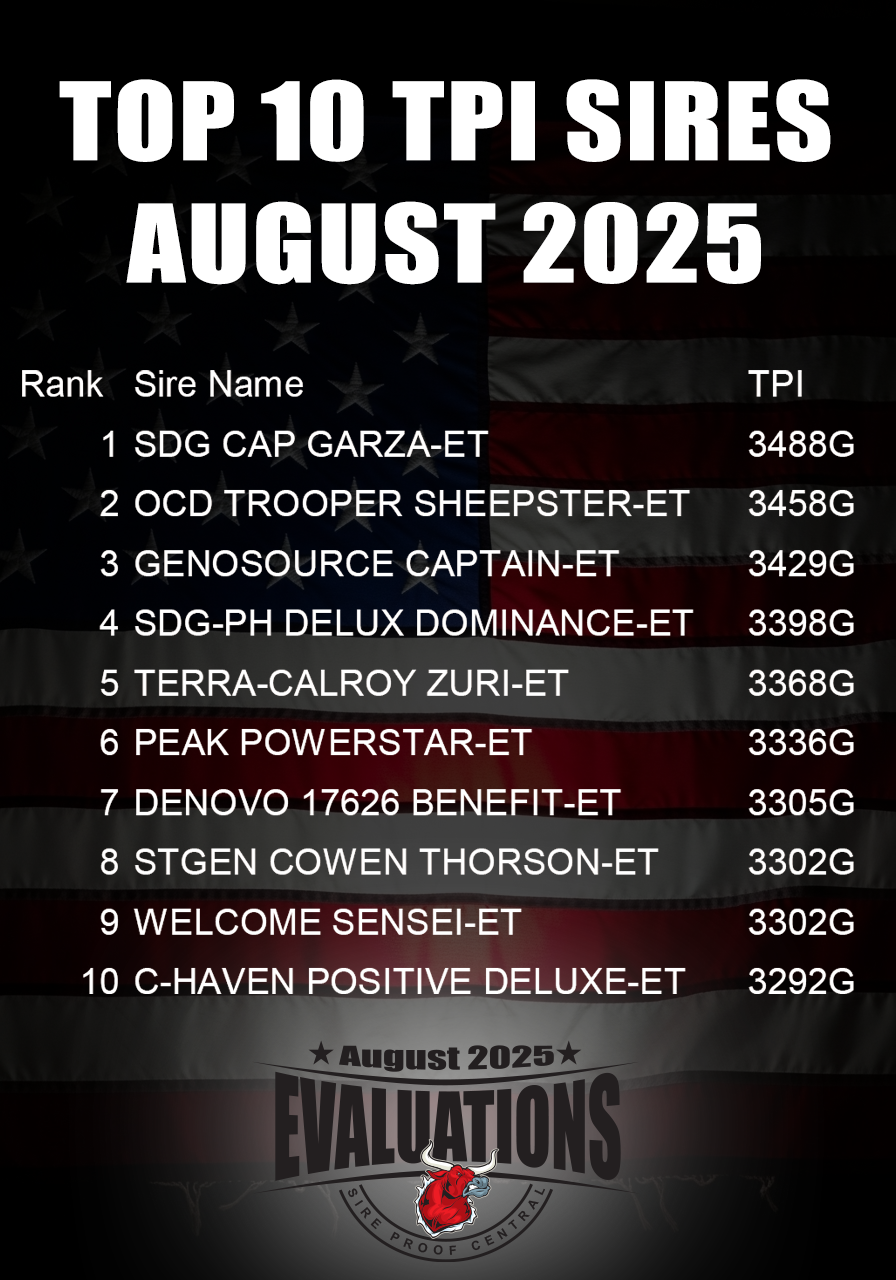
Executive Summary: August 2025’s TPI update reshapes the sire board without dethroning stalwarts: GARZA takes #1 with low SCS and balanced health-fertility, SHEEPSTER surges with components and robot-friendly workability, and CAPTAIN remains a dependable foundation while relatedness discipline becomes critical. Dominance offers timely fertility cover for heat stress, while POWERSTAR and BENEFIT are low-SCS, PL-positive options to reduce mastitis risk and support longevity. The actionable playbook: set a summer FI floor, shift 25–35% of heifer matings toward GARZA/DOMINANCE/SHEEPSTER while preserving outcross options, target POWERSTAR/BENEFIT to SCC-trouble and 3rd-lactation strings, and manage relationship coefficients tightly. Net effect: fewer Thursday treatments, steadier preg rates through heat, and more durable third-to-fifth lactation cows heading into fall.
Key Takeaways:
- GARZA jumps to #1 TPI (3488), overtaking CAPTAIN, on stronger health profile and SCS 2.86.
- SHEEPSTER debuts at #2 (3458), major components and milk with positive workability signals.
- CAPTAIN slips from #1 to #3 (3429) but remains an elite, balanced anchor with high reliability.
- DOMINANCE surges to #4 (3398), adding fertility and health cover with strong milk and PL.
- ZURI holds top-5 at #5 (3368), offering elite udders and FI; stable from April.
- POWERSTAR enters top 10 at #6 (3336), standout SCS 2.72 and +PL/+LIV for mastitis-risk herds.
The thing about this August run is—it didn’t just shuffle chairs. It widened the center lane. GARZA on top, SHEEPSTER blasting onto the board, CAPTAIN still the backbone. We’ve seen flavors of this before, sure. What strikes me this time is how the health and workability traits are stacking behind the milk and butterfat numbers in a way you can actually live with in September when the dew point sits on your parlor and fresh cows are touchy. That’s where it matters.
Quick reality check—by the numbers you can hang your hat on: GARZA is sitting about 3,488 TPI with low SCS and enough PL/FI balance that you’re not robbing fertility to juice the tank. SHEEPSTER lands mid‑3,450s with real component punch and workable SCS; first time this high on the genomic board and, yeah, it reads legit. CAPTAIN’s still a 3,420‑plus anchor, and his sons are everywhere—ask any New York or Wisconsin herd how many CAPTAIN granddaughters are in the heifer pens right now.
Here’s what’s happening—and why it matters in the parlor
GARZA at #1 feels commercial‑first, not just a spreadsheet win. Low SCS, steady PL, and that “doesn’t get in your way” fertility look. I’m thinking about those Pennsylvania tie‑stall strings moving toward partial TMR—these are the kind that stay on feed and don’t punish you in second lactation. According to the August TPI sheet, GARZA’s got the package to keep SCC off the cliff and still move components. That combo doesn’t come around every run.
SHEEPSTER’s surge is interesting. The Trooper/Taos branch has been appearing in robots with quieter box starts and fewer kicked cups (producers are noticing this everywhere). He’s not a silver bullet for every udder—if you’ve got a flat, shallow herd already, double‑check the udder composite before you go wide—but temperament and early compliance get ticked more often than not. What’s particularly noteworthy is how the component profile supports once‑a‑day cleanups on hot weeks without turning your filter sock into a crime scene.
CAPTAIN at #3 still runs the room. You can’t talk to a large New York herd right now without hearing “CAPTAIN sons in half my heifers.” That’s fine—just don’t get relationship‑locked (boxed in by high relatedness) and lose your outcross options. The evidence suggests better longevity and smoother third-calf transitions when you rotate in an outcross fitness sire without sacrificing the tank. I’ve seen too many Midwestern barns push great CAPTAIN lines a click too tight and then fight preg rates the next humid stretch.
DOMINANCE (#4) is the heat friend. Here’s the thing, though—when July–August conceptions sag on sand‑bedded freestalls in Michigan or the I‑29 corridor (humid and ugly, again), bias your matings FI‑positive and let DOMINANCE cover you without giving up much else.
ZURI (#5) daughters are Fancy enough for photos—he’ll clean up a sale catalog spread—but he won’t drain the tank. If you’re selling bred heifers or showy replacements, you already know why ZURI’s on the order sheet. And in fair season… well, it doesn’t hurt to have a little extra style walking through the ring.
POWERSTAR (#6) and BENEFIT (#7) are the quiet moneymakers. These two don’t flood social feeds, but they harden SCS and extend lifetime production. The feedback out of Minnesota sand barns has been pretty consistent: fewer mastitis events per 100 cows and just… easier third lactations. Not glamorous. Very profitable. What’s happening in those herds is simple—cleaner quarters through second freshening and fewer Thursday afternoon treatments when your feeder calls in sick. You can feel the stress go down.
What I’d change tomorrow (and yeah, this is the part we’ll argue about in the hallway at World Dairy Expo)
- Set a summer FI (Fertility Index) floor. Nothing heroic—just refuse to go negative in July–September on your high‑risk pens. It pays for itself in services saved and fewer do‑not‑breeds. If you’ve got a stubborn dry‑lot or a parlor that runs hot in the p.m., you’ll thank yourself.
- Move 25–35% of the heifer matings into the GARZA/DOMINANCE/SHEEPSTER lane while it’s this balanced. Keep CAPTAIN in the rotation—of course, you will—but don’t forget your outcross valves. An extra half‑step toward FI‑positive and low‑SCS this quarter is cheap insurance.
- Aim POWERSTAR/BENEFIT at your SCC‑trouble strings and those “nearly there” third‑lactation cows. It’s the least sexy allocation on paper and the most satisfying on a Wednesday when everything just milks.
- Watch inbreeding like a hawk. Not fear—just discipline. Current trends suggest the herds that keep two outcross sire lines active alongside their favorite CAPTAIN sons see fewer repro drags mid‑summer and cleaner calvings in January. It’s boring. It works.
A few regional notes while we’re here
High corn‑silage Southern Plains herds are telling me SHEEPSTER settles into box flow fast if you don’t slam the early‑lactation starch. In the Upper Midwest, where sand‑bedded freestalls meet cold‑weather ventilation quirks, POWERSTAR daughters look like the kind you forget because they never hit a treatment list. And out West, in those big dry‑lot setups, DOMINANCE pairs nicely with heat abatement that’s “good but not perfect” (which is most of us… let’s be honest).
If you’re robot‑heavy in Quebec or Michigan, test a small group with SHEEPSTER and one with GARZA and just track reattachments, unit‑kick events, and post‑milking SCC for six weeks. You’ll know quickly whether the start‑up behavior matches the chatter.
The Bottom Line
This development is fascinating because August didn’t dethrone CAPTAIN’s influence at all—it gave you better exits so you don’t paint yourself into a corner. GARZA adds speed you can actually live with. SHEEPSTER steadies the robot start. DOMINANCE props up fertility on those ugly humidity runs. POWERSTAR/BENEFIT turn flashy 2‑year‑olds into profitable 5‑year‑olds. Mix those lanes. Guard your relationships. And… permit yourself to be boring where it counts (udder health, FI floors, third‑lactation survivability).




