






Imports are rising. Futures are falling. Here’s what every dairy herd should know before the market moves again.
Executive Summary: A plan to import more Argentine beef may seem distant, but it’s already reshaping U.S. agriculture. The proposal to quadruple import quotas to 80,000 metric tons has dropped cattle futures nearly $100 per head and sparked tough conversations for dairies that now rely on beef‑on‑dairy calves for revenue. With 70 percent of large herds breeding to beef, and an average $250,000 in annual calf income at stake, every shift in the beef market touches the milk check. Farmers remember 1986 and 2020—years when fast policy moves caused lasting pain. What’s interesting now is how calmly producers are responding: adjusting breeding ratios, locking in forward contracts, and fine‑tuning rations instead of panicking. The broader reminder? Real stability in both beef and milk still starts in the barn, not the import ledger.
Every so often, a government policy hits the headlines and you can almost feel it ripple across the countryside. The latest is a proposed White House plan to quadruple Argentine beef imports—from about 20,000 to 80,000 metric tons.
At first, that might sound like a beef industry story, but it’s quickly becoming a dairy conversation. The reason is simple: our operations are tied together through the beef‑on‑dairy market more than ever before. And as many farmers are noticing, market decisions made in Washington—or Buenos Aires—have a way of showing up in the calf barn faster than you’d expect.

Looking at What’s Behind the Policy
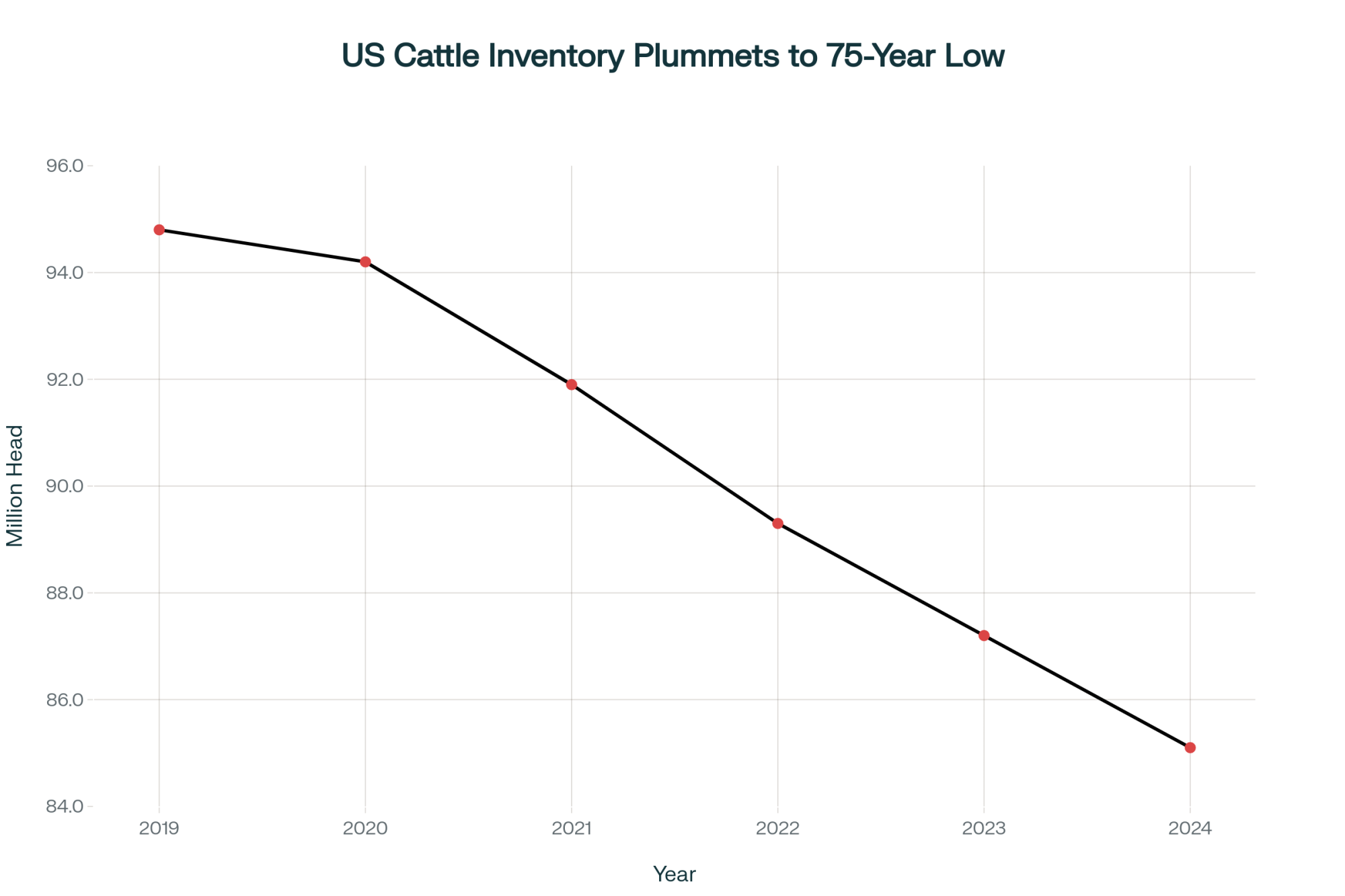
According to the USDA’s October Livestock, Dairy & Poultry Outlook, the U.S. cattle inventory now sits at its lowest level in 75 years. The causes aren’t new—multi‑year drought, high feed prices, and slower herd rebuilding across the Plains and West.
To ease those supply pressures, the administration is considering expanded beef imports to steady retail prices, which hit a record $6.30 per pound for ground beef this fall (Bureau of Labor Statistics).
On paper, that makes basic economic sense. But markets always react before the first kilogram of product moves. Just a week after the announcement, CME Group data showed futures prices down roughly $100 per head—or about 3 percent.
As Dr. Derrell Peel, livestock economist with Oklahoma State University Extension, put it: “You can’t rebuild a herd—or confidence—in a single policy cycle.”
And confidence is what sustains both cow‑calf ranches and dairies that depend on steady cross‑market signals.
The Beef‑on‑Dairy Link That’s Now Essential
Looking at this trend, it’s remarkable how fast beef‑on‑dairy has become a cornerstone of herd economics. In 2024, University of Wisconsin–Madison Extension researchers reported that nearly 70 percent of large dairies bred a portion of their cows to beef bulls.
The strategy significantly increased the average calf value. USDA AMS market data shows beef‑cross calves bringing $1,200 to $1,400 at birth, compared with $150 to $250 for pure Holstein bulls.
For a 1,500‑cow dairy breeding 40 percent to beef, that’s $240,000–260,000 in additional annual income. It’s the sort of capital that pays for genomic testing, sand bedding replacements, or that new holding pen upgrade.
A producer milking 1,200 cows in eastern Wisconsin told me recently, “Those beef calves have carried our barn loan for two years running. If prices fall much, we’ll need to rethink replacement plans.”
That’s real money—and real vulnerability—tied directly to policy decisions made thousands of miles from the farm.
What History Tells Us: The 1986 Buyout
What’s particularly interesting here is how this mirrors an earlier moment in ag policy—the 1986 Dairy Termination Program. Back then, USDA spent $1.8 billion to eliminate milk surpluses, buying out 14,000 farms and taking 1.5 million dairy cows off the grid.
It achieved its short‑term goal—but the cascade stunned markets. Surplus cows hit beef channels at once, and prices plunged 10–15 percent. Within two years, milk output had rebounded while much of the infrastructure serving small dairies had not.
The lesson still resonates today: market interventions can change prices quickly, but they rarely rebuild capacity at the same pace.

2020’s Big Reminder: When Efficiency Becomes Fragility
If 1986 was about overcorrection, then 2020 was about over‑efficiency. During the first months of COVID‑19, International Dairy Foods Association data showed 450–460 million pounds of milk dumped in April alone, while USDA ERS recorded beef and pork processing down more than 25 percent after plant shutdowns.
That period revealed how vulnerable “just‑in‑time” logistics can be. When processors or ports stall, milk and beef lose nearly all momentum.
Increasing reliance on imports—without parallel investment in domestic resilience—carries a similar risk. Once local capacity is allowed to wither, it’s slow and costly to bring back.
How Farmers Are Adjusting Already
Here’s what many Extension specialists and lenders are seeing so far:
- Breeding Ratios Are Shifting. Herds that were 60 percent beef are easing down toward 35–40 percent to maintain heifer pipelines.
- Feedlot Contracts Are Narrowing. Where buyers offered $1,300 per crossbred calf last spring, they’re now closer to $1,000 (USDA AMS Feeder Cattle Summary, October 2025). Forward contracting remains a critical stability tool.
- Genomic Programs Are Staying Put. Dr. Heather Huson, associate professor of animal genomics at Cornell University, warns that cutting testing “saves pennies now but costs years of progress in herd performance and butterfat output.”
- Ration Formulas Are Being Fine‑tuned. Nutritionists are rebalancing energy‑dense transition diets to maintain reproductive stability and milk components without increasing feed costs.
What’s encouraging is the tone—measured, thoughtful, and proactive. Dairies aren’t panicking; they’re preparing.
Regional Strategies, Shared Outlooks
Across the U.S., adaptation looks different but points to the same principle—resilience:
- Western dry‑lot systems, stretched by feed and water constraints, are leaning back toward dairy genetics to maintain replacements.
- Upper Midwest co‑ops, long integrated with beef‑on‑dairy programs, are renegotiating calf contracts to lock in 2026 pricing.
- Northeast fluid dairies balancing organic quotas and beef‑cross sales are prioritizing efficiency rather than retreating from diversification.
Different regions, same balancing act—protect cash flow today while safeguarding production capacity tomorrow.
The Bigger Question: Can We Stay Self‑Sufficient?
The U.S. currently produces about 83 percent of its own beef supply, according to USDA ERS Trade Data (2025).Economists caution that, if herd recovery stays slow while imports increase, that number could slide toward 70 percent within ten years.
That’s not about politics—it’s about security. Kansas State University Extension specialists remind us that “food sovereignty” doesn’t mean cutting trade; it means keeping enough domestic capability to respond when global systems falter.
For dairy, the same applies. Once cull markets, local plants, or skilled herd labor disappear, rebuilding them isn’t a quick turnaround—it’s generational work.
Signs of Progress Worth Watching
The good news is, practical resilience efforts are underway. Wisconsin’s Dairy Innovation Hub and USDA’s Regional Food Business Centers are channeling new funding into herd research, small processor support, and cold‑chain infrastructure.
As Dr. Mark Stephenson, director of UW–Madison’s Center for Dairy Profitability, said during a recent producer panel, “Resilience isn’t about size—it’s about diversity. The more ways we move milk and beef through our systems, the better we weather volatility.”
The Bottom Line
What’s interesting here is that every generation faces its own version of policy shockwaves. This one just happens to merge global trade with a cow management strategy.
Markets shift overnight. Herds don’t. Successful farms are the ones that use these moments not to retreat, but to reinforce what already works.
If history has taught us anything—from 1986’s buyout to 2020’s pandemic fallout—it’s that capacity equals security.Protect the cows, the genetics, and the local systems, and the rest finds its balance.
Progress in agriculture has always moved at the cow’s pace—and that’s still the pace that feeds the world.
Key Takeaways:
- A policy shift abroad can hit your milk check at home. Rising beef imports risk lowering calf values just as beef‑on‑dairy becomes vital to dairy income.
- With 70% of dairies breeding to beef and nearly $250,000 a year on the line per farm, small price swings now carry outsized impact.
- History is warning us: quick policy fixes in 1986 and 2020 show how capacity lost early takes decades to recover.
- Smart dairies are preparing now—tweaking breeding ratios, securing forward contracts, and tightening transition nutrition to stay profitable.
- Resilience beats reaction. Protect herd quality, diversify markets, and collaborate locally to keep your dairy strong through shifting trade winds.
Complete references and supporting documentation are available upon request by contacting the editorial team at editor@thebullvine.com.
Learn More:
- Transform Your Dairy Economics: How Beef-on-Dairy Crossbreeding Delivers 200% ROI – This guide moves from theory to application, revealing advanced ROI calculations that most producers miss. It provides tactical frameworks for optimizing your beef-on-dairy program to maximize revenue, improve herd efficiency, and secure a significant financial return on investment.
- Global Dairy Market Dynamics: Unveiling Shifts, Challenges, and Opportunities – For a wider perspective, this analysis examines the global economic currents impacting your milk check. It decodes international trade data and consumer trends, providing the strategic foresight needed to navigate market volatility and position your operation for long-term profitability.
- The New Math of Dairy Genetics: Why This Balanced Breeding Thing is Finally Clicking – This article details the innovative shift toward balanced genetics as a risk management tool. It provides a modern strategy for sire selection that enhances herd health and longevity, demonstrating how to leverage genomic data to build a more resilient and profitable herd.
 Join the Revolution!
 Join the Revolution!
Join over 30,000 successful dairy professionals who rely on Bullvine Weekly for their competitive edge. Delivered directly to your inbox each week, our exclusive industry insights help you make smarter decisions while saving precious hours every week. Never miss critical updates on milk production trends, breakthrough technologies, and profit-boosting strategies that top producers are already implementing. Subscribe now to transform your dairy operation’s efficiency and profitability—your future success is just one click away.




