
Archive for dairy genomic testing

The $1,350 Replacement Advantage

Why Today’s Best Dairies Cull Healthy Cows That Could Produce for Years

Executive Summary: Wisconsin dairyman Eric Grotegut no longer culls cows in crisis—he replaces them strategically on “Monday afternoons,” capturing a $1,350 per head advantage that’s reshaping dairy economics nationwide. Despite cows being genetically capable of living 13 months longer than they did 20 years ago, the math now favors earlier replacement: while a third-lactation cow generates $234 in annual profit, her $350 genetic lag means a younger replacement creates $2,704 in value over three years. This shift, powered by genomic selection tripling genetic progress to $75 yearly, beef-on-dairy premiums of $370-400 per calf, and IVF technology approaching commercial viability, has created an unexpected crisis—heifer inventory down 18% with prices soaring from $1,720 to over $3,000. The optimization technology driving these decisions requires an annual investment of $26,000-78,000, achieving positive ROI only above 400 cows, accelerating consolidation that may reduce U.S. dairy farms from 26,000 to 15,000-18,000 by 2035. With environmental genomics launching in 2026-2027, producers face three paths: scale up to 600+ cows and embrace technology, develop specialized niches like organic or direct marketing, or exit strategically before 2030 while preserving asset value. The longevity paradox reveals a fundamental truth—in modern dairying, keeping cows longer often means keeping the operation shorter.

You know, there’s something that doesn’t quite add up when you really think about it. Our cows today are genetically capable of living 13.2 months longer than they did twenty years ago—that’s what the folks at CDCB showed us at the October meeting held during World Dairy Expo, saying we’ve gained about 4.7 months of productive life per decadethrough genetic selection. But here’s what’s interesting: many of the most progressive producers I know are actually replacing them earlier, not later.

Eric Grotegut, who runs 1,400 cows up in Wisconsin, said something at that meeting that really stuck with me.

“15 to 25 years ago, it seemed like I was selling cows every day for a lame cow, a mastitis cow, a pneumonia cow—something all the time. Now most cull cows are on Monday afternoon.”

Monday afternoon. That shift—from emergency culling to what Eric calls “Monday afternoon” strategic replacement—well, that tells you everything about how dairy economics have completely flipped in the last decade or so.

The Math That Changes Everything

So I’ve been digging into what the researchers call the Retention Payoff calculation, or RPO for short. Basically, you’re asking: does keeping this cow generate more profit than replacing her with a younger animal? And what I’ve found is…the numbers are surprisingly clear-cut.

Here’s how it breaks down in a real scenario that many of us face. You’ve got a third-lactation cow producing 68 pounds daily—decent production, no major health issues, right? She’s profitable, generating about $234 in annual profit above her direct costs, according to the Wisconsin Extension models. So, naturally, you’d think, why would anyone replace her?

ComponentMature CowReplacement Heifer (3 Years)
Annual Profit Above Costs$234 (with $350 genetic lag at $75/yearprogress)Year 1: $97Year 2: $720Year 3: $1,031
Genetic Opportunity Cost$233/year (USDA analysis)No lag—current genetics
Net Present Value$1,353 (over 3 years)$2,704
Bottom Line Advantage$1,350 more value from replacement

Here’s what’s really happening, though. That cow carries genetics from roughly 4-5 years ago, which means she’s about $350 behind current genetic averages. We’re seeing genetic progress at $75 PTA Net Merit per year now—both CDCB and the Canadian Dairy Network have confirmed this. And that creates what Paul VanRaden at USDA calls a “genetic opportunity cost“—essentially $233 per year in lost value from not having current genetics in that stall.

“We’re not just looking at whether a cow covers her feed costs anymore. We’re evaluating whether she’s the most profitable use of that stall space given all available options.”
— Tom Overton, Cornell’s dairy management professor at the Western Dairy Management Conference

Three Technologies Converging to Change Everything

What’s driving this shift isn’t just one breakthrough—and this is what I think many folks miss—it’s three technologies hitting maturity at the same time, each reinforcing the others in ways nobody really predicted five years ago.

Genomic Selection Has Changed the Game Entirely

Since USDA launched official genomic evaluations for Holsteins and Jerseys back in January 2009, we’ve gone from experimental to essential. Today, 95% of U.S. AI bulls are genomically tested, and about 20% of heifer calves get tested within their first week of life, according to CDCB’s latest data.

The impact on genetic progress? Man, it’s been dramatic. Before genomics, we were seeing gains of about $28 PTA Net Merit per year. Now? We’re hitting $75 per year—nearly triple the rate.

The Canadian Dairy Network’s 2024 report shows even more dramatic shifts in specific traits. Production traits have doubled their rate of improvement, but here’s what’s really impressive: tough traits like daughter pregnancy rate have increased threefold to fourfold. That’s…that’s game-changing for our industry.

Kent Weigel at the University of Wisconsin, who’s been tracking this since the beginning, tells producers that “farmers typically cull the bottom 15 to 20% of calves based on genomic testing, but the exact proportion depends on the number of surplus heifer calves available on a given farm.” And he’s right—it’s all about finding that sweet spot for your operation.

Genomics didn’t just speed up progress—it blasted a hole in the old ceiling. Black bars for ‘then,’ red for ‘now.’ That’s a revolution in every stall.

Sexed Semen: Strategic but Still Limited

Now, sexed semen adoption in the U.S. sits at 25-30% according to NAAB statistics. Compare that to the UK, where they’re at 84% based on AHDB’s 2024 report. Why the gap? Well, the challenges are real, as many of you probably know.

Conception rates with sexed semen still run 15-20% below conventional, based on large-scale field data from Alta Genetics and Select Sires. The stuff costs 2.3 times more—you’re looking at $50-64 versus $18-28 for conventional. And during summer heat stress? Forget about it.

Peter Hansen’s group down at the University of Florida has shown that pregnancy rates can drop to 25-30% with sexed semen when the temperature-humidity index exceeds 72. Those of us dealing with hot summers know exactly what that means for breeding programs. July and August can be brutal.

But here’s what’s working: virgin heifers in fall and winter. You can still hit 60% conception rates with good management. Matt Lauber, working with Paul Fricke at Wisconsin, showed that with proper synchronization protocols, the fertility gap narrows to just 8-12%—making sexed semen far more viable in optimized systems. It’s not about using sexed semen everywhere—it’s about using it where it pencils out.

Beef-on-Dairy: The Revenue Stream Nobody Saw Coming

This might be the biggest shift I’ve seen in twenty years of watching this industry. We’ve gone from 200,000 beef-cross dairy calves in 2008 to 2.9 million in 2025, according to Rabobank’s analysis. These calves now represent 12-15% of the U.S. fed cattle supply. Think about that for a minute.

What’s driving it? Money, plain and simple. Day-old beef-cross calves are bringing $370-400 premiums over straight dairy bull calves based on USDA auction reports from Wisconsin and California. For a 1,000-cow operation breeding 60-70% to beef, that’s $222,000 to $280,000 in annual premium revenue that didn’t exist before 2015.

Glenn Klein, who manages 3,600 cows across multiple sites in Wisconsin, explained their approach at the Industry Meeting: “We’ve been doing beef-on-dairy since I think 2018 or 2019. We do it somewhat strategically based on the cow. We look at her genomics, see her past history, and basically decide whether she gets sexed semen or beef semen.

The Constraint Nobody Planned For

Lowest heifer numbers, record-busting prices. What felt like a quiet trend just crashed into reality, and every buyer’s feeling it.

But here’s where things get complicated—and it’s a perfect example of unintended consequences in our industry. This strategic shift toward beef-on-dairy has created the worst heifer shortage in 20 years.

CoBank’s August 2025 analysis shows national dairy replacement heifer inventory at 3.914 million head. That’s 18% below 2018 levels and the lowest we’ve seen since 2005. They’re projecting inventories will shrink by another 800,000 head before recovering in 2027.

The math is straightforward but painful. With 60-70% of the national herd now bred to beef—that’s per National Association of Animal Breeders data—we’ve essentially cut our replacement pipeline in half.

Heifer prices tell the story: from $1,720 in April 2023 to $3,010 by July 2025, according to USDA market reports. And I’ve seen high-quality Holsteins fetching over $4,000 at auctions in Turlock, California, and New Ulm, Minnesota.

This creates a real paradox, doesn’t it? While the RPO math strongly favors replacement, producers are actually reducing culling rates—down from 32.7% in 2019 to 27.9% in 2024, according to Canadian Dairy Information Centre data, which is the best North American dataset we have. They’re keeping marginal cows they would’ve culled five years ago when heifers cost $1,200.

“We know the economics favor replacement, but you can’t replace what you don’t have. So producers are keeping cows a bit longer than optimal while rebuilding heifer inventory.”
— Mike Overton, DVM, who directs technical services at Elanco

IVF: From Seedstock Tool to Commercial Reality

What’s fascinating to me is watching IVF technology move from the seedstock world into commercial dairies. Current pregnancy rates have climbed above 50-55% based on 2024 data from Trans Ova Genetics and other major providers—matching or even beating conventional AI in some cases.

The cost trajectory is what really matters, though. We’re at $350-450 per pregnancy today, but industry projections show that dropping to an estimated $200-300 by 2027-2029 as volumes scale and protocols improve.

Several technical improvements are converging here:

  • Optimized FSH protocols during the voluntary waiting period increase oocyte yields by 51%—that’s from Wisconsin research
  • Time-lapse embryo selection with continuous monitoring from fertilization through day 8 improves pregnancy rates by 15-25 percentage points, according to Animal Reproduction Science
  • Vitrification technology—that ultra-rapid freezing technique—now allows frozen embryos to match fresh transfer success rates

Sean Nicholson, who runs 1,600 cows in Tulare County, California, shared his experience with the California Dairy Magazine: “IVF pregnancy rates markedly exceed what we see with conventional AI, especially during summer when heat stress hammers traditional breeding.” His operation now uses beef IVF embryos for 7% of pregnancies—producing purebred Angus calves from Jersey recipients that bring even higher premiums than regular beef-crosses.

For operations above 800 cows, IVF is starting to pencil out. You can take your elite donors—that top 3-5%—and produce 10-15 pregnancies annually versus one naturally. This creates what I call a three-tier system: elite cows produce all your replacements via IVF, middle-tier cows just make milk, and bottom-tier cows produce beef calves for cash flow.

Success Story: Minnesota’s IVF Innovation

Take a look at how one Minnesota operation is making this work. They’re running 850 cows, started genomic testing everything three years ago, and now use IVF on their top 25 females. Last year, those 25 cows produced 180 pregnancies—enough to cover all their replacement needs plus some to sell. Meanwhile, they bred the rest of the herd to beef and captured an extra $240,000 in calf revenue. That’s…that’s transformative economics.

What’s interesting is they’re not doing this alone—they’ve partnered with two neighboring farms, each running 400-500 cows, to share IVF technician costs and expertise. It’s the kind of cooperative approach that makes advanced technology accessible at smaller scales.

Environmental Pressure: The Next Wave Coming

Here’s something that hasn’t hit most U.S. producers yet, but it’s definitely coming. John Cole at CDCB revealed in October that methane emissions evaluations will launch in 2026-2027, with disease resistance traits following shortly after. When these environmental traits are integrated into selection indices, genetic progress could accelerate from the current $75 per year to an estimated $110-125 per year, depending on the heritability and economic weightings of these new traits. That’s a 47-67% jump.

The University of Wisconsin’s $3.3 million methane project has found heritability of 0.20-0.28 for residual methane traits. That’s moderately to highly heritable, which means we can effectively select for it. They’re using milk spectral data and even fecal microbiome profiles as proxies for rumen emissions, which would make large-scale phenotyping actually feasible.

What’s particularly interesting is looking at what’s already happening in Europe. UK and Irish producers are getting 2-4 pence per liter premiums for verified emission reductions, according to Arla Foods’ 2024 sustainability report. Every dairy bull calf they raise counts against their farm’s carbon intensity score. When similar pressures reach U.S. markets—and trust me, they will—cows with poor environmental genetics might become economically unjustifiable regardless of their production level.

The Reality Check: Who Can Actually Execute This?

Now, all this sophisticated RPO optimization sounds great in theory. But after talking with producers and consultants across the country, I’ve realized there’s a massive gap between what’s theoretically optimal and what most farms can actually implement.

The industry basically breaks into five distinct tiers based on what I’m seeing:

Elite operations—those running 1,000+ cows and producing about 45% of U.S. milk—they’ve got the whole package. Daily milk weights, genomic testing for every calf, activity monitors —the works. Eric Grotegut’s Wisconsin operation falls squarely into this category. They’re truly optimizing these RPO calculations daily.

Progressive commercial farms running 400-1,000 cows —roughly 30% of our milk supply —have most of the tools but use them monthly rather than daily. They’ll perform genomic testing on 60-80% of calves and run activity monitors on breeding-age animals.

Mainstream operations—150-400 cows, about 20% of milk—they operate on rules of thumb. Kristen Metcalf, running 360 cows in Minnesota, described improving health through “implementing more frequent hoof trimming and rubber mats in the barn.” That’s good management, absolutely, but it’s not sophisticated RPO optimization.

Smaller operations with fewer than 150 cows, which produce about 5% of our milk, simply don’t have access to these tools. At $26,000-78,000 annual investment for full RPO infrastructure—genomic testing, monitors, software, consultants—it only achieves positive ROI above 400 cows.

You know, research from ETH Zurich published in the Journal of Dairy Science found that suboptimal culling decisions cost 1.55 Swiss francs per cow monthly. And here’s the kicker: losses from keeping cows too long were three times greater than premature culling losses. But that analysis required dynamic programming models with detailed farm data—exactly what most mid-size operations lack.

Practical Strategies by Farm Size

What farmers are discovering varies dramatically by scale, and honestly, there’s no one-size-fits-all answer here. Let me break down what’s actually working:

For Large Operations (800+ cows):

Go all-in on the technology. Full genomic testing runs about $40-50 per calf through companies like Zoetis or Neogen—that’s $12,000-20,000 annually for a 1,000-cow herd, but it pays back quickly.

Consider IVF programs for your top 3-5% once you’ve identified them genomically. Keep beef-on-dairy at 60-70% to maximize that revenue stream while beef premiums stay high.

And start preparing for environmental compliance now. Methane measurement infrastructure is projected at $50,000-100,000 based on current equipment costs, though specific U.S. regulatory requirements are still being developed.

For Mid-Size Operations (200-600 cows):

Focus on what I call the 80-20 approach—capture 80% of the value with 20% of the complexity:

  • Definitely genomic test all your heifers and cull the bottom 15-20% before spending $2,900 to raise them
  • Use your monthly DHIA test to identify cows below 75% of herd average production who are also open past 120 days
  • Put beef semen on your bottom 50% by either genomic merit or production
  • The key decision: can you scale to 600+ cows in the next 3-5 years? If not, start developing a niche strategy now
  • Consider cooperative approaches—some 400-cow operations are exploring shared IVF programs with neighbors to access technology at a viable scale

For Smaller Operations (under 200 cows):

Your economics are fundamentally different, and that’s okay. Focus on:

  • Reducing involuntary culling through better fresh cow management and hoof health
  • If you’re in the right location, organic certification can capture $7-12/cwt premiums that offset scale disadvantages
  • Direct marketing through on-farm stores or agritourism might work
  • But let’s be honest here—if you don’t have a clear competitive advantage like paid-off land, unique market access, or family labor, start planning your exit strategy for 2027-2030 before technology requirements intensify

Regional Realities Shape These Economics

It’s worth noting that these dynamics play out differently across regions. California’s massive operations—many running 3,000-5,000 cows—they’re already deep into IVF and sophisticated optimization. Meanwhile, Vermont’s pasture-based systems face entirely different economics where land constraints and organic premiums create alternative value equations.

The Upper Midwest sits somewhere in between, with operations like Grotegut’s finding that sweet spot of scale and technology adoption. Texas and New Mexico operations? They’re dealing with water constraints that trump genetic optimization. Each region has its own version of this story, you know?

And seasonally, everything shifts. Summer heat stress in the Southeast makes sexed semen nearly unusable from June through September. Wisconsin producers might have a solid eight-month breeding window, while Arizona dairies face reproductive challenges year-round. These aren’t minor details—they fundamentally change the economics.

The Consolidation Nobody Wants to Talk About

Here’s the uncomfortable truth: we need to face it directly. Every trend we’re seeing—RPO optimization, IVF scaling, beef-on-dairy, environmental genomics—creates economies of scale that favor large operations.

Based on current trajectories and what we saw from 2000-2020—a 54% decline in farm numbers while production increased 16%—I expect we’ll see U.S. dairy farm numbers drop from today’s roughly 26,000 to somewhere between 15,000 and 18,000 by 2035. That’s a 30-40% reduction.

These aren’t just business decisions—they’re family legacies facing new realities. Farms that have been in families for generations are weighing whether the next generation can make the economics work. And that’s…that’s tough to watch.

Technologies providing 10-20% efficiency improvements only achieve positive ROI at 400-800+ cow scale. Operations below these thresholds aren’t “behind”—they’re structurally excluded from the tools that enable optimization.

What to Watch in 2026

Looking ahead, here’s what I’m keeping an eye on:

  • Methane genomic evaluations launching mid-2026, according to CDCB’s timeline
  • Heifer inventory beginning recovery late 2026 into early 2027, per CoBank’s projections
  • IVF costs potentially hitting that $250-300 sweet spot—watch Trans Ova and other providers
  • Environmental regulations in California are potentially creating templates for other states

The Bottom Line for Your Operation

The longevity paradox—cows that can live longer but shouldn’t economically—it’s just one symptom of a broader transformation. What really matters is understanding where your operation fits in this changing landscape.

If you’re above 400 cows, the math increasingly favors aggressive adoption of advanced technologies and strategic culling based on genomic merit. That $1,350 RPO advantage? It’s real, and it compounds over time.

If you’re between 200-400 cows, you’re at a crossroads. Either develop a clear path to 600+ cows or find a niche that offsets your scale disadvantage. There’s no shame in either choice, but indecision…that’s what’s costly.

If you’re under 200 cows, be realistic about your options. Unless you have structural advantages—debt-free land, unique market access, off-farm income—the economics are working against you. A well-timed exit in 2027-2029 might preserve more value than struggling through 2030-2035.

The dairy industry is experiencing what economist Joseph Schumpeter called “creative destruction“—old systems giving way to new ones that are more efficient but also more capital-intensive. Cows built to last longer are leaving sooner, not because they can’t produce, but because the math increasingly says they shouldn’t.

Understanding and adapting to this reality—rather than fighting it—that’s what’ll determine which operations thrive in the next decade. The genetics exist for cows to live longer. The economics increasingly say they won’t. That’s not a bug in the system—it’s become the system itself.

But you know what? Within these constraints lie opportunities for those willing to adapt, whether through scale, specialization, or strategic partnerships. And there’s innovation happening at every scale—I’m seeing 200-cow operations finding profitable niches, 500-cow farms forming cooperative IVF programs, and yes, larger operations pushing efficiency boundaries we couldn’t imagine five years ago.

The key is making clear-eyed decisions based on your specific circumstances, not industry averages or what your neighbor’s doing. Because at the end of the day, the best strategy is the one that works for your land, your family, and your future.

Key Takeaways: 

  • The $1,350 replacement advantage is real and compounds annually: Even profitable third-lactation cows generate less value than younger replacements due to $75/year genetic progress—making strategic culling more profitable than longevity
  • Your scale determines your future: Operations need 400+ cows for optimization technology ROI, 600+ for sustainable competition, or a clear niche strategy (organic, direct marketing) to survive below these thresholds
  • Maximize beef-on-dairy NOW before 2027: With current $370-400 premiums and 60-70% breeding to beef optimal, this revenue stream won’t last—heifer inventory recovery and beef cycle correction will compress margins within 24 months
  • Technology adoption isn’t optional, it’s existential: Genomic testing ($40-50/calf), IVF (dropping to $200-300), and environmental compliance ($50,000-100,000) will separate survivors from casualties when methane regulations hit in 2026-2027
  • Decision time is 2026, not 2030: Whether scaling up, specializing, or exiting, waiting means competing against operations that have already optimized—make your strategic choice while you still have options

Complete references and supporting documentation are available upon request by contacting the editorial team at editor@thebullvine.com.

Learn More:

Join the Revolution!

Join over 30,000 successful dairy professionals who rely on Bullvine Weekly for their competitive edge. Delivered directly to your inbox each week, our exclusive industry insights help you make smarter decisions while saving precious hours every week. Never miss critical updates on milk production trends, breakthrough technologies, and profit-boosting strategies that top producers are already implementing. Subscribe now to transform your dairy operation’s efficiency and profitability—your future success is just one click away.

NewsSubscribe
First
Last
Consent

Feed Quality and the Hidden Economics of Beef-on-Dairy Programs

The Beef-on-Dairy Paradox: Why Spending More Per Calf Can Earn You More.

You know what’s been keeping me up lately? The price spreads we’re seeing between Holstein bulls and beef-dairy crosses at sale barns across the Midwest. Market reports indicate these spreads have widened considerably, and it’s got everyone talking.

However, what’s interesting—and this is something industry observers are starting to notice—is that not everyone running beef-on-dairy programs is actually making money. Some operations are doing worse than their neighbors who’ve stuck with straight Holsteins. How’s that possible with these market premiums? That’s a question worth exploring.

Different Philosophies, Different Outcomes

The Profit Paradox: Operations investing $150+ per calf in quality nutrition and genetics generate 40-50% higher net returns than cost-cutting approaches

Examining the data that’s emerging, we’re seeing significantly different approaches out there. And honestly, the outcomes are all over the map.

Some folks are understandably focused on keeping costs as low as possible. Makes sense, right? They’re trying to capture beef premiums without spending much extra—using their regular feeding programs, choosing lower-cost genetic options, basically treating beef crosses like slightly different Holstein calves. However, available data indicate that many of these operations capture only a fraction of the available quality premiums. Their net benefit might be positive, but it is often barely so.

It reminds me of that old saying—you can’t starve a profit out of cattle. Yet when feed costs climb, we all feel that temptation, don’t we?

Then you’ve got operations taking more measured steps. They’re investing in better calf nutrition, selecting proven beef genetics, and developing basic tracking systems. Nothing fancy, just steady improvements. Industry patterns suggest that these individuals generally capture most of the available premiums and exhibit reliable positive returns. Good old-fashioned blocking and tackling.

This development suggests something counterintuitive—operations spending the most per calf often generate the highest net returns. Seems backward at first. But when you think about it… they’re the ones with comprehensive data systems, precision feeding, and systematic breeding strategies. All the information we hear about at the winter meetings, but we wonder if it’s really worth it. Turns out, sometimes it really is.

Strategic Implementation Timeline: Building Your Program

Now, I know what you’re thinking—not everyone can transform their operation overnight. Most of us can’t, frankly. So what farmers are finding is a more practical path forward, especially when timing is critical.

Industry patterns suggest successful approaches tend to be gradual. You might start with foundation work—genomic testing on your best cows. Most operations implementing this staged approach report positive cash flow within 18 to 24 months. The $50 per head testing cost typically pays for itself within the first calf crop through better breeding decisions. Select proven beef sires with documented performance records. Nothing experimental, just reliable genetics that work.

The Long Game Wins: Quality-focused beef-on-dairy programs achieve 30% grade improvements by Year 3, while cost-cutting approaches stall at 12%—creating an 18-point performance gap that compounds annually in market premiums.

Industry data shows operations following systematic approaches typically see grade improvements of 20-30% over three-year periods. Start small, keep good records, and adjust as you learn.

And here’s something crucial that dairy nutrition research consistently demonstrates: consistency in calf nutrition matters more than many of us realize. When operations upgrade nutrition for all calves—not just the crosses—it appears to create that stable environment where genetics can really express themselves. The Beef Quality Assurance program, offered through state extension services, provides free resources on this topic. Makes sense when you stop and think about it.

The timing piece is critical here. If you’re considering a more serious commitment to beef and dairy, the biological clock doesn’t wait for our decision-making process, does it? Good breeding decisions made in the coming months should produce calves that hit the market while premiums remain attractive. Every breeding opportunity missed now is one less quality calf when you need it. That’s the unforgiving math of cattle production—nine months of gestation plus feeding time means today’s decisions create opportunities almost two years in the future.

As comfort levels increase, folks scale what’s working. More beef breeding, better feeding systems, stronger market relationships. But it’s gradual. Nobody’s revolutionizing their whole operation in one season.

That three-phase approach typically spans 24-36 months, from the first genomic test to an optimized program: foundation building (6 months), scaling what works (12 months), and then optimization based on actual results (12 months). The timeline matters because breeding decisions made today affect calves that won’t hit the market for nearly two years.

Some opportunities have already passed, honestly. The earliest adoption advantages, those first-mover processor relationships—those ships have sailed. That’s just reality. But industry indicators suggest there’s still a meaningful opportunity here. Regional processors are still developing programs, seeking consistent suppliers who can meet their quality specifications.

The Feed Quality Factor Nobody Talks About

I’ve noticed that when we discuss beef-on-dairy economics, feed quality rarely comes up for discussion. We’re always focused on feed costs, right? But when corn’s relatively affordable, having consistent feed quality might matter even more than the price per ton.

Take molasses, for instance. Most of us never give it a second thought. However, research from university trials on feed quality reveals that the sugar content in generic molasses can vary significantly—documented research shows it ranging from 39.2% to 67.3% in cane molasses samples. That kind of swing can reduce starter intake by up to 18% according to controlled feeding studies. Think about that for a minute… you’re trying to get these valuable crossbred calves off to a strong start, and inconsistent molasses is working against you.

Quality feed companies, such as Kalmbach Feeds, have responded by implementing strict quality standards. Their documentation indicates that they maintain a minimum specification of  Total Sugars in their molasses, along with controlled mineral levels and consistent Brix readings. That’s not just marketing talk—it’s measurable consistency that translates to calf performance.

The research backing this is compelling. When molasses quality varies, it affects not only palatability but also other factors as well. It alters rumen fermentation patterns, volatile fatty acid production, and ultimately, how well those expensive beef genetics can be expressed. Recent rumen development research indicates that consistent, quality-controlled molasses can increase butyrate production—and butyrate is crucial for rumen papillae development in young calves.

I understand the appeal of mixing your own rations when ingredients are reasonable. Some operations do it really well. But consider everything involved—mixer maintenance, storage losses, labor time, quality testing, and yeah, that occasional batch that doesn’t turn out quite right. Operations implementing these consistency improvements often report significant performance gains—some seeing a 10-15% improvement in feed efficiency—that more than offset the investment.

Sponsored Post

Regional Differences Matter More Than You’d Think

What farmers are finding is that this beef-on-dairy opportunity plays out really differently depending on where you farm.

In Wisconsin and Minnesota, processor density helps, but those winters… crossbred calves require different management when it’s twenty degrees below zero. Extra bedding, draft protection, maybe some building modifications. Many producers report budgeting extra for winter housing adjustments—it adds up. Consider that heifers may require different housing than steers as well.

Out East—Pennsylvania, New York—it’s a different game. Fewer processors mean every relationship matters more. Programs like National Beef’s AngusLink, Tyson’s Progressive Beef initiatives, or regional programs through American Foods Group offer structured premium opportunities; however, you must consistently meet their specific requirements. The humidity, though… some practitioners report respiratory challenges seem more common with crosses during those muggy summers.

And out West? California and Idaho operations face different challenges altogether. Scale requirements can be daunting—some processors want to see serious volume before they’ll even talk to you. But year-round feeding conditions? That’s a real advantage compared to the Midwest’s weather swings. Additionally, proximity to major feedlots offers various marketing options.

Extension services and breed associations often offer free consultation on genetic selection and program development—resources that many producers don’t realize are available. Some states even offer cost-share programs for genetic improvement. Check with your local extension office about what’s available in your area.

Reading the Market Tea Leaves

Looking at adoption patterns, beef-on-dairy breeding appears to be expanding rapidly across the industry. These premiums we’re seeing will probably hold for a while. But markets being markets, they’ll likely moderate as more producers adopt the practice. Once beef crosses become common enough in the supply chain, that scarcity premium starts to soften—we’ve seen it before with other trends.

The beef cow herd will rebuild eventually—it always does when calf prices stay attractive long enough. There is apparently a new packing capacity in development that should alleviate some current bottlenecks. These things take time, though. Years, not months.

This development suggests that operations building quality-focused programs now might maintain good margins even after scarcity premiums fade. Quality differentiation, operational efficiency, and perhaps some technological advantages—these create value that doesn’t depend entirely on tight supplies.

Let’s Be Honest About Risk

We should discuss potential pitfalls, because things do go wrong in this business.

Crossbred calves may present different management needs. Some practitioners report that they may respond differently to standard protocols, although research in this area is still in its early stages of development. What works for Holsteins doesn’t always translate directly to other breeds. Your vet can provide insights on what they’re seeing locally—it seems to vary quite a bit by region. Labor requirements may also increase, particularly during the critical first 60 days.

Markets shift—we’ve all lived through cycles. If you’re borrowing to expand beef-on-dairy programs, keeping debt conservative makes sense. Financial advisors often recommend maintaining a reasonable debt-to-asset ratio when making long-term commitments.

And processor relationships can change. Plant modifications, ownership transitions, program changes—they happen. Having alternatives, even if they’re not your first choice, provides important flexibility.

Finding Your Own Path

For smaller operations with fewer than 200 cows, success often stems from excellence in basics rather than technology. Good genetics, consistent nutrition, and simple but effective tracking. Consider partnering with service providers for expertise rather than trying to develop everything internally. Operations implementing basic improvements often see meaningful returns when they focus on consistency over complexity.

Mid-sized operations (200-500 cows) often do well with staged approaches. Spreading investments over time, testing at a smaller scale before expanding, leveraging cooperative resources where available. It’s about balancing risk and opportunity, right? These operations typically see the best return on investment when they focus on gradual system improvements rather than dramatic overhauls.

Larger operations face clearer but harder choices. Partial implementation rarely seems to work well at scale. Either build comprehensive systems for long-term positioning or maintain flexibility to adjust as markets evolve.

The Bigger Picture

I’ve noticed that beef-on-dairy reflects broader patterns we’ve seen in agriculture before. When commodity markets experience structural changes, operations that build capabilities and systems often maintain advantages even after initial premiums moderate. We saw it with the adoption of rbST, again with genomic testing, and now with beef-on-dairy.

The operations struggling aren’t necessarily doing anything wrong—they’re optimizing for different constraints. If capital or management bandwidth is limited, focusing on cost control makes perfect sense. But recognizing that this approach may limit access to emerging premiums helps with realistic planning.

Industry consolidation patterns suggest market transitions create both opportunities and challenges. Operations that adapt thoughtfully, building on their strengths while addressing market needs, generally emerge in good shape. Those that either resist change entirely or chase every trend without focus… well, that tends to be harder.

Feed quality consistency—like the molasses example we discussed—genetic selection, and systematic management create value beyond market cycles. Operations investing here position themselves not just for today’s premiums but for whatever comes next.

As we make breeding decisions for calves that won’t reach market for almost two years, thinking about where the industry might be heading matters as much as reacting to today’s prices. The biological lag in cattle production means today’s decisions create tomorrow’s reality—for better or worse.

The beef-on-dairy opportunity seems real, but it’s not uniform or guaranteed. Success likely requires matching strategy to your specific resources, capabilities, and regional context. And, perhaps most importantly, it requires recognizing that in evolving markets, what works today might not work tomorrow.

That’s the challenge—and opportunity—we’re all navigating together. What’s your take on it?

FINAL KEY TAKEAWAYS

  • The Profit Paradox: The most profitable beef-on-dairy programs often have higher per-calf costs. Their success comes from strategic investment in nutrition and genetics, which generates net returns that significantly outperform low-cost, minimum-effort approaches.
  • Feed Consistency Trumps Cost: Inconsistent ingredients are a hidden profit killer. Generic molasses, for example, can vary from 39% to 67% sugar, a swing shown to cut calf starter intake by up to 18% and undermine genetic potential. Paying for quality-controlled feed delivers more predictable performance.
  • Your Strategic Roadmap: Lasting success is built over 24-36 months, not one season. Start with a strong foundation (like genomic testing your best cows), gradually scale what works for your operation, and then optimize using your own carcass data—not industry averages.
  • Biology Doesn’t Wait: Breeding decisions made today create the calves that will hit the market in late 2027. To build a program that remains profitable even after current premiums soften, the time to invest in quality and consistency is now.

EXECUTIVE SUMMARY 

While market premiums for beef-on-dairy calves are strong, profitability varies wildly from farm to farm. The crucial difference isn’t luck; it’s strategy. Industry patterns reveal that producers who strategically invest in superior nutrition, genetics, and management consistently achieve higher net returns than neighbors focused solely on cutting costs. The hidden killer for many programs is feed inconsistency—for instance, when variable sugar content in molasses cuts starter intake by 18%, it sabotages the very genetic potential you’ve invested in. Real success requires a deliberate 24-36 month journey: building a foundation with tools like genomic testing, scaling up proven practices, and optimizing based on your own results. With today’s breeding decisions creating your 2027 market calves, the window is closing to build a quality-driven program that can thrive long-term. In this evolving market, the cost of inaction is proving far greater than the cost of strategic investment.

Complete references and supporting documentation are available upon request by contacting the editorial team at editor@thebullvine.com.

Learn More:

Join the Revolution!

Join over 30,000 successful dairy professionals who rely on Bullvine Weekly for their competitive edge. Delivered directly to your inbox each week, our exclusive industry insights help you make smarter decisions while saving precious hours every week. Never miss critical updates on milk production trends, breakthrough technologies, and profit-boosting strategies that top producers are already implementing. Subscribe now to transform your dairy operation’s efficiency and profitability—your future success is just one click away.
NewsSubscribe
First
Last
Consent

From 4-H Project to 20 All-Americans: The 28-Year-Old Proving Your Succession Plan Is Already Dead

This 28-year-old started with his grandfather’s teachings and one 4-H calf. Today, Tyler Woodman runs two farms, but more importantly, he’s teaching the next generation what we’ve forgotten.

Jim Strout’s voice cut through the mechanical rhythm of the feed mixer somewhere in the middle of morning chores. Tyler Woodman – the kind of guy who’s been working cattle since before he could drive – wedged his phone against his shoulder, silage dust coating everything, that sweet-sour smell of fermented corn mixing with the October morning fog rolling off the Connecticut River.

“Tyler, you sitting down?” Strout asked.

Woodman laughed. Who sits down when you’re feeding 400 head across two farms before most people’s first alarm goes off?

“I had no idea what was coming,” Woodman recalls, still sounding genuinely surprised months later. Here’s a guy who’d been up since 4:30, checked his Alta NEDAP NOW app while the coffee was brewing, reviewed alerts for both Mapleline’s Jerseys and neighboring Devine Farm’s Holsteins, moved fresh cows, and was halfway through morning feed… and he’s about to learn he’s won the 2025 Richard Caverly Memorial Dairy Award.

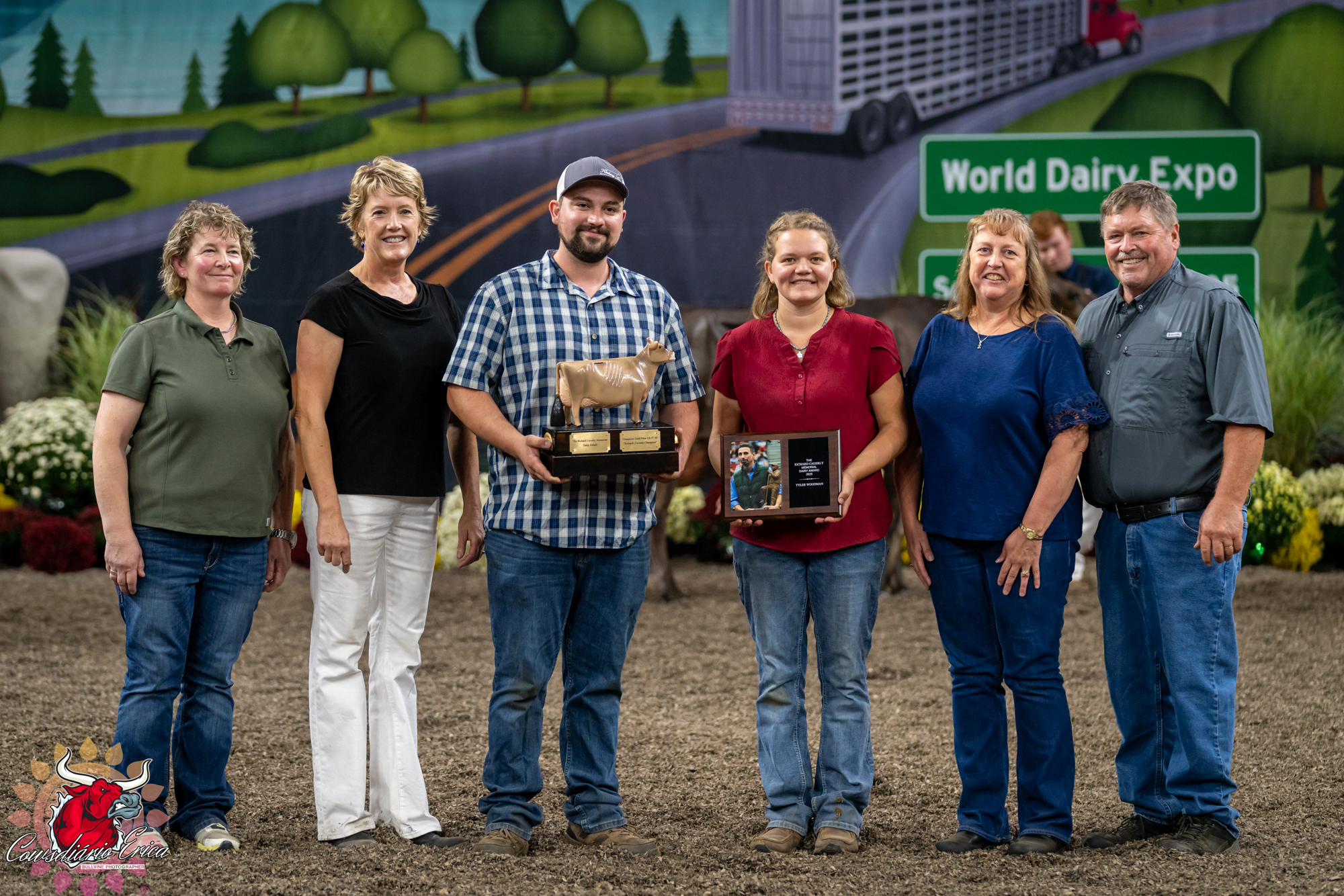
The moment that sparked a conversation: Tyler Woodman accepts the 2025 Richard Caverly Memorial Dairy Award at World Dairy Expo. But as the article argues, this isn’t just a feel-good story—it’s a critical look at the future of dairy succession.

Look, I’ll be straight with you – this isn’t just another feel-good story about a young farmer getting recognized. This is about something bigger. According to the latest Census data, we lost 39% of dairy farms between 2017 and 2022, went from 40,336 to just 24,470 operations. Meanwhile, 83.5% of family farms won’t make it to the third generation. Tyler Woodman represents exactly what we’re losing. And that should scare the hell out of every one of us still milking cows.

The Sandy Lineage: When a 4-H Project Becomes a Dynasty

Woodman-Farm MadMax Sandy EX-94 5E: The 13-year-old matriarch who launched Tyler Woodman’s dynasty. This cow, his first 4-H project, proves that true breeding excellence comes from understanding cow families, not just chasing fleeting trends.

Here’s the thing about breeding excellence that nobody wants to admit… it doesn’t happen by accident, and it sure doesn’t happen overnight.

Woodman’s foundation traces back to a cow most people would’ve shipped years ago. Woodman-Farm MadMax Sandy – turning 13 this December, still scoring EX-94 5E, still throwing daughters that make you stop and look twice – came from River-Valley Tri-P Secret. That was Tyler’s first 4-H project back when he was just a kid in New Hampshire trying to figure out why some cows just looked right and others didn’t.

“Sandy has always been special,” Woodman says, and you can hear something in his voice that every real breeder understands. Seven daughters on the ground, three milking daughters all scored excellent, granddaughters selling from Vermont to Wisconsin. You know what this is? This is what happens when you actually understand cow families instead of just chasing whatever bull everyone’s pushing this month.

Proof that a teenager’s vision can outperform industry trends. Woodman-Farm Burdette Victoria Secret EX-94 3E, a daughter of Sandy, is a two-time All-American nominee—the direct result of a mating decision Tyler Woodman made when he was just starting out.

Victoria Secret – one of Sandy’s daughters from a Burdette x MadMax cross that Woodman made when he was barely old enough to understand progeny proofs – was a two-time All-American nominee, most recently scoring EX-94 3E. Let that sink in. A mating made by a teenager is now producing cows that stop traffic at Expo.

The Genomic Revolution Nobody’s Talking About (But Everyone Should Be)

Let me paint you a picture of where we’re at in October 2025…

The industry’s generated $4.28 billion – that’s billion with a B – in cumulative economic impact from genomic testing since 2010. Annual genetic gains jumped from $37 to $85 per cow. That’s a 129% acceleration, folks. And yet… walk into any sale barn from here to California and half the guys there still think genomics is some fancy nonsense for the mega-dairies.

Woodman doesn’t buy into that old-school BS. “I have always been known to use milk bulls on my type cows and type bulls on milk cows,” he explains, like he’s talking about the weather. That breeding strategy sounds backward until you see the results walking around his barn.

Richard Caverly – God rest his soul – understood this before most of us could even spell genomics. He was pushing Ayrshire breeders to embrace testing when everyone else was clutching their paper pedigrees like they were the Ten Commandments. One time, Woodman had tested an animal for sale, and Caverly reached out immediately. Recognized the cow family from some herd in rural New England that had dispersed years earlier. That’s the power of combining old knowledge with new technology.

The April 2025 base change has already taken effect, and yes, it has made every animal look worse on paper, even though they’re genetically superior to what we had five years ago. If you’re not using this data, you’re essentially breeding blind while your neighbors are using night vision goggles.

WOODMAN’S GENOMIC SELECTION CHECKLIST (What He Actually Does, Not Theory)

  • Test every heifer calf at 2 months – earlier is better, always
  • Look for +150 Net Merit minimum – anything less goes to beef breeding
  • Check health traits first, production second – sick cows don’t pay bills
  • Cross-reference with actual dam performance – genomics lie sometimes
  • Use outcross bulls on high genomic heifers – heterosis still matters
  • Keep detailed records on every mating – memory fails, spreadsheets don’t

The Eastern States Revelation

Sometimes the moments that shape us come when we least expect them. For Woodman, it happened in the cattle barn at Eastern States – you know, that old building where the roof leaks every time it rains, but the acoustics are perfect for hearing a good cow bellow.

Picture this: young Tyler, still trying to build his show string, stops to admire some mature Ayrshire milk cows. The cow that caught his eye was a mature Ayrshire that, years later, he’d realize was connected to the legendary Sweet Pepper Black Francesca, a cow Caverly himself had developed. This older guy starts talking to him about the cows, really getting into the details about balance and dairy strength…

That stranger was Richard Caverly. Caverly worked with household names in the industry: Gold Prize, Nadine, Melanie, Delilah, Ashlyn, Victoria, Veronica, and Frannie. Working with his partner Bev, Caverly had developed the famed Sweet Pepper Black Francesca, the two-time Ayrshire Grand Champion at the World Dairy Expo and Eastern States Exposition.

“Breed your cow the way you want your cow to be, not what everyone else thinks they should be,” Caverly told him that day. Sounds simple, right? But in an industry where we’re all chasing the same bulls, the same families, the same trends that some university professor declared important… Caverly was telling a young breeder to trust his gut. Revolutionary stuff, really.

Managing Two Herds While Building Your Own Empire

Since July, Woodman’s mornings have gotten… interesting doesn’t quite cover it.

Managing both Mapleline Farm’s Jerseys – that beautiful spread in Hadley where the river valley creates perfect growing conditions – and Devine Farm’s Holsteins, while maintaining his own Ayrshire program split between Massachusetts and New Hampshire? That’s not a job. That’s three jobs, and he’s crushing all of them before your first cup of coffee gets cold.

Drive down through the Connecticut River Valley early morning, you’ll see the fog lifting off those fertile fields, and there’s Mapleline’s freestall barn lit up like a beacon. The Jerseys are already lined up for milking, their breath creating little clouds in the October air.

His morning routine would break most people. Hell, it would break most of the “farmers” posting sunrise photos on Instagram. 4:30 AM wake-up, immediately check the Alta NEDAP NOW app on his phone – because who needs coffee when you’ve got heat detection alerts pinging at you? The system tracks eating, rumination, and inactive behavior, essentially telling him which cows need attention before they even realize they need it.

“The Ayrshires adjust very well to the commercial setting with the Jerseys,” he notes. “They milk well and look good doing it.”

But here’s what he’s not saying – what most people don’t understand. Integrating specialty breeds into commercial operations requires a level of management skill that perhaps only 5% of dairymen possess. It’s one thing to run straight Holsteins where everything’s standardized. It’s a whole different ballgame optimizing nutrition, breeding, and management across multiple breeds simultaneously.

Oh, and in his “spare time”? He’s doing relief AI work for Alta, helping other farms improve conception rates. Because apparently managing 400+ head across two locations isn’t enough of a challenge. The man’s either crazy or brilliant. Probably both.

Creating the Stars and Stripes Sale: Because Waiting for Opportunity is for Suckers

Memorial Day weekend 2025… everyone remembers that weather. Rain coming sideways, temperature barely cracking 50 degrees, the kind of New England spring that makes you question your life choices.

What could’ve been a disaster for the Stars and Stripes sale in Greenfield turned into something else entirely. But here’s the thing about people like Woodman – they don’t wait for perfect conditions. Never have, never will.

Working with his wife, Toni (a Jersey girl through and through, who knows her way around a show halter better than most), and partners Zach Tarryk and Caitlin Small, they didn’t just organize another cattle sale. They built something bigger. Workshops the night before – actual hands-on teaching about fitting, show prep, and judging. Not some PowerPoint presentation in a stuffy room, but real learning with real cattle.

They specifically recruited youth to lead animals in the sale ring. Put a young person on the sales staff to make actual decisions. You know why that matters? Because most sales treat kids like decoration. Woodman made them participants.

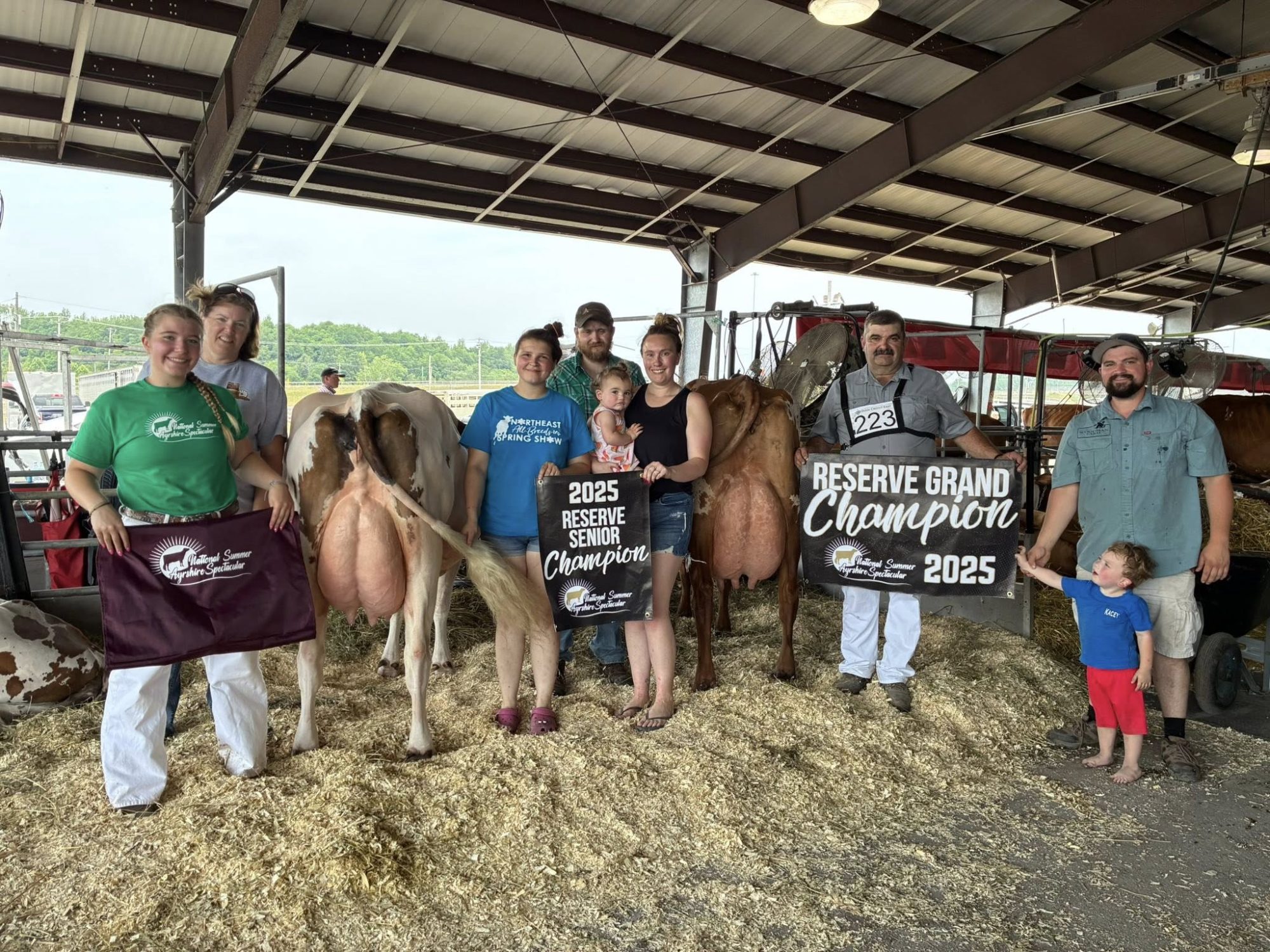
The real “Stars and Stripes” team: Tyler Woodman (far right) and his crew, including wife Toni and their son Kacey (next to Tyler), celebrate success at the 2025 National Summer Ayrshire Spectacular. This moment embodies the collaborative, youth-focused approach that defines their growing enterprise.

“We didn’t quite realize how many miles were driven, how many great cows we saw on the road, and the number of new friendships & connections we gained,” Woodman reflects. Translation: they worked their asses off, and it paid off bigger than anyone expected.

The Livi and Maddy Effect: Why Mentorship Actually Matters

The ultimate return on investment. Livi Russo with the calf that started it all—a relationship built not on a sale, but on a six-hour drive and a commitment to mentoring the next generation. This is the real-world result of Woodman’s belief that people, not just pedigrees, build a sustainable future.

You want to know what real impact looks like? Not Facebook likes or Instagram followers… actual impact? Let me tell you about Livi Russo.

In 2020, in the midst of the COVID-19 pandemic, when everything was sideways, her family reached out looking for a project calf. Most people would’ve just run the credit card and shipped the animal. Woodman? He loads up the trailer, drives the calf up to Northern Vermont himself – a six-hour round trip – and starts a relationship that would transform this kid’s life.

Fast forward to World Dairy Expo 2025, where those iconic colored shavings are popular, often featured in pictures. “One fond memory I have is watching Livi show her first Bred and Owned,” Woodman shares. He and Chris sat in those uncomfortable metal bleachers – you know the ones, where your back hurts after ten minutes – supposedly evaluating the class but really “just being so proud to see her succeed to this level.”

That’s not mentorship. That’s investment in the industry’s actual future.

Then there’s Maddy Poitras. Coming from longtime Jersey breeders – good people, who know their cattle – but she caught the Ayrshire bug working with Woodman. “Maddy has never backed down with any challenge we have thrown at her,” he says with obvious pride.

Here’s what kills me about all this: dairy programs are closing left and right. 4-H participation is dropping every year. FFA chapters can barely field a dairy judging team. And we have people like Woodman volunteering their time – their most valuable resource – to teach kids about topline clipping and breeding decisions. Then we wonder why succession rates are in the toilet?

The Milk Price Reality Check

Let’s discuss what nobody wants to talk about at the co-op meetings…

Class III milk futures for October 2025 are hovering around $16.94/cwt – and that’s if you believe the Chicago Mercantile Exchange knows what it’s doing. Meanwhile, genomic progress is accelerating. Annual genetic gains have more than doubled. But milk prices? They’re not keeping pace with anything except maybe our frustration levels.

According to the USDA’s latest numbers, we’re producing 226.4 billion pounds of milk with 26,290 licensed dairy herds. That’s up from 170.3 billion pounds in 2003, when we had 70,375 herds. Do the math – we’re producing 33% more milk with 63% fewer farms.

You know what Woodman’s response is? Work harder. Work smarter. Manage two farms. Do relief breeding. Organize sales. Mentor kids. Build his own herd on the side.

This is the new reality, whether we like it or not. The days of managing one 60-cow herd and sending the kids to college? Those days are dead and buried. You either scale up, specialize, or get incredibly efficient. Woodman’s doing all three, and he’s 28 years old.

What’s keeping the rest of us from adapting? Pride? Stubbornness? Fear? Pick your poison.

Family First, But Make It Profitable

The partnership that fuels the entire operation. Tyler and his wife, Toni, with their son Kacey and daughter Keegan. Behind every successful dairy is a family that understands the sacrifice and shares the vision for the future.

Behind every successful dairy operation – and I mean actually successful, not just surviving – is usually a spouse who gets it. For Tyler, that’s Toni, and together they’re raising their three-year-old son, Kacey, and one-year-old daughter Keegan, in the barn. Not despite it. In it.

“Kacey’s favorite is pushing cows through the freestall & milking,” Woodman shares. That little boy, barely tall enough to reach the panel switches, already knows the difference between a close-up cow and a fresh cow. While other kids are at daycare learning their ABCs, Kacey’s learning that cows have personalities, that fresh milk tastes nothing like the white water they sell at Stop & Shop, and that real work starts before the sun comes up.

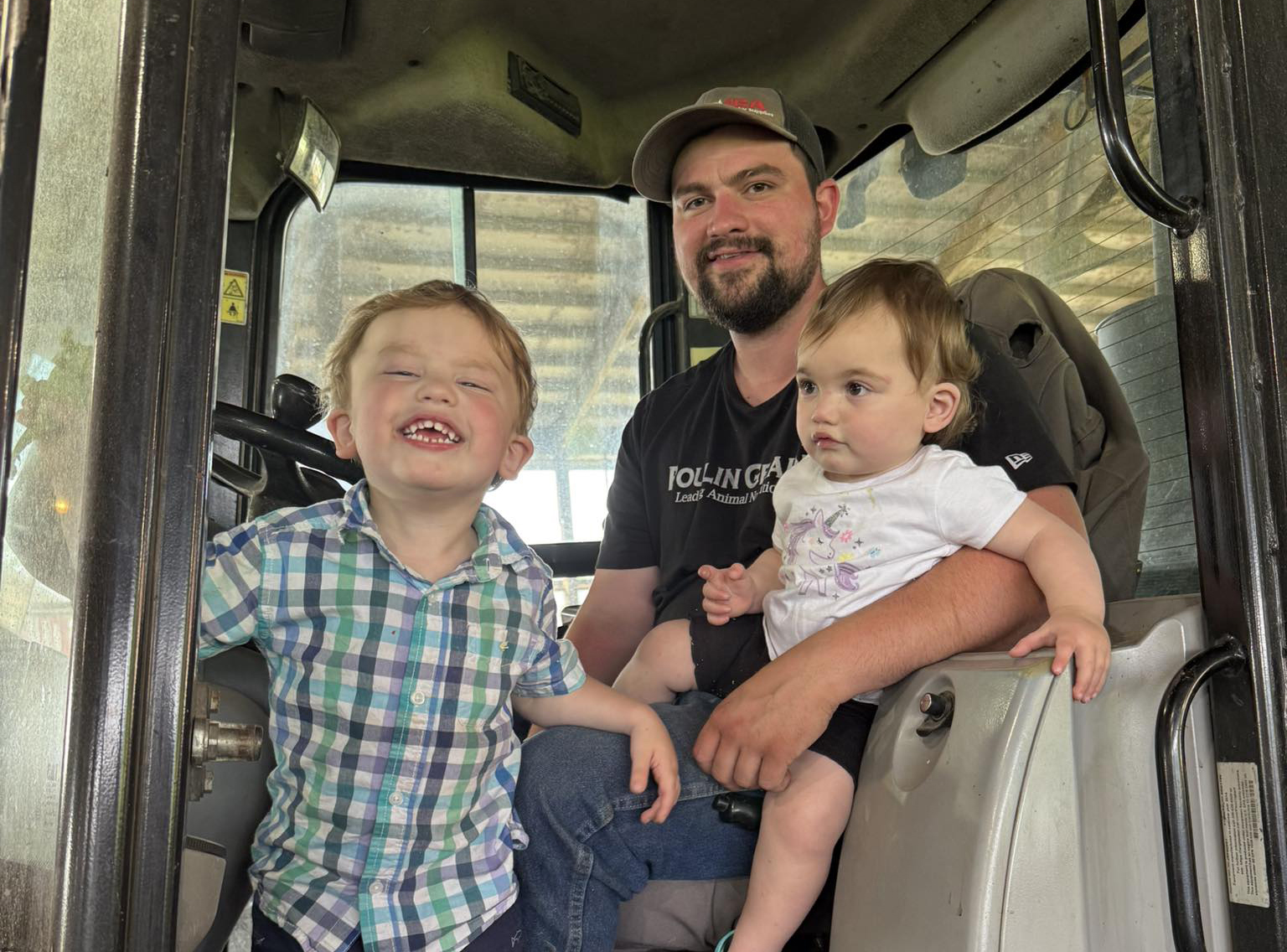
This isn’t a photo op; it’s a succession plan in action. Tyler with his son Kacey and daughter Keegan, proving that the next generation of dairy farmers isn’t raised in a daycare—they’re raised in the tractor cab.

They’re doing something else smart too – hiring college students from local universities. “Some who do not have cattle backgrounds but are willing to learn something new.” You watch these kids discover that they actually love this life and choose to stay in the industry… that’s how you build the future workforce. Not by complaining about “kids these days” at the feed store. By actually teaching them.

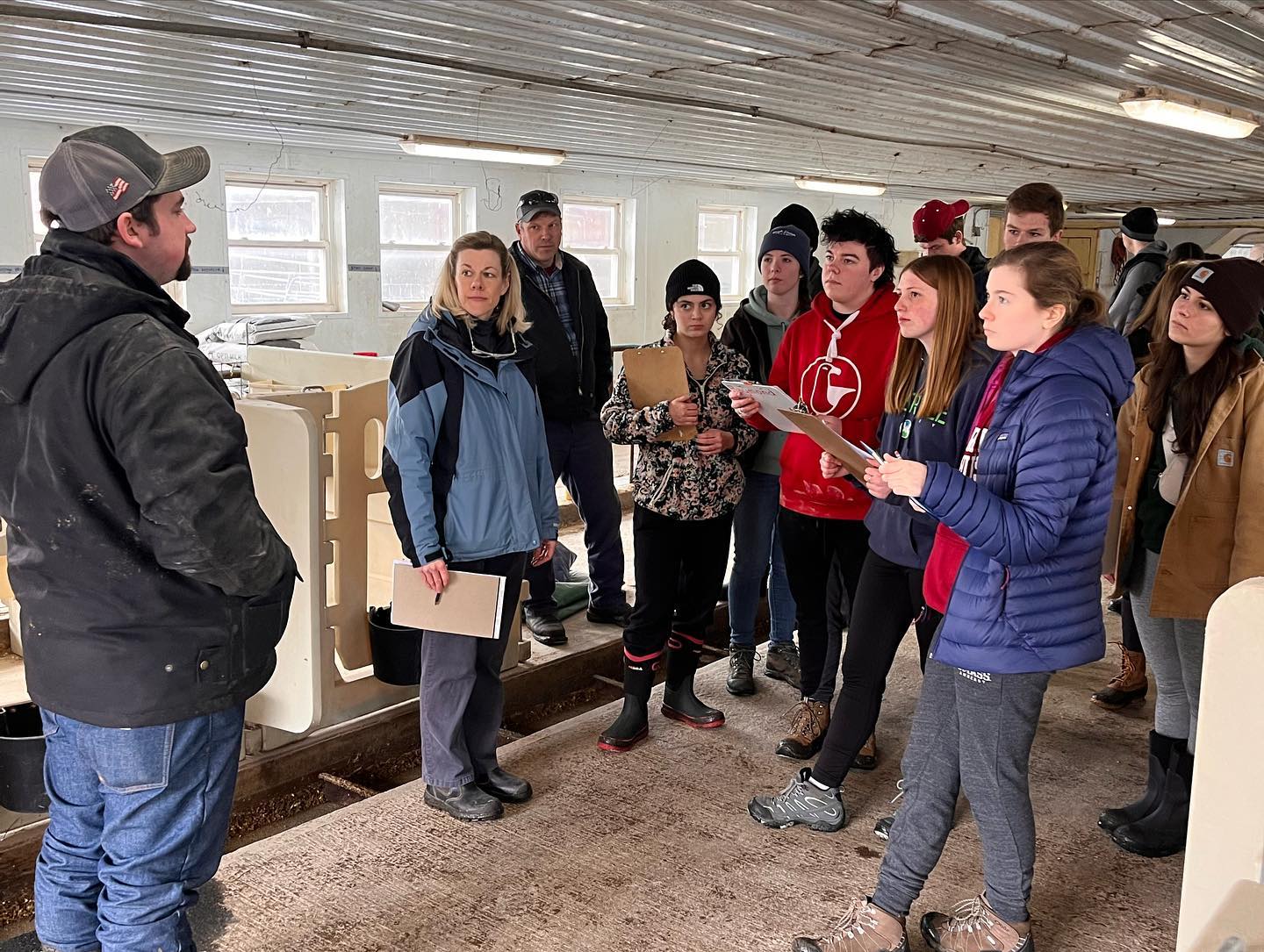
While others complain about the next generation, Woodman invests in it. Here, he gives UMass students a real-world lesson in dairy management—actively building the future workforce instead of just waiting for it to show up.

The Philosophy That Changes Everything

“Breed my cow the way I want my cow to be, not what everyone else thinks they should be.”

Caverly’s words, living through Woodman’s work. In an industry obsessed with trends – remember when everyone was chasing +3000 GTPI bulls like they were lottery tickets? – this philosophy is almost rebellious.

But here’s the kicker… it works. Using milk bulls on type cows and type bulls on milk cows sounds like contrarian nonsense until you realize it’s producing cows that excel everywhere. Commercial dairies want different things than show herds. Export markets have different requirements than domestic processors. The cheese plants want components, the fluid guys want volume. One-size-fits-all breeding? That ship has sailed.

The 2025 component revolution proves this. Butterfat and protein are at record highs because genomics finally lets us select for what processors actually pay for. Yet I’d bet half of you reading this are still selecting for volume when the market’s paying for solids. Why? Because that’s what we’ve always done?

What This Really Means for the Industry

Tyler Woodman receiving the Richard Caverly Memorial Dairy Award… it’s not just nice recognition for a hardworking young farmer. It’s a warning shot across the bow.

Here’s a 28-year-old who embodies everything the industry needs: technical expertise married to traditional values, innovation balanced with common sense, and the work ethic to juggle multiple operations while building his own future. He’s not waiting for the industry to hand him opportunities – he’s creating them from scratch.

Meanwhile, according to the 2022 Census of Agriculture, dairy farms have decreased to 24,470 from 40,336 just five years earlier. That’s a 39% drop. The consolidation train isn’t slowing down – if anything, it’s accelerating.

But Woodman’s story shows there’s another path. You don’t have to be the biggest. You don’t have to have the newest parlor or the fanciest robot. You do have to be smart about genetics, ruthlessly efficient in operations, and actually invested in the next generation. Not just talking about it at Farm Bureau meetings. Actually doing it.

The Morning After

The morning after receiving the award at World Dairy Expo – standing on those colored shavings while the crowd watched – Woodman was exactly where you’d expect. 4:30 AM, checking his NEDAP reports, moving fresh cows, planning breedings. The purple banner was already old news. The work continues.

“Being humble and supportive of your peers in the industry is what matters most,” he says, and coming from someone with nearly 20 All-American nominations means something. “Purple banners and blue ribbons are always great, but to receive them with hard work, perseverance, and dedication behind it means even more.”

That wooden carving of Glenamore Gold Prize EX-97-6E – Caverly’s favorite cow – sits on a shelf somewhere in Woodman’s office. But the real legacy? It’s in the youth he mentors. The genetic progress he’s driving. The example he sets every damn morning at 4:30.

Because here’s the truth nobody wants to say out loud at the co-op meetings or the breed association conventions: if we had more Tyler Woodmans – people willing to work multiple operations, embrace technology without abandoning tradition, mentor youth without expecting anything in return – we wouldn’t be talking about an 83.5% failure rate for generational transfers.

We’d be talking about the revival of American dairy farming.

The question is: will you be part of the problem or part of the solution?

Because while you’re thinking about it, scrolling through your phone, complaining about milk prices at the coffee shop… Tyler Woodman’s already three hours into his day, making decisions that’ll impact the industry for generations. Teaching a kid how to fit a heifer. Running genomics on next year’s calf crop. Building something that’ll outlast us all.

And that phone that rang in the middle of morning chores? It wasn’t just announcing an award winner.

It was announcing what the future of dairy farming looks like – if we’re smart enough to pay attention. 

Key Takeaways:

  • The 4:30 AM Advantage: Woodman manages Mapleline’s Jerseys AND Devine’s Holsteins before your alarm goes off – his NEDAP app alerts replaced morning coffee because “sick cows don’t wait for convenience”
  • Breed YOUR Way, Not THE Way: His contrarian formula (milk bulls on type cows, type bulls on milk cows) created Victoria Secret EX-94 from a teenage mating decision – proving Caverly’s mantra: “Breed for your barn, not the catalog”
  • Sandy’s 13-Year Lesson: His first 4-H project still scores EX-94 5E with seven daughters, three milking – while you culled her genetics chasing the latest fad bull that’s already forgotten
  • Youth ROI Beats Genomics: Woodman drives 6 hours to deliver one calf because “Livi showing at World Dairy Expo matters more than any breeding decision I’ll ever make”
  • The Genomic Checklist That Actually Works: Test at 2 months, cull under +150 NM to beef, use outcross bulls on high genomics – “spreadsheets don’t lie, memories do”

Executive Summary:

Tyler Woodman proves your dairy’s biggest threat isn’t milk prices or feed costs—it’s your refusal to adapt. At 28, this Caverly Award winner runs 400 cows across two farms, starting his day at 4:30 AM with NEDAP alerts, while your kids can’t even spell “succession.” His contrarian breeding strategy (milk bulls on type cows) created 20 All-Americans from a single 4-H project, exposing why genomic trends are killing your herd’s profitability. While 83.5% of farms die by generation three, Woodman drives 6 hours to mentor youth because he knows something you don’t: teaching one kid today saves ten farms tomorrow. His morning routine will shame you, his breeding philosophy will anger you, and his results will force you to admit everything you believe about dairy succession is wrong. This isn’t inspiration porn—it’s the blueprint for the only dairy model that survives 2030.

Learn More:

Join the Revolution!

Join over 30,000 successful dairy professionals who rely on Bullvine Weekly for their competitive edge. Delivered directly to your inbox each week, our exclusive industry insights help you make smarter decisions while saving precious hours every week. Never miss critical updates on milk production trends, breakthrough technologies, and profit-boosting strategies that top producers are already implementing. Subscribe now to transform your dairy operation’s efficiency and profitability—your future success is just one click away.
NewsSubscribe
First
Last
Consent

High Ranking TPI® Genomic Females Reach 3540 – June 2025

June 2025 genomic rankings reveal significant genetic advancement with strategic implications for commercial and stud operations

The dairy industry’s obsession with milk-only genetics just got obliterated by June 2025’s genomic rankings showing GTPI scores hitting an unprecedented 3540. Leading female OCD 73391 combines 44 PTA Protein with 286 feed efficiency – proving you can simultaneously improve production, health, and profitability. PEN-COL WHOOPS-ET dominates rankings, with daughters consistently delivering PTA Fat >110 while maintaining sub-3.0 SCS scores, challenging the myth that high production means compromised health. Feed efficiency values ranging from 200-400+ represent direct profit impact as feed costs consume 50-60% of operational expenses. S-S-I SHEEPSTER MICAN-ET exemplifies balanced selection, producing daughters with superior udder composite (1.2-1.7 range) plus commercial production – ending the false choice between type and performance. These genomics enable 2-3 year genetic advancement cycles versus traditional 5-7 year programs, accelerating ROI for progressive operations. Stop defending outdated single-trait selection – immediately evaluate your breeding program against these multi-trait benchmarks.

Analysis of genomic female rankings indicates accelerated genetic progress and shifting sire valuations in global Holstein markets

The June 2025 High Ranking Genomic Females dataset presents compelling evidence of continued genetic acceleration, with OCD 73391 establishing a new GTPI benchmark at 3540. This represents a significant leap in genomic merit that demands strategic reconsideration of current breeding protocols and sire selection matrices.

PEN-COL WHOOPS-ET: Production Efficiency Dominance

Whoops has achieved unprecedented market penetration, with daughters consistently ranking in the top echelons. The sire’s genetic signature shows:

  • Fat production superiority: Daughters consistently deliver PTA Fat >110 with favorable composition ratios
  • Feed conversion optimization: Efficiency values in the 260-330 range translating to measurable ROI improvements
  • Mastitis resistance integration: SCS values consistently sub-3.0 without production compromise

S-S-I SHEEPSTER MICAN-ET: Balanced Selection Architecture

Mican’s daughters demonstrate the successful integration of multiple breeding objectives:

  • Type-production balance: Superior UDC scores (1.2-1.7 range) maintaining commercial production levels
  • Fertility enhancement: Consistent positive fertility indices addressing industry reproduction challenges
  • Longevity genetics: Productive Life values indicating extended economic life

OCD THORSON DARTH VADER-ET: Feed Efficiency Specialist

Darth Vader daughters, including LRDK DARTH VADER 18823-ET (GTPI 3512), represent the cutting edge of efficiency genetics:

  • Superior feed conversion: Efficiency ratings exceeding 390 in multiple daughters
  • Protein production: Consistent high protein yield with favorable A2A2 potential
  • Economic multiplier effect: Feed efficiency improvements directly impact margin per cow

June High Ranking TPI® Genomic Females (PDF / EXCEL )

Send this to a friend