




While 66% of U.S. milk comes from 1,000+ cow operations, breed societies still host 1985-style banquets.
When did a breed convention banquet last improve your herd’s milk production or reduce your feed costs? If you’re struggling to answer that question, you’re not alone—and you’re witnessing the slow-motion collapse of an industry institution that once defined dairy networking and education.
Here’s the brutal math that breed societies don’t want you to see: While U.S. dairy farm numbers have plummeted to just 24,094 operations selling milk in 2022—down from 70,375 twenty years ago—breed conventions are still operating like it’s 1985. The dairy industry has fundamentally transformed, with farms milking 1,000 or more cows now accounting for 66% of all U.S. milk sales in 2022, up from 57% in 2017.
The pain is immediate and quantifiable. Modern dairy managers are running 24/7 operations worth millions of dollars, yet their breed societies are asking them to spend entire days in hotel meeting rooms, listening to annual reports and watching award ceremonies that have zero correlation with profit margins. Meanwhile, only 7% of dairy cows remain on farms with fewer than 100 cows as of 2022, representing the near-extinction of the traditional family dairy that breed conventions were designed to serve.
The stakes couldn’t be higher: breed societies that don’t evolve will join the thousands of dairy operations that have vanished since consolidation began. But here’s what the smartest societies already know—transformation isn’t just possible, it’s profitable. Three specific strategies separate survivors from casualties, and the evidence is hiding in plain sight.
Why Are Hotel Ballrooms Getting Emptier Each Year?
The numbers paint a devastating picture of institutional decline. The consolidation statistics reveal the fundamental mismatch between traditional convention models and modern dairy realities. In 2022, just 2,013 farms with 1,000 or more cows produced 66% of all U.S. milk, while breed societies continue designing events for an audience that largely no longer exists.
The rate of dairy farm exits has been relentless: the U.S. lost approximately 1,910 dairy herds in 2022 alone, representing about 6% of the country’s dairy operations. Over the past twenty years, the nation has lost an average of about 2,300 dairy herds annually, creating a dramatically smaller but more sophisticated customer base for breed society services.
Consider the demographic reality reshaping attendance patterns. The average U.S. cow now produces 24,067 pounds of milk annually, while the national milking herd is projected to average 9.380 million head in 2025, with milk per cow forecast at 24,120 pounds. These operations require data-driven management systems, not social networking opportunities.
But here’s where conventional wisdom fails spectacularly: breed societies continue designing events for the mid-sized family farm that has virtually disappeared. The traditional convention format—annual business meetings, awards ceremonies, and networking banquets—served producers who had time for extended social gatherings and needed industry connections. Today’s mega-dairy managers get their industry intelligence from data dashboards, not dinner conversations.
Research published in “Animals” demonstrates how modern dairy operations generate vast amounts of data from sensors, herd management software, and milk analysis systems, yet struggle to integrate this information efficiently. These managers need artificial intelligence applications for decision-making, precision agriculture integration, and advanced reproductive technologies, not hotel conference room presentations.

The Math That Breed Societies Don’t Want You to See
Let’s examine the financial reality that most breed societies refuse to acknowledge. Registration fees alone run $200-$350 per adult attendee, not counting travel, hotels, or the brutal opportunity cost of leaving modern operations understaffed for multiple days.
Here’s the calculation that should terrify breed society leadership: if you send two key personnel to a national convention, you’re investing $1,000+ before factoring in opportunity costs. What’s the measurable return? Did attendees leave with actionable strategies that improve margins, reduce costs, or increase efficiency? Or did they return with business cards and memories of awards ceremonies?
Compare this investment to demonstrable alternatives. Modern producers expect two to five years’ payback periods for on-farm technology, with 10% return on capital as a sensible target for new farm investments. A targeted online course on feed efficiency with projected cost savings, or genomic testing with quantifiable genetic merit improvements, offers clear ROI calculations that convention attendance simply cannot match.
Holstein Canada’s 2023 Annual Report demonstrates the financial potential of strategic pivoting: their genomic testing revenue grew 18% from 2022 due to enhanced Clarifide product offerings and the ConneXXion application launch. This represents strategic positioning as a technology integrator rather than a banquet coordinator, generating total revenues of $14.4 million in 2023.
The Economic Reality Check: Convention Model vs. Modern Dairy Needs
| Traditional Convention Model | Modern Dairy Reality |
| Target: Small-scale operations (historical) | Current reality: 66% of milk from 1,000+ cow operations |
| Focus: Annual meetings and networking | Priority: Data analytics and quantifiable ROI |
| Format: Multi-day, in-person attendance required | Preference: On-demand, flexible learning modules |
| Value proposition: Industry connections and awards | Required outcomes: Measurable performance improvements |
| Investment timeframe: Annual event participation | Decision cycle: Continuous improvement metrics |
What Modern Dairy Operations Actually Need (And Why Conventions Can’t Deliver)
The industry has bifurcated into two distinct populations with almost no overlap in professional development needs. Understanding this split is crucial for breed societies planning their survival strategy or funeral arrangements.
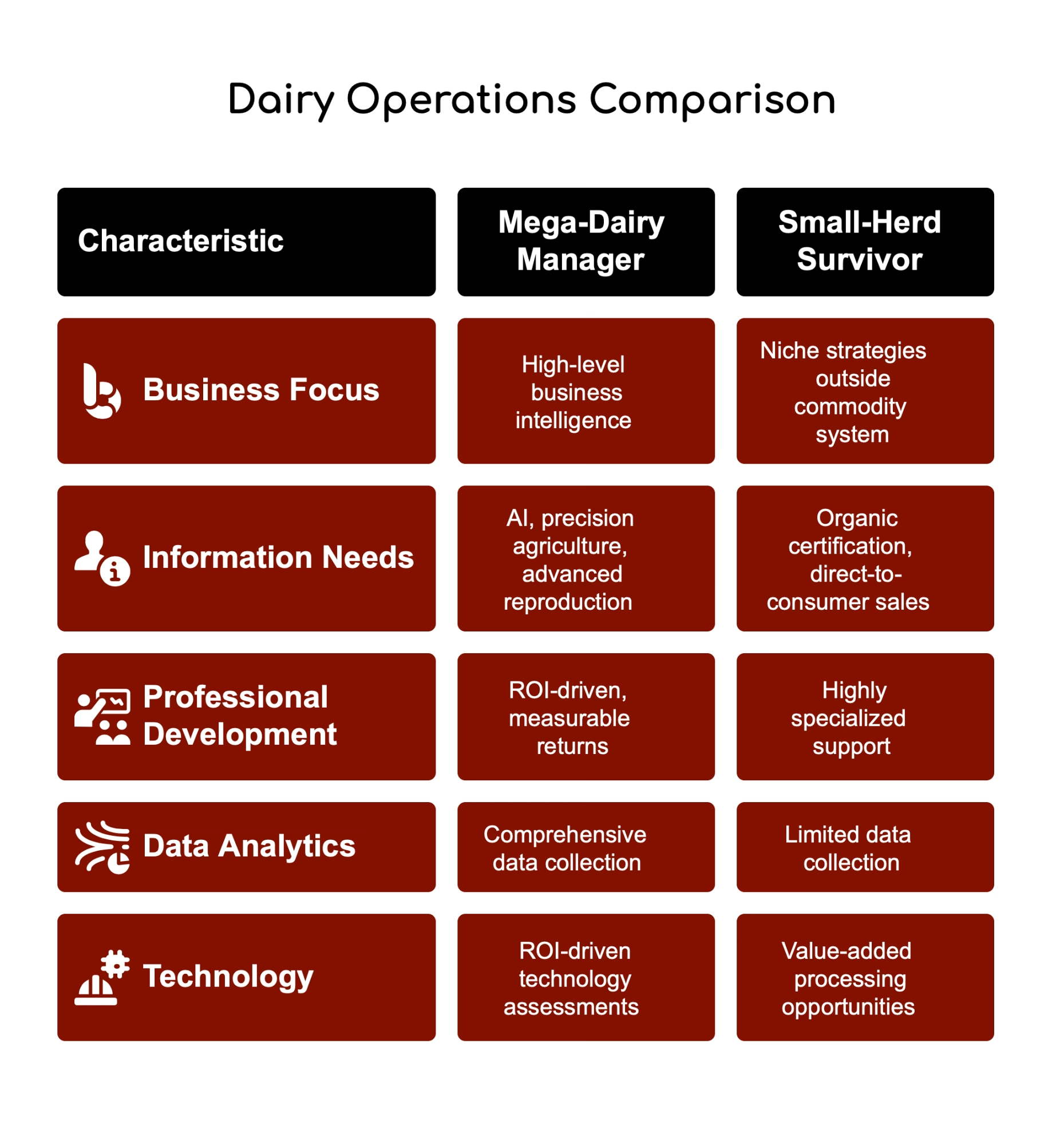
The Mega-Dairy Manager oversees complex, multi-million-dollar enterprises requiring high-level business intelligence, sophisticated financial management strategies, data analytics, labor management solutions, and ROI-driven technology assessments. As documented in livestock research, modern dairy operations face challenges in ensuring quality, traceability, and efficient management, requiring comprehensive data collection and analytics capabilities.
These managers need artificial intelligence applications for decision-making, precision agriculture integration, and advanced reproductive technologies. Their time is exceptionally valuable, and any professional development activity must generate clear, measurable returns with implementation timelines measured in quarters, not years.
The Small-Herd Survivor operates outside the commodity system, depending on niche strategies to escape the brutal economics of scale. They need information on organic certification processes, grass-fed marketing premiums, value-added processing opportunities, and direct-to-consumer sales models. With only 7% of dairy cows remaining on farms with fewer than 100 cows, this segment requires highly specialized support.
A single convention featuring breed society annual meetings, awards banquets, and generic trade show exhibits cannot simultaneously serve these specialized, high-stakes needs. The value proposition is fatally diluted. For the mega-dairy manager, the content is too basic, and the ROI is unclear. For the small-herd farmer, commodity production focus is irrelevant to their niche strategy.
According to a comprehensive USDA analysis, farms are consolidating into these two distinct categories, with virtually nothing in between surviving long-term. Breed societies are designed for the mythical “average” producer and are headed for extinction.
Solution #1: From Award Ceremonies to Data Analytics Powerhouses
Smart breed societies are executing a fundamental pivot from event hosts to indispensable data intelligence partners. Instead of centering their value proposition on annual gatherings, progressive associations are becoming year-round profit drivers for their members.
Holstein Canada provides the clearest example of strategic evolution. Their 2023 financial results show total revenues of $14.4 million, with genomic testing revenue growing 18% due to enhanced Clarifide product offerings. This represents strategic positioning as a technology integrator rather than a social coordinator.
The new revenue model includes sophisticated service offerings:
- Premium data analysis and benchmarking: Fee-for-service herd performance analytics comparing individual operations to regional and national averages
- Advanced mating program consultations: Customized breeding recommendations based on genomic evaluations and economic indices
- Genetics marketplaces: Commission-based online platforms for elite embryos, IVF sessions, and semen from member herds, complete with comprehensive performance records
Modern livestock management technology demonstrates the potential for breed societies to position themselves as data collection and analytics partners. Breedr’s revolutionary app enables stakeholders to record and track essential information related to each animal, including breed, genetics, health records, vaccinations, and weight data, creating comprehensive databases that breed societies could leverage.
“The dairy cattle improvement industry is changing fast due to new technology and shifting priorities. Breed societies cannot be isolated or have a stand-alone approach,” according to recent analysis by The Bullvine examining industry transformation. “They must accept how the dairy industry and practices will change by 2030 and beyond.”
Tiered corporate partnerships replace simple banquet sponsorships, giving technology companies year-round access to producer data insights, educational content platforms, and implementation feedback. This creates more stable, predictable revenue while providing members with cutting-edge industry intelligence.
Solution #2: Virtual Engagement That Actually Works
The hybrid model combines high-value, smaller in-person events with robust virtual experiences, acknowledging that most producers can’t justify multi-day absences but still value targeted networking and education.
Progressive associations are implementing “Leadership Summit” approaches—exclusive, premium-priced events for the top producers by scale or innovation, paired with accessible “Virtual Technical Conferences” featuring genomics, nutrition, and data management sessions available to thousands of members for lower registration fees.
Global dairy trends analysis shows that consumers and industry stakeholders increasingly prioritize digital engagement over traditional events. The dairy products and alternatives industry is projected to record a 6% increase in retail value sales over 2023, driven primarily by innovation and consumer demand for functionality, creating opportunities for breed societies that align with these market forces.
This model delivers multiple strategic advantages:
- Respects time and budget constraints of modern dairy operations managing 9.365 million head in the national herd
- Maintains premium experiences for high-touch networking among industry leaders
- Diversifies revenue streams beyond single annual events
- Opens new digital sponsorship opportunities with measurable engagement metrics
- Dramatically expands reach while gathering valuable data on member preferences
Year-round digital knowledge hubs shift the value proposition from annual events to continuous engagement. Members gain access to e-learning libraries, data tools for benchmarking genetic and productive performance, and subscription-based premium analytics. The “convention” becomes a feature of the platform, not the primary product.
Solution #3: On-Farm Education Over Hotel Conference Rooms
The most innovative societies are moving education from hotel conference rooms to working farms, replacing theoretical presentations with real-world demonstrations and measurable results.
“Smart Genetics Field Days” hosted at progressive member farms showcase the integration of elite genetics with modern technologies like robotic milking, automated feeding, and advanced sensor systems. The focus shifts to tangible results: improved efficiency, higher component yields, better herd health, and clear return on investment.
Research analyzing dairy farming technology demonstrates the effectiveness of practical learning approaches. Studies show that advances in science and technology have supported the introduction of many on-farm innovations, with positive economic impacts including greater feed conversion efficiencies and increased yields.
These regional events offer multiple advantages:
- More accessible and relevant to local conditions and regulations
- Partnerships with technology companies and university research programs reduce financial burden and provide direct access to technical experts
- Demonstration over presentation: Attendees examine actual performance records, genomic evaluations, and economic outcomes
- Networking with verified results: Participants connect with peers who have achieved documented improvements
The model aligns perfectly with the industry’s shift toward evidence-based decision making. Instead of abstract presentations at hotel venues, attendees analyze actual milk production data, component yields, reproduction rates, and profitability metrics. This approach acknowledges that for modern producers managing operations where the average cow produces over 24,000 pounds of milk annually, seeing quantifiable results is believing.
The Controversial Truth: Traditional Conventions Are Obsolete (And Here’s the Data to Prove It)
Let’s address the elephant in the room that breed society leadership desperately wants to avoid: traditional convention formats have become expensive anachronisms with no correlation to modern genetic progress or farm profitability.
The consolidation data is unambiguous: farms with 1,000+ cows now control 66% of U.S. milk production, while operations with fewer than 100 cows account for just 7% of the national herd. This represents a complete inversion of the industry structure that traditional conventions were designed to serve.
Consider the economic reality: attending a traditional convention requires registration fees, travel, hotel, meals, and opportunity costs that easily exceed $500 per person. Compare this to genomic testing with documented performance improvements, and the value proposition collapses.
Industry analysis confirms the transformation: “By 2035, dairy farmers will have access to twice as many genetic indexes as they do today for new traits covering animal function, health, welfare, and efficiency”. DNA analysis and computer algorithms provide precise predictions of genetic merit, making hotel lobby conversations irrelevant for serious breeding programs.
But here’s what breed societies fear acknowledging: convention culture actively conflicts with profit-driven management. Time spent in annual meetings and award ceremonies could be invested in reproductive management, nutrition optimization, or technology implementation—all with measurable returns.
Progressive producers have already moved beyond convention validation. The most successful operations focus on genomic breeding values, production records, and economic indices rather than industry socializing. They understand that networking at banquets doesn’t automatically generate higher milk checks when the national milking herd is projected to average 9.380 million head producing 24,120 pounds per cow.
Future Industry Implications: Evolve or Become Museum Pieces
What happens to breed societies that refuse to adapt? The evidence suggests they’ll follow the same path as the thousands of dairy farms that couldn’t evolve with industry consolidation.
Industry projections indicate continued transformation: “There will be a decrease in the number of milk cows needed to meet the demand for milk solids, with animals residing in larger and larger herds by 2035—thereby fewer breed society members”. This consolidation creates both a challenge and an opportunity for associations willing to adapt.
The window for voluntary transformation is rapidly closing. Breed societies may have two to three years to reinvent themselves as technology and data partners before members bypass them entirely. Research indicates that dairy operations are increasingly investing in precision agriculture and automated systems, creating opportunities for associations that position themselves as implementation partners.
Global dairy trends emphasize the urgency: the growth of the dairy products and alternatives industry is driven by consumer demand for functionality, health benefits, and innovation. Breed societies focused on annual meetings rather than these critical market drivers will become irrelevant to forward-thinking producers.
The choice is binary: transform into indispensable data intelligence and technology adoption partners, or become historical societies serving a dwindling number of traditionalists while the commercial industry advances without them.
The Bottom Line: Calculate Your Convention ROI Before It’s Too Late
Remember that devastating statistic from the opening—U.S. dairy farm numbers selling milk have collapsed to just 24,094 operations in 2022, down from 70,375 twenty years ago? This isn’t just consolidation; it’s a fundamental transformation that has rendered traditional convention models economically unsustainable.
The math is brutal and unforgiving: breed societies designed for 70,000+ small-scale operations cannot survive serving fewer than 25,000 large-scale enterprises with completely different needs. Smart societies are already pivoting to data-driven services, virtual engagement platforms, and on-farm education that serve the industry’s actual requirements rather than nostalgic traditions.
Here’s what successful breed society transformation looks like in practice:
- Revenue diversification through data analytics, genomic services, and technology partnerships rather than dependence on annual event registration
- Member engagement through continuous digital platforms providing real-time value rather than occasional hotel gatherings
- Educational delivery via on-farm demonstrations with measurable outcomes rather than conference room presentations with soft benefits
- Industry positioning as profit enhancement partners rather than tradition preservation societies
The window for voluntary evolution closes rapidly. Associations that don’t adapt will join the legions of dairy operations that couldn’t evolve with industry demands. Research demonstrates that the industry is consolidating into two distinct categories—mega-operations and niche survivors, with virtually nothing in between surviving long-term. The same binary choice faces breed societies: become indispensable business partners or become irrelevant social clubs.
Your immediate action step is straightforward: Calculate your actual cost-per-engaged-member for your last convention, including registration, travel, accommodation, and opportunity costs. Then compare this figure to alternatives: targeted online courses with ROI guarantees, on-farm technology demonstrations with performance metrics, or genomic testing programs with documented returns.
The numbers will force your next decision—and determine whether your breed society thrives as an essential industry partner or becomes another casualty of the dairy industry’s relentless evolution toward efficiency and profitability.
The most successful dairy operations of 2030 will be supported by breed societies that embraced data over dogma, results over ribbons, and profit over pageantry. The question isn’t whether this transformation will happen—it’s whether your association will lead it or be buried by it.
Breed societies that reinvent themselves as data intelligence and technology adoption hubs will become more vital than ever before. Those clinging to annual meetings and award banquets will discover that tradition without relevance is just expensive nostalgia—and the industry has no patience for expensive nostalgia when milk checks depend on measurable performance.
KEY TAKEAWAYS
- Data Analytics Pivot Delivers Measurable Returns: Holstein Canada’s strategic transformation generated 18% genomic testing revenue growth and $14.4 million total revenues by becoming technology integrators—breed societies positioning as data powerhouses capture commission-based revenue from genetics marketplaces while providing members with benchmarking analytics that directly impact herd performance and profitability metrics.
- Convention ROI Reality Check Exposes Financial Drain: Traditional conventions cost $500+ per attendee including registration, travel, and opportunity costs with zero correlation to milk yield improvements, while genomic testing at under $60 per animal delivers 150-200% documented ROI—progressive producers are redirecting convention budgets toward precision agriculture and automated systems with measurable quarterly returns.
- Industry Consolidation Demands Service Model Revolution: 66% of U.S. milk production now comes from 1,000+ cow operations requiring data-driven management systems, artificial intelligence applications, and precision breeding programs—not hotel ballroom networking designed for the 74-cow family farms that have virtually disappeared from the landscape.
- Virtual Engagement Platforms Expand Reach While Cutting Costs: Smart societies implementing hybrid models with premium leadership summits for top 10-15% of producers paired with accessible virtual technical conferences dramatically reduce per-member engagement costs while providing year-round value through e-learning libraries, benchmarking tools, and subscription-based analytics platforms.
- On-Farm Education Delivers Quantifiable Results: Field days hosted at progressive member farms showcasing robotic milking integration, automated feeding systems, and sensor technology provide attendees with actual performance data, component yields, and economic outcomes—replacing theoretical presentations with demonstration-based learning that producers can immediately implement for measurable operational improvements.
EXECUTIVE SUMMARY
Traditional breed conventions are bleeding money and relevance while dairy consolidation accelerates—U.S. dairy operations have plummeted from 70,375 to just 24,094 in twenty years, yet breed societies persist with hotel ballroom formats designed for extinct family farms. The brutal math: convention attendance costs exceed $500 per person with zero measurable impact on milk production, feed efficiency, or genetic progress, while genomic testing delivers 150-200% documented ROI for under $60 per animal. Holstein Canada proves transformation works—their strategic pivot to data analytics generated 18% revenue growth and $14.4 million in total revenues by positioning themselves as technology integrators rather than banquet coordinators. Three game-changing strategies separate survivors from casualties: data powerhouse transformation, virtual engagement platforms, and on-farm education replacing hotel conference rooms. With 66% of U.S. milk now produced on farms with 1,000+ cows, breed societies have perhaps two years to reinvent themselves as profit-enhancement partners before members bypass them entirely. Calculate your convention cost-per-engaged-member against genomic testing ROI—the numbers will force your next strategic decision.
Complete references and supporting documentation are available upon request by contacting the editorial team at editor@thebullvine.com.
Learn More:
- The Future of Dairy Breed Societies: Will Innovation or Irrelevance Prevail? – Reveals Holstein Canada’s specific innovation strategies and demonstrates how forward-thinking breed societies are successfully pivoting to technology integration while maintaining member value and industry relevance.
- 5 Technologies That Will Make or Break Your Dairy Farm in 2025 – Provides actionable implementation guidance for the exact data analytics and precision technologies that progressive breed societies should be promoting, with documented ROI examples and adoption strategies.
- 5 Steps To Maximize Your Dairy Cattle Breeding Program – Delivers practical frameworks for implementing the genomic testing and data-driven breeding approaches that smart breed societies are using to replace traditional convention models with measurable member value.
 Join the Revolution!
 Join the Revolution!
Join over 30,000 successful dairy professionals who rely on Bullvine Weekly for their competitive edge. Delivered directly to your inbox each week, our exclusive industry insights help you make smarter decisions while saving precious hours every week. Never miss critical updates on milk production trends, breakthrough technologies, and profit-boosting strategies that top producers are already implementing. Subscribe now to transform your dairy operation’s efficiency and profitability—your future success is just one click away.